
Driving a mini truck on Oklahoma roads can be an exciting venture, especially for local business owners or enthusiasts looking to combine utility with uniqueness. However, it’s essential to navigate through various legalities, safety standards, and registration processes to ensure compliance with state regulations. This guide breaks down everything you need to know—ranging from legal requirements and safety standards to registration processes and licensing requirements. Each chapter will provide you with essential insights that will help you hit the road with confidence and peace of mind.
On the Open Oklahoma Road: A Practical Guide to Legally Driving Your Mini Truck
When you pull a compact, high-utility vehicle onto an Oklahoma highway, the road immediately asks for more than horsepower and clearance. It demands compliance with a framework built to keep everyone safe, moving, and accountable. There may not be a special legal ribbon labeled “mini truck” in Oklahoma statutes, but that doesn’t mean these nimble workhorses dodge the rules. In practice, your mini truck is evaluated like other light vehicles or light-duty trucks, with the classification shaping the path to lawful operation. Understanding this pathway helps you avoid costly stops, fines, or insurance headaches, and it gives you confidence that your daily runs—whether you’re crossing town, cruising to a job site, or carrying tools and gear—meet the letter and the spirit of Oklahoma law. For readers who want a broader sense of the landscape around small trucks, consider exploring the Mini Trucks CaLa Blog, which offers perspectives from owners and enthusiasts on these versatile machines. Mini Trucks CaLa Blog.
The core requirements begin with registration and proof of ownership. In Oklahoma, your mini truck must be registered with the state DMVs, meaning you will need to demonstrate title ownership, complete the appropriate forms, and pay the applicable registration fees to receive license plates. This setup ties the vehicle to the state’s road-use system and is the baseline for lawful operation. Alongside registration, proof of insurance is not optional. Oklahoma’s minimum liability coverage—25/50/25 for bodily injury per person, per accident, and for property damage—applies to most vehicles on public roads. Carrying insurance is not merely a bureaucratic hurdle; it provides essential protection for you and other road users if an incident occurs. The practical effect is simple: without insurance that meets or exceeds these minimums, you should not be driving a mini truck on Oklahoma streets or highways.
Beyond registration and insurance lies the matter of safety and maintenance. Oklahoma does not require annual safety inspections for every vehicle, but the vehicle must be in safe operating condition. If you are pulled over or involved in a crash, law enforcement may request evidence that your mini truck is roadworthy. This puts a premium on the basics: working lights, functional brakes, properly inflated and treaded tires, and seat belts that work. The vehicle must also comply with broader safety standards asserted by federal regulators, and your mini truck should reflect the standards of the National Highway Traffic Safety Administration, including lighting, braking performance, and emissions compliance. When you operate a vehicle that has been modified from factory specifications, you should anticipate closer scrutiny. Modifications can affect safety systems and may require additional documentation or inspection to remain compliant.
Another axis of compliance is the driver’s license itself. For most mini trucks, a standard Class C driver’s license is sufficient for general personal use. If your vehicle’s weight and intended use push beyond certain thresholds, the rules shift. A gross vehicle weight rating (GVWR) exceeding 26,000 pounds typically triggers a Commercial Driver’s License (CDL) requirement. In practice, most mini trucks used for personal transport or light-duty work fall under the Class C category, which keeps everyday driving straightforward. If your vehicle is designed or used in a way that resembles a commercial operation—like frequent hauling of heavy cargo, regular trips as part of a business, or operation as a fleet vehicle—you should review whether a different licensing type is warranted. The distinction between private use and commercial use can be subtle but highly consequential, so when in doubt, a quick check with the Oklahoma DMV or DPS can clarify where your license should stand.
A critical but sometimes overlooked factor is how the vehicle complies with emissions requirements and inspections that may apply in your county. Oklahoma’s counties vary in their approach to emissions testing. Some areas may require testing for vehicles registered within their jurisdiction, while others may not. It is prudent to check with your local DMV office to confirm whether emissions testing applies to your mini truck and, if so, how often it must be performed. This is a reminder that even if a statewide rule seems straightforward, local regulatory nuance can affect your day-to-day driving. Staying informed about these local differences helps you avoid last-minute surprises when you renew registration or register a new vehicle.
A nuanced part of the legal landscape concerns the vehicle’s design and how its weight, configuration, and intended use influence classification. The Oklahoma framework doesn’t treat a “mini truck” as a standalone class; instead, the vehicle is categorized based on weight, design, and use as a passenger vehicle, light truck, or potentially commercial vehicle. This categorization matters because it informs whether you’re eligible to operate on public roads under regular licensing, whether certain equipment must be installed or maintained, and whether a commercial license might be required for heavy payloads. In practical terms, this means you should verify your mini truck’s GVWR as stated by the manufacturer and reflect that number in your registration paperwork. If there is any discrepancy between what you believe and what the official label indicates, contact the DMV for a precise determination. The official guidance is the most reliable compass when navigating a gray area where vehicle identity and regulatory expectations intersect.
For readers seeking clarity on these classifications and the practical steps to bring a mini truck into full compliance, it helps to approach the process step by step, almost as if you were building a ladder from the driveway to the highway. Start with the title and ownership documents to secure your legal claim to the vehicle. Then obtain the liability insurance that meets the state’s minimums, and prepare to present proof of insurance during registration and when operating on public roads. Prepare to demonstrate that the vehicle meets basic safety standards, including lighting and braking systems, with particular attention to the tires and seat belts. If you have employed any aftermarket modifications or safety-critical changes, keep records and documentation that show compliance with safety standards and, when necessary, how the modifications were tested or inspected. Finally, verify your licensing needs based on GVWR and intended use. If you plan to drive for work in a fashion that resembles commercial operation, consider whether a CDL or another licensing pathway is appropriate.
As you map these requirements against your own mini truck, you will likely find that a single source of truth can save time and reduce anxiety. The Oklahoma DMV website is the primary resource for current rules, forms, and contact information. Because regulations evolve, it is wise to confirm details before starting the registration process or making a plan to drive. The rules that apply to Oklahoma roads are designed to keep everyone moving safely, and they reward preparedness with smoother trips and fewer interruptions. When you align your vehicle with state standards, you not only comply with the law but also protect your investment and ensure that your daily driving remains predictable and low-stress.
In that spirit of practical preparation, take advantage of local resources and community knowledge while maintaining your individual due diligence. Reading the official pages is essential, but hearing experiences from other mini truck owners can offer useful context—how they handled registration, what documentation mattered most, and how they navigated the timing of license applications. This kind of learning often takes place in local clubs, hobbyist groups, and online communities that discuss real-world trials and solutions. It is precisely this blend of formal requirements and lived experience that makes the process approachable rather than opaque. If you are beginning to explore how your mini truck fits into Oklahoma’s road system, you will benefit from thinking through each facet of compliance in a connected way rather than in isolated checklists.
Ultimately, the question—can I drive my mini truck on Oklahoma roads?—has a practical, answerable core: yes, you can, as long as you align your vehicle and your credentials with the state’s regulatory framework. Registration, insurance, safety readiness, and appropriate licensing form the backbone of lawful operation. Emissions considerations and local variations add layers that you must verify for your specific county or city. When you understand how the classification of your vehicle affects licensing and registration, you can plan with confidence, submit the right forms, and enjoy the open road with the reassurance that you are driving within Oklahoma’s rules. This clarity is a virtue for any owner who wants a dependable vehicle that serves both work and everyday life without unintended legal risk.
For official guidance and the most up-to-date requirements, consult the Oklahoma Department of Motor Vehicles and related state agencies. The path to lawful operation is a clear sequence: confirm title, register, insure, inspect as needed, license appropriately, and stay aware of local emissions rules. By following this path, your mini truck can remain a reliable, legal companion on the diverse Oklahoma landscape. Official resources can be found at https://www.ok.gov/dmv.
null
null
Registering a Mini Truck for Oklahoma Roads: A Practical Guide to Legal, Safe, and Ready-to-Road Status
When you ask whether you can drive a mini truck on Oklahoma roads, the answer hinges on one core truth: legality begins with registration. A mini truck, compact and versatile, can share the same stretch of pavement as a full-size pickup, but only if it satisfies Oklahoma’s registration and safety requirements. The journey from purchase to open road is not just about ownership; it is about proving that the vehicle is properly documented, insured, and built to meet standards that keep everyone on the road safer. This process, while detailed, unfolds in a straightforward sequence that, once understood, becomes a reliable routine rather than a hurdle. The essence is simple: register correctly, display valid plates, maintain safety features, and comply with the appropriate licensing category based on how you intend to use the vehicle.\n\nTo begin, you will need to identify what category your mini truck falls into in Oklahoma’s system. The state does not treat every diminutive utility vehicle the same way; the line between a light-duty vehicle and a commercial vehicle can influence everything from registration fees to licensing requirements. In practice, many mini trucks used for personal transport fall under a light-duty classification, typically defined by a Gross Vehicle Weight Rating (GVWR) under 10,000 pounds. If your mini truck remains under that threshold and you use it for personal purposes, you will generally require a standard driver’s license appropriate for the vehicle type. If you are new behind the wheel or changing to a different vehicle class, you may begin with a learner’s permit before you can obtain a full license. These licensing nuances reflect Oklahoma’s aim to ensure drivers have the necessary skills and knowledge to operate a given class of vehicle safely.\n\nThe registration process itself starts with a visit to a local DMV office or an authorized agent. It is tempting to think of this as a bureaucratic checkpoint, but it serves a broader purpose: to verify ownership, ensure the vehicle meets safety standards, and establish a legal basis for operation on public roads. As you step into the process, bring with you the essential documents that demonstrate ownership and identity. A bill of sale or a title establishes proof of ownership, while a government-issued photo ID validates who you are. Insurance is another non-negotiable item; you must show proof of insurance coverage for the mini truck. The exact insurance requirements are not whimsical; they reflect state standards designed to protect drivers and other road users. In practical terms, you should gather your insurance card or an electronic proof of coverage and be prepared to present it at the time of registration.\n\nFees are the third pillar of the registration equation. Oklahoma does not publish a single flat rate for mini trucks because costs are influenced by several variables: vehicle weight, the vehicle’s age, and its value. The heavier the vehicle or the older it is, the more likely the registration fee will reflect depreciation, anticipated wear, and the cost of maintaining the roadworthiness of the vehicle. Similarly, higher-value vehicles may carry higher taxes as part of the registration package. It is prudent to budget for a reasonable range and to ask the clerk for a clear explanation of the fee breakdown. If the vehicle is intended for commercial activities—think small business use, merchandise transport, or service call work—there are additional licensing considerations to account for. Commercial use can trigger different plates, more rigorous inspections, or special permits depending on weight, payload, and the nature of the business. Even if the vehicle is small, the intended use can shift it into a category with distinct requirements, so clear, honest disclosure at the outset is essential.\n\nBeyond ownership and numbers, the state’s emphasis on safety remains paramount. Oklahoma’s safety standards include working lights, functional brakes, proper tires, and seat belts. A mini truck that lacks one of these fundamentals cannot be legally registered, and operating a vehicle without up-to-date equipment is a quick path to penalties. The practical takeaway is that inspecting the vehicle before you head to the DMV can save you a second trip. Check the headlights, taillights, turn signals, and brake lights; confirm that the brakes respond promptly and effectively; ensure tires have adequate tread and are not aged beyond reasonable use; and verify that seat belts operate smoothly for all passengers. If any element fails inspection, you will need to address it before registration can proceed. This is not merely a box to check; it is a public safety measure that reduces risk on the road for you and others.\n\nAfter the paperwork is filed and the fees are settled, the DMV will issue the registration certificate and license plates if the vehicle meets all requirements. The registration certificate serves as proof that the mini truck is authorized to operate on Oklahoma roads, and the plates must be displayed properly on the vehicle at all times while driving. The importance of this step cannot be overstated: without current registration and visible plates, you face legal consequences that range from fines to possible towing. The system is designed to enforce status and accountability; staying current helps you avoid unnecessary interruptions and keeps you aligned with state road rules.\n\nRegistration is not a one-and-done task. Generally, it requires annual renewal, with reminders often sent by mail. However, relying solely on mail reminders is not a best practice. The best approach is to monitor the expiration date yourself and verify any changes in the renewal process or fee structure each year. The renewal cycle is not a mere administrative chore; it is a signal that the vehicle remains compliant with evolving safety standards and any new regulatory expectations Oklahoma may adopt. The DMV’s online and in-person services provide convenient paths to renew, revalidate, or adjust plate information as necessary. If you anticipate a change in ownership, a shift in the vehicle’s primary use, or modifications that could affect the GVWR or safety features, you should revisit the registration process promptly to maintain continuous compliance.\n\nThe practical realities of this process become clearer when you consider the consequences of non-compliance. Failing to maintain valid registration can lead to fines, towing, and other legal repercussions that complicate even ordinary errands. More subtly, operating a vehicle without proper registration or with outdated safety features increases risk for you and every other road user. Oklahoma’s system is designed to reduce those risks by closely tying the vehicle’s ability to lawfully operate to its documented status and its safety readiness. This is why the registration step, though sometimes tedious, is a core part of driving a mini truck on state roads.\n\nA helpful way to frame your planning is to picture the entire lifecycle of the mini truck on Oklahoma’s public highways. From the moment you first decide to drive it, you must assess whether it will be used for personal or commercial purposes, estimate its GVWR, and confirm that it meets safety standards. When you register, you are not just obtaining plates. You are confirming that the vehicle is a controlled asset within the state’s transportation framework—one that has a lawful identity, adequate insurance coverage, and the mechanical integrity to travel safely. The idea is not to transform a hobby into bureaucracy for its own sake, but to ensure that every journey, from a simple trip to the grocery store to a longer work route, begins with a clear, enforceable right to be on the road.\n\nFor readers who want a broader sense of practical ownership and ongoing maintenance considerations, the broader landscape of mini truck content on the web can be surprisingly useful. To explore more perspectives on how enthusiasts approach ownership, customization, and compliant operation, consider a look at the Mini Trucks Cali blog. It offers a variety of discussions that complement the official guidance, including how owners navigate inspections, registrations, and practical upgrades that do not compromise safety. Mini Trucks Cali blog\n\nWhile the precise steps and fees can vary depending on your exact vehicle and use, the core message remains consistent: you can drive a mini truck on Oklahoma roads, so long as you register it properly, display valid plates, meet safety standards, and comply with licensing requirements that align with your intended use. If you are unsure about how your mini truck should be classified—whether it is a light-duty vehicle or a commercial vehicle—start with the DMV’s official guidance and ask questions at the counter. The classification you receive will influence the documentation you bring, the exact fees you pay, and any special permits you may need. The path from registration to road readiness is not about red tape; it is about clarity, accountability, and a straightforward commitment to road safety.\n\nFor those seeking the most authoritative guidance, the Oklahoma Department of Public Safety and the Oklahoma DMV pages offer the current standards, forms, and contact information. As you plan your next trip or your next upgrade, keep in mind that the rules can evolve, and reflecting those changes in your paperwork will save time and trouble on the day you register. The road belongs to everyone, but the privilege to use it relies on a clear, verifiable record that your mini truck is ready for the road in Oklahoma. With the right documents in hand, a small but significant dose of patience, and a willingness to keep safety at the forefront, your compact workhorse can join Oklahoma’s highways without friction.\n\nExternal resource: For official, up-to-date regulatory details and requirements, consult the Oklahoma DMV’s resources at https://www.ok.gov/dmv
On the Road in Oklahoma: Navigating Licensing and Registration for Your Mini Truck
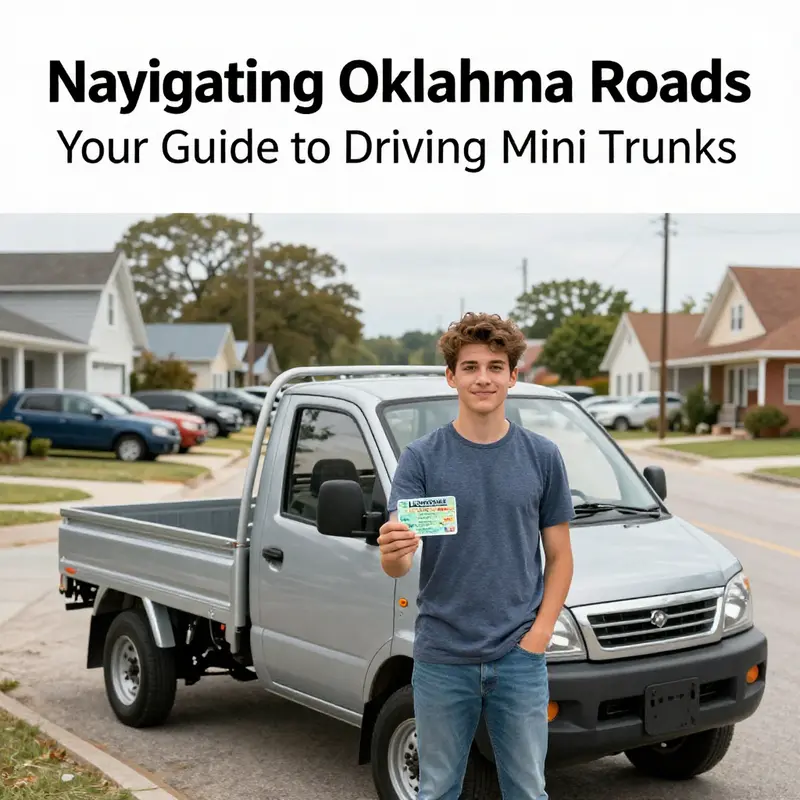
Owning a mini truck in Oklahoma is more than a statement of personal style or a clever way to haul small loads. It is a commitment to the same road rules that keep every driver and pedestrian safe, regardless of the vehicle’s size. The thrill of zipping down a quiet street or maneuvering into a tight parking spot in a rural town runs hand in hand with the responsibility to be properly licensed, registered, insured, and prepared for the road ahead. In Oklahoma, the path to legality for a mini truck is straightforward in principle but precise in practice. The vehicle must be properly registered with the state’s DMV, equipped with functioning safety features, and operated under a license appropriate to its class. When these pieces fit together, your mini truck can join the flow of traffic with the same rights as other light-duty vehicles, while still accommodating its unique size and capabilities. This chapter weaves together the practical steps, the legal distinctions, and the everyday checks that guard against cut corners or costly penalties, all while keeping the driving experience approachable rather than intimidating.
The licensing landscape for smaller, light-duty trucks in Oklahoma centers on how the vehicle is classified by weight and use. In most cases, a mini truck with a gross vehicle weight rating (GVWR) under 10,000 pounds falls into the familiar territory of a standard Class C driver’s license. That Class C license is the same credential most drivers need for passenger cars, small SUVs, and similar vehicles, and it represents the baseline accessibility that makes road travel feasible for many mini truck owners who operate these vehicles for personal or light commercial purposes. The exact intersection of vehicle class and license, however, hinges on the GVWR and the vehicle’s intended use. If the mini truck is marketed or used in a way that pushes it into a heavier category or brings it under the umbrella of a commercial operation—such as hauling large payloads, delivering goods, or handling materials that would trigger other regulatory considerations—you may encounter a different licensing reality, potentially involving a Commercial Driver’s License (CDL), such as a Class B CDL, depending on the specifics of weight and function.
To navigate this correctly, it is essential to verify the vehicle’s classification with the Oklahoma Department of Public Safety (OK DPS) or consult the official Oklahoma Vehicle Code. The DPS maintains detailed guidance on how GVWR, vehicle type, and use influence licensing requirements. When in doubt, use the official channels to confirm whether your mini truck requires a standard Class C license or a commercial endorsement or license. This step is not merely bureaucratic; it directly affects what you can legally operate, where you can drive, and under what conditions. A practical way to locate the precise criteria is to review the OK DPS vehicle licensing information, which outlines how vehicle classifications align with license types. For readers seeking a concrete, user-friendly entry point, the DPS’s vehicle licensing pages provide the framework you need to interpret your mini truck’s designation and the corresponding driver’s license you must hold.
Beyond licensing, vehicle registration and insurance form the other bookends of legality on Oklahoma roads. Every mini truck that enters public streets must be properly registered with the Oklahoma DMV and display valid license plates. Registration acts as the vehicle’s formal identity on state records, tying the machine to you as the registered owner and ensuring the state can track ownership, taxes, and compliance with safety standards. Insurance is not optional in practice; it is the financial shield that protects you, other drivers, and pedestrians in the event of an accident. Oklahoma law requires proof of insurance at the point of registration and ongoing coverage as you operate on public highways. Keeping these documents up to date is not a one-and-done task. Insurance lapses and unregistered vehicles carry fines, potential impoundment, and other penalties that can derail a weekend project or a daily commute.
The quiet core of these requirements is safety. Oklahoma’s standards for operating a mini truck on public roads demand that essential systems are in good working order: lights that illuminate and signal, brakes that respond reliably, tires that meet tread and inflation standards, and seat belts for all occupants. While a mini truck is compact, the obligations it carries are not diminished by size. A vehicle that fails to meet these safety benchmarks may be deemed unfit for road use, subject to inspection, ticketing, or removal from the roadway. The practical implication is clear: regular maintenance matters as much as the initial licensing or registration. A well-kept vehicle emits fewer worries about compliance and fewer questions from law enforcement when you’re cruising through a routine stop or checking into a rural weigh station.
For new drivers, the path to full driving privileges in Oklahoma can include a learner’s permit before obtaining a full license. If you are new behind the wheel, the permit phase allows you to practice under supervision and demonstrate the basic competencies that will transfer to a standard driving test later. The process isn’t about slowing you down; it’s about building a solid, safe foundation for operating any vehicle, including a mini truck, on real roads. As you prepare for the licensing exam, you’ll want to combine practice with study of the state’s road rules, right-of-way conventions, permissible what-to-drive scenarios, and the unique considerations that come with operating a smaller vehicle. The licensing office, the DPS, and the DMV all provide the official instructions and checklists to guide first-time applicants—from documentation to testing schedules—so you know exactly what to bring and how to proceed.
The practical question of “how do I get all these pieces to fit?” has a straightforward answer: start with the GVWR classification, confirm the license type needed, then complete the registration and insurance requirements, keeping safety standards in constant view. In that sequence, your mini truck evolves from a mere possession to a road-ready vehicle. If you want a practical, real-world sense of how owners talk about and approach these steps, you can explore the broader community discussions in their blog. Mini Trucks blog provides a focused look at the conversations that surround mini truck ownership, handling, and customization, offering context that complements the formal licensing path described here.
The journey does not end with securing a license or registering the vehicle. Once you are on the road, you are bound by ongoing responsibilities: keeping your documents current, maintaining your insurance, and ensuring your vehicle remains in compliance with safety standards. If you plan to drive for commercial purposes or anticipate loads that push your GVWR toward higher thresholds, revisit the licensing requirements. The landscape can shift with changes in weight, use, or state regulations, so periodic checks with the OK DPS and the Oklahoma DMV are prudent, especially after any modifications to the vehicle or its intended function. The goal is steady, legal operation rather than last-minute scrambling when a citation or roadside check appears.
In keeping with the practical intent of this chapter, the relationship between licensing, registration, and safety is not an abstract concept but a living routine. It shapes how you schedule maintenance, how you document proof of insurance, and how you plan the routes you choose to drive. For instance, you may decide on a maintenance calendar that coincides with registration renewals, so that your safety equipment, tires, and brakes are checked in a single, structured cycle. You might also adopt a simple record-keeping habit—storing VIN information, insurance certificates, and license details in a readily accessible place—to reduce stress during inspections or if you ever need to provide proof of compliance to law enforcement or a DMV official. And as you grow more comfortable with the process, you’ll discover it becomes less about meeting a checklist and more about embracing responsible driving as a regular part of owning a mini truck in Oklahoma.
These considerations—licensing class, vehicle classification, registration, insurance, and safety readiness—are mutually reinforcing. They ensure that you can enjoy your mini truck without friction on the road, and they protect you and others as you navigate the state’s varied landscapes, from the plains to the small-town streets where these vehicles often shine. In short, legality is the first layer of freedom you experience when you’re behind the wheel. The second is the confidence that comes from knowing you’ve prepared properly: your license aligns with your vehicle’s class, your registration is current, your insurance covers the necessary risks, and your truck’s safety systems are up to par. When all these pieces are in place, the Oklahoma road becomes not just accessible but a welcoming outlet for the efficiency and novelty that a mini truck brings to everyday travel.
External resource guidance is available to help you verify these details with official sources. For formal, up-to-date guidance, consult the Oklahoma Department of Public Safety’s vehicle licensing information and the state DMV resources. This official information is designed to keep you aligned with current statutes and practical steps for licensing, registration, and safety compliance on Oklahoma roads. In your planning, you can also draw on community discussions and experiences shared by other mini truck owners, but always return to the authoritative sources for definitive requirements and any changes that might affect your situation. The path to road-legal operation is not a mystery; it is a clear set of steps that, once followed, unlocks the full potential of your mini truck in Oklahoma’s unique driving environment. For the most precise and current licensing details, refer to the official sources linked through the state portals.
External resource: Official Oklahoma DPS Vehicle Licensing information can be found at https://www.ok.gov/dps/vehicle-licensing.html
Balancing the Load: How Oklahoma’s Weight Rules Shape Your Mini Truck on Public Roads
Can you legally drive a mini truck on Oklahoma roads? The short answer is yes, with caveats that go beyond the vehicle’s size or charm. In Oklahoma, as in many states, the road rules that matter most for a small, nimble vehicle like a mini truck aren’t only about where you can drive—it’s about what you can carry, how that cargo sits on the axles, and how your registration, lights, brakes, and licensing keep up with the weight you’re moving. The chapter that follows threads these concerns together, turning a practical question into a framework for safe, law-abiding operation. The central thread is weight, because weight is the most visible and measurable constraint that can turn a casual haul into a roadside stop, a costly ticket, or a damaged bridge sooner than you might expect. In Oklahoma, the weight classifications that affect most trucks and their loads hinge on two broad thresholds: a single axle and tandem axles. A single axle is limited to about 20,000 pounds, while tandem axles—two axles spaced in a way that the load is spread across them—carry up to roughly 34,000 pounds. These figures aren’t abstract numbers; they anchor how you plan every trip, every shipment, and every use of the mini truck as a conveyance. Even if your mini truck feels small, the way you load it can push it into a different class altogether, with corresponding rules. For a lot of owners who use a mini truck for personal tasks, the practical path remains straightforward: keep the vehicle’s Gross Vehicle Weight Rating, or GVWR, in the light-weight range, typically under 10,000 pounds for many everyday mini trucks. When the vehicle is registered as a light-duty vehicle, the requirement of a license that fits the vehicle type becomes the central licensing question. If you’re driving for personal use and your GVWR is under that 10,000-pound mark, a standard driver’s license appropriate for the vehicle will generally suffice. If you’re new behind the wheel, there may be a learner’s permit phase before you obtain a full license. These basics—the GVWR, the weight thresholds that trigger different requirements, and the licensing path—are the first lines of the map you’ll follow on Oklahoma roads. However, the map quickly widens once you consider loading and operation beyond personal use. When a mini truck is deployed for commercial purposes or heavier loads, the vehicle starts to slide toward the middle of weight categories that the state monitors closely. The same two thresholds that regulate the single axle and tandem axle loads still apply, but the consequences of violating them become more severe. In a commercial context, additional licensing requirements may come into play. The state’s framework is designed to prevent excessive stress on road surfaces and bridges, protect other motorists, and ensure that vehicles carrying heavy or hazardous loads remain under controlled conditions. The practical implication is simple in principle but requires careful work in practice: even a small vehicle can exceed the legal limits if the payload is miscalculated or loaded unevenly. For instance, a mini truck with a sizable payload that distributes more than the allowed weight across a single axle risks a roadside inspection, fines, or more serious liabilities if an incident occurs. Responsibility then means awareness—awareness of the exact GVWR on your vehicle’s label, awareness of how the load is distributed across axles, and awareness of the route you pick, because some corridors and weigh stations feature stricter enforcement than others. The Oklahoma DMV is the primary source of truth for what must be registered, how plates are issued, and which safety standards apply. Your mini truck should be registered and titled, with valid license plates, and it should meet the state’s safety standards. That includes functioning lights, brakes, tires, and seat belts. In a practical sense, this means that even when your vehicle is compact, it still needs to be kept in road-ready condition, with lights that work in all the necessary configurations, brakes that respond promptly, tires that can handle the load and the road surface, and seat belts that function for every occupant. If your use is commercial, plan for the possibility that more formal licensing or permits might be required. The exact licensing path depends on the vehicle’s classification and its intended use, and the Oklahoma DMV provides guidance on these distinctions. If your intent is personal use and your mini truck remains within the light-duty category, the path is to ensure your license aligns with the vehicle type, maintain registration and safety compliance, and stay within the weight limits that define your category. It is not hard to imagine the practical steps you take next: you verify the GVWR, confirm that the load you intend to carry won’t push the axle loads beyond the thresholds, and you consider the distribution of that load across the axles. Thoughtful load planning matters because axles aren’t just abstract numbers; they are the points where a road goes from a smooth surface to a site of potential stress. The heavier the payload and the poorer the weight distribution, the greater the risk of exceeding the per-axle limit. This is not merely a matter of avoiding fines; it is about the road itself, the bridges, and the long-term wear they endure. If the load grows, a load of 5,000 pounds distributed to a single axle could breach a limit that a better-balanced arrangement wouldn’t touch. If there’s any doubt, the prudent move is to weigh the vehicle at a certified scale, then rebalance or reduce payload to bring the per-axle weight back under the legal boundary. For many operators, this means more precise inventory, better packing strategies, and perhaps a commitment to lighter, more frequent trips rather than large, risky loads. The dynamic here is subtle: small vehicles with small footprints can deceptively deliver large payloads if the weight distribution is uneven, and the consequences of miscalculation can include roadside delays, penalties, and increased risk to other road users. In truth, the weight classification schema in Oklahoma acts as both a safety framework and a practical guide. It tells you what you can carry, how you must carry it, and what paperwork or licensing accompanies your use of the vehicle. It also underscores the importance of routine maintenance and compliance. A late-night check of lights, brakes, and tires is not a mere habit; it is a necessary safeguard that aligns your mini truck with the state’s expectations for any vehicle that travels public streets while carrying a load. The overarching message is that you can drive your mini truck on the road in Oklahoma, but you do so within a structure that prizes balance, accuracy, and accountability. The weight thresholds are the compass, the GVWR and the axle-load considerations are the map, and the ongoing registration and safety practices are the daily practice that keeps travel lawful and safer for everyone. These elements together create a practical ethic for mini truck use: know your vehicle’s classification, plan your load to respect per-axle limits, maintain the vehicle to a safety standard, and align licensing with your actual use. If you remain within these bounds, your journeys on Oklahoma’s highways can be straightforward and efficient. For readers who want to deepen their understanding of these thresholds and see how they sit within the broader landscape of trucking regulations, a good next step is to explore practical discussions and examples from the community of mini-truck enthusiasts, including resources that discuss general operating principles and upkeep. For broader context on ongoing updates to rules and practical tips, consider the MiniTrucksCaLa blog as a helpful companion resource. MiniTrucksCaLa blog. As you weigh your options and plan your loads, remember that the aim is to keep the load verified, the vehicle compliant, and the road safe for everyone. If you want to read more about official limits and how they are applied in different scenarios, you can turn to external, detailed explanations of Oklahoma’s weight limits that provide a broader regulatory frame. For a detailed breakdown of Oklahoma’s weight limits, see Freedom Heavy Haul’s guide on Oklahoma Truck Weight Limits. https://www.freedomheavyhaul.com/oklahoma-truck-weight-limits
Final thoughts
Driving your mini truck on Oklahoma’s roads opens up a world of possibilities, from enhancing local businesses to indulging in a hobby. By understanding and adhering to the legal requirements, safety standards, registration processes, and licensing needs discussed in this guide, you can ensure that your experience is not only enjoyable but also compliant with state regulations. Remember, a well-informed driver not only protects themselves but also contributes to the safety and legality of our roads.