
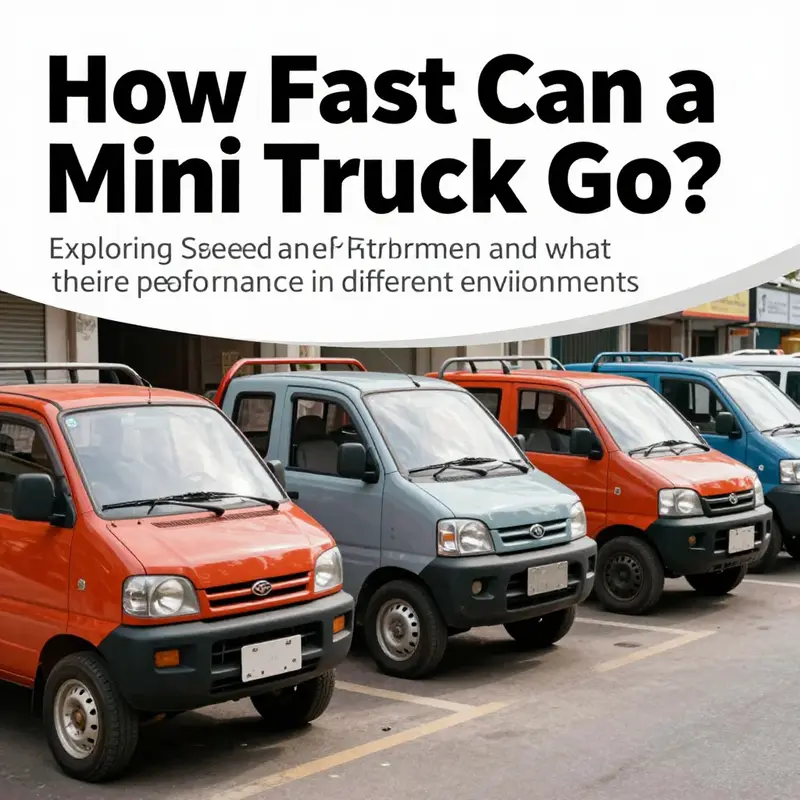
Mini trucks have gained popularity among local small business owners, residential property owners, and enthusiasts alike for their utility and versatile functionality. At the heart of their appeal lies the question of speed. Understanding how fast a mini truck can go is vital for owners who plan to use these vehicles for transport or delivery. In this article, we’ll dive into the top speeds of mini trucks, factors that influence their performance, and how they compare to other vehicles. This exploration will help you make an informed choice when considering a mini truck for your needs.
Pushing the Boundaries: How Fast Can a Mini Truck Really Go—and Why It Matters for Work and Wonder

When people first ask how fast a mini truck can go, they often imagine a small, boxy vehicle sprinting down a highway with the same urgency as a sports car. The reality is more nuanced. Mini trucks, which sit at the intersection of utility and portability, are engineered for a balance between practical payload, maneuverability, and efficiency. Speed is a calculated byproduct of their purpose rather than the central objective, and the numbers reflect a spectrum that ranges from the modest and reliable to the unexpectedly brisk, and in a few rare cases, the extreme—though those extremes belong to a different category altogether.
In the broad landscape of mini trucks you’ll encounter on paved roads and rugged trails alike, the most common configuration is a compact powertrain designed to maximize usable torque and reliability rather than top-end speed. For many conventional models equipped with a small internal combustion engine—think in the neighborhood of a single, modestly sized cylinder and a compact displacement—the top speed tends to settle in the 60 to 70 mph range, roughly 97 to 113 km/h. This band reflects a design choice: the engine’s power curve, the weight of a payload and chassis, and the gearing all converge to deliver steady acceleration and solid passing capability without pushing the limits of stability or fuel economy in urban and semi-urban settings. It’s worth noting that this speed envelope is often more than enough for workaday duties, where maneuverability, braking response, and tire durability can matter just as much as raw velocity.
Electric variants, increasingly common in the mini truck segment due to the efficiency and simplification of delivering torque at low rpm, tend to land at different points on the speed spectrum. Electric motors excel at delivering torque from zero and maintaining a flat torque curve, which translates into brisk takeoff and predictable acceleration. Yet their top speeds, especially in entry-to-mid range urban configurations, commonly hover around the 100 km/h mark (about 62 mph) with occasional variants nudging toward the 105 km/h threshold (roughly 65 mph) as battery management, weight distribution, and drivetrain tuning come into play. These figures reflect a balancing act between battery capacity, thermal management, and curb weights designed to preserve range under typical duty cycles. In practical terms, a mid-range electric mini truck can feel lively in traffic and comfortable cruising on major routes, while still prioritizing range efficiency over sprint capability.
It’s important to distinguish the everyday mini trucks from the kind that inhabit the margins of speed records and specialized racing. There exists a niche—formed around compact racing platforms—that can push into speeds far beyond conventional expectations. In those environments, a formula-inspired mini car with a much larger, turbocharged engine can exceed well over 350 km/h (about 217 mph). These machines are engineered for a different purpose entirely: pure performance, controlled track conditions, and the pursuit of cornering grip and aero balance rather than payload and rugged utility. They sit far outside the scope of typical urban or light-industrial use. The point here is not to conflate these high-speed machines with everyday mini trucks, but to acknowledge that the broader family of small, utility-oriented vehicles can cover a broad spectrum of speed depending on the intended application and design priorities.
To understand why speeds cluster where they do, it helps to look at the practical design elements that govern top speed in this class. First, weight is central. A lighter vehicle gains speed more readily, but for mini trucks used in delivery, service, or off-road tasks, there is a payload ceiling that must be met without compromising braking, suspension travel, or steering feedback. The chassis and bodywork, while small, still contribute appreciably to the aerodynamics and overall mass. A higher mass means more energy is required to achieve the same acceleration, which translates into a lower top-end velocity unless the powertrain is scaled accordingly. Second, gearing and drive-train configuration matter. In a gasoline-powered mini truck, the transmission ratios are chosen to optimize torque at low to mid-range speeds, ensuring that the vehicle can haul loads and navigate uneven surfaces without constantly shifting. In electric variants, the absence of a traditional multi-gear transmission shifts the emphasis toward a large-torque, high-tability drive that can still be tuned for top speed by limiting peak power or by employing software-managed motor controllers. Third, the tires and suspension must support both the drag of forward motion and the lateral stability required at higher speeds. Narrow or specialized off-road tires might be excellent for traction and load-bearing capacity but can cap top speed if they introduce excessive rolling resistance or unpredictable behavior at speed. The suspension geometry, steering rack ratio, and braking system all play supporting roles in keeping the vehicle safe and controllable as speed rises. The result is a carefully choreographed set of trade-offs: speed is not chosen in isolation but emerges from a broader performance envelope that prioritizes reliability, durability, and the ability to perform the job at hand without compromising safety.
The practical implications of these design choices extend beyond the factory door. For owners who rely on mini trucks for day-to-day work—from on-site construction deliveries to farm tasks and light utility missions—the top speed is only one dimension of performance. Considerability comes from how quickly the vehicle can accelerate to a safe cruising speed, how stable it remains across a range of road conditions, and how reliably it can sustain performance under load or in hot, duty-cycle environments. In urban settings, the ability to merge with faster traffic and maintain a comfortable cruising pace often matters more than hitting a brisk top speed. The tailpipe exhaust note, the immediacy of throttle response, and the feel of the steering response at highway roll are all part of the human experience that defines how fast the vehicle feels rather than how fast the instrument panel claims it can go.
Another layer of nuance appears when you consider the context of use. A mini truck designed for rough, off-road work typically won’t be tuned for high top-end speed; instead, it emphasizes torque delivery, climbing ability, and braking confidence on loose surfaces. The top speed in this scenario becomes a ceiling that is rarely reached because the vehicle is often working within a limited speed envelope dictated by traction, weight distribution, and the safety margins built into the chassis. Conversely, a lighter, road-oriented mini truck with a more aggressive powertrain can approach higher speeds, but those performance targets are balanced against the demands of payload, fuel economy, and regulatory constraints. In all cases, the top speed is a guidepost—the actual, real-world speed you experience while performing a job may differ based on load, road quality, weather, and the condition of the tires.
From a consumer perspective, it’s also important to be aware of the numbers in the precise terms manufacturers publish. The best-informed buyers scrutinize the exact power output, drivetrain layout, wheel size, and payload rating as a package. A 1.5-liter naturally aspirated engine, for instance, can deliver a maximum power output that translates into a top speed in the seventy-ish mph range when the vehicle is light and unladen, but that same engine paired with a heavier payload or in a tougher terrain can significantly reduce the practical top speed. In electric configurations, battery state of charge and thermal management can modulate the achievable top speed, especially on longer runs where heat buildup might trigger safety protections that limit maximum performance to protect the battery and power electronics.
The conversations around top speed are therefore as much about intent as they are about engineering. For rural roads where a clean highway merge matters, the ability to reach and maintain a safe highway speed is a practical concern. For urban settings, the top speed is less a point of pride and more a safety planning tool, guiding drivers to choose a configuration that preserves daylight visibility, braking distances, and nimbleness in tight spaces. The everyday user does not hunt for the top speed; they seek a reliable vehicle that can carry a meaningful payload, maneuver in urban corridors, and traverse varied surfaces with predictable handling. The best mini trucks in any given class strike a balance between speed, stability, and load-bearing capability, with each parameter tuned to the specific mission at hand.
If you’re exploring this topic as part of a broader curiosity about how speed translates into real-world performance, you may also encounter references to the way manufacturers tune these tiny workhorses for different markets. In some regions, where lane discipline and highway practice differ, the top-speed targets reflect local speed limits and the typical road geometry. In others, more rugged duty cycles and the expectation of longer stints on gravel or unpaved surfaces push designers toward a different equilibrium of power, torque, and suspension travel. Across these variations, one constant remains: the top speed is a useful metric, but the value that really determines success is how well the vehicle fulfills its practical role while maintaining safety margins under a wide range of operating conditions.
For readers seeking a concise takeaway, the familiar range for conventional, utility-focused mini trucks sits around 60 to 70 mph, with electric variants often presenting slightly lower ceiling speeds due to range and thermal considerations, yet sometimes reaching into the low 100 km/h range. It’s a spectrum that mirrors the diversity of the applications they serve and the engineering choices that are made to meet those needs. When you add the possibility of high-performance, race-derived microcars, you glimpse a different facet of the same family—a reminder that speed, in this universe, is not a single value but a spectrum shaped by purpose, constraints, and the engineer’s willingness to push the envelope.
To ground this discussion in practical terms, it’s helpful to consult broader technical references that summarize the landscape of ATV and mini-truck platforms. A comprehensive overview of ATV mini trucks delves into the typical ranges and the factors that influence them, including engine displacement, drivetrain design, payload capacity, and chassis rigidity. This broader context reinforces the idea that top speed is just one piece of a larger performance picture, and it invites readers to think about speed in relation to payload, handling, durability, and the specific environments where these vehicles spend most of their time. For a more technical survey, see the ATV-focused overview linked in the external resources. Meanwhile, if you want to explore practical, community-driven perspectives on how mini trucks integrate into real-life operations, you can visit a dedicated community blog that threads together usage stories, maintenance tips, and field-tested insights. In particular, the Mini Trucks OCALA Blog offers a wealth of practical context on how these machines perform in everyday work, how owners balance speed with safety, and how different configurations hold up under demanding tasks. Mini Trucks OCALA Blog.
In closing, the question of how fast a mini truck can go is answered by recognizing the dual identities these vehicles occupy: they are both work machines and, in certain configurations, capable of highway speeds. The best-performing, non-specialized mini trucks tend to live in the 60–70 mph range, while electric variants push toward the 100 km/h mark with occasional variants slightly above that threshold. High-speed, race-oriented mini cars exist, but they are designed for a completely different purpose and should not be mistaken for the utility-focused machines that populate most roads and job sites. If speed is only part of the story, the other parts—payload, reliability, and safety—shape the overall value these compact workhorses deliver. For readers who want to see how these ideas translate into real-world use and practical buying decisions, the linked blog and the broader ATV-technical reference provide complementary angles that enrich the understanding of what makes a mini truck fast enough for the task at hand. And for those who crave the most rigorous, cross-model technical grounding, the external reference offers a deeper dive into the engineering underpinnings of ATV mini trucks.
External resource: https://www.atvworld.com/technical-details-atv-mini-truck/
Speed on a Small Frame: Real-World Factors That Shape How Fast a Mini Truck Can Really Go
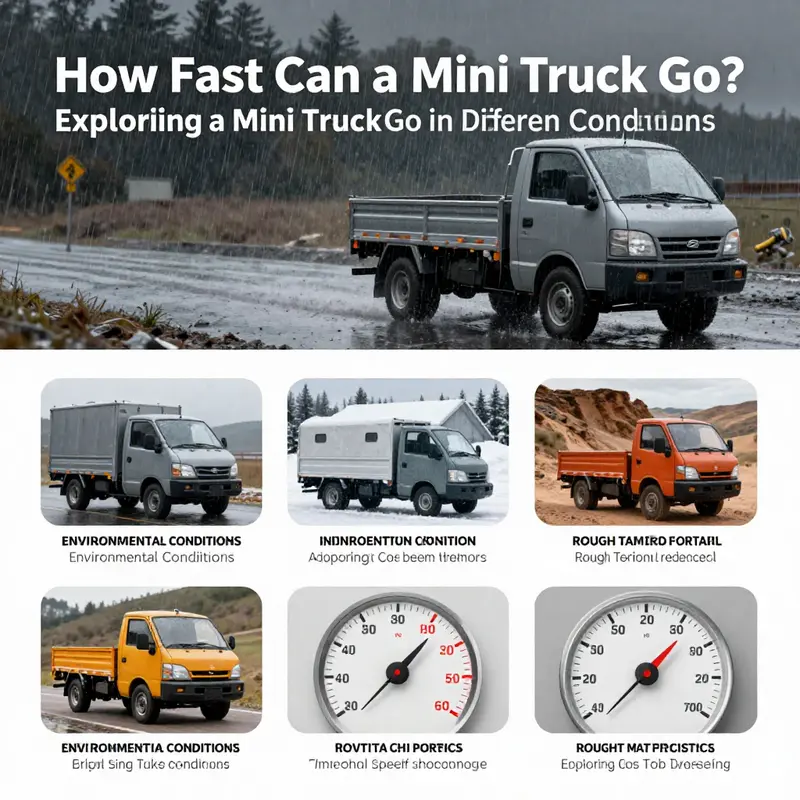
The question of how fast a mini truck can go invites more than a glance at a speedometer. It asks us to peel back layers of engineering, physics, and everyday use to understand why a compact utility truck might scream down a highway in one scenario and hesitate on a steep grade in another. In the world of small workhorses, speed is not a single number but a spectrum defined by design intent, powertrain choices, and the environment through which the vehicle operates. A quick survey of the landscape shows that even within a single class, the top end can vary dramatically. Electric variants with high-output powertrains can claim top speeds around the century mark or beyond, sometimes reaching around 125 mph (201 km/h) in manufacturer specifications. On the other end, light-duty internal combustion configurations with modest engines typically top out closer to 75 mph (roughly 120 km/h). And then there are micro-vehicles designed primarily for urban mobility, often capped near 100 km/h (about 62 mph) with occasional variants creeping a touch higher. The practical takeaway is simple: the label “mini” refers to size and purpose, not a universal cap on speed. The actual speed a mini truck can achieve is a function of what it is built to do, how it is built to do it, and the road and weather that stand in the way or invite it to perform.
To understand this fully, the discussion bends toward the core determinants that translate engine vigor into velocity while balancing safety, efficiency, and durability. Engine power and drivetrain layout sit at the heart of the story. A mini truck equipped with a higher-output powertrain and a well-tuned transmission tends to reach higher speeds than one powered by a smaller engine with a more modest gearing scheme. The drivetrain configuration matters as well. Two-wheel drive configurations, common in many compact trucks, can deliver brisk acceleration and comfortable highway cruising when the powertrain is well matched to the vehicle’s weight and aerodynamics. Four-wheel drive adds traction, which is invaluable in variable conditions, but it also introduces parasitic losses that can temper top speed and efficiency if the system is not finely tuned.
But power alone does not tell the whole tale. The weight of the cargo and the vehicle itself interacts with rolling resistance and the energy required to overcome gravity on hills. A full payload increases rolling resistance and demands more power to maintain a given speed on grades. Even a small increase in weight can translate into noticeable reductions in acceleration and top-end performance, especially when climbing or traversing uncertain surfaces. In practice, many users of mini trucks balance payload needs with the desire for brisk acceleration by selecting powertrains and gearing that preserve enough reserve power for highway maneuvering while still delivering the payload capacity required for daily tasks. The take-away here is nuanced: more power can help you reach a higher speed, but it does not guarantee that you will reach or sustain it if the load, road, and energy management do not align.
Aerodynamics, though often less dramatic for boxy little workhorses than for sleek passenger cars, still matters at higher speeds. A mini truck’s geometry—its cab-to-bed proportions, underbody airflow, and even the roughness of surfaces it travels over—shapes drag and, by extension, the top speed and efficiency. While a smaller vehicle experiences less dramatic drag increases than a larger sedan when scaled up, the impact is not negligible. Small aerodynamic improvements, such as smoothing sharp edges, optimizing the roof line, or reducing crosswinds with carefully designed mirrors and spoilers, can contribute to a measurable difference in highway performance. In many cases, the improvements may be incremental, but for drivers who regularly push the vehicle toward its upper limits or rely on steadier highway speeds for long work shifts, the gains can be meaningful.
Environmental conditions create a dynamic stage for speed, often the decisive factor in whether the theoretical top speed becomes an everyday reality. Road surface quality plays a critical supporting role. On smooth, dry asphalt, a well-maintained mini truck can approach its published limit more closely, especially if the powertrain and transmission are engineered to deliver smooth, linear acceleration and stable high-speed cruising. In contrast, rough pavement, potholes, gravel, or uneven patches can threaten stability at higher speeds, forcing the driver to back off to preserve ride comfort and control. Weather is another powerful influence. Rain and wet leaves reduce traction, and in such conditions, even a vehicle with robust power and a measured throttle response may require slower speeds to maintain stable braking distances and steering control. Snow and ice, with their reduced friction and the hazard of sliding, often compel a conservative approach to speed throughout the entire journey.
Elevation adds another layer of complexity. Driving uphill demands more power, and that demand can reduce the vehicle’s top speed. The effect compounds when the truck is carrying a heavy payload or when the grade is long or steep. Downhill sections, on the other hand, can invite higher speeds, but they bring the need for effective braking and stability management. The interplay between engine performance, transmission behavior, and braking systems becomes especially evident on mixed terrain, where a vehicle may need to accelerate on a descent just as quickly as it must climb a hill on the ascent. The efficient management of energy—whether through seamless torque delivery, regenerative charging in electric variants, or precise engine braking in traditional setups—helps maintain predictable performance across a range of elevations.
Urban versus rural environments also shape the speed story. In cities, speed is frequently constrained by traffic density, red lights, and the need for frequent stops. The practical, daily pace of a mini truck in urban settings often resembles a slow dance: accelerate, navigate traffic, brake, and repeat. In rural settings or on highways, the same vehicle may face more favorable conditions for maintaining speed once the initial acceleration phase is past. The freedom to sustain steady velocities hinges on road design, speed limits, and the availability of safe passing opportunities. A truck designed for urban duty may not be optimized for sustained highway velocity, even if it can reach a high top speed under ideal conditions. Conversely, trucks built with highway-oriented ambitions will be tuned to deliver not only a higher peak speed but also strong consistency in acceleration and braking performance at steady, higher rails of speed.
All of these factors—engine output, drivetrain, weight, aerodynamics, road quality, weather, elevation, and the urban-rural context—interact in a way that makes the simple question of “how fast can it go?” into a layered calculation. A given mini truck’s top speed may be defined in the manufacturer’s data, but the true usable speed emerges only when you consider real-world usage. If the goal is to understand performance in practical terms, a few guiding ideas help translate the numbers into everyday expectations. First, power-to-weight matters more than power alone. If the vehicle carries a payload that raises the overall weight significantly, the same engine must work harder to maintain speed, and the top end will typically recede. Second, gearing and torque delivery are critical. A transmission that can keep the engine in its sweet spot—where power is available across the range of road speeds you encounter—tends to feel quicker and more confident in both hill climbs and highway overtakes. Third, traction sets the ceiling in adverse conditions. Even with ample horsepower, a vehicle loses top speed when tire grip is compromised by rain, snow, or uneven surfaces. Traction control systems and stability programs, when properly calibrated, help preserve momentum rather than arrest it abruptly, offering a steadier ride at higher speeds in challenging weather.
To bring these ideas into a more tangible frame, consider the broad spectrum observed in real-world specifications without naming individual models. Electric mini trucks with high-energy battery packs and compact drivetrains may advertise impressive top speeds by marketing channels, often emphasizing highway usability. Their ability to reach higher speeds depends on factors including torque availability at low speeds and the maturity of the motor control systems. On the flip side, compact petrol-driven configurations with smaller displacement engines tend to cap earlier, delivering reliable urban performance with modest highway capability. Between these poles lies a continuum of configurations that balance practical needs—payload capacity, maneuverability, efficiency, and cost—with the aspiration to reach higher speeds when conditions permit. Within this spectrum, a driver’s decision about whether to prioritize peak speed or sustained performance will be shaped by the intended use, the region’s road networks, and the safety margins the operator is prepared to maintain.
It’s useful to anchor these concepts with the guidance manufacturers and researchers offer, while recognizing that the numbers can be highly model-specific. Officials and researchers emphasize that while a vehicle’s top speed is a useful metric, it does not always translate into the most important performance attribute for a given task. Acceleration, gearing characteristics, and stability at higher speeds often prove more critical for safety and efficiency on real roads. A well-balanced system—one that harmonizes power, gearing, braking, and chassis dynamics—tends to deliver the most usable performance. For those who want to dive deeper into the benchmarks and how they are established, a comprehensive, standardized data source provides a framework for comparing different mini-trucks under controlled conditions. It is worth noting that the type of test protocol used to determine top speed can influence the reported figures, and consumer choices should take into account the complete performance envelope, not just the peak.
If you are exploring the landscape of possibilities while weighing options for a daily workflow or a weekend project, a practical approach is to read the official specifications for any candidate vehicle. Such specifications usually include the maximum speed as well as power output, torque, weight distribution, and gross vehicle weight rating. The picture that emerges from these details is clearer when you view them through the lens of your own needs. A truck that prioritizes payload efficiency and city maneuverability may be perfectly adequate for routine tasks but may not feel comfortable at high speeds for extended periods. Conversely, a model tuned for highway duty might feel eager at speed but at the expense of payload flexibility or flatland efficiency. In all cases, safety remains the constant companion of speed: tire choice, braking capability, suspension behavior, steering precision, and electronic aids collectively shape how fast you should feel comfortable traveling on any given route.
For readers who want to connect this understanding to a broader ecosystem of information, several online resources consolidate test data, owner experiences, and manufacturer data into accessible comparisons. A well-regarded hub for vehicle-specific information and testing protocols can provide a practical reference point when evaluating how different mini trucks perform under a range of conditions. The environmental and usage context matters, and the best way to gauge real-world capability is to align specifications with the scenarios in which you plan to operate.
As you read through speed figures, it is important to stay mindful of the broader purpose of these vehicles. The strongest selling point of a mini truck is not its ability to eclipse highway performance of larger trucks but its clever balance of light weight, nimble handling, and efficient power delivery that keeps daily work moving with reliability. The fastest top speed is interesting, but the most relevant metric for most operators is how quickly the vehicle can respond to a sudden need, how stable it feels when it reaches highway speeds, and how efficiently it maintains those speeds over a full shift or a long, uninterrupted journey. In the end, speed is a facet of a larger question: will the vehicle reliably perform its intended tasks while staying within safety margins, fuel and energy budgets, and maintenance schedules? That is the judgment that matters most when deciding how fast a mini truck should go in practice.
For readers who crave a community perspective and a broader range of insights, the Mini Trucks Blog offers a wide array of discussions, real-world anecdotes, and practical considerations from drivers who regularly push these small machines through varied conditions. This resource can help temper technical expectations with firsthand experience, blending theory and practice in a way that makes the numbers more meaningful in everyday life. Mini Trucks Blog
Beyond personal testing and user experiences, there remains a body of authoritative data that helps anchor the speed question in a standardized framework. The U.S. Department of Energy’s Alternative Fuels Data Center provides reliable, up-to-date vehicle data and testing benchmarks that cover energy consumption, performance, and operating characteristics across a wide range of small, practical vehicles. This external resource offers a rigorous reference point for comparing speed capabilities while factoring in energy use and efficiency in different operating scenarios: https://afdc.energy.gov/vehicles.
As the discussion of speed converges with the realities of use, the take-home message is that a mini truck’s maximum velocity is a function of purposeful design, thoughtful engineering, and context. It is not merely the sum of horsepower and gearing, but the way those elements interact with weight, drag, traction, and the demands of the road. When planning usage—whether for urban deliveries, rural hauls, or mixed work across a region—consider not just the top speed but the speed envelope your tasks will require. Speed limits and traffic patterns matter, but so do acceleration, roll stability, braking response, and energy management. The most dependable answer to how fast a mini truck can go lies not in a single number but in a careful alignment of the powertrain, chassis, and usage profile with the realities of the roads you intend to traverse. In that alignment, the vehicle becomes not just fast, but fit for purpose—capable of meeting demands with predictability, efficiency, and safety, every day on the job.
In closing, the best practice for anyone evaluating speed is to start with the job at hand: what loads will you carry, on what routes, and under what weather and road conditions? Then map those needs to a powertrain and drivetrain configuration that can deliver the right balance of acceleration, top speed, and control. Remember that the highest top speed is not the ultimate objective; the most meaningful metric is the speed at which the vehicle can reliably perform its tasks, safely and efficiently, across the range of conditions it will encounter. This practical perspective makes the concept of “how fast can a mini truck go” a much richer conversation than a simple number on a speedometer.
null
null
Final thoughts
In conclusion, understanding the speed potential of mini trucks can greatly influence your decision to purchase one for business or personal use. From impressive models capable of high speeds on highways to others designed more for localized transport, the key is to match your choice with your driving needs. With all the information covered, mini truck owners can make informed decisions that best suit their driving habits and situations.