
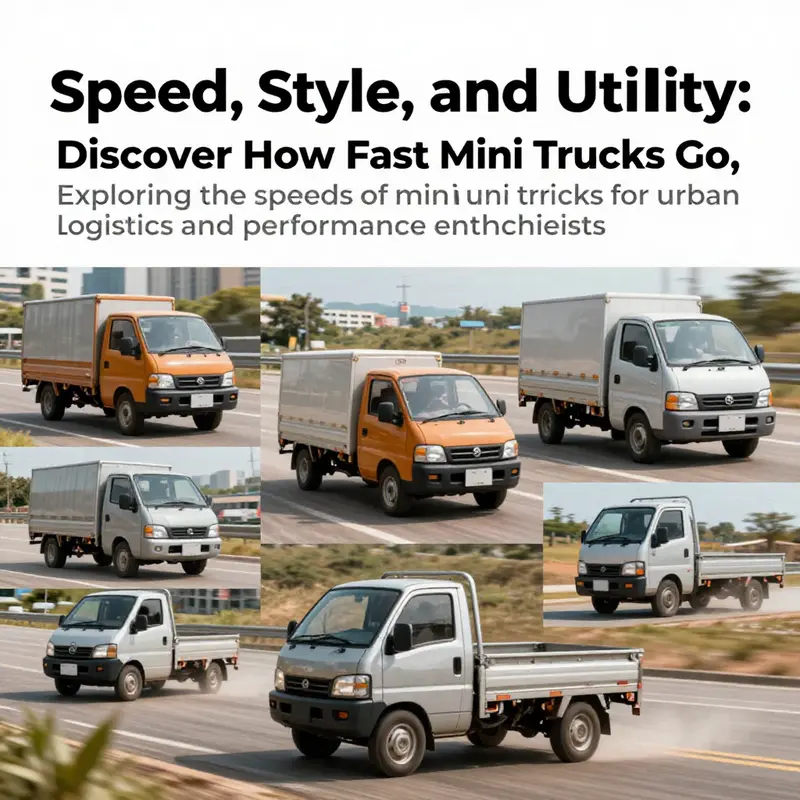
For local small business owners, residential property owners, and mini truck enthusiasts, understanding the speed capabilities of mini trucks is vital. These compact vehicles serve numerous purposes, from urban deliveries to recreational fun. In the upcoming chapters, we will delve into the standard speeds of mini trucks designed for city use, examine the advanced models built for speed, and discuss the diverse factors that influence their speed capabilities. Moreover, we’ll compare mini trucks to conventional trucks to provide a clearer perspective on their performance on the road.
Urban Velocity: How Fast Standard Mini Trucks Move on City Streets

Speed is rarely the sole measure of a mini truck’s usefulness in the dense fabric of city streets. In talking about how fast these compact cargo carriers actually go, one must balance nominal top speed with real-world performance, safety, and the everyday rhythms of urban logistics. The question is less about chasing the maximum number on a speedometer and more about understanding how a vehicle of modest power, tight turning radius, and carefully tuned acceleration fits into a delivery ecosystem where frequent stops, crowded lanes, and pedestrian traffic are the norm. In this light, the best way to frame the inquiry is to look at the speed envelope most standard, city-oriented mini trucks operate within, and then to trace why that envelope exists and how it shapes decision-making for fleets, drivers, and planners. The answer depends on the model, but in general terms, urban mini trucks hover within a practical range that prioritizes control, safety, and efficiency over outright speed.
For most standard city-oriented mini trucks, the top speed settles in the neighborhood of 35 to 60 kilometers per hour (roughly 22 to 37 miles per hour). This range is not a cap on capability so much as a design choice rooted in regulatory and safety considerations that are common across many urban-use vehicles. These vehicles are often engineered to be compliant with low-speed vehicle regulations that exist in numerous jurisdictions, specifically to ensure predictable handling and safer operation in pedestrian-heavy environments. The result is a speed band that keeps drivers within a comfortable margin for maneuvering through tight spaces, negotiating curbside deliveries, and enduring the stop-and-go cadence that marks most urban routes. When a vehicle is empty, there is occasionally a tendency for a higher ceiling within that same band, and some models can approach the upper edge of this range with minimal load. When a payload is added, however, the top speed typically retreats toward the lower portion of the band to preserve stability, braking performance, and power delivery for acceleration under load. In practical terms, a fleet operator can expect around 60 km/h as a practical upper bound under light duty, with urban operations often occurring in a more conservative corridor around 40 to 50 km/h to reflect real-world conditions and cargo requirements.
The design philosophy behind these speeds is not accidental. Urban environments demand a balance between responsiveness and predictability. A compact chassis, modest horsepower, and a drivetrain tuned for steady torque delivery improve the daily reliability of delivery cycles. These vehicles are optimized for short-range trips, with frequent stops, multiple handoffs, and the need to park in confined spaces where maneuverability and visibility trump raw velocity. The goal is not to outpace other traffic but to maintain a reliable, safe, and economical service rhythm. In practice, this translates to vehicles that accelerate smoothly from a stop, hold a steady pace along straight city corridors, and brake decisively without alarm at intersections and pedestrian crossings. The overall performance story emphasizes a controlled, nimble personality rather than a sprinting one. The result is a vehicle that can navigate crowded arterials and dense neighborhoods with greater ease and reduced risk, which in turn supports more predictable delivery windows and lower operating costs over the long term.
An important nuance of the urban speed equation is how load alters the performance profile. The majority of urban mini trucks are designed to carry payloads that can significantly affect acceleration, braking, and, to a lesser extent, top speed. Even a modest increase in weight can translate into a slower climb to cruising speed, longer braking distances, and higher energy consumption for the same trip. In regions with strict weight limits or regulatory constraints, the effect becomes more pronounced because the vehicle’s powertrain must balance payload torque with limits on wheel traction, safety margins, and energy efficiency. In other words, the same vehicle that can accelerate briskly when empty may settle into a more conservative tempo when loaded, precisely to maintain traction, predictable braking, and consistent handling. The practical implication for urban operators is straightforward: load management and route planning must be aligned with the speed envelope of the chosen vehicle to maintain reliable delivery times without compromising safety. It is this interplay between weight, speed, and control that makes the 40 to 50 km/h corridor so common in daily operations and why many fleets adopt standard operating procedures that anticipate slower acceleration and longer times at top speed when a payload is present.
Within this broader framework, a typical compact urban workhorse embodies a set of configurations chosen to maximize practicality over sprinting capability. Many of these vehicles employ a two-wheel-drive setup with a conventional front-axle arrangement. This configuration is favored for urban deliveries because it offers predictable handling, adequate traction on mixed surfaces, and lower mechanical complexity, all of which contribute to better reliability, easier maintenance, and lower total cost of ownership. The front-axle design provides stable steering response at the modest speeds typical of urban routes and simplifies the packaging of cargo space within a compact footprint. The focus on two-wheel drive in city work is not a statement about capability in open terrain; it is a deliberate engineering choice that aligns with the primary mission of these vehicles: to move goods efficiently through crowded streets, into parking bays, and along neighborhoods where the kind of aggressive off-road performance or high-speed stability demanded by highway driving is simply unnecessary. A vehicle configured in this fashion is easier to maneuver in tight spaces, easier to service, and more predictable for drivers who spend their days weaving through congestion.
The distribution of speed in daily urban use is a practical matter, not a theoretical one. It stems from a combination of hardware limits, safety standards, and the regulatory environment that governs what counts as a legally operating urban delivery vehicle. In many cases, the parameters are set by a blend of national and local rules that categorize certain small trucks as low-speed or urban-delivery vehicles. This categorization tends to cap speeds in a range that keeps the vehicle within safe operating limits for urban pedestrians and cyclists, while still enabling reasonable service levels for last-mile tasks. Operators learn to plan around these constraints, scheduling routes and time windows that reflect the actual pace of movement rather than the apparent capability of the vehicle’s engine. The effect is a service model that emphasizes reliability, timeliness, and predictable performance rather than headline top speed.
It is worth acknowledging a broader contrast that often surfaces in discussions of mini truck performance. There exist high-performance variants that push far beyond the urban envelope, boasting substantially higher top speeds and rapid acceleration. These are engineered for different use cases, where highway-like efficiency or rapid repositioning is valued over dense-city practicality. Such configurations can deliver top speeds well above the urban range and can accelerate from zero to significant velocities in a matter of seconds. They illustrate a spectrum that exists alongside standard urban models, underscoring the point that the answer to how fast a mini truck goes is not universal but highly contingent on the specific model, purpose, and regulatory framework. Yet for the typical city-oriented workhorse, the story remains firmly anchored in the 35 to 60 km/h band, with actual operation frequently occurring closer to the lower end of that spectrum due to payload, surface conditions, and the relentless cadence of urban stops.
This narrative of speed and utility is reinforced by practical examples in everyday fleets. Consider the broad class of compact commercial vehicles widely used for short-range deliveries and local utility tasks. In routine configurations, these vehicles perform best when their speed ceiling aligns with the realities of city traffic, curbside loading, and frequent route turnover. While some configurations may push the envelope, the everyday experience for most urban operators centers on trust, predictability, and efficiency. When a truck reaches the edge of its comfortable operating range, it is often signaling a need for a different tool for the job—an alternative vehicle with higher horsepower, greater load capacity, or different gearing suited to longer, open-road segments. In the same breath, the urban mini truck remains a remarkably capable instrument for serving dense neighborhoods, small businesses, and last-mile distributions where the speed instrument simply isn’t the primary determinant of success.
For readers seeking a deeper sense of how these values translate into concrete decision-making, the guidance rests on a blend of engineering principles and regulatory insight. The front-axle and two-wheel-drive choices underpin stable steering and predictable handling on mixed surfaces, while the overall powertrain tuning ensures that acceleration remains smooth and controlled as the vehicle negotiates traffic patterns. The aim is to deliver a reliable cadence that matches the pace of urban life, enabling operators to maintain steady service levels without inviting excessive risk. The urban speed envelope, then, becomes a practical boundary within which these vehicles operate. It allows crews to anticipate their progress along a route, dispatch centers to estimate delivery windows with greater accuracy, and regulators to enforce safe, predictable operation in crowded environments.
Within this context, an illustrative example—without naming specific models—helps to anchor the discussion. A compact, urban-focused commercial vehicle of this class typically operates within the described 35 to 60 km/h range. Its design emphasizes maneuverability, parking ease in cluttered city lots, and efficiency to keep energy costs in check during back-to-back deliveries. Load considerations stay at the forefront of planning, given their direct impact on acceleration and stability. The vehicle’s configuration supports this responsibility, prioritizing safety features suited to urban use and a chassis tuned for short, predictable trips rather than long, high-speed runs. When drivers encounter a stretch with less congestion and smoother pavement, there can be brief opportunities to approach the upper bound of the typical envelope; however, the sustained reality of city driving remains anchored closer to the lower-mid range due to the cumulative effect of stops, stops, and more stops.
The practical implications for fleet managers and operators are clear. End-to-end efficiency hinges on aligning vehicle choice with the expected operating environment. If a service area is dense, with frequent curbside pickups and deliveries, a vehicle that performs well in the 40 to 50 km/h band and offers precise steering and reliable stopping becomes invaluable. Conversely, if the job requires longer, highway-feeding legs or rapid repositioning between far-flung hubs, a different tool—one with higher top speed and a broader powerband—will be a more suitable fit. In other words, top speed by itself is a poor predictor of performance for urban last-mile work; average speed, acceleration under load, braking response, and the ability to operate comfortably in stop-and-go conditions tell a more meaningful story. This perspective resonates with the broader engineering and regulatory literature, including industry standards and guidance that emphasize safe, controlled operation within urban contexts. For readers who want to explore configurations and how they influence performance in more detail, the Mini Trucking Blog offers a helpful resource that delves into the practical implications of drive layouts and chassis design on urban efficiency.
In closing this chapter, the central idea remains clear: standard mini trucks designed for urban delivery are optimized for a balanced, safe, and efficient rhythm within a practical speed envelope. The typical top speed—often around 60 km/h when lightly loaded and trending lower as payload increases—fits the realities of city corridors, curbside access, and pedestrian-rich environments. While there are exceptions in the form of high-performance variants, these are exceptional cases rather than the norm for last-mile work. The choice of front-axle, two-wheel-drive configurations, and the overall drivetrain tuning reflects a deliberate compromise that favors controllable acceleration, reliable braking, and the kind of predictable handling that keeps drivers focused on deliveries rather than wrestling with the vehicle. For operators planning routes, garages, and scheduling in urban settings, the key takeaway is not how fast a mini truck can go, but how consistently and safely it can move goods through congested streets while meeting service commitments and regulatory requirements. To further explore how configurations and design choices influence overall performance in city settings, consider visiting the Mini Trucking Blog.
External resource for broader context on urban vehicle speed and safety regulations can be found here: https://www.nhtsa.gov/vehicle-safety/low-speed-vehicles.
Turbocharged Tiny Titans: Speed in Mini Trucks
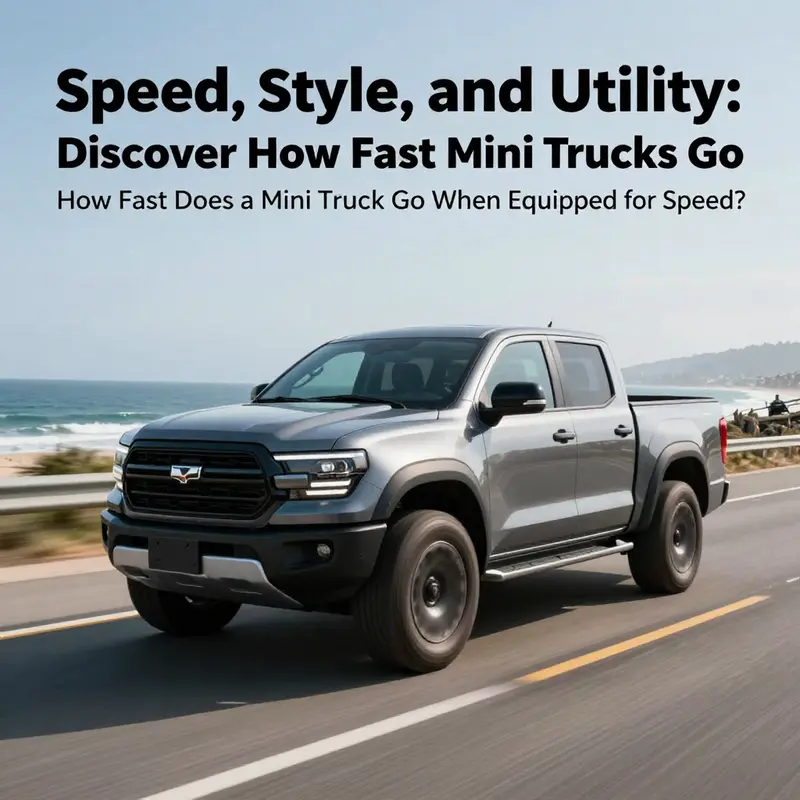
Speed in mini trucks is a balance between utility, safety, and engineering constraints. While some designs prioritize payload and efficiency, sportier variants push power-to-weight ratios higher, supported by lightweight chassis, aerodynamic tuning, and responsive drivetrains. Top speeds commonly range from modest urban cruising to higher performance aspirations, but real-world capability depends on weight, cooling, tires, and sensible gearing.
Turbocharged or high-horsepower electric drivetrains can elevate acceleration and maintain momentum on highways, yet engineers must manage heat, stability, and braking to keep the package safe and predictable under load. The result is a spectrum: everyday work trucks that shuttle goods around town, and aimed-for performance models that approach the sensation of larger pickups, all while still meeting practical constraints.
Readers should view speed as a function of harmony among power, weight, aerodynamics, and control systems, rather than a single number. The most compelling fast mini trucks deliver confident response, steady handling, and reliable stopping power, ensuring speed serves productivity rather than becomes a liability.
Speed in Motion: How Load, Design, and Duty Shape How Fast a Mini Truck Really Goes
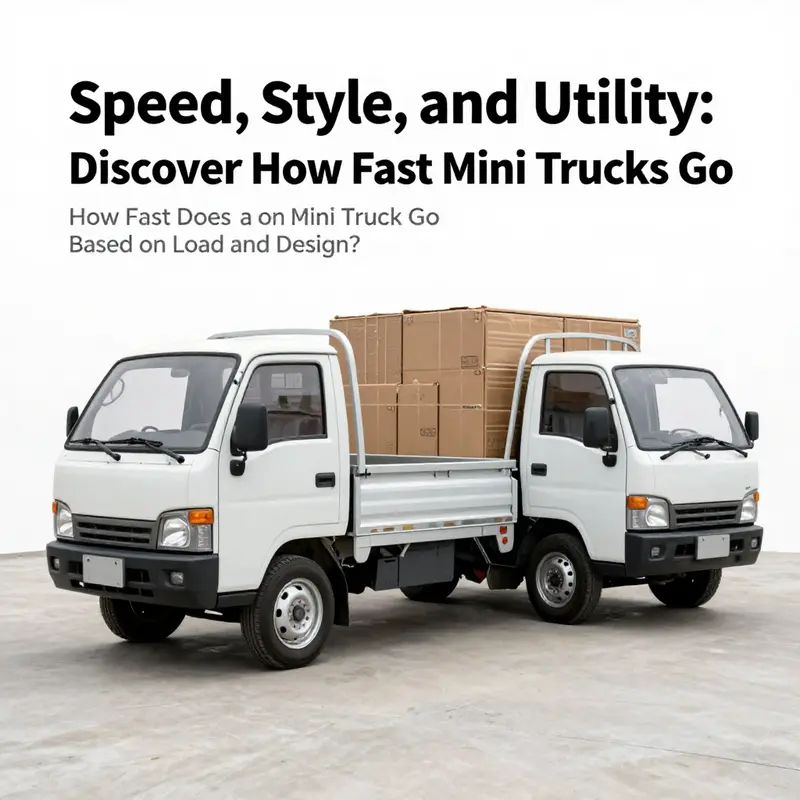
In the world of urban logistics, speed is only one part of a larger performance equation. Mini trucks are designed to carve through crowded streets while carrying payloads, and their top speed reflects a balance among power, weight, safety, and the legal framework that governs road use. The first truth is simple: there is no single number that defines how fast a mini truck can go. The category encompasses a spectrum. On the one hand, city‑oriented cargo vehicles tend to stay in the slow lane of commerce, optimized for efficient throughput and reliable braking rather than blistering acceleration. On the other hand, there are higher‑performance variants whose makers push the envelope of what a tiny chassis can handle. The result is a practical range rather than a single peak. In most everyday urban delivery models, empty vehicles hover around a top speed of roughly seventy kilometers per hour, a speed that respects the rhythm of city streets while preserving margins for stop‑and‑go traffic, pedestrians, and tight loading docks. When the truck is loaded to its usual payload, that top speed often slows to the forties or low fifties, typically in the range of forty to fifty kilometers per hour. This decline is by design: as weight climbs, rolling resistance grows and the drivetrain has to work harder to maintain acceleration. The driver’s ability to maintain momentum between stops becomes the dominant factor in delivery times, not the peak velocity on an open stretch of road. In practice, these numbers are not arbitrary. They emerge from a careful integration of power, gearing, and the physical realities of a small chassis tasked with hauling a meaningful load through urban corridors. A vehicle designed for city deliveries must provide enough propulsion to keep traffic moving at a steady pace while also delivering predictable performance when the route includes hills, ramps, or congested arterials. Efficiency and reliability often outrun the appeal of high speed, and the result is a design compromise that favors consistent operation over sensational top speeds. Yet the speed spectrum is real, and it is shaped by tangible engineering choices. When a mini truck is engineered for speed, the narrow roadways and frequent stops of urban routes become less of a constraint and more of a stage for controlled, rapid progress between points of delivery. In these scenarios, a lightweight, aerodynamically efficient body, a capable powertrain, and a drivetrain that can deliver power smoothly and predictably become the winning combination. There, top speeds can inch upward, but even then the city context remains the anchor. The driver must manage momentum with careful throttle inputs and braking to preserve tire grip, battery life, and passenger and pedestrian safety. In a typical urban‑delivery configuration, the motor arrangement and power management strategies are tuned to deliver what fleets actually need: reliable acceleration from a stop, stable cruising at moderate speeds, and a safe, controlled deceleration when approaching a corner or a loading dock. The math behind this is straightforward in principle: top speed is a function of available power, total vehicle weight, and the aerodynamic drag the body creates as it moves through air. At low speeds, power and torque are the primary levers; at higher speeds, drag becomes the dominant enemy. Each factor interacts with the others. A light, unladen mini truck benefits from lower rolling resistance and less energy required to reach higher speeds, but it cannot pretend to haul heavy payloads without constraints. Conversely, a heavier vehicle may carry more goods, yet it will reach a lower top speed due to the extra effort required to overcome the combined forces of gravity and drag. The result is a practical range rather than a single peak, with the specific numbers dependent on the exact design, motor configuration, and gearing that engineers choose for a given mission. A note about common configurations helps illuminate the picture without drifting into brand specificity. In many city‑oriented models, the powertrain is tuned for efficient, steady performance. These vehicles often utilize compact electric motors with single‑speed or limited multi‑speed transmission approaches, delivering power in a way that keeps the vehicle smooth and predictable in traffic. The emphasis tends to be on immediate response from a standing start and a measured, stable pace once the vehicle has gathered momentum. The goal is not sprinting speed but reliable delivery performance across a day’s route. When the design shifts toward higher performance, two factors commonly change in concert. First, the powertrain may be upgraded to deliver substantially more horsepower. A dual‑motor configuration, for example, can provide hundreds of horsepower, enabling top speeds that would have seemed impossible a few years ago for a vehicle of this size. A model with such a setup can push beyond typical city limits, approaching speeds well into the hundreds of miles per hour, and—more importantly for practical use—achieve rapid acceleration, with zero‑to‑sixty times that turn urban corridors into a stage for high‑speed progression between stops. The second factor is often a broader battery and cooling strategy, designed to support sustained high performance without overheating or excessive drain on range. Even here, the context matters. The same dual‑motor high‑performance system that can reach remarkable speeds will still be tempered by legal limits, road conditions, and the need to remain controllable in traffic. The result is a spectrum that ranges from ready‑for‑work city trucks to specialized machines that can accelerate with unusual alacrity in controlled settings or on open stretches where regulations permit. The role of transmission type in this equation is subtle but meaningful. A clutchless, single‑speed or dual‑speed arrangement can deliver power with minimal lag and high efficiency, which helps in sustaining steady speeds rather than chasing peak velocity. A more complex multi‑gear system can, in theory, optimize each phase of acceleration, cruising, and deceleration, but it adds mechanical weight and potential points of failure. In practice, many mini trucks favor simpler, robust transmissions that favor reliability and ease of maintenance, especially in fleets that operate across varied conditions and require predictable performance with minimal downtime. Aerodynamics, often overlooked in conversations about urban utility, becomes a quiet but persistent influence as speed climbs. A streamlined body reduces air drag, which translates into less energy lost to wind resistance and a higher effective top speed for a given power level. The clean lines, smooth underbody, and careful placement of features that might disrupt airflow all contribute to the ability to move mass more efficiently as velocity increases. While the aesthetic value of a sleek appearance is debatable in a work vehicle, the physics are not. Subtle design choices—such as a low frontal area, careful rake of the windshield, and measures to reduce drag around wheels and mirrors—collectively yield a meaningful gain in performance at the higher end of the speed spectrum. Not all mini trucks profit equally from such aero refinements, and the gains are highly sensitive to the vehicle’s weight profile and its intended duty cycle. A heavier payload can negate much of the aerodynamic advantage by adding mass that the motor must move and the brakes must control. This is where load distribution enters the conversation with practical seriousness. The weight carried by a mini truck does not simply add to the overall mass; it changes the dynamics of rolling resistance, braking effectiveness, and even steering feel. A lightly loaded truck tends to feel more nimble, with quicker acceleration and a brisker pace on open roads. As payload increases, the torque demands on the drivetrain rise, and the vehicle’s top speed tends to retreat accordingly. The distribution of that load matters as well. If weight is biased toward the rear, the vehicle’s traction and stability can change in ways that influence both cornering and the ability to maintain speed on grades. Beyond the weight, the way the load is secured and balanced affects braking and tire wear, which, in turn, indirectly affects how fast a mini truck can safely travel over a given route. In this light, speed is not merely a function of engine power and wheel torque; it emerges from an ecosystem of safety, handling, and predictability that governs day‑to‑day operation. Safety regulations and legal speed limits complete the framework that determines what speed a mini truck can legally attain. Governments define maximum speeds for different vehicle classes, and fleet operators frequently employ speed limiters to ensure compliance and reduce risk on busy roads. These constraints ensure that even when a vehicle is technically capable of higher speeds, it might never reach them on typical routes. The practical effect is that the theoretical top speed becomes a metric of interest rather than a daily reality for most urban fleets. The interplay of design choices, load, and regulation creates a tapestry of performance that is less a single line and more a landscape. A fleet operator evaluating a mini truck for city work weighs the expected payload against the required turn‑around times, the demand for consistent acceleration, the reliability of the powertrain under varied weather and road conditions, and the charging infrastructure that enables sustained operation. For an empty vehicle intended for city deliveries, reaching around 70 km/h in bursts may be feasible, while maintaining control, stability, and smoothness in traffic. As soon as a typical payload is introduced, the acceleration and cruising performance shift toward lower speeds, and the vehicle’s behavior is guided by the need to protect cargo, ensure safe deceleration, and keep energy consumption in sensible bounds. It is here that a balance is found: the vehicle’s top speed is not a showpiece but a parameter that, together with range, payload, and reliability, defines the day’s efficiency. When a machine is designed with performance in mind, the numbers shift, but the context does not disappear. A dual‑motor, high‑power variant may deliver top speeds in the vicinity of one hundred miles per hour or more under ideal conditions, and some models claim speeds approaching two hundred kilometers per hour. Yet such performance is rarely tested in real‑world urban operations, where legal limits, road geometry, traffic density, and the need for decisive, repeatable braking patterns dominate. The takeaway is not that one must choose between speed and practicality, but that both are permissible within a broader design philosophy. The same vehicle may be tuned to prioritize efficient urban delivery on a routine route, or for a rare high‑speed demonstration in a controlled environment, without losing sight of the daily demands of a fleet. If readers wish to explore how these design choices translate into real results, the broader conversation within the mini‑truck community provides a nuanced view of what is possible and what trade‑offs are prudent in practice. For more context on industry discussions around mini‑truck capabilities and performance, you can visit the Minitrucks Cola blog. This resource offers insights into how different designs, powertrains, and configurations perform in the field and how fleets navigate the tension between speed, payload, and efficiency. As with any specialized vehicle category, the takeaway is that the answer to how fast a mini truck goes depends on the exact model, the mission profile, and the constraints imposed by safety and the road network. To gain a more rounded sense of the performance envelope, consider the spectrum—from city‑oriented, empty‑state speeds around seventy kilometers per hour to loaded scenarios that settle into the forties or fifties, to rare, high‑performance configurations capable of much higher top speeds under controlled conditions. The lesson is practical and clear: speed is a piece of a larger performance picture, and the best choice for a given operation is the configuration that harmonizes power, payload, reliability, and regulatory compliance to deliver predictable, safe, and efficient service. For readers seeking a regulatory lens on how power, speed, and performance are framed in policy terms, see the UK Department for Transport guide on vehicle types and their performance for a broader context of how these numbers are interpreted in practice: https://www.gov.uk/government/publications/vehicle-types-and-their-performance.
Speed in the City Lane: How Mini Trucks Measure Up Against Conventional Haulers
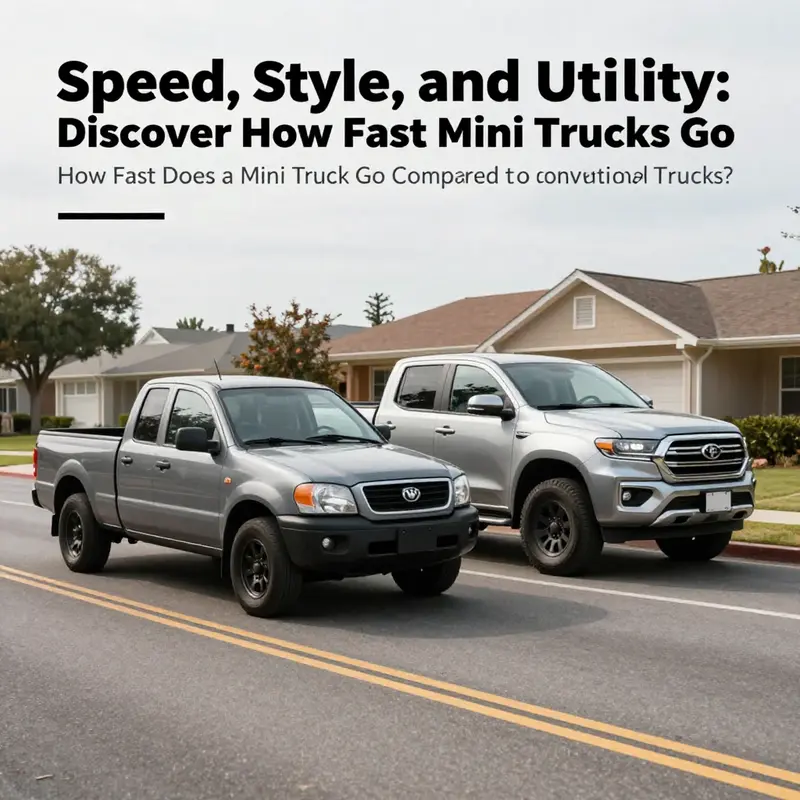
Across the spectrum of freight and urban logistics, the speed of a vehicle is more than a number on a spec sheet. It signals how quickly a route can be completed, how safely a load can be moved through congested streets, and how a fleet’s capacity is translated into real-world performance. Mini trucks—compact, often electric, and engineered for city streets and light-duty tasks—present a distinctive philosophy of speed. They are not simply scaled-down versions of their bigger counterparts; they are purpose-built tools designed to maximize maneuverability, energy efficiency, and predictable handling within the constraints of urban infrastructure. When we ask how fast a mini truck goes, we are really asking about the trade-offs between cargo capability, regulatory limits, powertrain architecture, and the everyday realities of city driving. In this sense, speed becomes a narrative about functionality as much as horsepower.
The most common range for the speed of standard mini trucks is not a single fixed figure but a band that reflects design intent, powertrain choice, and how the vehicle is meant to operate. In many urban delivery applications, these vehicles operate around 60 to 70 kilometers per hour when empty. This range corresponds to models built for efficiency and city duty cycles, where faster highway speeds would not only consume more energy but also raise safety concerns in dense traffic. When a cargo load is added, particularly a heavier one approaching the upper limits of a light-duty mini truck’s rating, the top speed typically decreases. A loaded vehicle must negotiate torque distribution, braking effectiveness, and aerodynamic changes with the same energy that pushes it forward when empty. In practice, that means 40 to 50 kilometers per hour becomes a common ceiling on the heaviest urban loads. These numbers reflect a careful balance: they keep acceleration steady enough to avoid startling delivery routes, maintain predictable braking behavior, and preserve battery life in electric configurations. Even as cities push for zero-emission fleets, the speed of these vehicles remains a deliberate design choice aimed at reliability and safety rather than outright velocity.
Yet the landscape of mini trucks is not monolithic. There are higher-performance variants that challenge the conventional wisdom of a “city-speed” profile. Some newer, more specialized models boast significantly greater power, with electric motors mounted in tandem to provide rapid torque delivery and higher top speeds. In a few engineered examples, top speeds can exceed what many would expect from a city-focused cargo vehicle. A dual-motor setup with substantial horsepower can push a mini truck into the realm of highway speeds, and in some cases even beyond the 100-kilometer-per-hour mark. It is important to recognize, however, that these high-speed configurations are not typical for everyday urban logistics. They are engineered for niche applications—where time-sensitive deliveries, light interstate movement, or regulated test environments justify the extra performance—and often come with trade-offs in energy consumption, thermal management, and ride dynamics that are not ideal for constant city operation.
To ground this in practical terms, consider the spread between ordinary, everyday mini trucks and their high-performance cousins. A well-documented segment of standard models tends to cap at around 60 to 70 kilometers per hour when empty, with rapid speed reductions when loaded. The numbers reflect regulatory and safety considerations common to low-speed electric vehicles used in urban settings, where the goal is to maximize energy efficiency, minimize noise, and maintain maneuverability in stop-and-go traffic. A few examples surfaced in industry notes and recent listings, illustrating how the same general category can display different performance envelopes depending on design priorities. One model noted as a 130-km low-speed electric double-cabin pickup demonstrates a much more conservative top speed of 60 kilometers per hour, underscoring the insistence on safety and control. Another double-cabin electric pickup shares the same cap. These references are instructive because they show how a vehicle can be tailored to an urban footprint while still delivering adequate payload capacity.
On the other end of the spectrum, discussions of high-speed variants reveal a different set of engineering challenges. A model that has been highlighted in early- and mid-2020s discourse shows top-end performance around 90 kilometers per hour, a level approaching conventional light trucks in highway segments, albeit with markedly lighter curb weight and smaller power demands. It is this duality—cities seeking clean, nimble solutions contrasted with a smaller subset of models pushing toward highway speeds—that defines the modern mini-truck category. The practical upshot for fleet managers and drivers alike is clear: for most urban and near-urban tasks, the speed ceiling is a carefully calibrated mix of efficiency, safety, and regulatory compliance. For specialized operations, there are rare, higher-performance exceptions, but they do not redefine the everyday use case of mini trucks in city logistics.
If we expand the lens to the broader context of conventional trucks, the comparison becomes more textured. Conventional trucks—diesel-powered, heavy-duty, and designed for long-haul reliability—are built with an emphasis on endurance and sustained highway performance. Those vehicles routinely exceed 100 kilometers per hour on open interstates and spend long hours cruising at higher speeds to move freight efficiently across regional and national corridors. The top speeds of these trucks reflect a different engineering philosophy: ballast and traction needed to propel heavy loads across long distances, rear-axle configurations tailored to highway stability, and the cooling and fuel systems tuned for extended ranges. In short, conventional trucks are designed for highway dominance, where speed, weight, and fuel economy converge to support large-scale freight distribution.
This contrast matters for anyone assessing the practical implications of speed in the supply chain. Mini trucks excel in energy efficiency, ease of parking, and fast turnarounds within dense urban cores. They are the workhorses of last-mile delivery, campus logistics, and small-business fleets that must weave through crowded streets, load parcels, and exit quickly without compromising safety. Their speed reflects these priorities: predictable acceleration, stable braking, and the ability to navigate traffic with a smaller silhouette. Conventional trucks, by contrast, are optimized for distance, payload, and highway agility over longer routes. Their higher potential top speeds are complemented by larger fuel tanks or battery packs, more robust cooling, and suspension systems designed to carry heavy weights and maintain stability at speed over varying road conditions.
The interplay of speed with payload and energy management is a central theme in the mini-truck narrative. When the vehicle is empty, it can exploit the higher end of its speed range more readily, especially if the powertrain is designed to deliver quick, linear torque. As the load increases, the speed envelope compresses and the driver may observe slower acceleration and a lower top speed. This behavior is not merely a consequence of horsepower; it is the product of how weight, drag, and battery or fuel dynamics interact under real-world conditions. Aerodynamics, even in compact form, plays a meaningful role. A compact body with a low center of gravity, smooth underbody surfaces, and carefully tuned wheel arches reduces drag and helps sustain efficient speeds at modest highway ranges. These features, while important, are often overshadowed by the vehicle’s core mission: to deliver cargo in urban and adjacent urban areas with safety and efficiency as constants, not merely speed as a selling point.
For readers who want a more concrete sense of model-to-model variation, it is useful to acknowledge the spectrum of configurations that exist within the mini-truck category. Some models emphasize urban delivery efficiency and mass-market practicality, with powertrains calibrated for consistent, moderate speed and reliable torque at low RPMs. Others push the limits of what a mini truck can do, trading some of the urban-safety margin for enhanced acceleration, higher top-end speed, and improved offload flexibility. This second group is where the line between a “mini truck” and a high-performance light-duty pickup becomes thin. In practice, fleets choose based on local road conditions, regulatory constraints, and the typical distance of daily operations. If a route seldom requires sustained highway cruising, there is little incentive to stretch the top speed of a mini truck beyond what is necessary for safe passage on rural connectors or fast-moving arterial streets. If a fleet’s service area includes longer urban-to-suburban legs, higher-end models may offer meaningful time savings, but at the cost of energy efficiency and increased maintenance complexity.
From a fleet-management perspective, these speed dynamics translate into scheduling, maintenance planning, and total cost of ownership. Energy use per mile is a central driver of operating costs, and faster speeds typically consume more energy, especially in electric variants where regenerative braking and battery health become critical. The decision matrix thus includes not only the raw top speed but also how quickly a vehicle can recover energy, how it behaves under partial loads, and how its powertrain responds to repeated starts and stops in a city environment. It’s not enough to list a top speed; managers weigh acceleration profiles, regenerative-braking efficiency, thermal management under urban duty cycles, and the potential for duty-cycle optimization—where the vehicle spends most of its operation in lower-speed, high-stop contexts, and only occasionally reaches higher speeds on specific legs.
To connect these threads to model-specific performance, a useful touchstone is the way manufacturers and dealers present their price-performance trade-offs. In the most common city-delivery configurations, a top speed around 60 to 70 kilometers per hour strikes a balance between urban dynamism and safety. A loaded state nudges that target downward to maintain driveability and controllable power delivery. On the other end of the spectrum, a rarer subset of high-performance mini trucks demonstrates that the envelope can be expanded under the right conditions; these variants emphasize acceleration and peak speed while acknowledging the higher energy demands and possible regulatory considerations that accompany such capability. The reality remains that the majority of urban-focused mini trucks are designed to thrive where quick, predictable transport of goods over short distances matters more than highway dominance. This design intent aligns with how city planners, fleet operators, and customers value reliability, safety, and steady service over sheer velocity.
For readers who want a closer look at how specific mini truck models stack up, consider exploring the Kingstar Kruzr model specs and features, which offer a concrete window into how different engineering choices translate into real-world performance. This internal reference can illuminate how one model’s approach to torque delivery, gearing, and battery management compares with another, providing a practical lens for assessing speed alongside payload and efficiency. The balance between speed and utility is rarely a simple matter of raw horsepower; it’s a nuanced equation that blends traction, control, weight distribution, and thermal behavior under typical daily workloads.
The broader takeaway is that speed in the mini-truck category is not a standalone metric but part of an integrated design philosophy. For urban operators, speed matters mainly as a facilitator of on-time deliveries and smoother traffic interactions. It supports predictable route planning, reduces dwell time at stops, and helps maintain service levels in dense networks. For long-haul replacements or mixed fleets that occasionally contend with highway traffic, a subset of higher-performance mini trucks can extend the utility of the category, but with caveats about energy efficiency, maintenance costs, and regulatory compliance.
As we compare mini trucks to conventional trucks, the essential distinction becomes clear: conventional trucks maximize highway speed and long-distance efficiency, trading off the compact footprint, nimble handling, and lower energy demands that define the mini truck class. The question then shifts from “how fast do mini trucks go?” to “how fast do mini trucks need to go to meet their intended duties, and what does that imply for the broader logistics ecosystem?” When framed this way, speed emerges as part of a system—one that includes route structures, urban design, fleet composition, and the evolving policy landscape around electric vehicles, safety standards, and emissions targets. In practice, the speed of a mini truck is best understood not as a single number but as a function of context: the job at hand, the road ahead, and the balance between speed, efficiency, and control that a fleet chooses for its operations.
External context from broader truck literature reinforces this view. While conventional trucks claim highway performance as their strongest suit, mini trucks carve out strategic advantages in areas where city streets and short-haul tasks define the day. For further perspective on these dynamics and to situate mini trucks within the global freight ecosystem, readers may consult established sources that examine how heavy-duty transport markets balance speed, payload, and route complexity. External reference: https://www.china-truck.com
Final thoughts
With their increasing popularity, mini trucks present unique advantages in speed and versatility. Standard mini trucks excel in urban environments, while high-performance models reimagine these vehicles for speedy adventures. Understanding the factors that influence their speed allows local small business owners and enthusiasts alike to make informed choices about their next vehicle. Whether you need efficiency for deliveries or desire thrills on the highway, mini trucks offer diverse options tailored to your needs.