

Mini trucks have become a popular choice for small business owners, residential property owners, and hobbyists alike. Understanding how much these versatile vehicles weigh is crucial for various reasons—be it for choosing the right model for your needs, understanding different regulations, or even ensuring you have the right vehicle for urban delivery. In the sections that follow, we’ll explore the weight of light commercial mini trucks designed for urban delivery, compare electric mini trucks with traditional models, and provide a comparative analysis of different mini truck variants. Together, these insights will equip you with the foundation you need to choose the best mini truck for your endeavors.
Wheels of Weight: Navigating Mass, Size, and Payload in Light Commercial Mini Trucks for City Delivery

In the tight arteries of modern cities, weight is more than a number on a spec sheet. It governs what a vehicle can carry, where it can operate, and how efficiently it can move through traffic, park in crowded lots, or fit into loading bays. For operators focused on urban delivery, weight is a daily calculus. It shapes not only the choice of a truck but also the economics of every route, every stop, and every hour spent idling at a curb. To understand how much a mini truck weighs is to peek into the tradeoffs that define city logistics: the balance between maneuverability, payload, and powertrain efficiency, all tuned to the constraints of the urban landscape.
At the heart of this discussion is a simple trio of terms that every buyer eventually grapples with: curb weight, payload, and the gross vehicle weight rating, or GVWR. Curb weight is the vehicle’s mass when it is empty, with all standard equipment, but without a payload. Payload is the maximum weight the vehicle can carry in its cargo box and any additional gear. GVWR is the limit of the vehicle’s total mass when fully loaded, including passengers and cargo. In practice, the light commercial mini trucks designed for city work sit on a delicate edge. They must be light enough to squeeze through narrow lanes and tight parking, yet robust enough to haul the daily freight that keeps shop doors open and deliveries moving. Different markets enforce different weight limits, and those limits ripple through every other design decision.
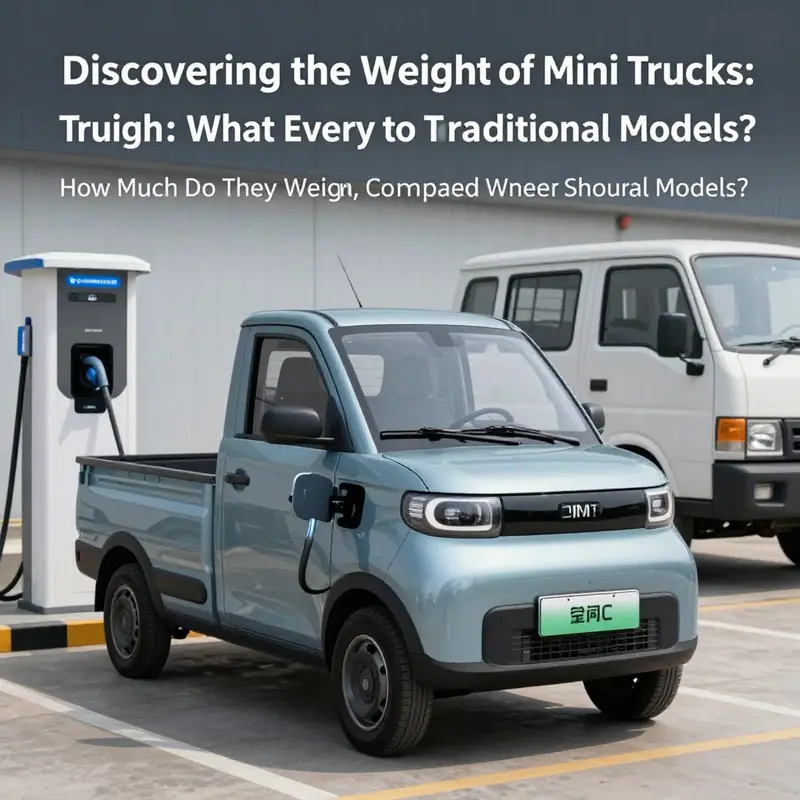
The range you’ll encounter in real-world discussions starts with the basic fact that these urban-oriented mini trucks can be quite varied in weight. Empty, or curb weight, often falls somewhere between 800 kilograms and about 1,300 kilograms depending on the chassis, the frame, and the powertrain choice. The lighter end of the spectrum is common among battery-powered variants that emphasize compact dimensions and city visibility. The heavier end is typical of diesel- or petrol-powered configurations that prioritize potency and luggage or tool storage capacity, sometimes at the cost of additional mass in the frame and drivetrain. The battery packs in electric models are a principal reason some variants carry more mass than their internal-combustion peers. A compact electric micro-truck may weigh a total mass closer to 1,200 kilograms when you include the battery and payload, underscoring how electrification shifts the scale even before you add cargo.
When we talk about the total mass of a mini truck for urban delivery, we’re looking at a broader spectrum. Representative discussions place the total mass, meaning the vehicle’s own mass plus its maximum payload, in a range around 1.7 tons up to roughly 2.5 tons. In plain terms, that means a compact unit designed for city work can be asked to move 1,700 kilograms or more when fully loaded. An electric micro truck that delivers light cargo might be tuned to a total mass of about 1.7 tons, with a practical payload around 720 kilograms, allowing it to carry a significant quantity of goods without straining its urban role. In other cases, some models are engineered to carry far heavier payloads, approaching nearly 2,000 kilograms, while still maintaining compact dimensions that keep urban maneuverability intact. This kind of design demonstrates that mini trucks can be purpose-built for distinctive urban tasks: some require quick acceleration and easy parking, while others need to haul sizeable loads through congested corridors.
The footprint of these vehicles further reinforces their urban utility. Drive-by in a crowded city block and you’ll notice how compact they stay while extending enough length to provide useful cargo space. Design parameters such as length, width, and height are tuned to enable efficient navigation through narrow streets and to fit into standard loading zones. A typical long-body configuration pushes toward roughly 2,950 millimeters in length, while a shorter option hovers around 2,400 millimeters. Widths around 1,200 millimeters and heights near 1,600 millimeters contribute to a package that is comfortable to handle within crowded spaces yet capable of swallowing a meaningful load. Those dimensions are not arbitrary; they reflect a deliberate choice to preserve turning radius, clearance under overhangs, and access to underutilized urban parking structures where larger trucks would fear to tread.
Behind the numbers lies a set of design trade-offs that are easy to miss in a catalog listing. For urban delivery, every extra kilogram of mass requires more energy to move, more braking capacity, and a larger footprint for parking and charging or fueling. In electric variants, the battery pack adds substantial mass but also unlocks clean, quiet operation and a lower tailpipe footprint. The heavier the vehicle, the more attention the designer pays to energy density, regenerative braking efficiency, and overall road dynamics to keep handling predictable as payload shifts from stop to stop. For light-duty diesel- or gasoline-driven versions, the mass tends to be anchored by more traditional powertrains, with emphasis placed on payload value against fuel economy and reliability. In essence, the weight story of a mini truck is a story about the needs of urban logistics: how to maximize payload while preserving the nimbleness that cities demand, how to balance charge or refuel cycles with service life, and how to ensure that the chassis architecture can stand up to daily wear in dense traffic.
Regulatory frameworks sit at the outer edge of this discussion, shaping what is feasible in any given market. In some jurisdictions, the concept of weight is tightly bounded by a relatively low GVWR—often around 1,000 kilograms—so manufacturers design to stay within that cap and still deliver a usable payload. In others, the same class of mini trucks operates under more permissive rules that allow higher total masses. The result is a spectrum: on one end, lightweight models optimized for short city runs with modest payloads and easy access; on the other, compact yet heavier-duty configurations that can move significant freight while still fitting into urban corridors. Those regulatory differences matter in practice. They influence everything from insurance costs and licensing requirements to curb access and parking restrictions. Buyers who only skim a spec sheet may miss how a seemingly minor shift in GVWR can cascade into the daily economics of urban delivery, altering driver routes, charging schedules, and the cadence of returns.
A closer look at the weight-payload pairing reveals even richer nuance. Consider a scenario where an electric mini truck carries a modest payload near 720 kilograms. With a total mass of about 1.7 tons, the payload fraction—payload divided by total mass—lands around the low forties in percent terms. That is a healthy share for a city-focused vehicle: enough cargo to make a route efficient while keeping the mass light enough to retain brisk acceleration, nimble cornering, and a manageable turning radius. On the other hand, a diesel- or gasoline-powered model that can push payload toward the upper end of the range shows that the total mass can approach or exceed two and a half tons in some designs. In those cases, the vehicle still remains compact, but the added mass shifts the performance envelope: takeoff and hill climbs demand more engine work, braking systems must be robust, and the suspension is tuned to tolerate heavier loads without sacrificing ride quality for the driver. The upshot is that each configuration carves out a distinct niche in urban logistics: lighter, easier-to-park units optimized for high-frequency stops and smaller loads; heavier, higher-capacity variants better suited to longer routes or routes with more frequent backhauls.
The numbers tell a story, but the story is also written in measurements. The fact that many compact urban trucks can offer long body configurations—up to nearly three meters in length—while staying just over a meter wide and around a meter and a half tall is more than a geometric curiosity. It is a deliberate packaging choice. Such dimensions maximize cargo capacity without surrendering the turning circle that makes a small vehicle seem almost invisible in a crowded street. In practical terms, this means a city operator can realize meaningful freight throughput on a single route with a vehicle that still fits within the tight confines of loading docks and curbside space. It also drops into a crucial planning equation: you can thus stage more frequent, smaller deliveries with less downtime and fewer return trips, or you can scale up a bit, accept a higher total mass, and still keep the route feasible given the city’s physical constraints.
As these weight and size considerations converge, the market narrative around urban delivery begins to shift toward electrification as a core enabler of city logistics efficiency. Electrified mini trucks, because of their battery packs, bring higher mass but often deliver quieter operation, lower local emissions, and favorable operating costs per kilometer. Yet the extra mass can complicate charging logistics. More mass means more energy is required to recharge after a typical urban shift, which in turn makes the placement of charging infrastructure and the cadence of top-ups critical to maintaining high vehicle availability on busy routes. The trade-off is not a simple equation of “more mass equals more capability.” It is a more layered calculus: does the payload gain justify the added weight and charge time when the vehicle must return to service quickly? Do the city’s charging options and electricity costs align with the planned utilization? These are the sort of questions that frame the decision for operators who run frequent urban deployments and need to optimize for throughput and uptime as much as for payload.
From a buyer’s perspective, this weight-aware lens reshapes the evaluation process. It invites a careful calculation of daily freight patterns: how many stops, how heavy is the average load, and how long will the vehicle be active before needing to recharge or refuel? It also prompts price-to-performance considerations. Lower curb weight with modest payload may be ideal for dense city cores but could require more trips to complete the same daily work. Conversely, a heavier, higher-payload configuration might reduce the number of trips but demand a longer charging window or more fuel, depending on the powertrain. The goal is to align the vehicle’s mass properties with the route profile, the city’s regulatory environment, and the business’s financial model. In practice, that means thinking hard about the cadence of deliveries, the typical cargo mix, and the available parking and charging options on the operator’s core corridors.
For readers seeking a broader sense of how these choices play out in real-world markets, a steady starting point is the industry conversation that situates mini trucks within the urban delivery ecosystem and links to ongoing discussions on the subject. A reliable entry point to this wider dialogue is the dedicated blog space that hosts insights, case studies, and practical considerations for owners and operators exploring lightweight, city-focused trucking options. You can explore more about these discussions at minitrucksocala blog—https://minitrucksocala.com/blog.
In sum, weight, payload, and size are not merely static numbers. They are live levers that shape the daily economics of urban delivery. The lightest end of the spectrum provides nimble maneuverability and frequent, small deliveries, paired with a cost structure that favors quick turnarounds. The heavier end expands payload capacity and route flexibility, at the cost of added mass and more careful planning around charging or refueling. Between these poles lies a spectrum of choices, each designed to meet different city priorities: tighter streets, parking constraints, traffic density, and the energy logistics of keeping fleets moving through a modern urban day. The most successful urban delivery programs treat weight as a strategic asset—an instrument that, when tuned to the city’s rhythm, can unlock consistent service, predictable costs, and a competitive edge in crowded markets.
External resources add texture to this discussion, reminding readers that market offerings and pricing evolve with technology, policy, and demand. For those exploring a broader set of wholesale or consumer considerations, online platforms and marketplaces present a window into current configurations and price ranges. A useful reference point for further reading and broader context is Alibaba, an external resource frequently cited in market overviews of urban freight solutions: https://www.alibaba.com
null
null
The Weight of Small Workhorses: How Mini Trucks Really Stack Up Across Variants
When people ask how much a mini truck weighs, they often picture a compact pallet-toting vehicle with a modest engine. In truth, the weight of these small workhorses is a nuanced story. It is not a single number but a spectrum shaped by design philosophy, powertrain choice, payload goals, and regulatory boundaries. To understand what those numbers mean in everyday use, it helps to move beyond empty chassis figures and consider how weight interacts with payload, handling, efficiency, and the tasks the vehicle is meant to perform. The simplest baseline is the curb weight—the empty vehicle—because it establishes the starting balance between the frame, the drivetrain, and the cabin. Yet in the world of mini trucks, curb weight is only half the equation. The other half is the payload—the mass the vehicle is designed to carry and still operate safely within its gross vehicle weight rating. These two numbers together determine the total mass a mini truck can manage on a typical job without breaching regulatory or mechanical limits. The way these weights are distributed also matters. A heavier chassis may improve durability and payload capacity, but it can also affect braking distance, acceleration, and fuel economy. Conversely, a lighter base with a heavy battery or a robust cargo box can introduce different handling characteristics. All of this underscores a central truth: a mini truck’s weight is best understood as a relationship, not a fixed attribute. It shifts with the vehicle’s intended role, the technology it employs, and the regulatory environment in which it operates.
For learners new to the topic, a convenient way to frame the conversation is to think in three broad categories: light commercial kei-style trucks, electric mini trucks designed for urban logistics, and compact diesel or petrol models that emphasize payload. Each has its own logic for weight budgeting, and each reveals why the same general class of vehicle can weigh quite differently from model to model. Kei-style trucks, for instance, are built to fulfill a regulatory niche that caps weight to keep them nimble and affordable in crowded urban settings. In this category, the maximum gross vehicle weight is often limited to around 1,000 kilograms (about 2,205 pounds). That cap isn’t just bureaucratic trivia; it shapes the entire engineering approach, from the size of the frame to the capacity of the engine and how much cargo can be carried without tipping the balance toward a heavier, more cumbersome machine. The empty or curb weight for these compact urban runners typically lands in the 800 to 1,000 kilogram range, or roughly 1,764 to 2,205 pounds. That means a lot of the life inside these machines is focused on making the most of limited mass—using compact dimensions, tight wheelbases, and efficient powertrains to maximize usable space and maneuverability while staying within the legal envelope.
Electric mini trucks, by comparison, bring a different set of mass considerations. Battery packs, energy storage, and electrical systems add significant heft, which tends to push the total vehicle mass higher than a comparable internal-combustion design. In practice, a long-range electric mini truck designed for urban deliveries and capable of carrying around a 1,000-kilogram payload may have a total mass that remains under a few thousand kilograms, but the exact figure isn’t always stated outright by every manufacturer. The key point is that the battery pack’s contribution to mass is non-negligible. It can make the electric variant heavier than its diesel counterparts even when the payload and wheelbase might be similar. Yet the trade-off is zero emissions and often smoother, quieter operation in city settings—a combination that makes the weight penalty worthwhile for certain fleets and routes.
Small diesel or petrol-powered mini trucks tend to sit between the kei-class baseline and the heavier specialized cargo machines. Without diving into specific brand names, the curb weight for these compact combustion-engine models typically falls in the 1,150 to 1,300 kilogram range (roughly 2,535 to 2,866 pounds). This heavier starting point reflects a sturdier frame, a more substantial powertrain, and often a chassis designed to carry heavier loads on a daily basis. In many cases, these vehicles are chosen for their balance between cargo capacity and road readiness, where the weight budget is allocated to a robust undercarriage and dependable mechanicals rather than ultra-light efficiency. The consequence is a broader spectrum of total mass when these trucks are loaded—an important reminder that “mini” does not imply a uniform mass profile.
A concise way to summarize the practical reality is to recognize that the weight of a mini truck generally spans from roughly 800 kilograms (about 1,764 pounds) in the lightest kei-style configurations, up to about 1,300 kilograms (approximately 2,866 pounds) in the heavier combustion-engine variants. But those numbers describe only the baseline. Once payload is added, total vehicle mass rises accordingly, and the exact total depends on the powertrain architecture, the design of the cargo area, and any add-ons that fleets might select to tailor the vehicle to a specific task. In other words, weigh a mini truck not by the size of its engine alone but by how its designers balance weight, strength, and capability to fulfill a particular job.
Diving into the comparative landscape clarifies the practical implications of weight differences. For electric mini trucks designed for cargo and utility, the mass is infused with the battery’s energy buffer. Even though the payload capacity might be listed at around 1,000 kilograms, the actual total weight is not always explicitly published by every producer. Yet industry logic suggests the total vehicle mass will be under the 3,000-kilogram mark in most standard configurations. That upper boundary aligns with the intent of urban-friendly electric light trucks: sufficient mass to stabilize the vehicle with a heavy battery and provide a reasonable payload, while staying light enough to maneuver easily in city streets and conserve energy. The zero-emission benefit of the electric configuration is part of the value proposition, yet it comes with a mass-related caveat: the heavier the vehicle (due to battery packs), the more attention is needed to dynamic braking and tire selection, especially when it is fully loaded.
On the other side of the spectrum sits the mini van box cargo truck in the diesel or petrol cohort. This variant typically emphasizes a high payload capacity—often around 3,000 kilograms (3 metric tons). The mass of the vehicle itself is likely higher than the electric variant’s, reflecting a heavier chassis and more substantial drivetrain. A 4×2 drive configuration remains a common baseline for many of these cargo-focused mini trucks, which prioritizes payload and reliability over off-road capability or complex all-wheel-drive systems. In practice, this combination translates to a vehicle that can haul substantial mass within Europe’s or other regions’ urban freight corridors, but with a heavier curb weight to match the stiffened body and box construction.
To illustrate the breadth of how weight scales with purpose, imagine a heavy-duty example that sits far outside the usual mini truck category. A six-axle fire-fighting truck, though not a mini in any sense, demonstrates the upper extreme of the weight spectrum—often exceeding 44 tonnes (about 97,000 pounds). This stark contrast is not a counterexample so much as a reminder that the term mini truck covers a wide family, from nimble city carriers to compact, high-capacity workhorses, and then far beyond if the task demands specialized equipment. The takeaway is not that a mini truck should be heavy like a fire engine, but that the weight range is a practical reflection of the job it is designed to do. The design goal is to optimize weight relative to payload, braking performance, and durability while staying within regulatory limits.
With these realities in mind, the general guideline that emerges is this: a mini truck’s weight is primarily a function of two levers—its drive system and its payload capacity. The electric variants lean heavier than their petrol counterparts because of the battery, yet they offer the benefit of quiet operation and lower local emissions for urban routes. The diesel or petrol mini trucks tend to start heavier at curb weight but can be paired with very substantial payloads, which makes them a compelling choice for fleets chasing volume and rugged chassis. The kei-class models sit at the lower end of the spectrum by design, trading off some payload flexibility for ultra-compact dimensions and compliance with weight caps.
All of this points to a practical consideration for anyone shopping for a mini truck: weight should be evaluated alongside payload. The numbers are not just about how much exists in the chassis; they signal how much mass the vehicle can carry before performance and safety margins begin to feel stretched. The balance between curb weight and payload dictates how the vehicle will behave on grades, in stop-and-go traffic, and when fully loaded. It also informs decisions about tire selection, braking systems, suspension tuning, and even the kinds of roads the vehicle will be asked to traverse. In urban delivery, for instance, a lighter base with a carefully chosen battery pack might offer superior efficiency and handling when the payload is modest. In contrast, a heavier chassis designed to tolerate frequent full payloads can reduce stress on components when carrying dense goods.
For readers who want to see a side-by-side sense of how variants differ in practice, a deeper look at model comparisons can be helpful. A practical resource that lays out the contrasts among variants and their specs is a dedicated model comparison page that explores the differences in weight, payload, and driveline across several configurations. This resource provides a grounded sense of how a lighter electric setup contrasts with a heavier diesel box truck in real-world terms, including considerations of drive configuration and chassis design. You can explore that comparison here: Kingstar Kruzr models specs and features.
From a fleet planning perspective, the picture becomes even clearer when you examine how weight interacts with duty cycles and routing. A typical urban delivery route demands repeated starts and stops, frequent braking, and predictable acceleration. In such a setting, a lighter base with an efficient motor can offer meaningful energy savings, provided the payload mass remains within the vehicle’s stability envelope. Conversely, when the job requires carrying heavy loads over longer distances, a more robust platform with a higher curb weight may deliver better lifetime reliability, even if it means a small hit to immediate energy efficiency. The trade-offs become a matter of programming: how many kilograms of payload per kilometer, per recharge, can be maintained without compromising safety or service levels? These are not abstract questions; they are the day-to-day calculus fleets perform when choosing the right tool for the task.
In the broader context of vehicle weights and classifications, it can be helpful to situate mini trucks within larger weight categories and regulatory environments. The kei truck segment exists partly because some jurisdictions cap the vehicle’s gross weight to around 1,000 kilograms, a constraint designed to keep small vehicles affordable and agile. This cap shapes not only the size and powertrain but also how manufacturers approach safety features, braking capabilities, and cargo area design. It is worth noting that the specific figures cited in research and product literature are sometimes presented as curb weight, gross vehicle weight rating, or payload capacity, and those labels can shift slightly from market to market. As a result, when weighing a mini truck for a particular application, it is essential to clearly distinguish curb weight from gross weight and to understand the payload they are meant to support. For a broader context on how these classes sit within the wider landscape of compact vehicles, external resources on kei concepts and classification offer helpful background (e.g., https://en.wikipedia.org/wiki/Kei_car).
The weight story of mini trucks, then, is not a fixed arithmetic problem but a design conversation about how much mass is useful and manageable for the tasks ahead. The electric variants lean to higher total mass because of batteries, yet they reward users with emissions-free operation and a different torque profile that can improve urban delivery performance. The diesel and petrol variants emphasize payload capacity and robust chassis, trading some efficiency for the ability to haul heavier items on a predictable cadence. Kei-class models stay nimble and compliant, prioritizing maneuverability and cost effectiveness over heavy payloads. When people consider a mini truck for a specific job, the best-fit choice often hinges on how well weight is allocated to balance payload, performance, and regulatory comfort across the typical routes the vehicle will travel.
To round out the discussion, it is useful to anchor these generalities in practical numbers that one might encounter in a spec sheet or a fleet brief. The weight range most commonly observed across the mini truck family sits roughly between 800 kilograms on the lightest kei configurations and about 1,300 kilograms for many compact diesel/petrol variants. Payload capacities push beyond those figures, with electric variants often targeting around 1,000 kilograms, while larger cargo-oriented mini trucks can claim payloads near 3,000 kilograms. The gap between these capacities underscores a critical point: the total vehicle mass is not simply a matter of how powerful the engine is but how the design accommodates the intended cargo and the operational environment. Even though a fire-fighting example is far from typical, it serves as a cautionary reminder that there are contexts where mass scales dramatically upward due to required equipment, safety margins, and the sheer size of the mission. For readers who want a concise reference, the table of variants in the detailed research results you provided earlier illustrates these patterns clearly—the electric variant with 1,000 kg payload sits on a light-to-midweight chassis, the diesel/petrol mini van box box truck can haul heavy payloads on a heavier frame, and the ergonomic extremes of specialized duties demonstrate the width of the spectrum.
Ultimately, the weight of a mini truck is more than a number on a spec sheet. It is a calculated balance that informs handling, efficiency, safety, and the ability to deliver on a given mission. For urban fleets, where every kilogram translates into energy use and maneuverability, weight becomes a central consideration in route planning and vehicle selection. For operations that require consistent, high-volume payloads, weight is the practical constraint that drives chassis choice and powertrain strategy. And in markets that prize compact form factors with strict regulatory caps, weight awareness is not optional—it is essential to staying within the legal and practical boundaries that make mini trucks the versatile, economical tools they are today.
External reference for broader context on weight classes and kei concepts: https://en.wikipedia.org/wiki/Kei_car
Final thoughts
Understanding how much a mini truck weighs is essential for owners considering urban transportation solutions. By comparing light commercial options, electric models, and various weight ranges, owners can make informed decisions about which vehicle best suits their operational needs. Whether you’re a small business owner looking to optimize delivery routes or a hobbyist exploring new vehicles, knowing the weight specifics can help you make the right choice.