
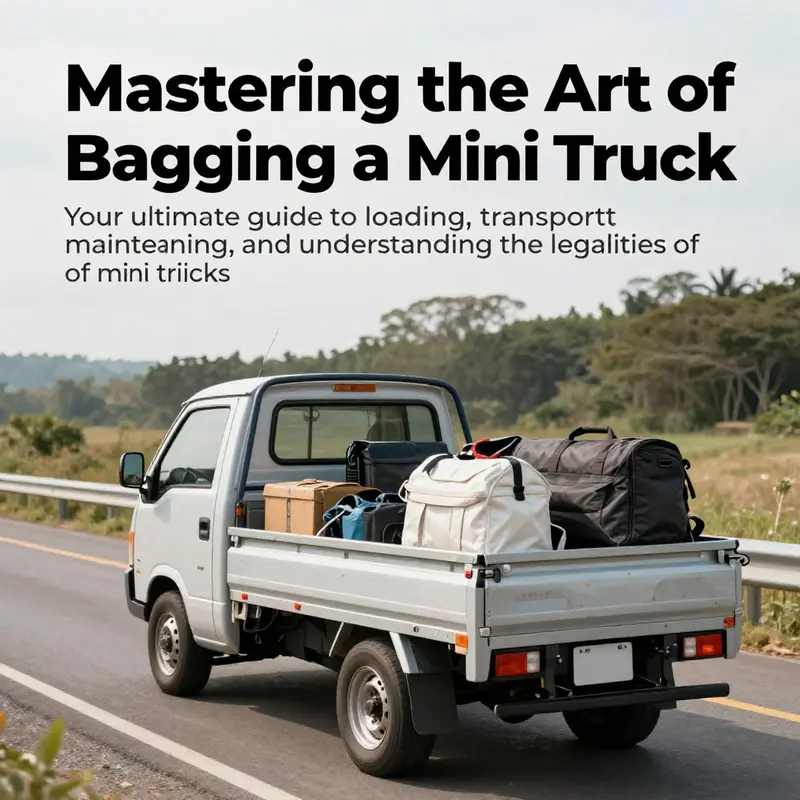
Loading a mini truck with care is essential for safe transport, and whether you’re a local business owner needing to haul goods, a property owner moving items, or a mini truck enthusiast ready to hit the road, knowing the ins and outs of securing your cargo is essential. In this guide, we will explore the safe loading practices for your mini truck, methods for transporting it securely, important maintenance routines during cargo loading, and the legal considerations you need to keep in mind. Each chapter provides insight that will help you ensure your mini truck journey is safe and efficient.
Mastering Load Security: How to Safely Bag and Load a Mini Truck

Planning and Securing Loads: A Practical Guide
Loading a mini truck properly is more than stacking boxes and tying a tarp. It begins with a clear plan, continues with thoughtful placement, and finishes with a methodical safety check. When people say “bag a mini truck,” they often mean the entire process of preparing, loading, and securing cargo for transport. This chapter walks through that process in a single, cohesive narrative so you can move goods confidently, protect your vehicle, and stay within the law.
Start by assessing what you will carry. Note each item’s weight, dimensions, shape, and fragility. List heavy pieces first, then medium and light. If some items require special containment, mark them. This inventory turns loading into a predictable task. It also helps you verify that the combined weight will not exceed the truck’s payload rating. The owner’s manual or the placard near the driver door shows that maximum. Respect those limits. Overloading reduces braking and steering performance and can produce fines.
Think of weight as the factor that controls stability. Place the heaviest items on the truck bed floor and as close to the axle center as space allows. A low and central mass gives the vehicle a stable center of gravity. Avoid loading heavy cargo on one side. Do not concentrate weight high above the bed. Even small shifts at higher elevations can create large rolling forces during turns. When moving mixed items, build a base of stable, dense objects, then stack lighter packages on top. Use pallets or crates to create uniform layers. They provide predictable surfaces and keep fragile items from bearing excessive pressure.
Use restraint systems that match the cargo and the truck. Ratchet straps deliver strong, adjustable tension for large or dense loads. Cargo nets work well for irregular bundles and smaller boxes. Corner protectors stop straps from cutting into cardboard or tarp edges. If you carry multiple groups of goods, separate them with dividers or cargo barriers. They keep shifting goods from migrating forward into the cab in a sudden stop. For long loads, cross-tie straps at several points along the length. Each tie prevents movement in a specific direction. The fewer the degrees of freedom, the safer the load.
When securing fragile items, wrap and cradle them. Use foam, moving blankets, or custom padding to fill gaps and absorb shock. Tie-downs should compress the padding lightly without deforming items. For oddly shaped objects, use soft straps or webbing that conform and spread pressure. When cargo comprises many small packages, use a containment method such as a cargo net or shrinkwrap. This prevents individual boxes from sliding into corners where they can crease, puncture, or burst.
Height and visibility are common oversights. Keep the load below legal limits and within the truck’s designed profile. Most public roads have bridge and overpass restrictions you should consider. In many places, a clearance above roughly 13.5 feet is unacceptable. More practically, avoid blocking the rearview mirror and side mirrors. If a load must obstruct direct sight, plan for an alternate means of checking blind spots. Use spotters when loading, and, if allowed, attach extended mirrors or a small rear camera before departure. Never drive with a tarp or cargo that covers brake lights or license plates.
Balance shifting forces by thinking about acceleration, deceleration, and cornering. A properly secured load will not slide forward on a sudden brake. Arrange straps to resist forces in all directions: forward, backward, and lateral. Tighten ratchets enough that the cargo is immobilized, but not so tight that packaging collapses. Check anchor points on the bed. They must be rated for load tension and free from rust or deformation. If an anchor seems marginal, use multiple tie-downs to share the load.
There are practical packing patterns that increase safety. For heavy boxes, line them along the centerline or between wheel wells. Lighter items can fill the sides. Fill gaps with soft materials to reduce movement. Avoid creating towers unless they are well-braced on three sides. If you must stack items, place a slip-resistant layer between levels and secure the whole stack with vertical straps. Remember that a small top-heavy stack can behave like a pendulum, swinging and transferring force to the truck frame.
Cargo that extends past the bed requires extra care. Flag or mark overhangs according to local rules. Secure the extended section with additional tie-downs and consider a secondary restraint that prevents vertical movement. If an item protrudes horizontally, ensure the remainder of the load stays balanced and the pivot points are secure. Long loads often change the truck’s handling; drive gradually and take corners wider to compensate.
Routine vehicle checks matter as much as packing technique. Confirm tire pressure before and after loading. Heavy loads heat tires faster and increase wear. Inspect brakes for responsiveness after loading and test steering feel. Lights and signals should be visible and functional; they are essential for safe communication on the road. Check the bed floor and sidewalls for damage that could cause sharp edges or anchor failure. Address issues before you load.
Legal and safety requirements shape many decisions. Know local constraints on payload, overhang, and hazardous materials. If you transport chemicals, compressed gases, or flammable liquids, follow the appropriate labeling and containment rules. Securement standards vary by jurisdiction, but the principles remain: plan, distribute, restrain, and inspect. The Chinese standard GB/T45745-2025, for example, stresses pre-loading checks and correct securing of unstable goods. Staying compliant avoids penalties and reduces risk.
Before you move, perform a final inspection. Walk around the truck and tug at straps to verify tension. Check that nothing rubs against tire sidewalls or tailpipes. Confirm mirrors clear the load and the driver has an unobstructed view of gauges and the road. Re-check straps after the first few miles as loads commonly settle. If you must stop to adjust anything, pull over safely and re-secure in a calm, controlled manner.
If you haul loads regularly, create a repeatable routine. Keep a packing kit with measured straps, padding, corner protectors, and bungee cords. Use a simple checklist: inventory, capacity check, base build, securement, visibility check, and post-departure re-check. Standardization reduces errors and speeds the job. For occasional haulers, practice loading small test runs in a safe area to judge handling changes before heading onto busy roads.
Minor investments go far. A set of high-quality ratchet straps, a cargo net, and corner protectors will pay for themselves in safety. Consider a lightweight tailgate extender or removable bed rails for long items. If you often transport fragile items, invest in crates sized to fit your cargo area. For multi-stop runs, label boxes by delivery order to limit unnecessary handling and re-stacking.
Finally, remember that maintenance underpins everything. A well-maintained mini truck responds predictably. Regularly check brakes, suspension, lights, and frame integrity. Replace worn anchor points and maintain tires to the manufacturer’s specifications. Proper maintenance ensures the vehicle can safely carry the loads you plan.
If you want additional community tips and real-life examples, the Mini Truck SoCal blog offers useful articles and owner experiences you can read for practical perspective: Mini Truck SoCal blog.
For authoritative guidance on certified tie-down systems and cargo securement best practices, consult the National Highway Traffic Safety Administration’s cargo guidelines: https://www.nhtsa.gov/equipment/cargo-securement
Secure Passage for the Tiny Haul: Mastering the Safe Transport of a Mini Truck

To begin, let intent guide action. The decision to transport a mini truck is, at its core, a decision about responsibility. It starts with a careful reading of the manufacturer’s manual to determine the exact payload limits, how weight should be distributed across axles, and where the strongest tie-down anchors live within the cargo area. Even a small miscalculation can cascade into compromised steering, reduced braking efficiency, or a higher center of gravity that invites instability on winding roads or uneven surfaces. This is not merely a theoretical caution. It is a practical boundary that mirrors the discipline expected in professional operations. The moment you accept that boundary is the moment you begin to plan with precision. When you plan, you translate numbers into actions: how many pounds per item, how much space that item will require, and how to sequence loading so that the base remains the heaviest and the top remains light and reachable for inspection during transit. If a manufacturer’s guidance exists, follow it; if not, a robust rule of thumb becomes your compass: keep the center of gravity as low as possible, spread weight evenly, and ensure that nothing shifts during movement.
The first dimension of sound transport is load capacity. The payload figure is not a figure to be flirted with; it is a hard limit that preserves braking performance, steering response, and tire integrity. Heed it as one would heed a bridge’s load rating. Before loading anything, take a moment to inspect the bed—look for dents, sharp edges, loose bolts, or any protrusion that could snag straps or damage goods. Clear the bed of debris, verify that all anchor points are clean and free of rust, and confirm that they are rated for the stress you intend to apply. When you know the exact capacity, you know how close to the edge you are willing to operate. It may be tempting to push near that edge to maximize space, but good practice is to maintain a safety margin that accommodates unexpected bumps along the route.
With capacity understood, the question becomes how to arrange the cargo so that stability is built into the load rather than earned through forceful restraint. Heavier items belong at the bottom, near the truck’s center of gravity, and closer to the bed’s floor. Lighter items on top contribute to a lower, more stable profile and reduce the risk that shifting weight will alter handling characteristics during a sudden stop or a curve. Balance matters not only from front to back but from side to side. A load that leans toward one wheel or one edge creates a moment that can magnify under braking or when traversing a dip or a crest. This is the moment for a quiet, methodical approach: lay out the items on the bed, visualize the centerline of the truck, and work toward a symmetrical pattern from the middle outward. Fragile items deserve special attention in this choreography; they require protective packaging and separation to prevent damage from vibration and contact with heavier objects. Each piece of cargo should have a defined niche, and each niche should be designed to prevent movement.
The securing of the load is where discipline becomes a practice of craft. High-quality straps, ratchet binders, and cargo nets are tools that translate intention into physical control. The goal of securing is not merely to hold items in place but to distribute the forces that arise in transit so that no single point bears excessive stress. Start with the anchor points. Every strap should connect to a point that is robust and well-anchored, not just a convenient spot on a rail. A common, reliable method is to run straps in a crisscross pattern over the top of the load to compress and stabilize, then lock them down with a measured amount of tension that minimizes slack yet avoids over-tightening that could damage the cargo or deform the packaging. For smaller items, cargo nets can act as a containment system that prevents individual pieces from shifting into one another and from migrating toward the cab or tailgate during a lane change or a bump. The height of the load deserves particular scrutiny. If, for any reason, the stack exceeds typical height limits, which in many jurisdictions hover around four meters for overtly tall freight, it is vital to mark the top clearly with bright flags or lights. This is not cosmetic; it is a safety signal that helps other drivers anticipate a taller profile and adjust their distance and speed accordingly.
Beyond the mechanics of loading and securing lies a broader commitment: to operate within a framework of compliance and vehicle safety that protects not only your cargo but everyone on the road. The vehicle that carries the load must itself be prepared to perform under stress. This involves a series of routine checks that are often overlooked, but that have outsized importance when a load is involved. Tire pressure should be checked to the manufacturer’s specifications and rechecked after loading, because tires respond to added weight in ways that can alter grip and response. Brakes must be tested for response and fade; lights and indicators should be functional, ensuring visibility and signaling to other road users. The cargo area should be kept clean and undamaged so that straps can anchor securely without slipping on slick surfaces or rubbing through compromised material. In short, a well-maintained vehicle is not a luxury accessory in transport; it is a foundational guarantee of safety and reliability for the entire operation.
This is also where the legal and safety landscape enters in a meaningful, practical way. Regulations governing load securing can vary by jurisdiction, and for good reason: different road geometries, speed limits, and traffic patterns create different risk profiles. An awareness of these regulations helps you tailor your approach to the rules that apply to your route. The Guangdong example referenced in the research results highlights how enforcement and standards shape everyday practice. When vehicles used for cargo transport deviate from recognized standards—whether through excessive length, width, or weight—safety risks multiply. Illegal modifications can produce large blind spots, compromised braking, and unstable handling that put other road users in jeopardy. This is not a theoretical critique; it is a practical imperative to choose a transport method and a vehicle that align with established standards. The legitimacy that comes from compliant practice reduces risk and enhances predictability on the road. For readers seeking a broader regulatory context, the linked official report provides a detailed snapshot of how authorities view these issues and the rationale behind the standards that guide responsible transport.
To translate these principles into action, a simple, continuous mental loop helps: plan, load, secure, inspect, and monitor. Plan by confirming the payload limit and the route’s constraints. Load by placing the heaviest items at the bottom, distributing weight evenly, and reserving the bulk of the cargo’s mass near the truck’s centerline. Secure by anchoring every item to a robust point with a balanced cross-lashing pattern, and contain smaller pieces with nets or additional restraints as needed. Inspect by walking around the truck, checking strap tension, anchor integrity, and the absence of loose items that can rattle or shift. Finally, monitor during transit—checking the tension at safe intervals, adjusting for road conditions, and maintaining a steady, predictable travel pace that respects the vehicle’s capabilities. This approach reduces the chance of surprises and keeps the journey smooth from start to finish.
As a practical aside, readers who want to widen their understanding of general loading practices without getting bogged down in a single brand or model can explore the broader perspectives available on the site. The blog has sections that discuss fundamentals, case studies, and broader loading strategies that complement the specifics in this chapter. For a concise introduction to those ideas, you can visit the main blog hub: minitrucksocala.com/blog/. This internal resource links you to a wider landscape of guidance while keeping the focus on secure transport and responsible handling. The goal is not to chase novelty but to build a stable foundation—one that scales with more complex loads or longer journeys without losing the essential emphasis on safety and compliance.
In closing, securing a mini truck for transport is a disciplined practice that blends mechanical understanding with responsible, rules-based decision making. It requires appreciating the limits of the vehicle, arranging and restraining cargo with care, and maintaining vigilance throughout the journey. It asks for forethought and calm under pressure, because a well-planned and well-executed transport is less a moment of luck and more a habit you cultivate through repeated, mindful practice. By following these principles, you safeguard not only the cargo but the people who share the road and the reliability of your own business or project. The route may present unexpected twists, but a secure transport plan turns those twists into manageable, predictable steps, guiding the mini truck to its destination with the cargo secured, the vehicle performing within its design, and the road left with fewer unintended consequences. The goal is achievable through deliberate preparation, careful load management, and unwavering attention to safety standards that protect everyone who travels alongside the load. For those pursuing a deeper regulatory understanding or a broader context, the cited external resource offers a formal perspective on how standards shape practice and how enforcement actions influence everyday decisions on the road. See the Guangdong traffic authorities’ official report for a more expansive treatment of the regulatory environment that underpins responsible cargo transport: https://www.gdtransport.gov.cn/ztzl/tzgg/202602/t20260206_175832.html.
Steady, Safe, and Sound: Maintenance and Care for Mini Trucks During Cargo Loading

The compact footprint of a mini truck invites efficiency, but it also demands a disciplined approach to maintenance and care whenever cargo is loaded, secured, and transported. In many fleets and for countless personal-use scenarios, the aim is not just to move items from point A to point B, but to preserve the vehicle’s integrity, protect the cargo, and keep everyone on board and on the road safe. The dialogue between the vehicle and its loads begins long before any strap is tightened or any wheel turns. It begins with method, awareness, and a respect for the limits built into the design of the truck. When these elements align, the risk of handling errors—overlooked checks, unbalanced loads, or inadequate securing—drops dramatically, and the operation becomes a repeatable, dependable routine rather than a one-off gamble with momentum and weather, surface, or road conditions. The discussion here threads together load planning, securing practices, pre-load inspections, loading techniques, and maintenance routines into a cohesive practice. It also ties those practices to the broader regulatory environment and to the realities of varied work settings, from urban deliveries and municipal services to rural and off-road tasks where a mini truck’s nimbleness is most valuable. The goal is not an exhaustive manual but a living, practical guide that reads like a careful conversation between driver, cargo, and machine. For broader perspectives on ongoing care and knowledge sharing, readers can explore the country’s established trucking discourse through the main blog hub, which aggregates practical tips, case studies, and reflections on the evolving role of mini trucks in varied work ecosystems. Minitrucks Blog.
A foundational premise of safe cargo handling with mini trucks is clear: respect the vehicle’s payload envelope, keep weight centered, and ensure that every load interaction—whether the first item placed or the last strap tightened—channels energy toward stability rather than surprise. This principle becomes particularly important in situations that demand off-road capability or travel on poorly surfaced roads. The payload capacity, though variable by model, typically falls within a broad spectrum, with many mid-duty mini trucks rated around 1,500–3,500 kilograms. A careful operator treats these figures as living numbers—guidelines that can shift with tire condition, fuel weight, battery load in electric variants, and the vehicle’s mounting or mounting surface. The careful approach begins at the point of plan. Before any item is touched, one checks the route, the terrain, and the anticipated load distribution. The process is not lengthily described as a checklist but lived as a series of micro-decisions: Is the bed flat and free of debris? Are there any protrusions that could abrade cargo or straps? Is the surface level enough to place the first anchor point with confidence? These questions, asked aloud or in a quiet mental note, set a tone of control that pays dividends in the next steps. As items come into the bed, the load discipline centers on balance and compatibility. Heavy items go in first and rest toward the truck’s strongest anchor points. They form the base, a solid platform that can bear further weight without the risk of shifting under acceleration, deceleration, or a sudden turn. From there, lighter and more fragile items are layered with care, their placement determined by how much movement they can tolerate and how much protection they require from contact with other cargo. The careful practitioner visualizes the box, crate, or bundle as part of a three-dimensional puzzle, where gravity, inertia, and friction work together rather than against the stability of the whole. The heart of this philosophy lies in weight management and distribution, a discipline that, when mastered, reduces not only the likelihood of items moving but also the hazard a shifting load can pose to the driver’s visibility and to the vehicle’s steering and braking response. This balance becomes even more critical for mini trucks deployed in rural or off-road environments where uneven surfaces, rutted tracks, or grades magnify any weight imbalance. In those contexts, a well-distributed payload supports traction and cornering stability, which translates into fewer control challenges and safer travel. The practical upshot is straightforward: distribute load evenly across the bed, avoid a concentration of weight in the rear or on one side, and verify that the center of gravity remains within the vehicle’s stabilized envelope throughout the journey. The steps may seem obvious, but their precise execution matters. The operator should continually reassess as loading progresses, especially when adding items of markedly different shape, size, or weight. If a large toolbox goes in late, its offset may require a slight rebalancing of the previously placed items. The point is not to chase perfection in a single moment but to maintain proportional balance as cargo changes shape and weight during the loading sequence. A robust plan also anticipates the human factor: the crew loading, securing, and monitoring needs clear communication, defined responsibilities, and a shared adherence to safety signals and stop points. When a step is missed, the consequences often appear later as fatigue, misalignment, or the need for a re-load. In that sense, the discipline of load distribution becomes a safety culture, a way of thinking about every job as a chain where each link supports the next. Maintaining such a culture begins with securing cargo properly. A broad, practical approach to securing is essential, because unsecured loads are the chief source of loose items, debris on the road, and compromised visibility. The simplest image for secure cargo is a well-tied package set—one that cannot shift with minimal contact or gentle jostling. This reality underscores a practical truth: micro-movements, caused by normal vehicle dynamics, accumulate into significant displacements that can lead to damage, loss, or dangerous debris. The mechanisms of securing cargo involve a mix of straps, nets, and anchor points that are robust, durable, and suited to the job. Ratchet straps, for instance, are commonly used to anchor items to the bed’s existing lashing points, while cargo nets help contain smaller items and prevent them from migrating into the cab area or onto the road behind. For larger or heavier lots, corner and cross-strapping methods distribute pressure across the geometry of the cargo and the vehicle itself, creating a lattice of restraint that reduces point loads and minimizes the risk of bounce or slide. The securing plan is not an afterthought; it evolves in tandem with load distribution. As items are placed, the operator should perform a quick, physical test—an attempt to move the load slightly by hand and then a more deliberate pull test with the strap or net in place. If any movement is detected, the securing system is adjusted. This iterative process—place, test, adjust—reduces the chance of a single failure point compromising the entire load. In practice, the securing phase benefits from a calm, methodical rhythm rather than brute force. The heavier the item, the more critical it is to use proper equipment and technique. A strap that is too thin or a net with frayed fibers can fail under tension, while a corner tie-down that is not fully anchored may allow the item to pry free under movement. In those moments, the importance of trained eyes and steady hands becomes evident. The operator’s awareness should extend beyond the cargo to the environment: weather can alter traction, road grade can change the influence of a load on steering, and even the bed’s surface condition—dust, moisture, or residues—can affect friction between cargo and bed. The equipment used to secure should be appropriate to the job, with load-rated fasteners that match or exceed the cargo’s mass. A thorough inspection after loading is important: confirm that all straps are aligned away from sharp edges, that there is no twist in the webbing, and that the load remains visible in mirrors and through windows without obstructing the driver’s line of sight. It is wise to perform a final dynamic check, driving at a low speed over small bumps to observe whether any cargo movement occurs. If movement is detected, the immediate action is to resecure—not to press on and hope for the best. In the journey ahead, simple habits translate into long-term benefits for the mini truck and its operator. Regular checks of tie-down integrity, strap wear, and chord strength become routine parts of the pre-trip ritual. The maintenance mind-set naturally extends to the vehicle’s bed area, where the lining and mount points should be examined for signs of wear or damage that could compromise securing. The bed’s corners and anchor bolts deserve particular attention because they are the serious workhorses of the securing system. A bed with worn anchor points or a damaged liner can fail under load, leading to dangerous slippage or cargo damage. A well-maintained bed translates directly into operational confidence. Once cargo is secured, the operator should verify the overall health of the mini truck before repositioning into highway mode or moving to off-road paths. This includes a self-check of lighting, tires, brakes, steering, and suspension. If the truck is electric, battery health and charging safety must be considered—especially with loads that generate heat or could impact thermal management. A pre-loading inspection can catch issues before the weight of the cargo adds strain. The goal is to reduce surprises on the road and to preserve the vehicle’s longevity. Maintenance and cargo care are not only actions to protect people and goods; they are also practices that protect the vehicle itself. A consistent routine of inspection and care leads to longer service life and better performance, particularly at the points of contact between load and chassis, where stress concentrates in everyday operations. A well-cared-for truck feels different in use: smoother handling, more predictable braking, quieter operation, and better fuel efficiency as friction and vibration are managed. For operators who depend on the reliability of mini trucks for daily tasks—from city deliveries and municipal work to rural transport—the payoff for investing in disciplined maintenance, careful loading, and mindful driving is measured not only in compliance with regulations but in the reduction of downtime, fewer on-road failures, and a more predictable workday. In this sense, the chapter’s core message is not merely about mechanics but about building a practice—a way of thinking that aligns loading, securing, and vehicle health into a cohesive, repeatable workflow. And while the specifics can vary by model, circumstance, and cargo type, the underlying principle remains universal: treat load planning as a shared, continuous responsibility between person, vehicle, and environment, and approach each operation with attention, patience, and respect for the equipment. For readers seeking additional perspectives on ongoing practice and shared experiences, the broader ecosystem of mini-truck knowledge is accessible through the main blog hub, which links practical tips, field reports, and evolving best practices. As always, operators should consult the official service manual and, when needed, contact the supplier for manufacturer-specific care instructions to ensure compatibility with the vehicle’s design and performance goals. External reference: Official Maintenance Guidelines for Mini Trucks – IVAN: https://www.ivan.org.uk/resources/minitruck-maintenance
Bagging a Mini Truck: Legal Risks, Compliance Steps, and Safer Alternatives
Bagging a mini truck—installing air suspension to lower the body dramatically—is a popular modification among enthusiasts. It transforms stance, ride height, and curb appeal. But the legal landscape around such changes is complex. This chapter walks through the legal risks, the practical compliance steps, and safer alternatives you can choose. The goal is to help you pursue the look you want while keeping your vehicle legal, insured, and safe on the road.
Understanding the legal stakes begins with how authorities classify suspension and body modifications. Many jurisdictions treat extreme lowering or lifting as a regulated change. Limits often apply to allowable suspension travel, body lift height, and ground clearance. Rules exist to preserve vehicle safety systems, maintain proper bumper and light heights, and ensure underbody components clear public road surfaces. If your air suspension lowers the chassis so far that bumpers, lights, or structural members drop below statutory points, the vehicle may fail inspection or be declared unroadworthy.
One practical consequence of illegal modifications is inspection failure. Vehicles must pass periodic inspections in many areas. Inspection criteria typically cover ride height, lighting positions, steering geometry, and the integrity of suspension components. A truck that sits too low can trigger multiple failure points. Beyond inspections, enforcement can include traffic stops, citations, and orders to restore the vehicle to compliant condition. In extreme cases, authorities may impound a vehicle until it is corrected.
Insurance is another critical area where legality matters. Standard insurance policies assume the vehicle is driven in safe, legal condition. If a claim arises after an accident, insurers examine whether modifications contributed to the incident. Many insurers explicitly exclude coverage for claims linked to undocumented or illegal modifications. That can mean denial of coverage for repair costs, medical bills, or liability claims. If your bagged mini truck is found to have contributed to a crash because of reduced ground clearance or altered handling, you could face uncovered medical, repair, and legal bills.
Liability exposure increases if a modification affects vehicle control or crashworthiness. Lowered ride height can change suspension geometry and increase the risk of bottoming out. When critical components like fuel lines, brakes, or the drivetrain are at greater risk of damage, the chance of mechanical failure rises. Should a failure cause injury or property damage, a judge or jury may view the modification as negligent if it violated regulations or common-sense safety practices. That can magnify financial and legal consequences beyond insurance denials.
Local differences matter. Laws vary widely between states and countries. Some areas set strict numeric limits for suspension or body lift. Others use broader standards focused on safety and equipment function. A truck legal in one state might be illegal in the neighboring one. You must check local statutes, vehicle codes, and administrative rules before modifying your mini truck. In many places, the DMV or transport authority publishes clear guidance. If no specific rule exists, enforcement may rest on an officer’s judgment of safety and roadworthiness, which is less predictable.
Emissions and safety systems are additional legal touchpoints. If a modification interferes with emission-control devices, catalytic systems, or onboard diagnostics, you can violate environmental regulations. Similarly, check that sensor placement and bumper heights do not compromise airbag deployment or other passive safety systems. Modifying ride height should never obstruct lights, license plates, or reflectors, as those are often subject to strict placement and visibility standards.
A practical compliance path starts with research and documentation. Before any work, obtain copies of relevant vehicle code sections for your jurisdiction. If numeric limits apply, measure and plan your suspension to remain within them. If rules are performance-based, favor conservative changes that maintain adequate ground clearance and preserve system functions. Document the work with invoices, photos, and technical descriptions. Keep records of parts, installers, and inspection certificates. Good documentation helps if you need to justify the modification to an insurer or inspector.
Use reputable, certified installers and parts. Professional shops often know local regulations and can recommend setups that meet them. They can also install safety features such as fail-safe ride-height controllers. These controllers maintain a minimum legal ride height at startup or highway speeds. Portable level sensors can warn drivers when clearance is too low. In short, install systems that allow the truck to be safe and legal whenever it enters public roads.
Consider removable, convertible, or compliant options. Instead of a permanent, extreme drop, choose an air system designed to allow normal ride height for street driving. Many enthusiasts use adjustable suspension that raises for public roads and lowers for shows. Ensure the system includes secure presets and cannot be left illegally low while driving on public highways. Another alternative is subtle lowering that achieves a distinctive stance without exceeding legal limits. These options produce the desired aesthetic while minimizing legal risk.
Before you drive, perform a compliance checklist. Verify headlight aim and license plate visibility at the altered stance. Confirm that bumpers, reflectors, and side markers meet legal height ranges. Test turning clearance and steering geometry. Inspect for potential contact points under full compression or when traversing common road hazards. If the truck will carry cargo, test with typical loads. Load-induced sag can change ride height drastically and push the vehicle out of compliance.
When it comes to inspection and approval, be proactive. Some jurisdictions offer pre-approval or engineering sign-off for certain modifications. Obtaining an engineering certificate or a licensed inspection report can protect you. It demonstrates that a qualified professional evaluated the modification and found it safe and compliant. Keep that paperwork in the vehicle and provide it to insurers or enforcement officers when necessary.
If enforcement finds your modification noncompliant, know your options. You may be required to return the vehicle to a compliant configuration. That can mean reinstalling factory suspension, adding spacers, or adjusting ride-height controllers. If you disagree with an enforcement action, administrative appeals exist in many places. Document everything, and seek legal counsel if fines or impoundments occur. A measured appeal can be less costly than ignoring orders.
Recordkeeping is not glamorous, but it matters legally. Maintain receipts, installation manuals, calibration data, and inspection certificates. If a dispute arises, clear records show you researched legality, used certified parts and installers, and took steps to meet safety standards. This documentation can be crucial if an insurer questions coverage or if a traffic court asks whether you were negligent.
Beyond legality, consider the role of public safety and courtesy. A truck lowered excessively can pose hazards to other road users. Underbody parts can become debris sources when scraped, and stalled or damaged vehicles block lanes. Choosing modifications that reduce these risks helps protect you and the community. It also reduces the chance that enforcement will target your vehicle simply because it creates a nuisance.
Seek expert advice when in doubt. Contact your local DMV, transport authority, or a motor-vehicle attorney before committing to an extreme modification. Share technical plans and ask for written guidance when possible. Professional installers can often point to experienced fabricators who build compliant systems. And if you belong to a local enthusiast community, learn from members who navigate regulations responsibly. For general inspiration and community resources, see the Mini Truck SoCal blog for insights and local perspectives [https://minitrucksocala.com/blog/].
Finally, if you value the bagged look but worry about legality, weigh alternatives. Adjustable setups, subtle stance changes, protective skid plates, and conservative presets give much of the desired aesthetic with less legal risk. Always prioritize safety, documentation, and local compliance. That approach reduces the likelihood of fines, protects your insurance cover, and preserves your ability to enjoy the truck on public roads.
For concrete legal language about suspension and body lift limits in one well-documented jurisdiction, review the California Vehicle Code section on suspension and body lift limits at the DMV website: https://www.dmv.ca.gov/portal/vc/section-27500.html
Final thoughts
Understanding how to effectively bag a mini truck is crucial for anyone looking to maximize the efficiency of their transport operations. From loading conditions that prioritize safety, to ensuring that your transport is compliant with local regulations, every step is important. By following the guidance provided in this article, you can ensure that every journey with your mini truck is safe, secure, and adheres to the relevant laws. Remember, proper maintenance and awareness of legal matters will not only protect your cargo but also enhance your driving experience.