
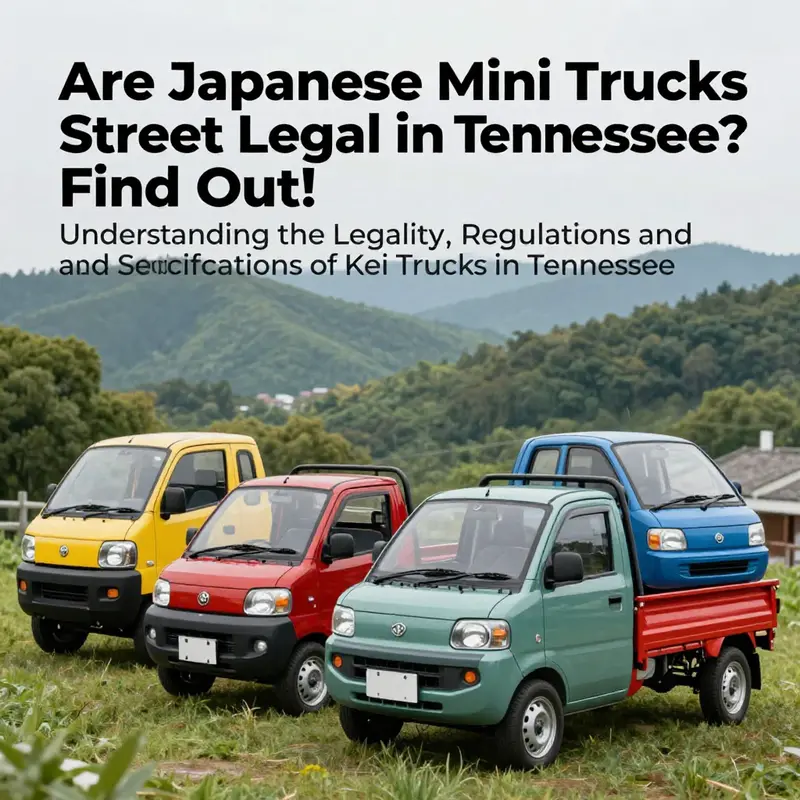
Japanese mini trucks, renowned for their utility and compact size, have gained popularity among local small business owners, residential property owners, and avid mini truck enthusiasts alike. However, if you’re considering one of these Kei trucks for your day-to-day operations or personal enjoyment, it’s crucial to understand their legal standing on the roads of Tennessee. This article delves into the ownership laws, regulatory challenges, design specifications, and federal import regulations that affect the road legality of these unique vehicles. By the end, you’ll have a comprehensive view of what it means to own and use a Kei truck in Tennessee, ensuring you make informed decisions whether for business or recreational purposes.
Crossing the Line: Ownership, Regulation, and Road-Use Realities of Japanese Mini Trucks in Tennessee
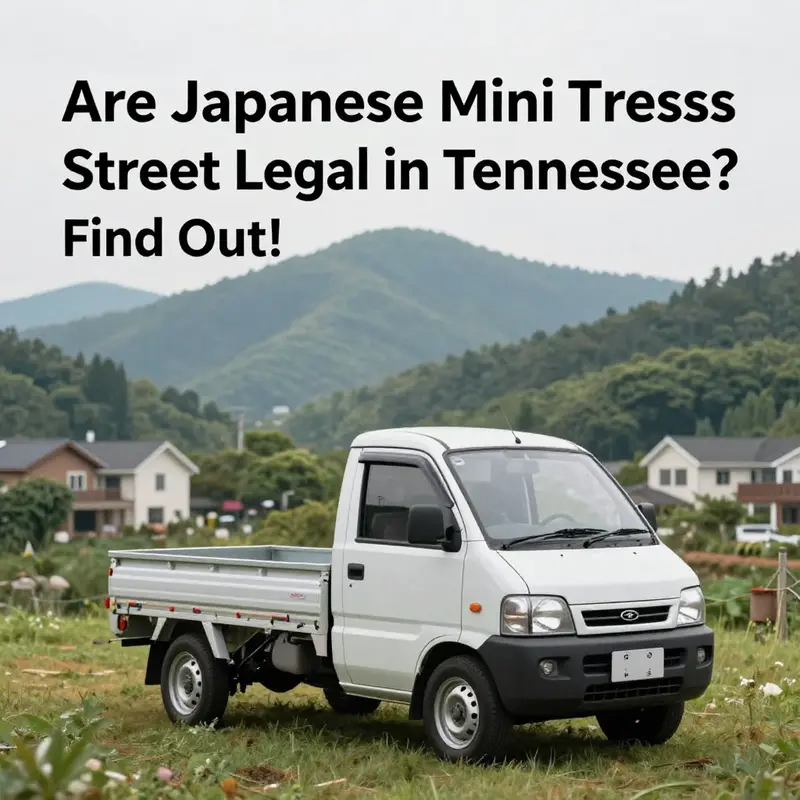
A fascination with compact efficiency drew many to Japanese kei trucks, tiny workhorses built around simple, agile designs. In Tennessee, that allure collides with a concrete legal landscape that distinguishes what you can own from what you can legally drive on public streets. The core of the issue is not whether a person may possess one of these vehicles on private property, but whether a vehicle that is small in scale and often spartan in safety features can be registered and operated as a street vehicle. In practical terms, ownership tends to be allowed—private property rights and farm operations frequently accommodate such equipment—but road-use rests on meeting state standards that were designed for much larger and more rigorously built vehicles. This distinction matters because the same kei truck that is a practical asset for farm tasks can quickly become a legal obstacle when the owner attempts to turn it into a daily-driver or a light-commercial vehicle on a public road. The Tennessee Department of Transportation, along with safety and emissions authorities, sets a framework that emphasizes compatibility with wider highway norms. Those norms include not only the vehicle’s physical footprint, but also its energy performance, noise and exhaust emissions, and the reliability of core safety systems such as lighting, braking, and crash protection. The complexity is intensified by the fact that kei trucks were designed to meet Japanese regulations, not United States ones. The result is a vehicle that can be perfectly suited to off-road work or private-site tasks but may require substantial modification and regulatory approval before it can legally share Tennessee’s public roadways with full traffic. This dual reality—ownership permitted, road use restricted—frames a practical guide for anyone contemplating bringing one of these compact machines into Tennessee’s broader traffic system. In this context, the law draws a clear line between private-use flexibility and the public road’s more rigid requirements. When a kei truck remains on farm property or in controlled industrial settings, owners enjoy the value of a highly maneuverable tool. The moment the operator seeks to traverse a highway or street, however, the vehicle’s dimensions, weight, and safety package become a litmus test. The regulatory standard is not a single checklist but an entire framework that shapes every decision from aftermarket modifications to how a vehicle is registered. The state’s emphasis on safety means that the vehicle’s structural integrity, crash protection, and occupant restraint capabilities are weighed against the risk they pose to the operator and other road users. A vehicle built around a compact, lightweight chassis often lacks the robust crumple zones and airbags that conventional passenger vehicles routinely carry. It may also present challenges in meeting lighting and braking requirements that motor vehicle codes assume will be present on modern roadworthy cars. The result is a practical reality: even if a kei truck is legally owned, it may not receive a standard Tennessee registration as a passenger vehicle, effectively curtailing its usefulness on public roads. This separation between ownership and operation is not a marginal issue but a real constraint that shapes how enthusiasts and small-business operators approach these tools. The federal “25-year import rule” can add another layer of complexity. It allows the importation of certain foreign vehicles older than a quarter of a century, which in theory widens the range of potential candidates for Tennessee streets. Yet the federal rule does not erase state-level safety and emissions standards. A vehicle that somehow clears import rules still faces Tennessee’s own regulatory gatekeeping, which assesses whether the vehicle passes state-imposed safety criteria or emissions limits, and whether modifications can bring it into compliance. In practice, many kei trucks that arrive in the U.S. market fall short of these thresholds. They may possess engines with very small displacement, lightweight frames, and minimal safety equipment, designed for efficiency and low maintenance rather than highway performance. Those features make them unconventional guests on a Tennessee highway system designed around larger vehicles with more sophisticated safety systems. As a consequence, owners often find themselves weighing a trade-off: private-use capability and cost-effectiveness against the realities of regulatory compliance and the potential costs of required modifications. It is a reminder that curiosity about these machines cannot be separated from a careful, regulated approach to road legality. The dialogue around legality also invites questions about the practicalities of driving a very small vehicle at highway speeds, in mixed traffic, where fatigue, weather, and varying road grades test a vehicle’s performance envelope. The answer is nuanced. Kei trucks bring excellent power-to-weight characteristics for off-road work and short, low-speed distances. They excel in tight spaces where larger vehicles struggle and can be impressively reliable under tough operating conditions. Yet those strengths do not automatically translate into street-legal status. To bridge the gap, an owner would need to navigate a multi-step process that may involve inspections, compliance checks, and possible modifications to align with Tennessee’s standards. In this sense, Tennessee’s approach mirrors a broader philosophy: encourage productive use and ownership while ensuring that any vehicle sharing public roads meets a baseline of safety and environmental responsibility. The nuance is exactly why a straightforward declaration like “they are legal” or “they are not legal” proves insufficient. The truth rests in the details—how the vehicle is used, how it is registered, and whether it has undergone the requisite modifications and inspections to satisfy the state’s regulatory expectations. For readers seeking broader context on how Tennessee addresses these vehicles, the Minitrucks Calala blog offers ongoing coverage that helps frame local concerns within a wider community of owners and operators. This resource can provide practical perspectives on ownership experiences, maintenance considerations, and the evolving regulatory conversations that shape what is possible on Tennessee roads. As with any specialized vehicle, the path toward lawful road use begins with an informed assessment of obligations and possibilities. An owner contemplating public-road operation should begin with the state’s official safety and motor vehicle guidance, recognizing that private-use scenarios may remain permissive while road-use scenarios demand compliance with a clearer set of standards. The balance is not just about legality for the sake of paperwork; it is about ensuring predictable, safe integration of compact, efficient vehicles into a state’s traffic system. This chapter has traced the broad contours of that balance, emphasizing ownership rights on private property while acknowledging the stringent road-use criteria that can govern public highways. The bottom line is practical and pragmatic: these vehicles offer distinct advantages for specific tasks, but the decision to bring one onto Tennessee’s public roads must be anchored in a rigorous, process-driven approach to compliance. For anyone who wants to explore this topic further, the journey is best taken through trusted, up-to-date sources that explain the current requirements and how they translate into real-world options. An informed owner will verify whether a kei truck can be legally registered as a passenger vehicle, whether it can be registered under a different vehicle category, and what modifications would be necessary to meet state standards. The intent is not to dampen interest but to illuminate the steps needed to transform curiosity into a compliant, road-ready reality. In that spirit, a careful plan that starts with official guidance and includes expert consultations will yield the most reliable path forward. The peculiar blend of efficiency, ruggedness, and compact design offered by kei trucks remains compelling. Tennessee’s regulatory framework does not negate that appeal; it simply asks for a clear, compliant path to road use. Those who pursue that path will find a nuanced landscape that rewards careful preparation, honest assessment of capabilities, and a willingness to align with the state’s safety and environmental expectations. For readers who want to dive deeper into this topic, the World Law Digest provides an broader overview of Kei truck legality in Tennessee, which can serve as a helpful companion to state-level resources and practical guidance. World Law Digest: Are Kei Trucks Legal in Tennessee?
Kei Trucks in Tennessee: A Roadmap to Legality

In Tennessee, owning a Japanese Kei truck is legal, but driving one on public roads requires meeting safety and emissions standards. Kei trucks are compact and efficient, appealing to property owners, hobbyists, and businesses for light-duty tasks in tight spaces. However, to register a Kei truck for street use, the vehicle must comply with U.S. crash safety, lighting, restraint, and emissions requirements.
Federal rules such as the 25-year import threshold do not automatically grant street legality in Tennessee. The federal age-based allowance does not override state inspections or registration criteria, so ownership on private property is possible while public-road use remains constrained. Many owners find that the practical path involves a careful regulatory process rather than a simple purchase.
The process typically begins with the Tennessee Department of Safety and Homeland Security to determine if the model can meet current standards or if modifications or waivers exist. Potential updates can include retrofitting lighting, seat belts, braking systems, and emissions controls, each triggering review and cost. Insurance coverage must also align with the vehicle’s legal status, and local ordinances may impose further restrictions.
Prospective owners should treat the journey as a regulatory project, seek expert guidance, and review external analyses and country-specific considerations to understand the pathways to compliance. While enthusiasm for Kei trucks remains strong, Tennessee’s framework emphasizes safety and predictability on public roads.
Small Machines, Big Rules: How Kei Truck Design Shapes Legality on Tennessee Roads

In the quiet logic of a narrow lane, a kei truck can feel almost magical—a tiny workhorse designed to squeeze into spaces where larger pickups would fear to tread. The appeal is not only practical but almost cinematic: a compact chassis, a bed enough for a pallet or two, and a silhouette that slips through traffic with a whisper rather than a roar. But when such a vehicle crosses from Japanese streets into Tennessee’s regulated landscape, the magic is checked by a stack of rules that are as concrete as the pavement. The design specifications that define Kei trucks in Japan—and that every chassis and engine responds to—become a legal heartbeat on U.S. soil, where safety, emissions, and highway performance are measured against a different standard. The result is a nuanced truth: these nimble machines can be owned in Tennessee, yet their public-road use sits behind a gate of rules that reflect a broader system of expectations about size, power, and protection on the highway. Understanding this requires tracing both the design biography of Kei trucks and the procedural path that governs road legality in Tennessee, all while keeping sight of how local authorities interpret federal guidelines within state enforcement.
At the core of Kei truck design are three dimensional constraints that together produce a vehicle with markedly different capabilities from standard pickups. The engine displaces no more than 660 cubic centimeters, a figure that translates into modest power by any measure used on American roads. The width is capped at about 1.48 meters, or roughly 4.89 feet, with a length limit around 3.4 meters and a height that can approach two meters. In practical terms, this means a Kei truck occupies a space in urban and rural environments that is almost confounding to larger trucks: it can dance through tight alleys, park where bigger vehicles would block two spaces, and sip fuel with a frugality that many motorists will envy. Yet those same design choices also yield an absence of the safety architecture that U.S. regulators have codified as standard. Airbags, crumple zones, advanced restraint systems, robust crash protection, and a certain redundancy in lighting and signaling are not integral features of most Kei designs as they were originally conceived for different road networks and regulatory regimes. The result is a vehicle that excels in efficiency and maneuverability but arrives on a U.S. road system with a different safety threshold to clear.
This divergence between Japanese design norms and American safety expectations shapes the Tennessee legal posture in fundamental ways. Ownership of Kei trucks is generally permissible, a footprint of private-property practicality that resonates with individuals who value compact utility or enjoy off-road and farm-use scenarios. However, taking this vehicle onto public roadways in Tennessee often triggers a cascade of regulatory considerations. The core of the issue lies in the Federal Motor Vehicle Safety Standards, FMVSS, which establish the minimum safety requirements for vehicles sold or operated in the United States. Kei trucks, whose origins are tuned to a different set of standards, frequently do not meet these criteria in their stock form. The implication is not only a compliance question but also a registration one: getting a Kei truck registered as a passenger vehicle or their equivalent for highway use is not straightforward and, in many cases, not feasible without substantial modification. Modifying a Japanese Kei to satisfy FMVSS—ranging from protective structures and occupant protection to lighting and emissions controls—can be a complex and expensive undertaking, and it may still fall short in a state like Tennessee that enforces specific interpretations of federal guidelines alongside its own emissions and safety mandates.
The dialogue between the 25-year import rule and Tennessee’s regulatory framework adds another layer of complexity. A federal provision often cited in debates around Kei trucks and other older imports is the so-called 25-year rule, which allows the importation of foreign-built vehicles that are at least 25 years old. In theory, this creates a potential route to bring some Kei models into the United States without the same import barriers that apply to newer vehicles. In practice, however, this rule does not automatically confer street legality within Tennessee. Once such a vehicle arrives on U.S. soil, state-level requirements come into play. Even if a Kei is legally imported on account of age, it still must satisfy Tennessee’s safety and emissions standards to be eligible for registration and operation on public roads. The practical upshot is that the 25-year rule can open doors to ownership, but it does not grant an express pass to highway use without meeting state-imposed criteria.
For many enthusiasts, the most sensible accommodation is to separate the vehicle’s intended use from the public roadway altogether. Kei trucks can be legally owned and operated on private property, used on farms, or engaged in off-road activities where public traffic does not come into play. This dual-track reality—private-use freedom paired with public-road restrictions—often shapes how a Tennessee resident approaches vehicle projects. It also invites thoughtful planning about where and how a Kei truck will be driven, stored, and maintained. In addition to ownership considerations, prospective drivers must be mindful of insurance implications and liability concerns that accompany any vehicle used on public roads, especially when the design frame does not align with conventional highway requirements. The overall calculus is not merely about meeting a list of checkboxes; it is about aligning a vehicle’s intended role with a regulatory environment that prioritizes occupant protection, crash resilience, and predictable performance in a broad array of driving conditions.
Within this framework, practical pathways emerge for those who want to stay compliant while appreciating the Kei truck’s unique value. First, consult state resources that interpret how federal standards apply in Tennessee, recognizing that the line between compliant with FMVSS and not road-legal is frequently contingent on the vehicle’s configuration, intended use, and the specific model year. Second, be prepared for the possibility that the stock Kei may not reasonably be brought into compliance for highway operation without losing its defining characteristics. Third, embrace the possibility of restricted public-road use, which is sometimes permissible on certain classes of roads or under certain conditions that state authorities can clarify, rather than assuming universal loopholes. Fourth, consider the importance of documentation—proof of ownership, compliance attempts, and any correspondence with the department of safety or motor vehicle authorities—that can anchor discussions with inspectors or legal counsel if questions arise about registration status.
An ongoing thread worth following is how the Kei design—compact dimensions, lightweight architecture, and an emphasis on urban and small-scale utility—continues to captivate a segment of Tennessee drivers who prize maneuverability and efficiency. The ergonomic advantage of the small footprint meets a web of complex regulatory criteria that can either constrain or, in particular circumstances, creatively accommodate vehicle use. For readers seeking a broader perspective on the culture and practicalities surrounding Kei trucks, a visit to the Minitrucks Calala blog offers a window into community discussions, restoration projects, and the way owners navigate space, performance, and legality across different regions. The resource is a useful companion to the technical specifics discussed here, illustrating how design choices intersect with real-world use and regulatory interpretation. Minitrucks Calala blog
As all this unfolds, Tennessee residents should approach Kei trucks with both curiosity and caution: curiosity about how a remarkably small chassis can support serious work, and caution about the legal terrain that governs road use. The design specifications that enable kei trucks to perform in tight urban environments simultaneously constrain their eligibility for public-road operation in Tennessee. Ownership remains viable for many scenarios, yet the restricted status of their operation on major highways reflects a broader axis of safety, standards, and regulatory alignment. The practical takeaway is straightforward: if a Kei truck is intended for regular highway travel, anticipate a rigorous process of review, potential modification, and official confirmation from state authorities. If the vehicle is primarily for private-property tasks or off-road recreation, the Kei’s strengths—compact size, ease of handling, and cost efficiency—can still be fully realized within a legal framework that respects both design intent and public-safety priorities.
For readers seeking current guidance, the most authoritative source remains the state’s own safety and regulatory office. Laws and interpretations evolve, and authoritative guidance will reflect the latest policy decisions, enforcement practices, and technical criteria. When in doubt, consult official channels for up-to-date requirements and possibilities for registration, operation, or exemptions. The Tennessee Department of Safety and Homeland Security provides a pathway to clarity on these questions and can confirm whether any new policy developments might affect the status of Kei trucks within the state’s roadways. https://www.tn.gov/safety
Under Federal Gatekeepers: How Import Rules Shape Japanese Kei Trucks in Tennessee

The question of whether a compact Japanese mini truck can legally share Tennessee roads sits at the crossroads of federal import policy and state vehicle regulation. Across the United States, these kei trucks occupy a gray zone where ownership can be lawful, but on-road use is governed by a tangle of rules that federal authorities set before state officials decide how to register or restrict a vehicle. Reading that landscape requires keeping two main threads in view: the age-based import rule that opens or closes doors to entry, and the safety and emissions standards that determine whether a vehicle can ever become a street-going asset rather than a private curiosity. The Tennessee experience mirrors national practice, with its own local hurdles layered on top of federal guardrails.
Central to the federal side is the 25-year rule. This rule allows the importation of vehicles that are 25 years old or older from the date of manufacture without the need to meet current U.S. safety and emissions standards. It does not, however, license those vehicles for immediate road use. The exemption is about entry, not operation. In practice, a kei truck imported under the 25-year rule can arrive on U.S. soil, but the moment an owner contemplates driving it on a Tennessee highway, the vehicle must still be evaluated under the country’s existing safety and environmental requirements. The distinction matters: ownership on private property or use on private land can be permissible, but using the vehicle on public roads typically requires it to meet another set of standards or to be reclassified within state regulations.
Beyond entry, the safety framework adds another layer of complexity. Kei trucks, by design, are compact, lightweight, and focused on efficiency rather than crash resilience. They are not built to U.S. crashworthiness standards, and in many cases they lack features commonly required by American regulations, such as airbags and robust crumple zones. The National Highway Traffic Safety Administration (NHTSA) does not certify these imported vehicles as safe for routine on-road use unless they meet certain criteria. This creates a practical hurdle: even a decades-old kei truck that slips past the 25-year cap within the federal system still faces a rigorous assessment when a prospective owner seeks registration for street driving. The alignment between an old vehicle’s existing structure and modern U.S. safety expectations rarely happens by accident; it usually requires deliberate modification and meticulous documentation, a process that can be costly and technically demanding.
The regulatory conversation also includes the Environmental Protection Agency (EPA), which oversees emissions standards. A 25-year-old vehicle may escape the most stringent current emissions tests, but state registration often depends on meeting applicable EPA rules or obtaining a vehicle-wide exemption where allowed. In Tennessee, as in many states, the line between “imported and allowed” and “registered for street use” involves verifying emissions compatibility, ensuring the vehicle’s exhaust and fuel systems do not violate state air-quality requirements, and proving that the vehicle’s operation would not contribute disproportionately to local pollution. The result is a two-step journey: first, the vehicle enters the country under the federal 25-year umbrella, and second, it must clear state gates that assess safety and emissions before it can legally roll on public roads.
Recent trade policy developments, while focusing on larger and more commercially significant classes of trucks, underscore how political decisions can ripple through the import pipeline and touch even kei trucks in subtle but meaningful ways. In October 2025, an executive action initiated a 25 percent tariff on imported medium- and heavy-duty trucks and components beginning November 1, 2025. Although this tariff targets larger commercial equipment, it signals a broader pattern of heightened scrutiny and cost pressure on imported trucks from abroad. In parallel, tariffs on Japanese passenger vehicles were reduced to 15 percent starting September 16, 2025, yet those reductions do not automatically apply to non-compliant commercial or utility vehicles like kei trucks. The practical effect for Tennessee importers is a reminder that legal access is never merely a matter of compliance with safety and emissions on paper; it is also framed by the economics of tariffs, supply chains, and the willingness of officials to authorize entry and use under those shifting conditions. The outcome can determine whether a kei truck remains a showroom piece, a private-property utility, or a legitimate conduit for work and transportation on public streets.
Compliance is the core challenge. Importers who intend to use kei trucks on public roads must navigate a path that can involve substantial modifications to achieve US-standard safety features and crashworthiness, coupled with emissions and fuel-system adjustments required by the EPA and state authorities. For many enthusiasts, the cost and technical complexity make on-road use impractical, pushing them toward off-road, private-property, or exhibition-only applications. Some owners simply keep the vehicle for collection or contingency use on private land, thereby staying within the letter of the law while avoiding the high barriers to street legality. Others pursue a more ambitious route: reengineering aspects of the truck to meet safety standards and then applying for appropriate registration in Tennessee. The decision is rarely straightforward, because it forces a balancing act between preserving the kei truck’s appeal as a compact, economical vehicle and meeting the robust safety and environmental expectations of the American highway system. The import journey, in this light, is as much a risk assessment as a technical one, weighing the allure of a nostalgic, diminutive workhorse against the realities of modern traffic safety and air quality regulation.
For readers who want to situate these considerations within a broader community of like-minded readers and ongoing discussions, there are resources that collect experience, guidelines, and practical insights from people who have pursued these paths. See the kei truck discussions on the broader site hub for a sense of how hobbyists, builders, and small-scale importers navigate the interplay of federal entry rules and state road-use requirements. minitrucksocala.com/blog/
In short, federal import regulations set the initial eligibility framework for Japanese kei trucks, but state-level registration and use hinge on safety and emissions criteria that can be prohibitive for many older, smaller vehicles. Tennessee reflects that pattern: ownership can be legitimate, but street legality depends on a vehicle’s ability to meet a higher bar—one that was not engineered into most kei trucks in their country of origin. That mismatch persists even when the vehicle arrives via the 25-year rule, and it is precisely this mismatch that explains why many kei trucks, while collectible and appealing to enthusiasts, remain off the public-road map in Tennessee unless owners undertake substantial, and often costly, modifications.
For those who want the formal guidance that governs these decisions, the national standard-bearer remains the agency that oversees vehicle importation. Official guidance is available from the National Highway Traffic Safety Administration, which maintains resources detailing what it takes to import and register vehicles in the United States. This agency’s documentation helps clarify whether a given kei truck can ever be expected to meet on-road safety criteria after entry and what kinds of approvals, exemptions, or modifications might be involved if an owner hopes to drive legally on Tennessee streets.
As this chapter weaves together federal import logic with state practice, it becomes clear that the path from a Japanese kei truck’s arrival at a U.S. port to its sunrise on a Tennessee roadway is long and contingent. The 25-year rule can open the door to importation, but the interior of the vehicle must still pass scrutiny for safety, crashworthiness, and emissions. Tariff developments, while not a direct street-legal determinant, add economic pressure that cascades into the feasibility calculations for any importer. The net effect is a nuanced landscape where the dream of a tiny, efficient, nostalgic work vehicle collides with the rigor of federal and state road-use standards. Those who pursue this path should proceed with careful planning, professional consultation, and a clear-eyed assessment of the costs and regulatory steps involved.
External reference for formal guidance ends the practical discussion. For official guidance, see the NHTSA Vehicle Importation page: https://www.nhtsa.gov/vehicle-importation.
Small, Regulated, and Road-Ready? Navigating Safety and Emissions Standards for Japanese Kei Trucks in Tennessee
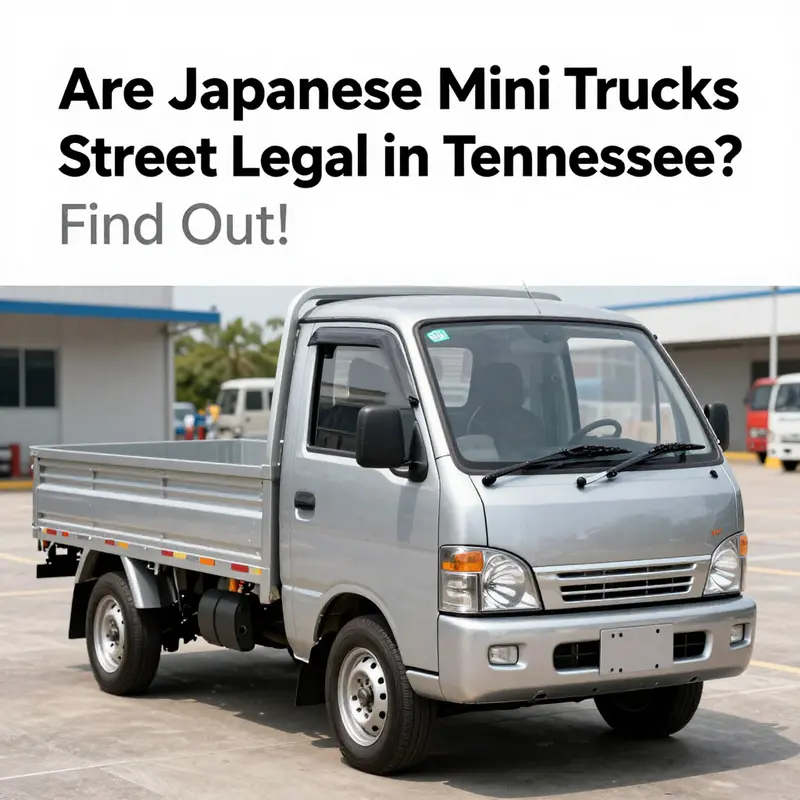
On Tennessee roads, the question of street legality for Japanese kei trucks hinges on a careful balance of import rules, federal safety standards, and Tennessee’s own inspection and registration regime. Ownership on private property is straightforward for any vehicle that can be legally imported, but turning a compact Japanese mini truck into a usable commuter on state highways requires navigating a web of rules that were not written with such vehicles in mind. Kei trucks—compact by any standard, typically under ten feet in length and powered by tiny 660cc engines—sit at the intersection of curiosity and regulatory scrutiny. They offer utility in tight spaces and off-road work, yet their very design raises questions about highway safety, which is exactly what Tennessee regulators scrutinize when a vehicle seeks to share public roadways with full-sized cars and trucks. The resulting landscape is not a simple yes-or-no verdict on street legality; instead, it is a layered process in which federal rules and state requirements interact, sometimes harmoniously and other times contentiously, to determine whether a given kei truck can be registered, insured, and lawfully operated on Tennessee streets. For readers who want to dive deeper into the lived experience of this niche, many hobbyists reference broader discussions in community blogs that collect practical insights, including discussions that tie back to the Tennessee context. minitrucksocala.com/blog/ This kind of resource helps flesh out how enthusiasts interpret the rules in different counties and how practical considerations—such as lighting upgrades, signaling, and inspection readiness—play out in real life. Still, even with online guidance, the legal pathway remains anchored in formal requirements that cannot be bypassed by enthusiasm alone.
A central pillar in Tennessee’s framework is the 25-year rule that governs emissions for imported vehicles. Under federal policy, vehicles that are at least 25 years old, counted from the year the model was manufactured, can be imported and registered in many states without meeting current U.S. emissions standards. This provision, often cited by importers and collectors, creates a potential doorway for older kei trucks originating from Japan. However, the existence of a federal emissions exemption does not automatically render a kei truck street-legal in Tennessee. Emissions compliance exists alongside safety standards, and Tennessee maintains its own set of requirements that vehicles must satisfy to be registered for public road use. In practice, this means a kei truck that qualifies under the 25-year rule may still need to demonstrate that it meets basic federal safety standards set by the National Highway Traffic Safety Administration (NHTSA). These standards cover essential systems that affect occupant protection and general roadworthiness, such as seat belts, lighting, and crashworthiness. The alliance between federal safety obligations and state registration criteria ensures that even older imports retain a baseline of safety that aligns with broader U.S. highway expectations.
The safety picture, therefore, is not simply a matter of whether a vehicle can meet modern emissions rules. It also requires evidence that the kei truck has, or can be equipped with, the safety features that U.S. regulators expect in everyday traffic. Seat belts are a non-negotiable in most jurisdictions, and Tennessee follows the federal lead that any passenger vehicle should provide reliable restraint systems. Lighting is another focal point: headlights that illuminate adequately, functional turn signals, and proper brake lights are part of the baseline that enables other drivers to anticipate the kei truck’s movements. The regulations also implicitly address crashworthiness, asking whether the vehicle’s structure and components provide a reasonable degree of protection in the event of a collision. It is worth noting that many kei trucks, especially older Japanese models, were not built with the same emphasis on airbags or advanced crumple zones found in later U.S. and European designs. This discrepancy often becomes a practical hurdle rather than a theoretical one. Tennessee inspectors and licensing officials take these factors into account during the registration process, weighing the vehicle’s overall safety profile against the state’s own standards and the federal expectations that apply to imported vehicles.
Even when a kei truck passes the federal safety test and the 25-year emissions exemption applies, Tennessee adds its own layers of review. State-specific modifications may be required to ensure the vehicle aligns with local safety and emissions regulations before the vehicle can be registered for street use. In some cases, jurisdictions may require functional turn signals, proper headlamps, and validated brake lights. These components, which might have been rudimentary or absent on a vintage Japanese model, become a litmus test for whether the vehicle can be safely integrated into Tennessee’s traffic ecosystem. The challenge is not merely at the point of import or title transfer; it is ongoing throughout the inspection and registration process. A kei truck that clears the federal gates can still be turned back at the state line if it fails to meet Tennessee’s inspection criteria, or if it cannot demonstrate that essential systems are compliant and operable.
From a practical standpoint, the roadworthiness question for kei trucks in Tennessee hinges on how they are used. A vehicle that is legally registered for street use must prove its suitability for public road conditions, which are far different from off-road or private-property environments where a kei truck might otherwise shine. The short wheelbase, light mass, and modest power output inherent to these vehicles can limit highway performance and maneuverability, especially on longer trips or in heavy traffic. This reality informs how authorities assess the vehicle’s readiness for public roads. It also shapes how owners and importers approach the process: not only to satisfy the letter of the law but to ensure that the truck can operate reliably and predictably in the kinds of driving scenarios that Tennessee drivers encounter regularly. In this context, a kei truck’s viability on Tennessee highways becomes a function of thoughtful preparation, careful compliance, and ongoing maintenance.
To navigate this terrain successfully, prospective owners typically begin with the federal framework and then align it with state procedures. They consult with the Tennessee Department of Safety and Homeland Security (TDOSHS) or a licensed importer who understands the nuances of both the 25-year rule and the state’s inspection criteria. These steps can include compiling documentation of the vehicle’s age and origin, confirming that essential safety features exist or can be added, and planning for any necessary electrical or lighting upgrades. The practical takeaway is clear: a kei truck may be permissible on Tennessee roads under certain conditions, but those conditions demand a precise alignment of parts, paperwork, and compliance checks that can be as exacting as they are essential. For readers seeking a broader sense of how these issues play out in everyday scenarios, exploring community discussions and case studies can be informative. They illuminate the kinds of adjustments owners commonly undertake to meet Tennessee’s criteria, from upgrading lighting and signaling to verifying that the vehicle passes a state inspection. And while such sources can offer useful context, they should complement, not replace, official guidance from the TDOSHS, which provides the current rules and the latest interpretations.
The regulatory journey for kei trucks in Tennessee also emphasizes the importance of due diligence. Before an import, a potential owner should verify that the vehicle will not only clear federal safety requirements but also satisfy Tennessee’s specific expectations for inspections and registration. This due diligence often involves coordinating with a registered importer who understands the choreography of paperwork, VIN verification, and compliance testing. It also supports safer outcomes for all road users, ensuring that the kei truck’s ability to perform its intended tasks does not come at the expense of basic public-safety norms. The broader aim is to reconcile the appeal of these compact workhorses with the state’s commitment to safe, predictable, and legally compliant road use.
For readers interested in further context, a broader examination of how the 25-year rule intersects with state requirements can be enlightening. It helps explain why ownership on private property remains straightforward, while on-road use requires a much more deliberate, regulated path. As you weigh the option of bringing a kei truck into Tennessee, consider both the practical realities—the vehicle’s size, power, and handling—and the regulatory realities—the need to align with federal safety standards and state inspection criteria. This integrated view helps demystify the street-legal question and clarifies what steps are necessary to move from interest to legitimate road use. And it reinforces the idea that curiosity about kei trucks in Tennessee should be paired with careful planning and professional guidance to ensure that all regulatory bases are covered.
In closing, the pathway to street legality for Japanese mini trucks in Tennessee is not a simple clearance slip but a structured process that couples federal safety requirements with state-specific modifications and inspection criteria. It is entirely possible, under the right conditions, to register and operate a kei truck on Tennessee roads, but such an outcome hinges on rigorous compliance, thoughtful preparation, and ongoing attention to regulatory updates. Those who pursue this route should remain mindful that the rules can evolve, and staying informed—through official channels and trusted importers—remains essential. For ongoing reading and practical perspectives, the internal link above points to a resource where enthusiasts share ideas and experiences, which can complement the formal information provided by state agencies. And for authoritative guidance on vehicle registration and inspection, refer to the official Tennessee safety portal. External resources can provide a broader framework, but the formal requirements will always anchor the process to what is legally permissible on Tennessee’s streets.
External link for further reference: https://www.tn.gov/safety
Final thoughts
In summary, while Kei trucks offer tremendous utility and charm, navigating the complexities of their legality in Tennessee requires knowledge of ownership laws, regulations for road use, and safety standards. As mini truck enthusiasts or business owners, being informed helps ensure you can enjoy your vehicles responsibly and legally. Always consider consulting local regulations and the Tennessee Department of Safety and Homeland Security for the most current guidance specific to your needs and circumstances.