
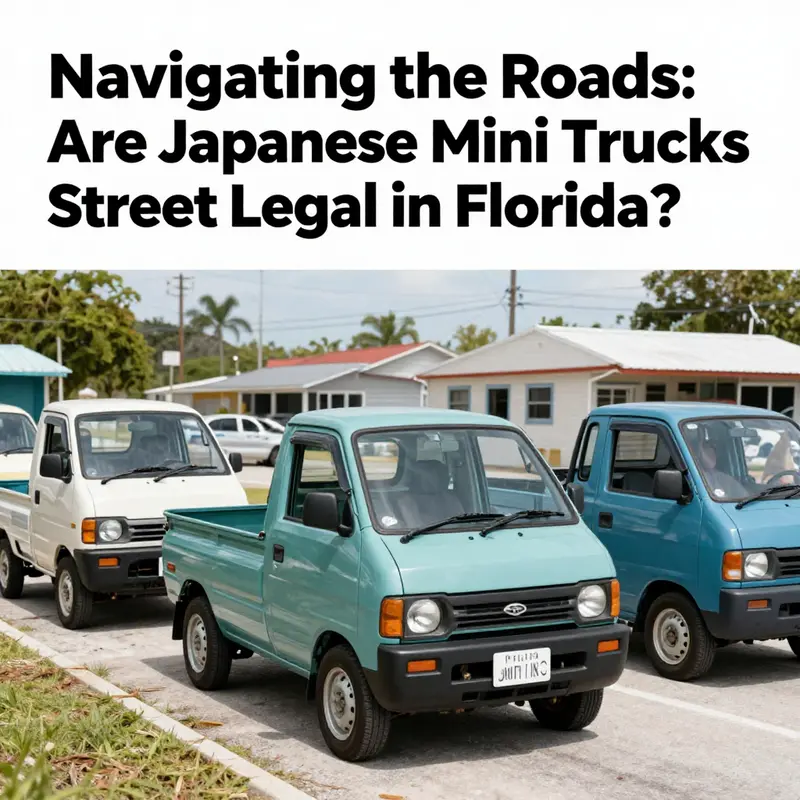
Japanese mini trucks, particularly Kei trucks, have gained popularity among local small business owners, residential property owners, and enthusiasts in Florida. While these compact vehicles are known for their practicality and versatility, the path to making one street-legal involves understanding various regulations. This article will guide you through three critical areas: federal compliance, importation requirements, and the registration process. By the end, you will have a comprehensive understanding of how to navigate Florida’s legal landscape to enjoy your mini truck on the road legally.
Beyond the 25-Year Rule: Navigating Federal Standards and Florida Inspections for Japanese Kei-Class Mini Trucks
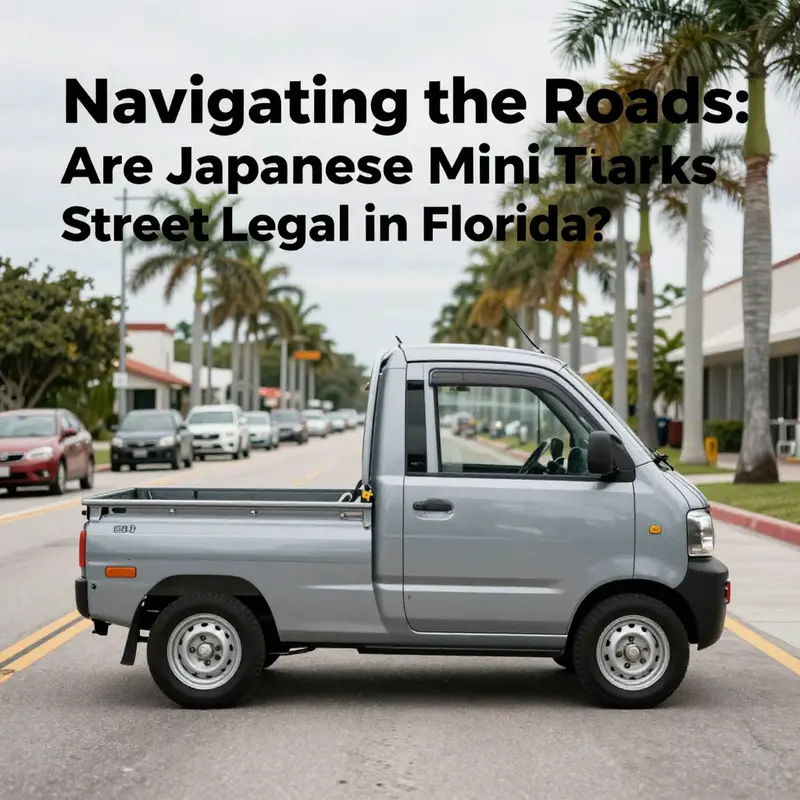
The allure of Japanese kei-class mini trucks sits at an intersection of practicality, craft, and regulatory navigation. They are small, nimble workhorses designed for tight urban alleys and rugged farm lanes alike. Yet the question of whether these diminutive vehicles can be driven on Florida streets is not a simple yes or no. It hinges on how federal safety and emissions policies interact with state registration rules, and how the vehicle in question was built and kept over time. In Florida, as in much of the United States, the path from import to road-ready is shaped by a layered system: federal standards that govern whether a vehicle can even be sold or imported into the country, and state rules that determine whether a vehicle can be legally titled, insured, and operated on public roadways. The critical hinge point remains the so-called 25-year rule, which acknowledges that vehicles manufactured more than 25 years ago can be imported without needing to meet current federal safety and emissions standards. But that federal openness does not automatically unlock Florida registration, not by a long shot. The story is less about a single regulation and more about how a vehicle’s age interacts with the precise language of safety inspections, emissions testing, and the patchwork of state requirements that govern what actually gets driven on Floridian streets.
To begin with, the federal framework creates the backdrop. The U.S. Department of Transportation and the Environmental Protection Agency set the safety and emissions rules that apply to new vehicles and to imported ones. In practice, this means that modern, post-25-year vehicles must comply with a broad set of FMVSS standards and federal emissions limits in order to be marketed domestically. The 25-year rule is a carve-out that recognizes the historical context: many older vehicles were built to standards that preceded the current, sometimes more stringent, federal regime. The logic is straightforward but not simplistic. If a kei-class mini truck was manufactured before the threshold date, it may be imported without having to demonstrate compliance with the latest FMVSS and EPA rules. However, import is only the first gate, and it does not endow a vehicle with a free pass to use Florida’s public streets.
The first critical distinction concerns the moment a vehicle arrives on U.S. soil. The federal exemption applies to importation, not to the ongoing operation of the vehicle on U.S. roads. Even when a vehicle qualifies for import under the 25-year rule, it is subject to state-level processes that verify that the machine still meets road-traffic expectations in the country that will use it. In Florida, that means a careful, often exacting inspection regime administered by the Department of Highway Safety and Motor Vehicles (DHSMV). The Florida process focuses on a practical set of safety features and verifiable compliance with standards that are presumed in a modern fleet. It is not about nostalgia or the novelty of a kei-class silhouette; it is about ensuring that every vehicle on the road provides predictable lighting, reliable braking, proper seat belts, and a baseline attitude toward safety that matches Florida’s operating environment.
What this means in concrete terms is that even a kei-class mini truck that is comfortably older than 25 years can still be refused registration if it fails to meet Florida’s safety expectations or cannot be demonstrated to be in a condition that is safe for public roads. The inspection process looks for basic but non-negotiable features: functional lighting and signaling systems that comply with applicable standards, seat belts that are present and operable, proper turn indicators, tail lights, and reflectors that meet visibility requirements, and the general road-worthiness that keeps the vehicle from becoming a hazard in traffic. The emphasis is not a fascination with the vehicle’s origin, but a pragmatic assessment of its capacity to participate in a modern traffic environment. For many kei-class trucks—designed decades ago for different road conditions and regulatory landscapes—the gaps between their original configuration and current U.S. requirements can be significant.
The tension between import permissiveness and registration rigor deepens when one considers the kind of safety architecture that U.S. standards typically require. Modern FMVSS compliance often includes crash protection systems, frontal and side-impact protection considerations, and advanced restraint systems that might not be present in older Japanese kei-class designs. In the United States, these measures have evolved to address a broad range of real-world crash scenarios and the diverse mix of vehicles on the road. Kei trucks, originally engineered for narrow streets and light-duty work, sometimes arrive with a simpler, more utilitarian approach to safety features. The question Florida regulators pose is whether those features, as installed or as capable of installation, satisfy a baseline safety expectation for passenger vehicle operation on a public road. The state’s inspection and registration framework is designed to catch basic deficiencies, but it can also demand modifications to bring a vehicle up to the expected standard. The practical implication is that even with the 25-year import pathway, the vehicle’s ongoing viability on Florida roads may hinge on whether owners are prepared to retrofit or adjust the vehicle to meet those expectations.
The regulatory landscape in Florida also reflects a broader national conversation about how to balance private hobbyist imports with public safety. Some states have taken a more permissive approach to older Japanese-made, small-displacement vehicles. Texas, for example, passed legislation in 2023 (commonly cited as Senate Bill 1816) that created a pathway for certain smaller, Japanese-made vehicles to be licensed more readily based on engine displacement and top speed. That approach recognizes a specific profile for these vehicles and, in effect, creates a narrow corridor through which a subset of kei-class or kei-like imports can be registered and operated with fewer hurdles. Florida, however, has not enacted a comparable regime. The absence of a Florida-specific legislative framework means that importers and prospective owners must treat the 25-year rule as a federal opening and must then navigate Florida’s own inspection and registration stipulations on a case-by-case basis.
This lack of a Florida-specific workaround reinforces a practical reality: the pathway to street legality in the Sunshine State for an older Japanese micro-truck commonly starts with a candid assessment of the vehicle’s current condition. The inspection will verify that it still functions as a roadworthy vehicle. It will test the lights, including headlamps, tail lamps, and turn signals, and will check that lighting complies with applicable standards for road use. It will assess the braking system to ensure it can respond predictably in different traffic scenarios, and it will examine the steering and suspension for reliable control. The inspector will also verify that the vehicle has seat belts that are functional, a fundamental safety requirement in almost every modern regulatory framework. And the emissions question will rear its head in at least some testing regimes or in documentation associated with the vehicle’s age and origin. A vehicle that cannot demonstrate passable performance in these domains will encounter a roadblock that is not easily overcome by nostalgia or by the charm of a kei-class silhouette.
To the would-be owner, this is an invitation to view the process in terms of value, risk, and planning. The 25-year rule opens a door; Florida’s inspection regime determines how far through that door one can proceed. This is where the practical economics of ownership come into play. If a kei-class mini truck is to be registered and driven in Florida, the owner must often assess the cost of bringing the vehicle up to a configuration that passes inspection. This can mean procurement of replacement panels to address rust or structural concerns, updating lighting to meet current standards, ensuring seat belts are installed or refurbished, and potentially addressing any emissions-related issues with the vehicle’s existing exhaust and engine management systems. The task is not merely a matter of shipping the vehicle into the country and presenting a title; it is a multi-layered project that requires careful budgeting, technical assessment, and often negotiations with import specialists who understand both the federal exemptions and Florida’s specific red tape.
Given this reality, many enthusiasts begin by framing the discussion around what is feasible in Florida. A vehicle that is older than 25 years may be legally importable, but its road-readiness depends on whether the owner is prepared to undertake the necessary retrofit work and to present documentation that shows the vehicle meets Florida requirements. The car may need to prove that it is not only old but also safe. In practice, this sometimes means that the path to street legality in Florida resembles a two-track journey: one route is the straightforward, legally permissible import under the federal 25-year rule, and the other route is the more onerous state-level process that argues for compliance through retrofitted safety features and verified performance. The difference between these routes is often the cost point that separates a dream from a practical project.
The narrative of Florida’s regulatory stance is not a static one. It evolves with how regulators interpret safety and emissions in the context of imports. The absence of a state law mirroring Texas’s 2023 reform means thatFlorida’s gatekeeping remains active, but it also means that the door is not permanently closed. For the person who is genuinely committed to a kei-class mini truck as a street vehicle, the journey begins with accurate, up-to-date information. It is essential to confirm the vehicle’s year of manufacture, verify that it is eligible under the 25-year rule, and then engage with a Florida DHSMV professional or an authorized importer who can provide guidance on whether the vehicle can be registered given its current state or with the proposed modifications. The process can be technical and time-consuming, but it is not impossible. It requires a clear-eyed assessment of the vehicle’s condition, a realistic appraisal of retrofit costs, and a willingness to navigate government processes that are designed to protect operators and passengers as well as the public on the road.
In the broader context of how these vehicles are regarded by communities of enthusiasts and import specialists, there is a recognition that the kei-class category represents a niche within a larger dialogue about mobility, cost of ownership, and the shifting needs of transport in different regions. Some hobbyists view these vehicles as a clever solution for light-duty tasks, with the added appeal of unique styling and cultural resonance. Others emphasize the important lesson that safety and compliance cannot be sidelined for the sake of novelty. The Florida experience, in particular, underscores this balance. It reveals that the willingness to explore import options must be matched by a disciplined approach to compliance and safety verification. The 25-year rule is not a surefire guarantee of street legality; it is a doorway that opens only so far, and then the further steps depend on state regulation, vehicle condition, and the practical realities of road safety.
For readers who want to explore further and gauge how a community of like-minded enthusiasts navigates these issues, there is value in referring to broader discussions in the hobbyist landscape. The central hub for the community offers a space where people share insights about importing, evaluating, and restoring kei-class vehicles for use on public roads or for specialized roles on private property and rural routes. Engaging with that community can help a prospective owner understand what kinds of modifications have been successful, what documentation tends to be most persuasive in inspections, and what the common pitfalls are when attempting to register a vehicle that originated outside the United States. The conversation is not merely about compliance; it is about a practical synthesis of heritage, utility, and safety that makes sense within Florida’s regulatory framework.
As this chapter underscores, the federal and state dimensions of this issue are tightly interwoven. The 25-year rule provides a federal anchor, but Florida’s registration regime determines the actual day-to-day reality of driving a kei-class mini truck on public roads. The absence of a space-making Florida statute means that owners must invest in due diligence, seek professional guidance, and be prepared for a potentially costly retrofit if the vehicle’s current configuration does not align with safety and emissions expectations. For some, this is an inviting challenge—a project that blends mechanical curiosity with regulatory navigation. For others, it might be a deterrent, prompting a shift toward alternative uses, such as private property work, off-road adventures, or community-supported, low-speed demonstrations that do not require a full road-legal status. Either way, the core message remains consistent: the path from import to street use in Florida is not a single decision but a careful sequence of checks, upgrades, and confirmations that the vehicle can safely operate within Florida’s roads and around its diverse mix of drivers and pedestrians.
In the end, the 25-year rule remains a crucial hinge. It is the doorway through which older, Japanese-made micro trucks may enter the country, and possibly enter Florida’s driving ecosystem. But the door is not a guarantee of legal street use. The subsequent steps, and their costs, rest with the vehicle’s current condition, the specific safety and emissions requirements in force at the time of registration, and the willingness of owners to engage with professional import specialists who understand how to align a vehicle’s history with Florida’s inspection standards. It is this alignment, rather than nostalgia alone, that determines whether a kei-class mini truck can finally share Florida’s roads. For anyone considering this route, it is wise to begin with a candid assessment, consult with a Florida DHSMV representative or an experienced import professional, and be prepared for a measured, multi-step process rather than a single, simple approval.
To connect with a broader community experience and gain practical insights that align with Florida’s regulatory environment, readers can explore ongoing discussions and case studies in the community hub for small-truck enthusiasts. This resource offers perspectives from people who have navigated import, inspection, and registration challenges in various jurisdictions, including how adjustments to lighting, safety equipment, and documentation have helped many owners move from intent to road use. For a deeper dive into the community’s practical considerations and real-world outcomes, see the hub’s main blog repository. minitrucksocala.com/blog
Finally, for anyone seeking the official, governing guidance that anchors these discussions, Florida’s Department of Highway Safety and Motor Vehicles provides the regulatory frame and the current expectations for inspection and safety compliance. This is the primary point of reference for understanding what Florida requires, how inspections are conducted, and what documentation is necessary for a vehicle to earn a title and license for street use. The DHSMV’s portal offers access to forms, checklists, and contact information for the relevant offices that handle the import, inspection, and registration process. As regulations evolve, staying informed through official channels is essential for anyone seriously considering bringing a kei-class mini truck into Florida and attempting to operate it on public roads.
External resource note: For official guidance, refer to the Florida DHSMV at https://www.flhsmv.gov/.
Crossing the 25-Year Threshold: Florida’s Practical Path to Street-Legal Japanese Mini Trucks
A small pickup from a distant shore can carry a surprising amount of local color. In Florida, where open roads meet bright, humid mornings and the staccato of diesel and gasoline engines, the idea of a Japanese mini truck rolling along public streets invites a blend of curiosity and pragmatic caution. These compact workhorses, born under a very different regulatory climate, carry a distinct charm: utilitarian design, efficient footprints, and a willingness to squeeze into tight job sites or chilly early mornings with a stubborn reliability. Yet charm does not automatically translate into street legitimacy. The road system is built on a tangle of federal standards and state rules, a framework designed to ensure safety and environmental protection for drivers, pedestrians, and communities alike. For anyone considering bringing a kei-style pickup into Florida traffic, the questions are not merely about how it might perform on a rural back road, but how it can be imported, registered, and legally operated within the state’s regulatory spectrum. The core answer hinges on a key date and a set of practical steps that align an older vehicle with modern expectations. The 25-year rule—often described as a broad exemption in import circles—frames the long arc of legality. Vehicles manufactured more than 25 years prior to the present are exempt from the federal safety and emissions standards that govern new and newer cars, and this exemption opens a pathway for personal import with significantly fewer federal modifications. As of 2026, that line in the sand sits at February 27, 2001. Any Japanese mini truck built on or before that date can, in principle, be imported into the United States and registered in Florida, provided it clears a separate, state-level set of requirements. The practical implication is that the lineage of a kei truck, once it crosses the ocean and lands on Florida soil, becomes less about meeting modern federal technology mandates and more about proving age, mechanical soundness, and compliance with state registration norms. The narrative that follows weaves together the federal framework and Florida’s administrative reality, showing how a vehicle born into a different regulatory epoch can still find a place on the Sunshine State’s streets. It is a story of timing, documentation, and the patient work of alignment—first with the letter of federal policy, and then with the precise steps Florida requires to turn an imported vehicle into a titled, road-legal asset. In practice, the import pathway is not a one-size-fits-all corridor; it demands careful planning, honest appraisal of the vehicle’s condition, and realistic expectations about the work needed to meet state requirements. The allure of a compact, nimble truck is unmistakable—especially in a state where urban sprawl, coastal terrain, and rural miles all demand a vehicle that can maneuver efficiently while delivering payloads in a way that doesn’t drain fuel or complicate daily life. The psychological appeal of these vehicles—albeit modest in horsepower and contemporary appearance—often outpaces the bureaucratic realities, which are less about cool factor and more about safety, compliance, and accountability on the road. The federal framework is precise about the baseline: if a vehicle cannot comply with FMVSS, it cannot be imported as a new on-road vehicle. The 25-year rule creates a critical exception, but it does not erase the need for due diligence. It is important to understand that the exemption is not a blanket pass for all aspects of operation. Even when a vehicle is exempt from federal safety and emissions standards, Florida’s DHSMV (Department of Highway Safety and Motor Vehicles) and related agencies still require a process that demonstrates the vehicle’s age, its mechanical viability, and its readiness for the responsibilities of public driving. This creates a two-layered pathway: first, the federal allowance that the vehicle’s age grants; and second, the state’s validation, which confirms that the vehicle is legally operable within Florida’s jurisdiction. The layers are not adversarial; rather, they are complementary, and success hinges on compliance across both domains. The journey begins with a precise determination of the vehicle’s age. Owners or importers must document the manufacture year, provide a bill of sale, and show proof of foreign registration to establish an unbroken chain of ownership and origin. These documents are not mere formalities; they are the essential evidence that a vehicle is indeed a product of a bygone era that qualifies for exemption from certain federal requirements. In many cases, the import process also invites consultation with professionals who specialize in international vehicle transfers. An authorized importer, a broker, or a knowledgeable attorney can offer clarity on the specific paperwork, timelines, and fees involved. The Florida-specific steps then translate that federal exemption into practical registration; this is where the narrative becomes more concrete and less theoretical. The Florida DHSMV is responsible for issuing a title and registration that allows the vehicle to be driven on public roads. Even with the 25-year exemption, the state imposes procedural checks designed to ensure safety and technical reliability. The vehicle must pass a state inspection focused on basic safety criteria and mechanical soundness. Some nuance exists regarding emissions: Florida’s approach recognizes that vehicles that fall under the 25-year exemption are not subject to current federal Emissions Standards as part of import compliance. However, Florida’s inspection regime may still probe emissions-related aspects if applicable to the vehicle’s age or configuration. In practice, this means that the vehicle must be mechanically sound, have functioning safety equipment, and exhibit reasonable emissions behavior for its age, though the precise thresholds will depend on current state regulations and the vehicle’s particular circumstances. This inspection is not a mere formality; it is the gatekeeper of registration, translating the federal exemption into lawful operation within Florida’s borders. The documentation package works in tandem with the inspection. A bill of sale or invoice, proof of foreign registration, and the completed Application for Certificate of Title (the state form required for title transfers) all feed into the DHSMV’s records. Fees and taxes accompany the process, as they do with any vehicle registration in Florida. The amount is a practical reminder that road access comes with responsibilities beyond the vehicle’s mechanical condition. The state’s rules recognize the realities of a diverse vehicle fleet in a growing state, where personal utility vehicles, farm-use vehicles, and compact trucks from abroad all seek appropriate channels to reach the market. The 25-year rule is not a license to ignore safety; rather, it acknowledges that vehicles from a different era may present a different baseline for compliance and performance. It is also a reality check on the part of the importer. Older equipment often needs attention in areas that modern standards address implicitly—framing, seatbelts, lighting, wiper functionality, braking performance, and reliability under heat and humidity. For the Florida driver, the practical implication is a demand for diligence. It is not enough to claim age; one must demonstrate that the vehicle is fit for public road use. This is where the role of an import specialist can become especially valuable. An expert can interpret the overlap between federal exemptions and state requirements, identify the documentation gaps, and anticipate potential hurdles in the inspection phase. They can also help gauge whether the vehicle has undergone repairs or modifications that affect its eligibility. The practical reality is that not every 25-year-old kei truck will automatically become a highway-ready Florida vehicle. Some will require careful assessment and perhaps restoration to typical safety and mechanical benchmarks. The goal is not to transform the vehicle into something modern or compliant with today’s FMVSS standards, but to ensure it meets Florida’s safety expectations and that the title and registration process is handled properly. The narrative around importation is also a reminder that the 25-year rule exists within a broader traffic safety ecosystem. Even with exemption from federal standards for the oldest vehicles, the road remains a shared space with other drivers, pedestrians, cyclists, and municipal operations. That shared space justifies the state’s insistence on clear documentation and a sound mechanical condition, ensuring that a vehicle from another country can operate without imposing undue risk on others. For readers who want a practical starting point, a reliable source of practical guidance is a good first stop. A comprehensive blog that focuses on the world of mini trucks can provide nuanced, down-to-earth insights about the importing process, common pitfalls, and the day-to-day realities of ownership. While the conversation often veers into legal and bureaucratic detail, it remains anchored in the everyday experiences of people who have chosen to pursue this path. The blog compiles anecdotes about what to expect during the inspection, how to prepare the necessary documents, and what common inspection items to anticipate. It also offers a sense of the community surrounding these vehicles—owners who value the efficiency, simplicity, and charm of a compact pickup that smiles at narrow streets and crowded job sites in equal measure. For readers who want a direct starting point into this world, exploring the Mini Trucks Blog can be a useful step. The blog’s broad coverage reflects the community’s shared experiences and practical advice, helping to translate regulatory language into concrete actions. The existence of such a resource underscores how a niche pursuit evolves into a broader, more accessible hobby or lifestyle. It creates a bridge between the dream of owning a kei-style truck and the reality of making it work within Florida’s rules. In this chapter, the key is to balance aspiration with procedure. The 25-year rule invites a specific category of vehicles to enter the United States with fewer federal hurdles, but it does not replace the necessity of state-level compliance. The journey from import to registration is a careful choreography: establish the vehicle’s age and origin; verify that the essential documents trace a legitimate ownership chain; prepare a bill of sale and proof of foreign registration; complete the state title application; and then pass the reliability and safety checks that Florida requires. It is a process that rewards preparation and honest assessment. The end result—a legally drivable, Florida-registered vehicle—depends on aligning the realities of an older vehicle with the state’s expectations, rather than attempting to retrofit modern compliance without the appropriate federal basis. The practical takeaway for anyone considering this path is to approach the project with a clear plan and a willingness to engage professionals who understand the cross-border dimension of vehicle ownership. The import process is more likely to smooth out when the importer observes that Florida’s registration system is robust, not hostile to difference, and designed to maintain public safety while allowing for a diverse set of vehicle types on the road. This careful balance—between official exemptions and required inspections—exists because the road is a shared space and because a vehicle’s age does not diminish the responsibility that comes with being on public streets. It is a reminder that legality is not a single checkbox but a holistic process of documentation, verification, and safe operation. In the broader picture, this journey also reflects Florida’s particular regulatory culture: a state that values practical access to practical vehicles while maintaining robust oversight to protect road users. The 25-year rule is the gateway; the state inspection, documentation, and registration steps are the path that keeps that gateway secure and navigable. Those who navigate it successfully often do so with a blend of patience, professional guidance, and a willingness to respect the legitimate concerns of modern traffic management. The result is the realization of a long-held interest: a compact, economical Japanese mini truck that can rightfully share Florida’s highways with other vehicles, as a legal, road-ready asset that respects both its heritage and the jurisdiction that now governs its daily use. For readers who want to see how this plays out in practice, and to gain a more grounded sense of the steps and expectations, the community resources mentioned—along with official channels—provide a practical compass. The federal perspective remains essential to understanding why those older vehicles can be imported in the first place, while the Florida-specific procedures explain how to complete the journey from foreign import to locally licensed vehicle. As with any cross-border automotive pursuit, success hinges on attention to detail, timely action, and a willingness to collaborate with professionals who know the terrain. For those who are ready to dive deeper into the specifics and to begin mapping out a practical plan, the path is clearer than it might seem at first glance. The 25-year threshold is not a distant ideal; it is a real, actionable criterion that shifts a complex regulatory landscape toward a navigable route. The remaining steps—document gathering, inspection scheduling, title application, and fee settlement—are procedural but essential. They convert the romance of a compact truck from a romantic idea into a street-legal reality. If the goal is to have a workhorse that can navigate a Florida city or farm lane with the same efficiency it offered in its homeland, the 25-year rule provides a feasible starting point. It is not a guarantee of smooth sailing in every case, but it is a well-trodden path used by importers and enthusiasts who have walked the process before. The moral of the story is simple: the legal journey for a Japanese mini truck in Florida is ultimately about alignment. Alignment between federal age-based exemptions and state-level safety assurances. Alignment between thoroughly prepared paperwork and a thorough, honest assessment of the vehicle’s condition. Alignment between the dream of a compact, capable work vehicle and the realities of road safety and administrative diligence. In this sense, the Florida path is a disciplined, practical approach rather than a shortcut. It rewards those who invest time in understanding the rules, gather the right documents, and engage the right professionals to guide the process. For those who want to see how this alignment looks in day-to-day terms, the Mini Trucks Blog offers a window into the community’s experiences, challenges, and small victories as people work through imports, registrations, and the joy of owning a unique, efficient vehicle across oceans and counties. This is not merely about legal hurdles; it is about connecting a distant origin with a local road. It is about translating a vehicle’s legacy into a present-day utility that respects Florida’s safety norms while preserving the distinctive character of a compact, well-loved work truck. In the end, the answer remains pragmatic: yes, Japanese mini trucks that are more than 25 years old can be imported and registered as street-legal Florida vehicles, provided the owner completes the state’s registration steps, passes the required inspection, and maintains documentation that proves age and origin. Newer models face stiffer federal compliance requirements and may require modifications or other pathways to operate legally. The balance of risk, effort, and potential reward rests on the importer’s diligence, the vehicle’s condition, and the willingness of the buyer to navigate both federal allowances and state processes. The result, for the patient and well-informed, is a rare sight on Florida roads—a small, efficient vehicle that carries the story of its journey from a different regulatory era into a place where it can be enjoyed as a practical, legal, and appreciated contributor to the state’s vibrant driving landscape. For those who want authoritative, ongoing guidance beyond general summaries, the official federal resource on vehicle importation remains a critical touchstone and reference point. See the NHTSA’s vehicle importation guidelines for comprehensive details and current standards: https://www.nhtsa.gov/vehicle-importation
Crossing the 25-Year Bridge: Making Japanese Kei Trucks Street-Legal in Florida Without the Guesswork
The allure of Japanese kei trucks sits at an intersection of efficiency, charm, and practicality. In Florida, where roads stretch wide and weather invites outdoor work, these compact machines offer a unique blend of maneuverability and payload that can outpace larger trucks in tight spaces, while still hauling surprisingly robust loads. Yet allure alone does not confer legality. The journey from import curiosity to a Florida street-legal kei truck is shaped by age, paperwork, and the careful navigation of both federal and state requirements. The central premise is simple on the surface: in the United States, kei trucks can be lawful on public roads if they meet the relevant safety and emissions standards or qualify for age-based exemptions. In Florida, the practical doorway to road use hinges on one quiet but powerful rule—the vehicle must be at least 25 years old. That year marks a regulatory threshold that, for older kei trucks, often reconciles the vehicle with federal requirements by removing the need to meet current FMVSS (federal motor vehicle safety standards) and emissions standards. It is less a license to ignore standards and more a legal pass to rely on a historical standard that predated the current regulatory regime. This is not an invitation to overlook documentation, testing, or inspections; rather, it is a recognition that the legal landscape shifts once the calendar ticks into the 25-year mark, creating a predictable pathway to Florida registration and street use for older imports.
To understand the Florida pathway, one must first acknowledge the distinction between older imports and newer entries. Vehicles manufactured more than 25 years ago can often be imported into the United States without needing to demonstrate compliance with the modern federal safety and emissions rules. That rule—line in the sand for importers—significantly buffers 25-year-old kei trucks from the most stringent FMVSS and EPA testing regimes. It’s a practical bridge that recognizes the historical context of global automotive markets. For Florida residents and hobbyists who acquire a kei truck built before a specific year, that bridge becomes a handle on the door to the state’s roadways. The year-cutoff itself is inexorable: as of 2026, a kei truck manufactured before 2001 typically qualifies for the 25-year exemption. It’s a straightforward, if sometimes misunderstood, shortcut to legality, provided the vehicle’s condition, documentation, and origin can be verified with confidence.
Yet the 25-year rule is not a universal exemption that makes every old truck a free ride. A close look at the process reveals a layered sequence of steps designed to confirm that the vehicle is indeed what it claims to be, and that it can be safely operated in Florida’s traffic environment. The import and registration process begins long before a vehicle ever leaves a port or a seller’s lot. It begins with proof of age. The importer or owner must present documentation that confirms the vehicle’s year of manufacture. Original Japanese import invoices, a Japanese title, or other credible documentation that reveals the production year are essential. For a 25-year-old kei truck in Florida, that documentation supports the premise that the vehicle falls outside the reach of current FMVSS and EPA compliance requirements. It’s important to have this age verification on hand not only for the U.S. import process but also for the Florida DHSMV, which will scrutinize the vehicle’s age as part of the registration packet.
Once age is established, the next consideration is the importation pathway itself. In some cases, an Import Certificate of Conformity (ICC) from the governing federal agency is required to demonstrate compliance with certain standards. In the 25-year framework, however, the ICC requirement is frequently waived or deemed unnecessary because the vehicle is regarded as exempt from the current standards. This exemption is not a blanket guarantee, though; it remains subject to the exact year, documentation, and the vehicle’s conformity with a genuine historical standard. The practical upshot is that the older kei truck can be imported into the United States, and then brought into Florida with fewer federal hurdles than newer imports, provided the age claim is properly documented and the vehicle is otherwise fit for highway use.
With importation under way or completed, the Florida registration process becomes the next major milestone. The Florida Department of Highway Safety and Motor Vehicles (DHSMV) shoulders the responsibility of turning an imported vehicle into a legal street machine within the state. The paperwork to be submitted typically includes the foreign title, a bill of sale, and proof of importation. The presence of a foreign title is not merely a formality; it establishes ownership and offers a traceable linkage to the vehicle’s history, which the state requires for tax and title operations. The bill of sale serves as a financial trail, corroborating the chain of ownership and the vehicle’s value for tax purposes. Proof of importation demonstrates that the vehicle has legally entered the country and that it has been processed through the appropriate channels, which the state uses to authenticate the vehicle’s status.
At this stage, the inspection component may vary by county. Florida counties sometimes require a safety inspection even for older vehicles, despite the 25-year exemption from FMVSS conformity. This inspection acts as a practical safeguard, ensuring that critical safety features—such as lighting, brakes, and safety equipment—are up to standard for public roads. For kei trucks that fell into the older category, the inspection can be a pivotal moment: a clean bill of health allows the vehicle to carry out its daily duties, while a missed or failed inspection adds a layer of delay and potential additional work. The exact criteria and how strictly they are enforced can depend on the county and the local regulatory climate at the time of registration.
Taxes and fees are another predictable, if sometimes overlooked, part of the journey. Florida’s tax regime is nuanced by a combination of state and local levies. A state sales tax of 7 percent applies, with the potential for additional local taxes depending on the county and city of residence. Registration fees are assessed based on the vehicle’s value and weight, among other factors. These expenses should be anticipated in advance, not as an afterthought, because they can influence the overall cost-benefit calculus of bringing a kei truck into Florida road use. The costs are not merely bureaucratic hurdles; they reflect the state’s approach to balancing the practical value of a small, versatile utility vehicle with the need for a transparent, auditable registration framework.
All of this is the path, but the actual journey is frequently punctuated by practical realities that demand due diligence. The 25-year rule is a strong anchor, yet it does not absolve buyers of the need to verify the vehicle’s condition, ensure the VIN matches official records, and confirm that the vehicle has the documentation to survive not only the initial registration but also ongoing compliance checks. For instance, a kei truck may appear to be 25 years old but could carry a history that complicates title transfer—perhaps a prior title issue, a collision that altered the VIN, or an export record that does not align neatly with U.S. paperwork. These are not common, but they are the kinds of surprises that can arise when a vehicle is moved across borders. Addressing such issues early—before the vehicle is in Florida, before any registration tasks begin—saves time and reduces the risk of a stalled project.
Overall, the Florida pathway to street legality for Japanese kei trucks rests on a careful mix of age verification, proper documentation, and adherence to the state’s registration requirements. The 25-year rule is the essential lever; it enables many kei trucks to sidestep the most rigorous federal conformity checks. However, it does not replace the need for a comprehensive, well-documented import history, a clean title, and a compliant, verifiable vehicle condition. The process rewards those who approach it with patience and meticulous record-keeping, and it pays dividends in the form of a legally operating, economical, and surprisingly practical vehicle on Florida roads.
For readers who want to dive deeper into the philosophy of kei-truck culture and read about practical builds, modification choices, and real-world experiences, consider exploring a broader community resource at minitrucksocala.com/blog. This hub offers perspectives that illuminate why the 25-year rule matters in daily decision-making, how owners navigate the paperwork maze, and how a kei truck becomes a dependable partner in everything from farm tasks to weekend adventures. The literature and community insights can enrich the process, especially for first-time importers who must balance dream with due diligence. A careful reader will recognize that the practical route to Florida street legality is as much about paperwork discipline as it is about mechanical condition, and that the two are inseparable parts of the same journey.
The opportunity to bring a 25-plus-year kei truck into Florida is real, and for many, it represents a thoughtful intersection of fuel efficiency, urban practicality, and the charm of a vehicle that looks like a time capsule on wheels. The key is to respect the timeline of the regulatory framework, assemble the correct evidence of age and origin, and anticipate the county-level steps that might accompany the state’s requirements. The reward—a legally driven, compact workhorse that can tackle both suburban commutes and farm chores with equal ease—makes the careful, diligent approach worth it. It turns a curiosity into a daily driver and a piece of automotive history into a functional tool on the roads of the Sunshine State.
In navigating this path, there is no substitute for direct guidance from the Florida DHSMV and, when appropriate, an experienced import specialist. They can verify the exact documentation requirements for your vehicle’s year, assess whether any local inspection is mandatory, and provide up-to-date guidance on taxes and fees. While the general framework is stable, the specifics can shift with policy changes, local ordinances, or county-level interpretations. Proactive communication with the relevant authorities reduces delays and clarifies expectations. In practice, the most successful import-and-register stories are those that pair a well-documented age verification with a predictable inspection outcome and a transparent financial plan. The kei-truck dream—proof that a small, capable vehicle can operate legally in Florida—rests on this disciplined preparation, plus a respectful understanding of how federal, then state, oversight shapes the path from import to everyday driving.
External resource: For a broader, official reference on state guidelines and safety inspections, visit the Florida Department of Highway Safety and Motor Vehicles and the related state portal: Florida DHSMV guidelines. This resource provides current information on how Florida handles title transfers, registrations, and inspections for imported vehicles, including those that fall under the 25-year exemption. It is essential reading for anyone who wants to couple the practical steps outlined above with the most up-to-date regulatory context and to ensure that every box is checked before the kei truck hits Florida’s streets.
Final thoughts
The journey towards making a Japanese mini truck street-legal in Florida involves understanding federal regulations, navigating specific importation requirements, and successfully completing the registration process. By familiarizing yourself with these steps, you can enjoy the benefits of owning a practical and versatile vehicle while ensuring compliance with the law. Now that you’re equipped with this knowledge, it’s time to explore your options for getting that mini truck on the road!