

Japanese mini trucks, like the Suzuki Carry and Mitsubishi Minicab, have captured the hearts of many small business owners, residential property owners, and hobbyists in Louisiana. Yet, questions about their legality on public roads often arise. Living amidst scenic highways and bustling towns can spark excitement about whether these compact, efficient vehicles can join the roadways legally. The good news is yes—Japanese mini trucks can be street legal in Louisiana, but only under certain regulations. In this comprehensive guide, we will walk through everything you need to know, from understanding the regulations and the 25-year rule to the safety and emissions compliance requirements. We’ll delve into the procedures for importing these beloved vehicles and discuss how to navigate the necessary insurance and registration. By the end, you will be equipped with all the essential information to enjoy your mini truck to the fullest while staying compliant with Louisiana’s regulations.
Making Japanese Mini Trucks Street Legal in Louisiana: Rules, Risks, and Practical Steps
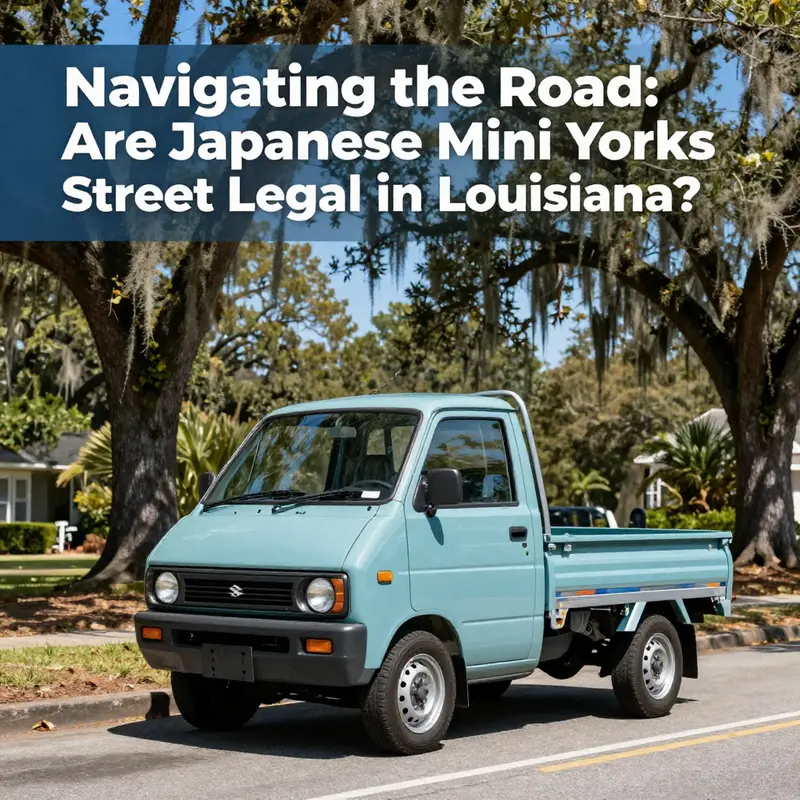
Understanding whether a Japanese mini truck can legally travel on Louisiana roads starts with two clear realities. First, federal rules control vehicle importation. Second, state rules control titling, inspection, and registration. Those two layers create a path for a mini truck to become roadworthy and legal. They also create hurdles that owners must navigate carefully.
At the federal level, the most important factor is the 25-year import exemption. Vehicles that are 25 years old or older bypass modern federal safety and emissions requirements. That exemption makes many older mini trucks eligible for importation and registration. It does not mean the vehicle is automatically street legal. It means the vehicle can enter the country without meeting current crash-test or emissions standards. Once in the United States, state agencies decide whether to allow registration and operation on public roads.
Louisiana does not have a single law that names mini trucks or exempts them by type. Instead, standard state rules apply to any motor vehicle brought into the state. To get a mini truck registered, owners must prove legal importation and ownership. Typical documents include a bill of sale, title from the country of origin, and customs paperwork. If documents are in a foreign language, a notarized translation is usually required. A specially completed import form is often part of this packet for vehicles that rely on the 25-year exemption.
A physical inspection is another key step. The inspection focuses on basic and essential systems. Inspectors check lights, turn signals, brake function, tires, steering, horn, and windshield condition. They look for visible safety issues. Louisiana may require verification that the vehicle’s identification number is clear and matches paperwork. If an inspection finds deficiencies, the vehicle must be repaired before registration. The goal is to ensure the vehicle can operate safely on public roads, even if it lacks modern crash protection.
Titling and registration follow successful inspection and documentation submission. Once the state issues a title, owners pay registration fees and obtain license plates. Insurance is also mandatory. Depending on insurer policies, coverage can be more difficult to secure for these vehicles. Some insurers consider mini trucks a higher risk due to their light weight and small size. Shop around, and be prepared to explain the vehicle’s use and safety features to potential insurers.
Practical safety considerations should guide every decision. Mini trucks were designed for low-speed, local work. Their compact frames often lack the structural protections common in modern vehicles. Many do not have airbags, and seat belts may be basic. Their top speed is usually lower than typical highway speeds. Driving a mini truck on high-speed interstates exposes occupants to increased risk. Owners should honestly assess where and how they plan to use these vehicles.
Modifications can improve safety and usability, but they come with rules. Upgrading brakes, installing brighter lighting, and adding safety belts are common practical steps. However, extensive modifications can affect eligibility for registration. Major changes that alter the vehicle’s classification may trigger additional inspections or paperwork. Always document modifications and, when possible, obtain written confirmation of compliance from a qualified mechanic. Keep receipts and technical specifications for any components added.
Vehicle classification matters. Louisiana assigns vehicle types based on weight and intended use. How a mini truck is classified will affect registration fees and regulatory requirements. Some owners register mini trucks as utility vehicles, while others use a standard light truck designation. Classification often depends on the vehicle’s gross vehicle weight rating and how the state interprets its design. When in doubt, consult the motor vehicle office for guidance before completing registration paperwork.
Insurance companies evaluate mini trucks differently. Some offer custom or specialty policies for older imported vehicles. Others may classify these trucks under commercial or recreational policies. Be explicit about your intended use. If you plan to use the vehicle for daily commuting, tell insurers. If it will be limited to off-highway or farm use, also state that. Misrepresenting use can void coverage and complicate claims.
Every owner should think about practical limits. Mini trucks perform best at lower speeds and over short distances. Long highway trips strain small engines and transmissions. Passing maneuvers become riskier at higher speeds. Visibility is limited compared to larger vehicles, and crash survivability is lower. Owners who accept these limits often find mini trucks ideal for tasks like local deliveries, farm work, neighborhood errands, and shows.
For those who want community knowledge, maintenance tips, or ideas for safe customization, the MiniTruckSoCal blog offers practical discussions and project examples. It is a good place to find hands-on accounts from owners who share lessons learned about inspections, parts sourcing, and sensible upgrades. Community experience can help new owners avoid common pitfalls.
Before making any purchase or import decision, verify current rules. Federal exemptions and state procedures change slowly, but small administrative updates do happen. Talking directly with the state motor vehicle office clarifies specific documentation and inspection expectations. A consultation with a licensed import specialist eliminates guesswork. They can review documents, confirm compliance, and explain how to navigate Customs and Border Protection procedures.
One more pragmatic step is to plan for long-term ownership costs. Older vehicles often require parts that are rare or imported. Maintenance may be more frequent than for newer, locally supported models. Consider storage, seasonal use, and access to a mechanic familiar with older imports. Budget for modifications that enhance safety. Those are investments in legal use and occupant protection.
In short, Japanese mini trucks can become street legal in Louisiana if owners follow federal import rules and meet state registration requirements. The 25-year exemption is the key federal pathway. State inspections, proper titling, and insurance complete the process. However, legality is only one part of the decision. Practical safety, proper use, and realistic expectations about performance must guide ownership choices. For official, up-to-date instructions and to begin registration, contact the Louisiana Office of Motor Vehicles directly: https://www.dps.louisiana.gov/omv/
Vintage in the Fast Lane: The 25-Year Rule and the Rebirth of Japanese Kei Trucks on Louisiana Roads
Louisiana has a way of making the road feel expansive and intimate all at once, a place where a small, boxy silhouette can carve a path through live oaks and broad marshes with a quiet confidence. In recent years, a new kind of traveler has found its way into the state’s steady stream of pickups, sedans, and SUVs: the vintage kei truck. These compact, purpose-built Japanese mini trucks once lived their lives largely out of sight, rarely sold in the United States and almost never considered for mainstream use. Then the 25-year rule arrived, a federal measure that shifted the terrain of import, ownership, and roadworthy status in ways that delighted enthusiasts and unsettled regulators in equal measure. The rule is straightforward on paper—it allows vehicles that are at least 25 years old to be imported into the United States without having to meet current federal safety and emissions standards. In practical terms, that means a truck built in 1999 or earlier can enter the country with far fewer regulatory hurdles, a welcome relief for collectors, restorers, and casual drivers who value charm, simplicity, and frugal efficiency. But the moment the kei truck crosses the threshold from import into everyday use on a Louisiana street, the story shifts. The federal exemption does not erase the responsibilities that fall to the state motor vehicle authorities, the insurers who underwrite the vehicle, or the safety inspectors who verify that every peppy light and bustle of a ride works as it should. The 25-year rule is a gateway, not a guarantee. And that distinction matters deeply in a state with its own particular regulatory texture and a climate that tests metal, rubber, and reflectors in fast, humid cycles.
The first place to look for clarity is the rule itself, which helps explain why these little trucks have become more than curios in places like Louisiana. The federal exemption is tied to time rather than to a compatibility check with modern design standards. Vehicles older than a quarter of a century are not automatically modernized by virtue of being older; rather, they sidestep the federal conformity gate that screens for current crash safety features and tailpipe emissions. This is a practical shift for importers and owners who want to preserve the character of a vehicle while still bringing it into the country. It also means there is a necessary synergy with state procedures that govern registration, safety, and insurance. In Louisiana, the journey from a foreign, older vehicle to a road-legal daily driver begins with the basics: title, ownership proof, and the right import documentation. A clean title proves ownership; a bill of sale or other proof establishes the chain of custody; and customs paperwork demonstrates that the vehicle cleared U.S. borders legally. These documents are not mere paperwork; they are the bridge between a vintage chassis and a plate on the wall of a modern garage.
To accompany the import papers, the vehicle must move through the Louisiana Department of Motor Vehicles in a process that is at once familiar and distinctive. The DMV wants a vehicle that can safely operate on state roadways, and it expects to see proof that the import was legal and that the owner has a plan for ongoing compliance. The safety inspection, a staple in many states, becomes a turning point for kei trucks. This inspection does not demand that the vehicle meet the latest crash standards but it does require that basic safety systems function properly. Lights, brakes, tires, steering, and windshield reliability are evaluated, and the inspector looks for the absence of dangerous corrosion or obvious mechanical failure. Even with a 25-year rule in play, a truck that rattles, misaligns, or leaks will not earn its Louisiana plate without attention. The emphasis is pragmatic: a small, nimble utility vehicle must be as reliable on a rain-drenched back road as it is in a Sunday cruise through a town’s historic district.
Insurance is another axis of the equation. In custody of an older, imported vehicle, the owner must demonstrate that the vehicle is insurable and that coverage will respond to typical risks encountered on Louisiana streets. This is not a formality; it is a practical assurance that the vehicle can be responsibly operated, with a legitimate means of recovery in the event of a claim. The insurance policy, in turn, informs how the vehicle is used—whether as a daily driver, a weekend toy, or a lightweight work companion. The alignment between DMV requirements and insurance coverage is essential. Without insurance, a title and a plate are just a promise that cannot be kept when the engine splutters to life in traffic.
There is a practical tension embedded in the process. Because the 25-year rule relieves the vehicle from current U.S. safety and emissions mandates, some owners assume that compliance is inherently automatic. In truth, compliance in Louisiana still hinges on ensuring that the vehicle passes a state inspection that confirms road readiness. A kei truck may pass visually and mechanically, yet the inspector will assess whether it meets basic state safety expectations. This often translates into ensuring the vehicle’s electrical system is intact, the braking system is responsive, and the tires are in a safe condition for the road ahead. The year of manufacture does not grant a free pass from inspection; it simply shifts the focus from compliance with a moving federal standard to the reliability of a vehicle that has traveled years, perhaps continents, to reach Louisiana highways.
The import journey also intersects with local culture and communities that have grown around these compact machines. In Louisiana, as in other states, enthusiasts exchange knowledge through online communities and in-person gatherings. The 25-year rule has given rise to a subset of car culture that values ingenuity, practicality, and the quirky charm of a vehicle with a small footprint but a big personality. Restorers talk about sourcing parts that were never intended for the American market, about adapting engines and drive trains to make old-school vehicles safer and easier to maintain, and about the simple joy of a vehicle that can be parked nearly anywhere, yet still feels capable of handling rural work and urban errand running with equal aplomb. The community aspect isn’t merely social; it is a collaborative forum where owners share photo documentation of their registrations, inspections, and travel routes, helping others navigate the labyrinth of paperwork that often accompanies an import vehicle. For readers seeking a sense of how these conversations unfold and what practical steps others have found effective, the broader kei-truck community’s online hub offers a window into the workflow of ownership. A simple entry point for this ongoing discussion can be found at minitrucksocala.com/blog/, where narratives, build logs, and restoration progress illuminate both the challenges and rewards of bringing a vintage Japanese mini truck into daily service in Louisiana (https://minitrucksocala.com/blog/). This is not a glossy advertisement; it is a living map of trial, error, and success built by people who care about utility, design, and the quieter pace of life that a small truck can suggest on a long Louisiana afternoon.
Beyond documentation and inspection, there is hardware to consider. The vehicle’s electrical accessories must be reliable, a task that is often straightforward on newer imports but may require careful attention on older chassis. Lights that illuminate the night, durable brakes that respond confidently in wet weather, and tires that grip the road on slick Louisiana surfaces are all essential. The inspection will catch glaring deficiencies, but the ongoing use of a foreign, older vehicle demands a steady rhythm of maintenance and part sourcing. Parts may come from overseas suppliers or specialized salvage yards; the ability to identify compatible components becomes as important as the initial registration. In practice, this means owners often develop a network that blends local mechanics with overseas vendors, a collaboration that ensures the old truck can remain a dependable participant in daily life, not a weekend novelty.
Another layer to consider is the vehicle’s practical fit within Louisiana’s roadscape. The kei truck’s small size yields an advantage in city streets and crowded neighborhoods, where parking and maneuverability are at a premium. The low weight helps with fuel economy, a factor that resonates in a state where fuel prices and environmental awareness are part of long conversations about transportation. But the compact footprint also means limited cargo capacity, fewer creature comforts, and the need to adapt to a weather system known for heavy rain and humidity. For someone who sees a kei truck as a clever utility tool rather than a status symbol, these trade-offs are a fair exchange for a vehicle with a storied past and a unique aesthetic. The 25-year rule thus serves not only as a regulatory doorway but as a cultural hinge, enabling a broader range of people to consider a different set of priorities when choosing a daily driver, a work companion, or a weekend project.
The regulatory landscape remains dynamic, and changes in interpretation or new policy tweaks can alter the journey from import to license plate. This is why the most reliable path is to connect with experienced import specialists or the state DMV directly to verify current expectations. The rule’s cardinal benefit—opening the door to a class of vehicles that were otherwise out of reach—rests on the willingness of owners to engage with a process that values persistence and preparation as much as it values nostalgia. In Louisiana, that interplay between federal eligibility and state accountability has given rise to a modest, patient optimism: a belief that a small, efficient, and character-filled vehicle can be a legitimate part of the road ecology. As more of these little trucks cross into the public orbit, they carry with them a sense of history: that the best tools for certain jobs are sometimes the simplest, and that simple design can still echo with the ingenuity of a different era.
For those seeking the most solid, up-to-date guidance, there is a straightforward resource provided by federal regulators on vehicle imports. It is the definitive reference that clarifies the scope of the 25-year rule, the documentation required for import, and the steps to align with state requirements. Reading this material alongside local guidance from the Louisiana DMV helps create a complete picture of what it takes to bring a vintage Japanese mini truck onto a Louisiana street and keep it there, legally and safely. The rule’s 25-year glow continues to draw curious drivers and restoration-minded enthusiasts into a shared space where history, practicality, and road-ready reliability converge on the same two-lane highways and quiet cul-de-sacs that define life in the Pelican State. And as the community grows, so too does the knowledge that these compact vehicles can be more than curios; they can be reliable, affordable, and endearing members of a diverse automotive landscape.
External resource: For official guidance on how the federal government handles vehicle imports, see the U.S. Department of Transportation’s vehicle imports page at https://www.transportation.gov/vehicle-imports.
Meeting Safety and Emissions Standards: The Practical Route to Making a Japanese Mini Truck Street Legal in Louisiana
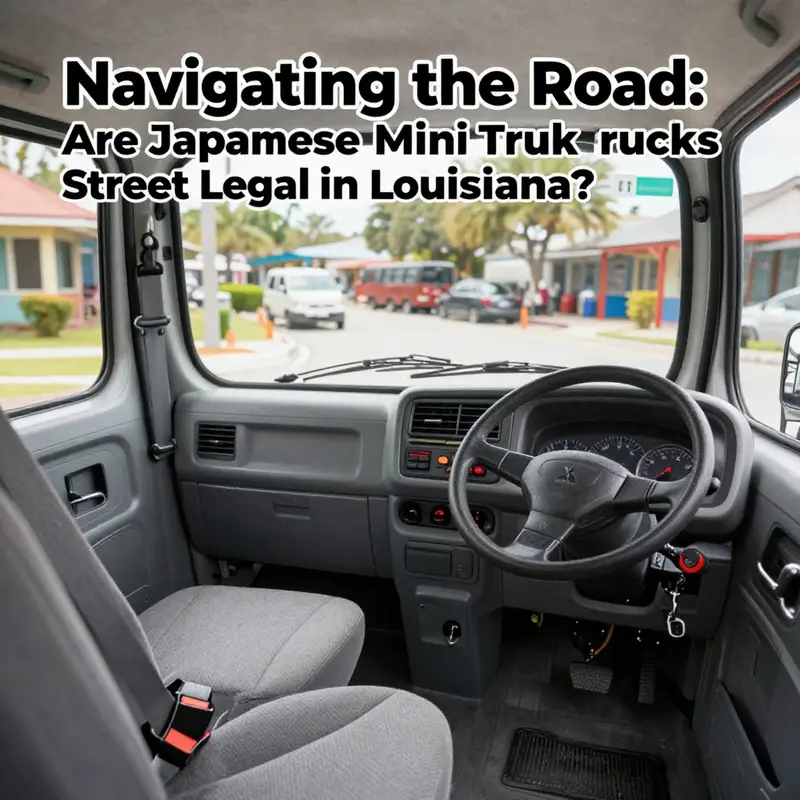
Getting a Japanese mini truck onto Louisiana roads means navigating two levels of regulation. At the federal level, the focus is on safety and emissions approval. At the state level, Louisiana enforces vehicle registration, inspection, and titling rules. Both layers must be satisfied for legal operation. Understanding how they interact helps owners avoid wasted time and unexpected costs.
Federal rules first. The National Highway Traffic Safety Administration (NHTSA) enforces the Federal Motor Vehicle Safety Standards (FMVSS). These standards cover basic crash protection, lighting, braking, tires, steering, and restraint systems. Many mini trucks were built for narrow domestic markets and may lack features U.S. standards require. That does not automatically bar them from registration. But nonconforming items often require modification or a documented exemption. One common route is the 25-year exemption. Vehicles at least 25 years old are not held to current FMVSS and EPA emission rules for importation. This age-based allowance opens the door for many older mini trucks, but it is not a free pass during state-level licensing and inspection.
Emissions compliance is the second federal hurdle. The Environmental Protection Agency regulates vehicle emissions under the Clean Air Act. Imported vehicles must meet U.S. emissions levels or arrive under an approved exemption. Since engine designs and emission control systems vary between countries, many mini trucks do not match U.S. standards out of the box. If the vehicle is eligible for the 25-year rule, EPA certification for emissions is not required, simplifying import. If the truck is newer than 25 years, the importer must obtain EPA approval, show manufacturer compliance, or secure a formal waiver. The EPA’s import guidance spells out paperwork, testing, and labeling requirements.
Passing federal muster often requires documentation. Important papers include the foreign title or bill of sale, a manufacturer statement or import declaration, and any customs forms proving lawful entry. Keep original documents. State agencies commonly demand originals during titling. If federal approvals or exemptions apply, retain copies of those determinations as well.
Louisiana law adds another layer. The state requires vehicles to be properly titled and registered with the Department of Motor Vehicles. For mini trucks, expect an in-person inspection to verify the vehicle’s identity and roadworthiness. Inspectors check basic safety features: headlights, brake lights, turn signals, mirrors, seat belts, tires, and brake function. Louisiana may also require a vehicle identification number verification and a physical odometer reading. Note that compliance with federal standards does not relieve owners from meeting these state checks. A truck cleared by federal agencies could still fail a Louisiana inspection for local equipment standards or missing safety items.
Emissions testing in Louisiana depends on geography. Some parishes have vehicle emissions programs. If your mini truck will be registered in a parish that requires emissions testing, prepare to show compliance. Even if the truck qualified under the federal 25-year rule, a parish-level emissions program may still mandate an inspection. Confirm local requirements early. A short call to the parish office or the Louisiana DMV prevents surprises at registration time.
Practical modifications are commonly necessary. Lighting upgrades may be required to meet U.S. lumen or positioning standards. Turn signals and brake light wiring might need reconfiguration. Mirrors often need enlarging or repositioning to provide the field of view required by state law. Seat belts and anchor points must be in good condition and properly installed. Brakes, tires, and suspension must be serviceable and safe for highway speeds. In some cases, adding a federally compliant tire placard or updating the speedometer is advisable so that metrics match state expectations. Keep modification work documented, with receipts and installer statements, to present during inspection.
Insurance and licensing cannot be overlooked. Insurers expect vehicles to be roadworthy and titled before issuing coverage. Liability coverage is mandatory in Louisiana. Before buying a mini truck, confirm that insurers will cover it once titled. Some carriers require an inspection report or written proof of modifications. Without insurance, registration will be blocked. Obtain proof of insurance that meets Louisiana minimums and keep it available when applying for plates.
Costs and timelines vary widely. Import fees, customs duty, transport, inspection charges, and modification expenses add up. Budget for unexpected repairs discovered during inspection. The 25-year eligibility clock is based on model year, not purchase date. If your truck hits the 25-year mark while in transit, plan paperwork accordingly to avoid delays. The federal approval process for non-25-year vehicles can take months and may require costly testing. Work with a licensed importer or compliance specialist if the truck is newer than 25 years.
Documentation and a checklist streamline the process. Assemble the foreign title, bill of sale, any original manufacturer paperwork, customs entry forms, and bill of lading. Keep receipts for transport and modification work. Have a list of required safety items and a record of the inspection results. This evidence reduces back-and-forth with agencies. A clear paper trail also helps when dealing with insurers and law enforcement during routine checks.
When to consult professionals. If the vehicle is under the 25-year threshold, federal compliance can be technical and expensive. A licensed customs broker or registered importer understands FMVSS and EPA procedures. Experienced mechanics familiar with imported vehicles can propose compliant modification solutions that meet both federal intent and Louisiana inspection practices. Legal counsel can help interpret gray areas, such as state enforcement discretion or parish-specific emission rules. Hiring experts costs money but often saves time and reduces risk.
Practical tips for owners. Verify the model year early and confirm the 25-year eligibility. Call the Louisiana DMV before purchasing to ask about inspection expectations. Confirm parish-level emissions or safety inspection requirements in the destination parish. Get written estimates for any expected modifications. Retain all paperwork in originals. Photograph the vehicle, visible VINs, and compliance labels. Finally, budget conservatively; the cheapest purchase price may be outweighed by modification and compliance costs.
The path to legal operation in Louisiana is manageable with preparation. Federal rules determine whether a mini truck can enter and under what conditions. State rules determine whether it can be titled and driven. Meeting both sets of obligations often involves paperwork, modest to significant vehicle work, and local inspections. Owners who plan carefully and consult knowledgeable professionals reduce surprises. For practical community insights and owner experiences, see the Minitrucks SoCal blog for posts and guides from enthusiasts and operators in similar circumstances: https://minitrucksocala.com/blog/
For official federal guidance on vehicle emissions and import requirements, refer to the EPA’s vehicle importation page: https://www.epa.gov/otaq/importing-vehicles-united-states
Importing and Registering a Japanese Mini Truck in Louisiana: A Practical Roadmap
Importing and Registering: A Practical Roadmap
Making a Japanese mini truck road-legal in Louisiana is a procedural journey. It blends federal import rules, U.S. customs, and Louisiana vehicle registration requirements. Each step matters, and missing documentation or a single failed inspection can delay entry or registration. This chapter walks through the practical sequence you will follow, the paperwork you must gather, likely costs, and common pitfalls to avoid.
First, determine whether the vehicle qualifies for the federal 25-year exemption. Vehicles at least 25 years old are exempt from many Federal Motor Vehicle Safety Standards (FMVSS) and EPA emissions rules. As of February 28, 2026, that means model year 2001 or earlier. If your mini truck meets that age threshold, importation into the United States is generally permitted without full federal certification. Newer models face stringent certification requirements and are usually ineligible unless approved through special EPA programs. Establishing eligibility early keeps you from investing time and money in a truck that cannot be imported.
If the vehicle is eligible, prepare the export and import paperwork. Key documents include a bill of lading and a commercial invoice. You will need a certificate of origin and an export certificate issued by the exporting country’s transport authority. For U.S. customs processing, expect to submit CBP Form 7501 (Entry Summary). The EPA uses Form 3520-1 to determine emission compliance or exemption. Keep a clear chain of ownership: a clean bill of sale helps avoid title problems. Missing or inconsistent paperwork often triggers CBP holds and inspection delays.
Customs entry happens through the Automated Commercial Environment (ACE). Many importers hire a licensed customs broker to file entries and manage duties. Duties are assessed using the Harmonized Tariff Schedule and vary by vehicle classification. Typical light-duty truck rates fall between 2.5% and 5%, but rates can change depending on the truck’s description. You will also face brokerage fees, port handling charges, and potential excise taxes. These costs add up quickly, so budget for duties, broker fees, inland transport, and port storage. A broker can also advise on whether your particular mini truck might face additional assessments.
After customs clearance, the truck must be transported to Louisiana and prepared for state inspection. The Louisiana Department of Public Safety & Corrections, Office of Motor Vehicles (OMV), requires inspection for title and registration. Expect VIN verification and checks for tampering or salvage branding. The state inspection validates basic safety items: brakes, lights, tires, steering, and windshield condition. Depending on local requirements, you may also need proof of insurance before the OMV will issue plates and a title. Pay attention to local parish rules—some parishes maintain additional testing or registration requirements.
If your mini truck qualified under the 25-year rule, federal emission certification is typically not required. However, Louisiana may still enforce state-specific emissions or safety standards. If the vehicle does not qualify for the exemption, you will need an EPA certification demonstrating emissions compliance. That process often requires costly modifications and third-party testing. Converting a nonconforming truck to meet U.S. emissions and safety standards is complex. It can involve retrofitting emissions control systems, changing lighting to meet DOT standards, and altering bumpers and seat restraints. For many vehicles, the cost of modification exceeds the vehicle’s value.
Title transfer and registration in Louisiana require careful paperwork. Bring your original bill of sale, customs entry documents, CBP Form 7501, and any export certificates. The OMV will need these documents to issue a Louisiana certificate of title. If the vehicle was imported under a salvaged or branded title, expect additional documentation and possible inspection requirements. Once a state title is issued, you can register and receive license plates. Make sure your insurance policy covers an imported vehicle; some insurance companies require additional information or will not insure certain imports.
Timeline varies by route and preparation. Shipping often takes several weeks. Customs clearance generally completes within a few days with correct documentation, but holds and inspections can extend that timeline. The OMV title and registration process may take additional days to weeks, depending on backlog and documentation accuracy. Working with an experienced importer or broker reduces surprises and accelerates clearance and registration.
Practical tips reduce risk and expenses. First, verify the truck’s VIN and model year before purchase. Ask the seller for export documentation and a complete maintenance history. Second, use a licensed customs broker. Brokers understand tariff classifications, duty calculations, and ACE filings. Third, inspect the truck for U.S. safety issues likely to arise during state inspection. Check lighting, turn signals, mirrors, windscreen integrity, and brake system condition. Fourth, budget for unexpected costs: modifications, inspection repairs, storage fees, and re-shipping if problems arise.
Avoid common pitfalls. Do not assume a vehicle cleared by customs will automatically pass state inspection. Federal exemption does not equal state compliance. Missing or inconsistent documents cause CBP or OMV holds. Vehicles with altered or missing VIN plates often trigger salvage or fraud investigations. And remember, trying to circumvent import rules risks seizure and fines. If the truck was previously branded as salvaged, it may be difficult to register in Louisiana without additional evidence and inspections.
If you plan to import multiple mini trucks or a custom conversion, consider professional consultation. Licensed import specialists and vehicle compliance shops provide a realistic assessment of modification costs and timelines. They can also help source proper replacement parts for lighting and emissions controls. For community insight and build inspiration, online owner communities and regional blogs offer real-world accounts of similar imports. One useful resource for tips and community commentary is the Mini Trucks SoCal blog, which covers mini truck ownership and customization experiences: Mini Trucks SoCal blog.
In summary, success depends on early verification of eligibility, meticulous documentation, and realistic budgeting. The 25-year rule simplifies federal requirements for older trucks, but state-level inspections and documentation checks remain. Use a customs broker to navigate CBP filings and duties. Prepare the truck to pass Louisiana’s safety inspection, secure title and insurance, and register promptly. When in doubt, contact Louisiana OMV directly or consult an experienced importer to confirm requirements for your specific truck. For official federal guidance on motor vehicle imports, consult the Department of Transportation’s import page: https://www.transportation.gov/vehicle-imports
Getting a Japanese Mini Truck Road-Legal in Louisiana: Insurance, Registration, and What Agencies Expect

Insurance, registration, and the mechanics of compliance come together when you try to make a Japanese mini truck street legal in Louisiana. These small vehicles often arrive with charm and utility, but turning one into a registered, insured vehicle for Louisiana roads requires meeting both federal import rules and state-specific requirements. Understanding what insurers and the Louisiana Department of Motor Vehicles (DMV) expect will save time, money, and frustration.
Louisiana law treats these mini trucks like any other road vehicle for insurance purposes. That means every registered vehicle must carry liability coverage that meets state minimums: $15,000 bodily injury per person, $30,000 bodily injury per accident, and $25,000 property damage. Those numbers are non-negotiable at the point of registration. Insurers will ask for a VIN, a title or proof of ownership, and documentation showing the vehicle has cleared any required inspections. Without that paperwork, you cannot complete registration, and you cannot legally drive the truck on public roads.
Beyond the basic minimums, insurers evaluate risk differently for a mini truck than for a typical passenger car. Factors that raise underwriting scrutiny include an unconventional VIN, a vehicle originally built to foreign specifications, missing modern safety features, or an unusual use case such as commercial hauling or off-road conversion. Be prepared to answer questions about the truck’s intended use, who will drive it, and where it will be stored. For many owners, the cleanest path to coverage is to present a complete registration package when requesting quotes. That reduces uncertainty and may secure standard liability rates rather than a high-risk surcharge.
Registration is where the federal and state systems intersect. Many mini trucks imported from abroad fall under the federal 25-year exemption, meaning models 25 years old or older are not required to meet modern U.S. safety and emissions regulations for importation. That exemption allows them into the country, but it does not guarantee state registration. Louisiana requires a physical compliance inspection, VIN verification, and proof the vehicle cleared customs. The DMV will not issue a title or plates without those items.
Common items the DMV and inspectors check include working lights, turn signals, horn, brakes, steering, tires, mirrors, and seat belts. While federal import rules may allow older vehicles to cross the border, the state still expects the vehicle to meet reasonable safety standards. Vehicles lacking basic safety hardware, or those with features that pose a hazard on American roads, can be refused registration. Examples include extremely narrow track width or lights that fail to meet U.S. brightness or color standards.
If an inspector finds missing or noncompliant equipment, you will face two choices. One, modify the vehicle to bring it up to standard. This can include adding or upgrading seat belts, replacing lighting, improving brakes, or installing mirrors that provide an adequate field of view. Two, if the vehicle is fundamentally noncompliant for regular road use, pursue an alternative registration path such as a restricted or collector classification. Some owners apply for a limited show-or-display status if the vehicle is primarily for exhibition; that status usually prohibits regular driving on public roads.
Keep paperwork organized and ready. For registration and title transfer you will need a clear chain of ownership, such as a bill of sale and an original foreign title, in addition to customs clearance documents. The customs paperwork proves the vehicle legally entered the country. Louisiana’s DMV will perform a VIN verification, so any ambiguity in the VIN plate or sticker can stall the process. If the VIN has been altered, or if it does not match records, expect additional scrutiny and possible delays while authorities verify authenticity.
Insurance companies and the DMV often work from the same basic packet of documents. Presenting a clean title, customs clearance, and a passed safety inspection usually unlocks both registration and insurance. If you have had to perform modifications, document them with receipts and invoices. Photographs showing the installation of seat belts, upgraded lights, or other compliance work help both the DMV inspector and the insurance underwriter assess whether risk has been reduced.
Expect practical hurdles. Some mini trucks have a low top speed relative to highway conditions. While Louisiana may allow registration for local road use, insurers may restrict coverage or require endorsements if the truck will be used on higher-speed roads. Define your expected operation clearly: short, local trips on city streets and rural roads are different from daily highway commuting. If you intend to use the truck for regular travel at interstate speeds, discuss that specifically with your insurer. They may require additional safety modifications or refuse coverage for high-speed use.
Another reality is resale and market perception. A properly documented and titled mini truck with state plates and insurance is easier to sell. Buyers look for a clear title, proof of legal importation, and notes on any modifications. A paper trail showing compliance work and a passed inspection increases market value and reduces buyer concerns about future registration problems.
When interacting with government offices and insurers, be clear and concise. Bring originals and copies of every document. If customs paperwork is in a foreign language, have a certified translation available. If the vehicle came through an importer or broker, ask them for a compiled packet with everything the DMV and insurers will need. That packet should include a bill of sale, the foreign registration or title, customs forms, a completed VIN verification form, and inspection certificates. Being thorough at this stage avoids repeated trips and denials.
Community resources can help you navigate the process. Enthusiast blogs and local forums offer practical tips on common inspections and acceptable modifications. For region-specific advice and build inspiration, see the Minitrucks SoCal blog for real-world examples and owner stories.
Finally, when the DMV and insurer give you a green light, maintain compliance. Keep insurance current. Display plates as required. Preserve inspection records and receipts for any modifications. Laws and enforcement can change, and having an organized file will protect you if questions arise about the vehicle’s legal status.
If you need the most current, authoritative guidance on Louisiana registration procedures, documentation requirements, and contact details for local DMV offices, consult the Louisiana Department of Motor Vehicles website: https://www.dmv.la.gov
Final thoughts
Understanding the legal requirements for Japanese mini trucks in Louisiana is essential for both enthusiasts and potential owners. With the right knowledge, navigating the importation process, compliance with safety and emissions regulations, and obtaining the necessary insurance and registration can be a smooth journey. As you consider adding a unique, compact vehicle to your collection or for business needs, keep in mind these guidelines to ensure you can enjoy your mini truck legally and responsibly on Louisiana’s roads.