
If you’re a small business owner, a mini truck enthusiast, or simply someone looking to enjoy the practicality of a mini truck, turning it street legal is your next big step. Understanding the requirements can feel overwhelming, but it doesn’t have to be. This guide is designed to walk you through each essential phase, from verifying the eligibility of your vehicle to understanding safety standards, emissions compliance, and what you need for insurance and registration. With practical insights and friendly advice, you’ll be ready to hit the road legally and safely in your mini truck in no time!
From Eligibility to On-Road Reality: The Roadmap for Making a Mini Truck Street Legal
Every journey toward a street-legal mini truck begins with a question of eligibility. Not every tiny utility vehicle, not every off-road or go-kart-inspired chassis, can be turned into a public-road performer. Some designs simply aren’t built to meet modern safety, emissions, and registration standards. Others stumble on the simple fact that the laws governing small, low-speed, or specialty vehicles differ dramatically from one jurisdiction to the next. The first chapters of this exploration have outlined the broad landscape, and this chapter seeks to stitch that landscape into a coherent path you can actually follow. The aim is not to promise a guaranteed, universal result but to illuminate the checks, trades, and timelines that commonly separate a feasible project from a failed one. The core idea is straightforward: verify eligibility, align with safety and emissions standards, secure proper paperwork, and enroll the vehicle in a compliant ownership and operation framework. If you treat each step as a formal requirement rather than a hopeful workaround, you reduce the risk of discovering well into the process that your dream mini truck may be permanently constrained to off-road use or farm lanes. As with any legal undertaking involving public roads, the advice here emphasizes local authority guidance, documented compliance, and an honest assessment of what your vehicle can become under your jurisdiction’s rules, not what you want it to be in your imagination.
First, the crux of eligibility lies in the vehicle’s specifications and the way they intersect with your region’s definitions of street-legal. Some places treat these small machines as low-speed vehicles, with explicit limits on maximum speed, occupant protection, and safety equipment. Others treat them as commercial or agricultural vehicles with separate registration tracks, perhaps with seasonal or limited-use allowances. In practical terms, you’ll encounter questions about engine displacement, overall weight, braking power, and the vehicle’s ability to meet basic on-road performance criteria. Kei trucks, with their compact frames and efficient engines, are often the poster children for this class, but even they are not automatically approved for road use outside their home regulatory system. The 660cc class that underpins many kei designs is friendly to tax and registration schemes in some regions, yet it can complicate compliance elsewhere simply because the broader market for on-road use demands different crash-test data, protection standards, and modern emissions controls. This is why the verification phase cannot be rushed or deferred to a mechanic’s gut feeling. It requires a careful poll of the local rules, a direct inquiry to the DMV or its equivalent, and, if needed, a formal compliance assessment carried out by a licensed inspector.
As you move from eligibility into feasibility, you’ll quickly encounter the intertwined questions of safety and emissions. Safety does not end at having functioning lights; it is about a systemic upgrade of the vehicle to meet standards that protect occupants and other road users. You’ll likely need to install or upgrade essential equipment: headlights, tail lights, turn signals, rearview mirrors, a horn that satisfies local noise and signaling requirements, and seat belts for all seating positions. A working windshield, when applicable, is not a luxury but a requirement in many regions. The metal frame and chassis must be robust enough to endure typical road conditions without compromising occupant protection. A dozen small details can collectively determine pass or fail in an inspection: the evenness of lighting intensity, the color of the signal lamps, the reliability of the braking system, the presence of a functional speedometer and odometer, and the visibility of the license plate at night, among others. In several jurisdictions, the lighting and signaling system must adhere to recognized federal standards (for example, FMVSS in the United States). The goal is not to mimic a full-size vehicle but to prove that the mini truck operates with the same functional predictability as other street-legal vehicles on shared roadways.
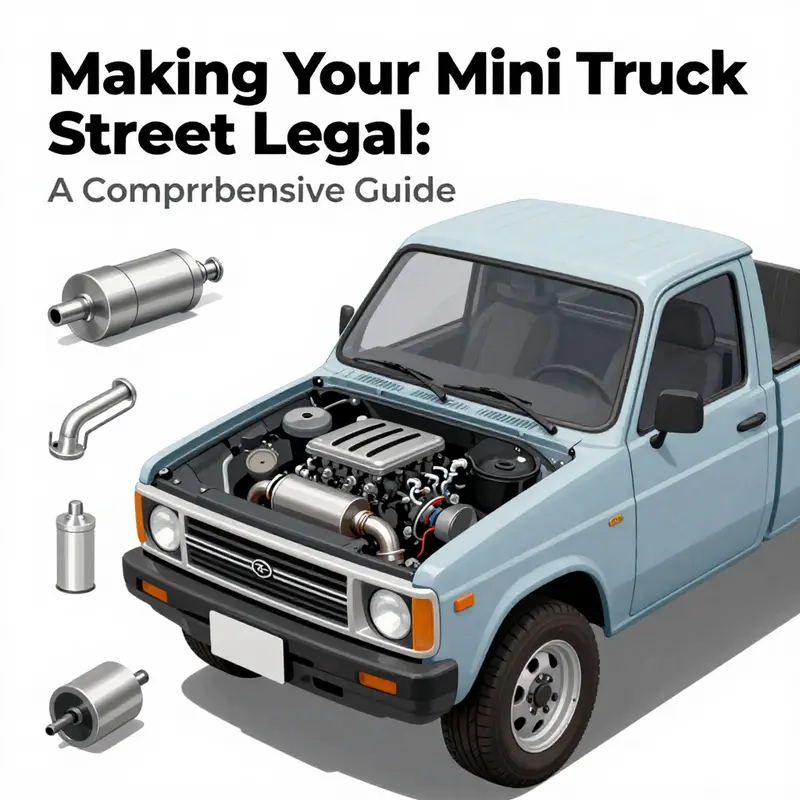
Emissions compliance stands as a second pillar in the verification process. The engine must meet on-road emissions standards, which may require retrofitting with catalytic converters or using an engine that has been certified for on-road use. In some cases, older or non-compliant engines may be allowed only for off-road use unless a special exemption is granted. This is not a matter of preference but of environmental and regulatory alignment. It often means working with certified parts and, if necessary, aligning with a tested exhaust configuration that reduces nitrogen oxides, hydrocarbons, and particulate matter to levels compatible with the broader regulatory framework. The process can entail technical testing, documentation of components, and sometimes a formal environmental assessment conducted by a qualified technician or a government-authored program. The practical upshot is simple: you should plan for the emissions step as a structured modification project rather than a post-hoc add-on. When you view emissions compliance as a critical, testable parameter, you avoid the common pitfall of discovering mid-stream that your engine cannot be reconciled with the on-road requirements in your region.
With safety and emissions addressed, the next layer concerns documentation, ownership, and the actual registration pathway. The administrative route varies by country and by state or province, but the essentials are remarkably consistent: you must demonstrate ownership, provide a bill of sale, and present documentation showing that the vehicle meets the applicable safety and environmental standards. Some jurisdictions require a vehicle inspection or a certification from an authorized mechanic, proof of insurance, and a formal application for title or title replacement reflecting the on-road classification. The paperwork is not a nuisance; it is the formal recognition that your mini truck is a distinct road-going entity subject to traffic laws, insurance requirements, and financial responsibility rules. The title and registration process also serves as a verification mechanism for the public authorities to ensure the vehicle’s identity matches its documented parameters, including the engine displacement, VIN, and the modifications performed to meet the standards. As you navigate this phase, maintain a meticulous file: purchase receipts, parts catalogs for the safety and emissions upgrades, inspection reports, and correspondence with the DMV or equivalent agency. A well-organized file accelerates the inspection and reduces the risk that a single missing page delays the entire process.
Alongside registration comes the obligation of insurance. Liability coverage is typically mandatory for any vehicle operating on public roads. The specifics—such as minimum coverage limits and whether the policy must name the vehicle or the owner—vary by jurisdiction, but the expectation remains constant: you must demonstrate financial responsibility for your vehicle’s use. The insurance conversation, though sometimes uncomfortable due to premium costs or perceived risk, is also the most practical mechanism to ensure you can cover potential damages or medical expenses arising from traffic incidents. The best approach is to obtain quotes early in the process and to consult an agent who understands non-standard or modified vehicles. An experienced agent can help you navigate questions about retrofitted components, emissions upgrades, and potential usage restrictions linked to the street-legal status.
Another critical dimension is the operational framework: speed limitations and road access. Even when successfully registered and insured, many mini trucks fall under the classification of low-speed vehicles, which imposes practical speed caps—often in the range of 25 to 35 mph. Some authorities forbid highway use, limiting operation to local streets or specific zones. These limitations reflect safety concerns tied to smaller braking capacity, stability under higher speeds, and the potential for conflicts with faster-traffic vehicles. It is not enough to be legally permitted to drive on a road; your vehicle must also be mechanically and dynamically capable of safe operation within the posted speed regime. Expect to encounter a blend of local ordinances, parking restrictions, and potential zoning considerations that govern where and when your street-legal mini truck may be used. The more precisely you align the vehicle’s performance envelope with the legal definitions of its class, the smoother the path to ongoing compliance will be.
To bring the whole narrative together, a practical approach is to engage early and often with the authorities who oversee vehicle safety, licensing, and registration. Official guidance is indispensable because of how widely rules can diverge. In the United States, for instance, the National Highway Traffic Safety Administration provides federal standards and procedures that shape how modifications are treated and how compliance is demonstrated. Consulting their framework can help you anticipate the kinds of documentation, tests, or certifications you might need, even if your local DMV adds its own filters. For additional clarity on the federal safety landscape and how it interfaces with state rules, refer to the official resources that govern vehicle safety standards and the pathways for non-compliant or modified vehicles. This careful alignment reduces the risk of discovering incompatible requirements late in the process, when changes become expensive or impractical.
As you move through this roadmap, the practical recommendation is to view the journey as a dialogue with authorities rather than a solo rebuild project. Confirm eligibility early with the DMV or transportation authority, present a thorough plan for safety and emissions upgrades, and document every modification with drawings, part numbers, and supplier receipts. Do not rely on informal anecdotes or the hope that a clever tweak will suffice. The objective is to secure a clear, auditable trail that demonstrates how the vehicle meets the established standards. If you encounter a roadblock, approach it with a transparent adjustment plan rather than a defense of the original design. In many jurisdictions, a cooperative process—sometimes involving an approved mechanic or an authorized inspection station—can transform a potential dead end into a compliant street entry, provided the vehicle can be shown to meet the necessary benchmarks.
For readers seeking a broader perspective and further case studies, you can explore additional insights in our blog archives, which often discuss practical considerations, share project narratives, and highlight learnings from a community of enthusiasts who have walked this path. minitrucksocala.com/blog/.
The path to making a mini truck street legal is rarely linear, but it is navigable with discipline, documentation, and a clear understanding of local expectations. By focusing on eligibility, safety and emissions alignment, and formal registration steps, you place yourself in a position where the vehicle you envisioned can coexist on public roads with other drivers and pedestrians. The journey is as much about stewardship of public safety and regulatory compliance as it is about mechanical ingenuity. While the road ahead will depend on jurisdictional specifics, the fundamental truth holds: the more you treat the process as a rigorous compliance project, the higher your chances of turning a compact, capable machine into a legal, useful, and safe road companion.
External reference: For federal safety standards and procedures related to modifying non-compliant vehicles, consult the National Highway Traffic Safety Administration at https://www.nhtsa.gov/vehicle-manufacturers-and-distributors
Road-Ready Responsibility: Navigating Safety Standards to Make a Mini Truck Street Legal
Turning a compact utility vehicle into a street-legal machine is as much a legal project as a mechanical one. It demands a mindful alignment of safety, environmental, and bureaucratic requirements. While the exact rules differ by jurisdiction, the underlying principles are universal: a vehicle must protect occupants and others, minimize pollution, and be verifiable through documents and inspections. When approached with patience and a clear checklist, the road to legality becomes a sequence of deliberate design choices rather than a rush to bolt on parts. The aim is not simply to pass a single inspection but to build a vehicle that behaves like a road machine in everyday traffic, with predictable lighting, reliable braking, and enduring durability on travel, hills, and weather. In most places, the safety baseline is anchored in standards that govern all street vehicles, and those standards are expressed through a combination of federal guidelines and state or provincial regulations. A mini truck, depending on how it is classified in a given region, might fall under categories like low-speed vehicles or off-road vehicles that can be adapted for public roads. This classification matters because it shapes which requirements are most essential and, in some cases, which routes exist for achieving compliance. The practical path begins with a rigorous assessment of the vehicle’s current state and ends with a formal demonstration to the relevant authority that the vehicle now operates safely, within emissions limits, and with the necessary paperwork in order. In practical terms, this means treating safety standards as living requirements rather than as a single retrofit checklist you attempt to satisfy once and forget. The process hinges on three pillars: safety equipment that works when you need it, a structure strong enough to withstand daily road use, and an emissions profile that respects the air you share with others. Each pillar has its own subtleties, but they all converge on one crucial point: street legality is less about a one-size-fits-all solution and more about a verifiable commitment to roadworthiness that the authorities can trust. The first pillar—safety equipment—demands dependable visibility, communication, and occupant protection. Headlights and brake lights must illuminate clearly in all weather, while turn signals and rear lighting must communicate intent to other drivers with consistency. A robust set of mirrors is not merely a luxury; it is a fundamental safety feature that reduces blind spots and supports safer lane changes. Seat belts, where appropriate for the vehicle’s seating configuration, provide a basic layer of occupant protection, and a functional horn remains a simple but critical alert mechanism. In many jurisdictions, a windshield is not optional if the vehicle is designed for on-road use; when present, it must be intact, secure, and free of obstructions to the driver’s view. Wipers and a static, weather-ready design for visibility in rain or snow are equally important. The second pillar centers on the structural integrity of the vehicle. The frame and chassis must withstand the stresses of daily driving, from the vibrations of rough pavement to the forces generated in ordinary braking and cornering. A compliant model typically requires that the frame be engineered or reinforced to sustain crashworthiness standards that gradually align with the expectations for passenger cars or light-duty vehicles, even if the vehicle’s dimensions and weight differ. The idea of crashworthiness is not to turn a mini truck into a full-size vehicle, but to ensure that the structure does not fail catastrophically in common scenarios—essentially, that the vehicle remains intact long enough to avoid unanticipated and preventable harm. The third pillar, emissions controls, is the environmental counterpart to safety. It is impossible to claim road legality without a vehicle that does not violate air quality norms. This means that the powertrain must meet the relevant emissions standards for on-road use. In some cases, this may involve retrofitting with catalytic converters or adopting an engine that has earned on-road certification. The specifics can be technical and region-dependent. Older or unapproved powerplants, which might have thrived off-road or in limited-use contexts, often require more substantial modifications to satisfy environmental authorities. The overarching goal is to balance performance with responsibility, ensuring the mini truck does not contribute disproportionate pollutants to the atmosphere while still delivering practical utility. Beyond equipment and engineering, the legal framework also encompasses how you prove and document compliance. A vehicle that looks street-ready on a hoist and in a workshop can still fail to meet public-road requirements if there is no documented trail demonstrating that the work meets defined standards. Registration and title are not mere formalities but formal recognition that the vehicle conforms to applicable rules. This often means providing proof of ownership, a bill of sale, and documentation showing alignment with safety and emissions standards. Some jurisdictions require a formal inspection by an authorized mechanic or a certified assessment proving that the modifications meet the applicable FMVSS or equivalent standards. The inspection functions as a bridge between design intent and enforceable compliance, a tangible checkpoint that signals the vehicle’s readiness for public roads. Once the mechanical and structural elements are sound and the paperwork is complete, the step into ownership and operation is enabled by insurance. Liability coverage is a standard expectation, typically mandated for any vehicle traveling on public roads. Insurance is not just a financial safeguard; it is a practical reflection of the vehicle’s risk profile and a signal to other road users that the vehicle is part of a regulated system. The safety and legality discussion would be incomplete without considering speed and usage limitations. Mini trucks and LSVs often come with defined operating speeds and road-use constraints. Some regions restrict these vehicles to local streets or specific corridors where traffic volumes are lower and speeds are modest. The possibility of highway operation is commonly more restricted, if not altogether disallowed, for vehicles that meet low-speed classifications. This nuance is essential: even a perfectly safety-compliant vehicle may be legally barred from highway travel if the classification and local rules do not permit it. When a person embarks on the journey to street legality, the consultation of local authorities becomes a decisive step. The rules vary not only from country to country but also between states, provinces, or counties within a single country. A direct conversation with the local DMV or transportation department often clarifies which category the vehicle falls into and what the precise requirements are. Some rural or agricultural regions provide different pathways for farm-use or utility-style vehicles, and those pathways can offer practical, if sometimes limited, routes to on-road operation. The guidance here is straightforward: start with the official sources, then verify the steps with a licensed inspector or a qualified conversion professional who understands the regional nuances. The value of expert advice cannot be overstated. A well-informed professional not only helps interpret the rules but also anticipates common pitfalls, such as misaligned lighting standards or misinterpreted inspection criteria. They can propose a practical sequence of modifications that satisfy the safety and emissions standards without overbuilding the vehicle or incurring unnecessary cost. For readers seeking practical, experience-based insights that extend beyond formal requirements, community resources and practical guides can be a useful complement to official documentation. For example, a compact hub of enthusiast content maintains a repository of practical advice, test cases, and road test experiences that illuminate common scenarios encountered by hobbyists navigating street-legal conversions. Readers can explore such perspectives at the practitioner-focused blog hub, which offers a broad spectrum of discussions about on-road adaptations and compliance workflows. This kind of resource can help translate the often-technical language of regulations into actionable steps, while also highlighting potential issues that surveys and regulatory texts might not capture. When engaging with these community resources, it is wise to cross-check any practical guidance against the official DMV pages and the FMVSS requirements to ensure alignment with the specific jurisdiction. As a final note, the path to street legality for a mini truck is not a one-off achievement but an ongoing commitment to safety, compliance, and accountability. Laws evolve, and what is acceptable today may change with new standards or updated interpretations. Maintaining compliance means staying informed, keeping records up to date, and periodically rechecking the vehicle’s condition and certification status. In this sense, the process mirrors responsible vehicle ownership more broadly: it is not a single conversion moment but a continuous practice of care, documentation, and adherence to safety norms. For readers who want a curated starting point to deepen this understanding, the general safety framework is anchored in the national safety guidance that governs all on-road vehicles. The key takeaway is clear: street legality exists at the nexus of thoughtful design, rigorous testing, and transparent documentation. It is a collaborative effort that involves the vehicle owner, conversion professionals, and the regulatory authorities that ensure everyone shares the road with confidence and accountability. For ongoing, community-driven perspectives, you can visit the practical blog resource at minitrucksocala.com/blog. And for a detailed overview of federally guided safety standards, you can review the official federal vehicle safety information provided by the National Highway Traffic Safety Administration at https://www.nhtsa.gov/vehicle-safety.
Emissions Compliance Steps for Making a Mini Truck Street Legal
Emissions compliance stands as a central gatekeeper on the path to turning a compact, do-it-yourself utility vehicle into a lawful participant in the public traffic system. It is not merely a box to check; it is a reflection of how a machine designed for off-road fun or tight-space utility aligns with the air quality and safety expectations that govern wheeled lives on everyday streets. Across regions, the exact requirements vary, but the guiding principle remains consistent: the engine and exhaust system must demonstrate that they do not produce pollutants above the limits set for on-road use, while the vehicle as a whole must meet the functional and safety expectations that accompany public operation. In the United States and many other jurisdictions, this means navigating a landscape that includes federal emissions frameworks, state or provincial rules, and the practical realities of the vehicle’s origin—whether it was built as a true on-road machine, a kit, or a purpose-built low-speed vehicle. The Environmental Protection Agency (EPA) provides the broad canvas, while local departments of motor vehicles fill in the details that determine whether a given mini truck earns a title and a plate and can legally share the road with larger, purpose-built vehicles. The journey begins with a clear determination of how the vehicle will be classified for emissions purposes and then moves through a series of technical and administrative steps that ensure the machine meets not only the letter but also the spirit of the rules intended to protect air quality and road safety. If you take this seriously from the outset, you set a foundation that reduces the odds of costly retrofits or last-minute stalls at the inspection lane, and you create a path that other modest, offbeat builds can follow with greater assurance. The path also invites practical consideration: the vehicle’s use case, the environment in which it will operate, and the willingness to invest in compatible technology that makes a mini truck a legitimate road participant rather than a novelty that rides on a gray area in the law. In this context, emissions compliance is less a single checklist and more a disciplined, iterative process that connects the engineering of the engine and exhaust to the bureaucratic channels that grant road-worthiness. A crucial first move is to establish how the particular mini truck will be classified for emissions purposes. In some regions, certain small, low-speed vehicles (LSVs) or agricultural use vehicles have a pathway to on-road operation that differs from traditional passenger cars. In others, the vehicle may resemble a light-duty vehicle only in form, yet fail the emissions test unless it meets a specific on-road certification. The parent question—“Is my mini truck eligible for street use under my jurisdiction?”—will guide every subsequent decision. This is not simply about meeting a numerical threshold; it is about aligning the vehicle’s design and its operating profile with the regulatory intent of allowing a smaller machine to share the road while preserving air quality and safety. Once eligibility is established, the emissions thread tightens around several concrete actions. The most immediate is to verify that the engine itself is certified under the appropriate program. In a gasoline-powered setup, you are looking at whether the engine is certified under the EPA’s Nonroad Engine Certification Program or under On-Road Vehicle Emissions Standards, depending on whether the vehicle is classified as a light-duty motor vehicle for road use. The documentation you gather will need to prove that the engine and its exhaust system—at least as installed in your specific vehicle—meet the standards applicable to its intended use. This documentation is not a mere formality; it is the evidence that the vehicle, in its current configuration, has been designed and tested to operate in a way that won’t undermine air quality. If the engine and exhaust do not meet these standards in their current form, the path typically requires retrofit or replacement with components that are certified for on-road use. The retrofitting process often centers on three core components: a catalytic converter, which reduces tailpipe pollutants; oxygen sensors, which provide feedback to the engine management system to regulate the fuel-air mix and combustion efficiency; and the engine control unit (ECU), which manages timing, fuel delivery, and emissions-related operations. These components must be installed correctly and calibrated so that the exhaust chemistry follows the expected profile under varying load and speed conditions. In practice, this means choosing parts that are certified for on-road use and confirming that their integration with the existing engine hardware preserves, or improves, emissions performance. For some builds, especially those that originate as kits or are heavily modified from a noncompliant chassis, the process may be more involved. The vehicle might require a full engine remap, sensor reconfiguration, or even a replacement engine to align with on-road certifications. The goal is not to achieve a temporary fix but to create a stable, road-hardy configuration in which emissions behavior remains predictable across standard driving cycles. There is also a modern, ever-present dimension to emissions compliance: electric and hybrid mini trucks. In these cases, tailpipe emissions disappear, simplifying the compliance narrative in one dimension. Yet even battery-powered or hybrid platforms must clear regulatory hurdles related to the safety and performance of the battery system, electromagnetic compatibility, and the overall construction. Some jurisdictions will still require a form of emissions declaration or certificate of compliance, even for zero-emission vehicles, to document that the vehicle’s design adheres to safety and environmental standards. In essence, the absence of exhaust pollutants does not automatically guarantee street legality; the vehicle must still demonstrate that its high-voltage systems, thermal management, and structural integrity meet public road standards. The work behind emissions compliance is, therefore, a blend of engineering rigor and bureaucratic diligence. It is a process that rewards thorough record-keeping, transparent testing, and alignment with both national guidelines and local expectations. After the technical adjustments, the next phase centers on documentation and official recognition. You will need proof of ownership, a bill of sale if applicable, and evidence showing compliance with safety and emissions standards. Many jurisdictions require an inspection by an authorized mechanic or an official testing facility to verify both the hardware changes and the resulting emissions performance. If the vehicle was built from a kit or through significant modification, a more formal certification process may be necessary to ensure that the vehicle’s emissions performance remains consistent across the entire operating envelope. It is also important to recognize that some engines, particularly older or nonconforming ones, may be restricted to off-road use unless an exception or approval is granted. This reality underscores the importance of early, honest assessment of eligibility, as retrofitting an engine to meet on-road standards is typically more cost-effective than attempting to rehabilitate a noncompliant configuration after the fact. Insurance is another practical dimension of emissions compliance. Liability coverage is generally required for any vehicle operating on public roads, and the insurance landscape is often designed to reflect the on-road use risks associated with altered or light-duty vehicles. The process includes shopping for a policy that recognizes the vehicle’s intended use and its compliance status. In the end, the path to street legality hinges on a disciplined integration of engineering conformity, regulatory navigation, and pragmatic administration. It requires an early decision about the vehicle’s intended role on public roads, followed by careful selection of compatible components, rigorous testing, and precise documentation. For readers who want to explore the broader context of practical builds and compliance considerations, the Minitrucks California blog offers an ongoing stream of reflections and case studies that illuminate both the challenges and the methods of bringing small, capable trucks into lawful operation on local streets. See more at minitrucksocala.com/blog. As you progress through your own project, remember that the journey is not only about passing a test at the end of the line; it is about building a vehicle that behaves responsibly, on the road and in the air alike, and about forging a transparent trail of compliance that regulators can verify with confidence. When in doubt, consult your local DMV or transportation authority to confirm the precise requirements in your jurisdiction, and review the EPA’s detailed guidelines for vehicle emissions testing and certification. These resources anchor the process in current standards and provide the official benchmarks that govern how a small, street-ready machine earns its place on the road. For readers seeking deeper technical specifics on regulatory expectations, the EPA’s Vehicle Emissions Testing information can be consulted here: https://www.epa.gov/vehicle-emissions-testing.
Paperwork, Plates, and Pathways: Navigating Title and Registration for Your Street-Legal Mini Truck
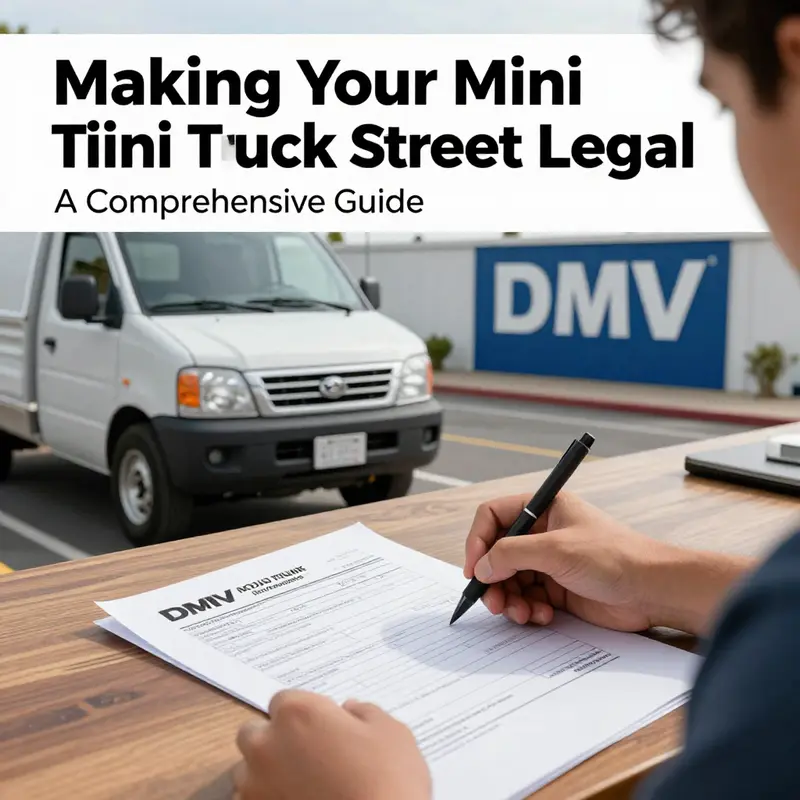
Bringing a mini truck from a clever idea or a showroom floor mock-up to a daily-driver on city streets hinges not just on how it looks or performs, but on how the paperwork lines up with the laws that govern street-legal vehicles. Registration and title procedures are the bridge between a modified machine and a legal, insurable, and responsible presence on public roads. This part of the journey requires patience, organization, and a practical understanding of how local authorities assess eligibility, safety, emissions, and ownership. While the build might be filled with creative decisions about tires, suspensions, and powertrains, the registration phase demands a different kind of attention—the kind that makes the vehicle verifiable, traceable, and compliant in the eyes of the state. The DMV is not an adversary; it is a system designed to confirm that what you bring to the street meets minimum standards for safety, environmental responsibility, and accountability. When you approach it with a plan, the process becomes less of a hurdle and more of a structured path that guides you toward legitimate operation and eventual peace of mind on the road.
Proof of ownership sits at the heart of this journey. You will need documents that establish who owns the vehicle and how that ownership is transferred or recorded. A bill of sale is the most common starting point, providing a clear record of purchase, price, and the parties involved. If the vehicle came from a factory or a dealer, a manufacturer’s certificate of origin might be required to prove initial title eligibility and the legitimacy of the build. For a kit or a vehicle assembled from components, the DMV often scrutinizes the chain of ownership to ensure there are no gaps that could complicate future titling. In any case, the names on the documents must align with the applicant’s identity, and the VIN listed on the paperwork must match the physical identifier on the vehicle. The basics of ownership documentation are straightforward, but they are not optional. They prevent you from running into delays or impound risks once you’ve finished the rest of the process.
With ownership established, the next essential step is the vehicle identification number—your vehicle’s fingerprint. The VIN is not merely a serial; it is the key to a vehicle’s federal and state history, a unique locator for registrations, recalls, and insurance. Some mini trucks, especially those built from multiple parts or imported as a kit, may require a VIN assignment or validation by the DMV. That means you may need to present the vehicle for inspection to verify the frame or chassis number, ensure the VIN physically present on the vehicle corresponds to the documents, and confirm that the number hasn’t been altered or obscured. It is wise to photograph the VIN area before you begin the process and to bring clear, high-resolution images to any appointment. A small misalignment between documents and the vehicle can trigger a cascade of delays; precision at this stage pays dividends later.
Fees are the invisible gatekeeper of the registration process. They vary widely from one state to another and can include title fees, registration fees, and applicable taxes. In many jurisdictions, there is a separate cost for safety inspections or emissions tests if those are required for on-road use. The key is to anticipate these costs as part of a realistic budgeting exercise rather than as an afterthought. Gather a rough estimate by visiting your state or provincial DMV site, reading the sections on title and registration for new or rebuilt vehicles, and talking to a licensed inspector if your jurisdiction requires one. If you are preparing for an on-road transformation, you may also encounter fees associated with inspections or compliance verifications for safety standards and lighting, which ensures that headlights, taillights, turn signals, and the horn perform in a manner consistent with the vehicle’s intended function on public roads.
Safety inspection and emissions testing are the two pillars that confirm the vehicle’s readiness for public operation. A safety inspection focuses on the mechanical and structural integrity of the vehicle. It assesses braking performance, steering, suspension, lighting, mirrors, seat belts, windshield (if applicable), and the general sturdiness of the frame to handle daily road conditions and traffic. Emissions testing, when required, demonstrates that the engine meets the environmental standards established for on-road use. The specifics—whether both tests are needed, and what standards apply—depend on the state or country you call home. In certain regions, older engines or certain configurations may be treated differently, with pathways for off-road use or farm-use exemptions that require additional documentation or special certifications. Being proactive here means ensuring the vehicle’s lighting complies with FMVSS standards or the local equivalents, the exhaust system is intact, and the engine is tuned to meet emissions benchmarks before you walk into the test site. A well-prepared vehicle reduces the risk of a failed inspection and the friction that follows.
Documentation you assemble during this phase should be thorough and organized. It is not unusual to collect copies of the title or bill of sale, proof of ownership, VIN verification sheets, inspection certificates, and any mechanic’s notes or certification statements related to emissions compliance. If the vehicle has undergone modifications to make it street-legal, you should maintain a written record of those changes, supported by receipts or technician certifications. Some jurisdictions request a poster-sized packet of information for the inspector or the DMV reviewer; others prefer digital submissions. Either way, having a logically organized file—divided into ownership, VIN, safety, emissions, and proof of compliance—will expedite the process. It also creates a clear narrative of how the vehicle meets the legal expectations of on-road operation. In practice, there is a value in keeping spare copies of critical documents—title applications, VIN verification forms, and inspection reports—so you can respond quickly if you switch states or if an official needs a follow-up.
The actual sequence of events to bring this all together is a blend of preparation and delegation. Start by gathering ownership documents and verifying the VIN against the vehicle. Contact your local DMV or transportation authority to confirm which inspections or tests are required for a mini truck or similar vehicle, and whether you fall under a specific classification like a low-speed vehicle or an off-road vehicle that can be authorized for on-road use. If you are dealing with a kit or a newly assembled vehicle, you may encounter pathways that require additional certification or a more formal demonstration of compliance. Plan for a potential mechanic’s inspection or a certification from an authorized inspector, and budget time for scheduling. The process is not instantaneous, but it becomes predictable when you treat each step as a milestone with a clear outcome: a document or certification that confirms your vehicle is fit to share the road with other drivers.
While the specifics of the process are deeply jurisdictional, there is a shared wisdom in how people approach it. Start with the DMV’s official resources, then corroborate the information with an experienced local vehicle inspector or a trusted shop that understands street-legal conversions. It is practical to keep a log of every contact, every appointment, and every document request. The record-keeping itself reduces anxiety and helps you avoid the costly, time-consuming pitfalls that can emerge with misfiled papers or mismatched identities. For a sense of community experience and practical notes from others who have navigated similar paths, you can visit the minitrucksocala blog, which gathers discussions and tips that often reflect the kinds of questions you will encounter in the real world. This community input is not a substitute for official guidance, but it can illuminate common obstacles and share workable strategies for a smooth filings experience (https://minitrucksocala.com/blog/).
As you move toward finalizing the title and registration, remember that the end goal is simple: a vehicle you can legally operate on public roads without fear of fines or compliance issues. The meticulous collection of ownership documents, correct VIN verification, transparent disclosures about modifications, and adherence to the required safety and emissions standards create a license to drive that your mini truck deserves. The DMV process is not a final verdict on the vehicle’s value or capability; rather, it is the formal acknowledgment that the vehicle has been assessed according to the rules that govern the road. If you approach it methodically, the path from build completion to plate issuance becomes a sequence of achievable milestones rather than a single, daunting hurdle. And once the plates arrive and the title is secured, your on-road experience is framed not only by the vehicle’s performance but by the confidence that comes with knowing every regulatory box has been checked.
Balancing Insurance Responsibilities and Speed Restrictions for Your Street-Legal Mini Truck
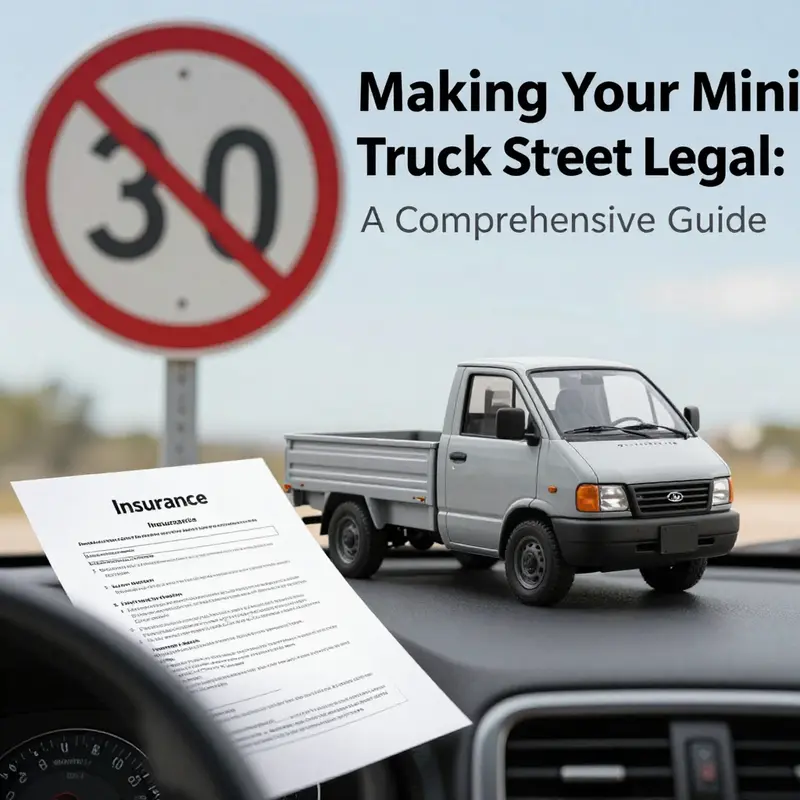
Navigating Insurance Requirements
When transforming a mini truck into a street-legal vehicle, securing the right insurance coverage is as essential as installing lights or mirrors. Almost every jurisdiction makes liability insurance mandatory for motor vehicles operating on public roads, and mini trucks are no exception. This requirement protects other motorists, pedestrians, and you from the financial fallout of an accident. In most states, that means obtaining a policy that covers bodily injury and property damage at or above the minimum limits set by your Department of Motor Vehicles (DMV). While some regions insist on basic liability alone, others may require broader protection.
Exploring available options reveals three primary forms of coverage. Liability insurance addresses costs you cause to third parties. Collision pays for repairs to your mini truck when you’re at fault, and comprehensive coverage safeguards against non-collision incidents such as theft, vandalism, or fire. Although collision and comprehensive policies carry higher premiums, they can protect your investment in custom modifications or restored components. Before committing to a plan, compare quotes from several insurers—some specialize in non-standard vehicles, while others bundle policies for multiple vehicles to lower overall costs.
Proof of insurance is another critical step. You must present a valid insurance identification card when registering the mini truck, during state inspections, or upon a traffic stop. Many DMVs now accept digital proof via mobile apps, but keeping a paper copy in the glovebox remains wise. Insurers periodically request updates to confirm your vehicle still meets policy requirements; failure to comply can lead to lapses, hefty fines, or suspension of registration.
Some insurers impose additional conditions when covering a mini truck. They may require that you complete a defensive driving course or store the vehicle in a secured garage overnight. Always read the fine print for mileage limits, usage restrictions, and deductibles. If you plan to use your mini truck for business deliveries or farm tasks, inform your insurer—standard personal auto policies rarely cover commercial activities.
Understanding Speed Classifications and Legal Limits
Speed limitations are intimately tied to how your mini truck is classified. In many states, vehicles that cannot exceed 25 mph fall under the low-speed vehicle (LSV) category. LSVs enjoy a streamlined registration process but are restricted to roads with posted limits of 35 mph or less. For example, suburban neighborhoods or rural backroads often qualify, while highways or major thoroughfares remain off-limits. Operating an LSV on higher-speed roads not only attracts violations but also endangers occupants lacking full-scale crash protection.
If your mini truck is capable of higher speeds, reclassifying it as a full-fledged motor vehicle can open more road options—but it also triggers stricter safety and equipment mandates. You might need to install advanced braking systems, side-impact protection, reinforced frames, and emissions controls. Once reclassified, you’re subject to the same speed limits, traffic laws, and parking regulations as any standard passenger car or light truck.
Clarifying the exact top speed of your mini truck is therefore crucial before registration. Many manufacturers advertise a factory-limit of 25 mph, but aftermarket modifications—such as upgraded transmissions or engine swaps—can boost performance. If you exceed the LSV threshold, you’ll have to meet federal Motor Vehicle Safety Standards (FMVSS) for crashworthiness and lighting, and obtain relevant certifications during inspection. Some states even require a speed governor or restrict power-to-weight ratios for LSVs, so review local statutes carefully.
Interplay Between Insurance and Speed Ratings
Insurance companies take speed classifications seriously when assessing risk. A mini truck limited to 25 mph presents a lower liability profile than one capable of highway speeds. Consequently, insurers may offer discounted premiums for vehicles certified as LSVs. Conversely, a deregulated mini truck with higher performance will face rate adjustments reflective of greater collision risk at elevated speeds.
When discussing rates with an agent, disclose any speed governors or mechanical governors installed. Providing official certification that your mini truck cannot exceed LSV thresholds can reduce your liability coverage costs. If you decide to remove a governor later, remember to update your policy and comply with reclassification procedures; neglecting to do so could void coverage in the event of an accident.
Practical Tips for Compliance and Safe Operation
- Record all modifications and retain receipts for parts and labor. When insurers or inspectors ask for proof of compliance, clear documentation expedites approval.
- Affix an LSV decal or license plate indicator when required by your state. These visual cues alert law enforcement officers to your speed category and help avoid misunderstandings on the road.
- Join local owner groups or forums, such as the Minitrucks OC blog, to exchange real-world experiences about insurers, inspection stations, and enforcement patterns.
- Perform routine maintenance on lights, mirrors, and horns. Equipment failures at low speeds still incur citations and could jeopardize your insurance claims.
- Review posted speed limits diligently and avoid roads that exceed your mini truck’s certified maximum. Sign up for traffic alerts or use mobile apps that warn of speed zone changes.
By aligning your insurance coverage with your mini truck’s speed classification, and by respecting posted limits, you protect both your legal standing and your financial investment. Meeting these dual requirements also fosters confidence in your vehicle’s safety and reliability, ensuring every trip is as secure as it is enjoyable.
For the latest details on state-specific LSV classifications, registration steps, and speed restrictions, consult your local DMV resources or visit the California DMV’s official classification page: https://www.dmv.ca.gov/portal/vehicle-classification-and-requirements-for-low-speed-vehicles/.
Final thoughts
By understanding and following these steps to make your mini truck street legal, you open up a world of opportunities. Not only will you enjoy the convenience of local drives, but you’ll also ensure your vehicle complies with necessary regulations—keeping you and your passengers safe and legal on the road. Remember, the journey doesn’t end here; it’s just the beginning. Stay informed, keep your mini truck well-maintained, and enjoy the ride.