

Mini trucks are becoming increasingly popular among residents and business owners in Georgia, offering a unique blend of utility and compactness. However, navigating the legal landscape surrounding their operation can be confusing. Through this exploration, we’ll clarify the regulations that govern mini trucks in Georgia, the necessary safety and compliance standards you need to meet, and the operational guidelines ensuring you can enjoy your mini truck responsibly. Whether you’re a local small business owner seeking a versatile vehicle, a residential property owner considering a mini truck for personal use, or simply an enthusiast passionate about these unique rides, this guide is for you.
Small Trucks, Big Questions: Navigating Georgia’s Legal Terrain for Kei-Style Mini Trucks
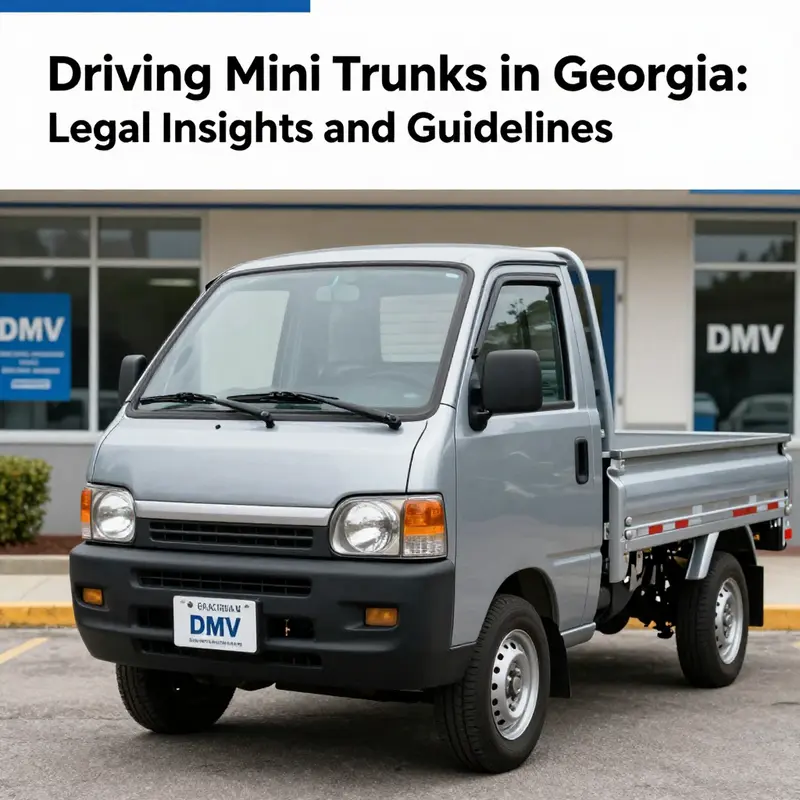
Georgia has a longstanding affection for practical, compact transportation, a sentiment that resonates especially with neighborhoods where space is at a premium and fuel efficiency matters. The buzz around mini trucks—compact work vehicles that resemble a pickup but lean toward a lighter, lower-weight design—has often carried with it a second, heavier question: can these small machines legally share Georgia’s roads? The answer, at least for now, is nuanced and shaped by layers of state regulation, safety expectations, and legislative action that has shifted over time. The core of the matter rests on how Georgia classifies such vehicles, how they must be registered, what safety criteria they must meet, and what limits apply to where and when they can be operated. The present moment finds Georgia continuing to enforce a framework that makes kei or kei-like vehicles much less accessible on public roads than their enthusiasts would prefer, while also laying out pathways for compliance that are technically feasible for small, low-weight vehicles that meet existing standards. This chapter traces the arc of those rules and the practical implications they carry for residents, small businesses, and municipalities alike, while keeping sight of the larger question that sits behind every debate about road-legal mini trucks: how does a state balance the benefits of smaller, more efficient vehicles with the imperatives of safety, infrastructure, and consistency in traffic law enforcement?
To begin, it helps to understand the basic regulatory scaffolding within Georgia that shapes any vehicle’s eligibility for road use. Mini trucks in the state are not a separate, stand-alone category with a glossy label that guarantees easy passage onto every street; instead, they fall into established classifications such as light-duty vehicles or, depending on specifications, low-speed vehicles (LSVs). These classifications are not mere labels; they dictate a series of practical constraints—how the vehicle is titled and registered, what safety features are required, what kinds of roads can be used, and what licensing prerequisites the operator must meet. In essence, Georgia treats the policing of mini trucks through the lens of broader vehicle categories, which in turn hinge on measurable parameters like gross vehicle weight rating (GVWR), top speed, and the intended operating environment. The distinctions matter not just on paper but in the day-to-day choices a driver makes when considering where to use such a vehicle, what kind of insurance is required, and what kind of inspections may be necessary to keep the vehicle in compliance.
A focal point of current Georgia policy discussions—and a point of recurring confusion for the public—is the status of kei vehicles, those compact, fuel-efficient trucks that have gained popularity in other states and regions for their maneuverability, cost savings, and utility in tight urban spaces. The term kei itself hails from a Japanese origin and refers to a particular set of size and power characteristics designed for light-duty urban driving. In Georgia, a legislative initiative emerged with the aim of reinstating road use for kei vehicles, drawing attention from motorists who see these small machines as practical solutions for short commutes, campus operations, light commercial tasks, and shared-use scenarios. Yet the governor exercised a veto over that bill, a decision that has effectively maintained the existing ban on kei vehicles on public roads. The veto underscores a reality that is common to many states: the road network was designed around larger, standard-weight vehicles, and the introduction of a new class with unique safety, performance, and enforcement considerations invites a careful, sometimes cautious, deliberation. The practical consequence for residents is clear: if you own or are considering acquiring a kei-like mini truck in Georgia, you must anticipate that public-road operation remains restricted under current state policy. For now, the vehicle must be either kept off public roads or must be operated in domains that fit within the established exceptions and classifications that Georgia recognizes.
What does this mean in real terms for the average driver or small business owner who envisions a light, economical vehicle for campus routes, farm work, or neighborhood deliveries? First, any mini truck that is intended for public-road use must be properly registered with Georgia’s Department of Driver Services (DDS) and the state’s motor vehicle registration system. The registration process is not a mere formality; it is a formal recognition by the state that the vehicle meets specific criteria and that the owner assumes responsibility for compliance with ongoing safety and operation standards. The title must reflect an accurate classification, which in Georgia might place the vehicle in a light-duty category or another applicable class depending on GVWR and design characteristics. Misclassification or gaps in documentation can lead to enforcement actions, including fines, vehicle impoundment, or invalid insurance coverage. This underscores a foundational principle: with mini trucks, the paperwork is not optional; it is an essential component of lawful operation.
Safety standards form the other half of the compliance equation. Vehicles intended for road use must meet baseline safety requirements that protect the driver, passengers, and other road users. In practical terms, this means working lights that are clearly visible, properly functioning brakes, seat belts for all seating positions, and a windshield that meets visibility and structural integrity standards. The doors, latches, mirrors, and any safety equipment that existed in conventional passenger vehicles are typically part of the expectation when a vehicle seeks to become road-legal in Georgia. The state’s safety framework works in tandem with inspections, ensuring that a vehicle does not proceed on public streets if it fails to pass a safety review. In a broader sense, the safety criteria reflect a state interest in maintaining uniform standards that allow law enforcement and road users to predict how a vehicle will behave in common traffic scenarios, thus reducing the risk of accidents that could arise from a vehicle whose structural design or equipment is not aligned with standard road-use expectations.
Beyond safety, Georgia imposes speed-related constraints that can alter the allure of a mini truck for certain tasks. If a vehicle is classified as a low-speed vehicle, it faces explicit limitations on where it may operate. The speed cap for LSVs typically hovers around 25 to 35 mph, and Georgia’s regulations are clear that such vehicles cannot be driven on interstate highways or other high-speed roadways. Even when a mini truck falls under a light-duty designation, it is essential to be mindful of speed and performance specifications that could influence where it can travel legally. The difference between a vehicle that can coexist with everyday traffic and one that is restricted to certain streets is not merely academic; it shapes daily travel plans, insurance premiums, and the viability of the vehicle for work-related tasks. For operators who need to traverse longer distances or move between different neighborhoods or commercial zones, the practical calculus often points toward vehicles that align with standard road-use norms, or toward alternative arrangements that keep the vehicle within permitted corridors while still delivering the intended utility.
The driver’s license requirement is a straightforward but important piece of the puzzle. In Georgia, operating a mini truck on public roads generally requires a standard driver’s license. This is not a license category that grants exemption or special privileges simply because the vehicle is compact. The practical implication is that a driver cannot rely on a special permit or a rider’s license to legally operate the vehicle on all roads; the operator must have the appropriate licensure consistent with the vehicle’s classification. This aligns with broader road-safety objectives and ensures that drivers have the relevant knowledge of traffic laws, signaling, speed control, and handling of a vehicle in various weather and road conditions. The driver’s license requirement also intersects with insurance considerations, as coverage terms often hinge on the operator’s licensure and the vehicle’s classification under Georgia law.
As the Legislature and executive branch evaluated kei vehicles and similar concepts, the policy conversation touched on broader considerations about infrastructure and enforcement. Critics of a wider kei-vehicle deployment on Georgia roads raised concerns about how such vehicles would integrate with existing traffic, how they would be identified for enforcement when violations occur, and whether current road designs and traffic signals could accommodate the distinctive performance profiles of tiny trucks with low GVWR and lighter frames. Supporters, conversely, highlighted practical advantages: reduced fuel consumption, lower upfront costs, and the potential to ease transportation for people who otherwise rely on buses or more expensive vehicles. The governor’s veto of the kei-vehicle bill signaled a deliberate choice to uphold the status quo and to avoid a phase-in that could complicate enforcement, redesign of infrastructure, or reinterpretation of safety standards across the state. The veto thus preserves a legal landscape in which public-road operation of kei-like mini trucks remains restricted, while leaving room for ongoing dialogue about how Georgia might address safety, efficiency, and accessibility in the future.
For individuals weighing the options, this means a careful, informed approach to planning transportation and commercial tasks. If the goal is to operate a small, light-weight vehicle on public roads, one must acknowledge that current law does not automatically grant broad access to kei-style mini trucks. The vehicle must align with defined categories and comply with the requisite registration, safety, and licensing requirements. If the vehicle’s GVWR and design qualify it as a standard light-duty vehicle, it still must meet the same fundamental constraints that apply to other light-duty pickups: proper title, valid registration, functional safety equipment, and compliance with all applicable traffic laws. If, on the other hand, the operator intends to use the vehicle primarily on private property, in controlled environments, or on designated low-speed corridors that are explicitly permitted, there may be opportunities to leverage the vehicle’s capabilities within a constrained setting, though such usage would not equate to full, unrestricted public-road operation.
The decision to veto the kei-vehicle legislation is also a reminder of the continuing need for up-to-date, authoritative guidance. The Georgia Department of Driver Services (DDS) and the Georgia Department of Revenue’s motor vehicle division remain central sources for the most current interpretations of road-use eligibility, registration procedures, and safety requirements. Seeking official guidance helps prevent misinterpretation or assumptions that could lead to penalties, fines, or unintended exposure to liability. Because policy is subject to change and enforcement practices can evolve as new needs or concerns arise, staying informed is essential for anyone who owns, operates, or is considering purchasing a mini truck for use in Georgia.
In addition to state-level considerations, practical decisions may hinge on local ordinances or municipal regulations. Some cities or counties may have additional rules governing curbside placement, on-street parking, or the operation of low-speed vehicles within particular districts. The interplay between state law and local ordinances can add another layer of complexity to the equation. As a result, responsible operators often engage in due diligence that goes beyond the statute and into the realm of local governance. This means checking with local city or county authorities about any permit requirements, permitted operating zones, or restrictions on vehicle types that can be used for commercial or public-service tasks in specific neighborhoods or business districts. The end result is a more holistic understanding of how a miniature, highly maneuverable vehicle could fit into a community’s transportation ecosystem without creating friction with law enforcement or other road users.
For readers seeking a concise synthesis of where things stand, the current legal stance in Georgia is that kei-like mini trucks do not have broad road-use authorization under standard public-road conditions. The safety and registration prerequisites still apply to any vehicle that Georgia accepts on its roads, but kei-style configurations remain subject to a vetoed policy proposal rather than a clear, freely accessible pathway to road operation. This does not render small, practical transport fantasies obsolete; rather, it reframes them within a more deliberate framework. Those who need efficient, compact transport for narrow alleys, campus routes, or controlled environments can still pursue viable options by selecting vehicles that comply with established classifications and by coordinating with DDS and DMV to ensure they meet all necessary criteria. The key is to view these decisions through the lens of compliance rather than convenience: the state’s regulatory posture prioritizes safety, consistency, and accountability on public roadways, even as communities and businesses continue to explore legitimate, value-driven uses for compact transport solutions.
In closing, while the current policy landscape in Georgia may not align with the optimism surrounding kei-title mini trucks in other regions, it remains navigable for those who approach the matter with a clear understanding of classifications, registration, safety, and licensing requirements. Those who want to stay ahead of potential shifts in policy can keep a steady watch on official channels such as the DDS and the Governor’s Office for updates. The broader takeaway is that Georgia continues to favor a measured approach to road use for small, light vehicles, balancing the practical benefits of compact transport with the overarching aims of road safety and regulatory clarity. As the conversation evolves, motorists and small-business operators who plan ahead—by preparing complete documentation, verifying compliance with safety standards, and keeping an eye on legislative developments—will be better positioned to adapt to any future changes that could expand or redefine the road-legal reach of mini trucks in the state.
For readers seeking community perspectives and ongoing coverage on this topic, deeper dives and updates can be found at the community blog dedicated to mini trucks. The blog serves as a repository for practical experiences, repair insights, and policy discussions that help residents understand how others navigate the regulatory landscape, even when official rules remain conservative about road use. Visit minitrucksocala.com/blog/ for more discussions and context from enthusiasts who are tracking how Georgia’s policy evolves and what that could mean for temporary or experimental deployments on private property, controlled sites, and non-public road environments. This resource can be especially useful for readers who want to bridge the gap between policy language and everyday decision-making, offering a space where people compare notes on registrations, inspections, and the day-to-day realities of operating compact vehicles within Georgia’s regulatory boundaries.
As you reflect on your own transportation needs and how a mini truck might fit into them, consider the broader ecosystem that supports or constrains these vehicles. The policy framework emphasizes accountability and safety, while the practical side emphasizes accessibility and utility. The split between those two poles is not unique to Georgia; it is a universal tension in how societies adopt smaller, more efficient vehicles in urban and rural contexts alike. The chapter you have read thus far is a careful invitation to think critically about what is legally permissible, what is practically viable, and what local conditions might demand in any given use case. When policy moves, it will likely do so in response to nuanced safety data, evolving road infrastructure, and a measured consensus among lawmakers, regulators, law enforcement, and the driving public. Until then, Georgia’s path for mini trucks remains clearly defined by the current regulatory framework, with the veto on kei-vehicle road use signaling a cautious horizon that prioritizes safety and coherence over rapid expansion of new vehicle categories on public streets.
External resource: For an official statement outlining the governor’s position on kei-vehicle legislation and the rationale behind the veto, see the Georgia Governor’s Office release at https://www.governor.georgia.gov/news/2025/12/gov-vetoes-bill-allowing-kei-vehicles-on-roads. This resource provides authoritative context and the formal stance that informs ongoing discussions at the state level.
Georgia Mini Truck Regulatory Guide
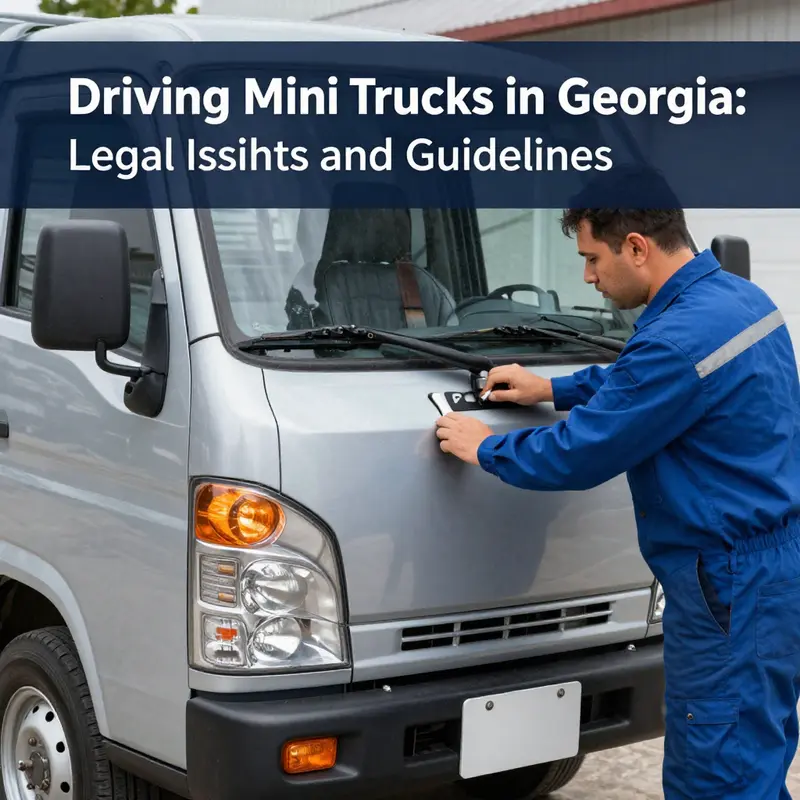
Georgia classifies mini trucks as either light-duty vehicles or low-speed vehicles depending on GVWR, speed, and equipment. Registration, title, and insurance depend on the classification. Safety features such as seat belts, lights, tires, and a functional wiper are required. Emissions requirements may apply in certain counties, and some local jurisdictions may require periodic inspections. For commercial use, insurance needs and weight/load considerations become more important. Regular checks with DDS and DMV help ensure lawful operation. Always verify classification with official agencies and review county-specific rules to stay compliant while operating a mini truck on Georgia roads.
Small, Legal, and Road-Ready: The Practical Path for Mini Trucks in Georgia
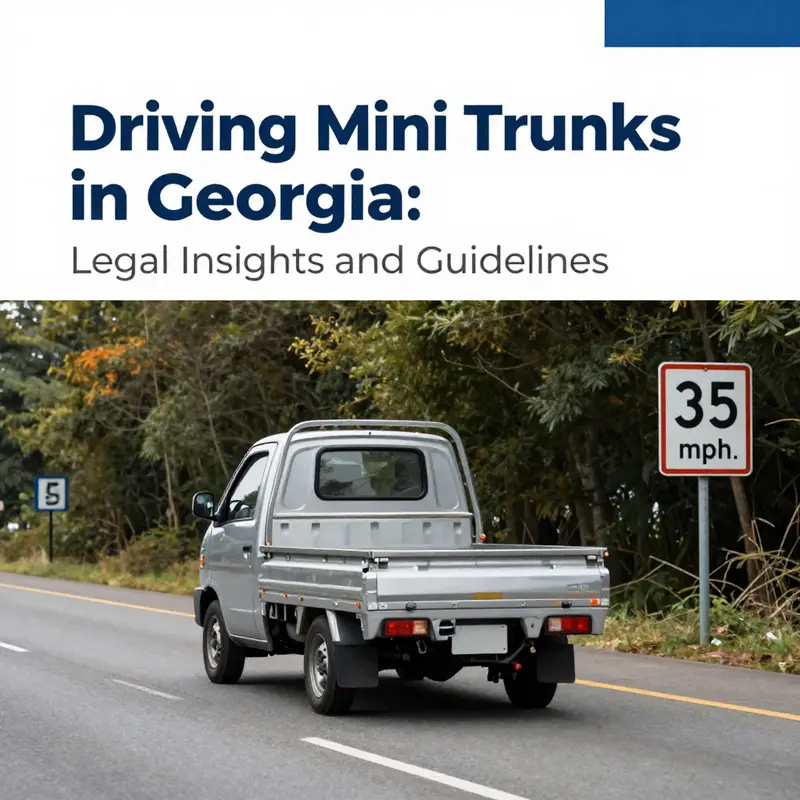
On a narrow street lined with brick storefronts and delivery vans, a fleet manager carves a new path for urban logistics. The question often begins as a practical one: can a tiny work truck legally move goods through Georgia’s cities without triggering a maze of permits, inspections, and odd exemptions? The answer sits at the intersection of state classification, vehicle weight, safety, and the rhythms of local streets. In Georgia, mini trucks—often described in the regulatory language as light-duty trucks or, in certain contexts, low-speed vehicles—exist in a legal space that is not universal and not one-size-fits-all. The road rules are framed not by a single blanket policy but by a blend of state statutes, departmental regulations, and county or city ordinances designed to keep traffic predictable while letting small, efficient work vehicles serve urban needs. Understanding this mosaic helps operators plan a legitimate operation from the outset, avoid fines, and ensure that a compact vehicle can actually fulfill its intended role without becoming a liability on city streets or on busy arterials.
To begin, the heart of the legality lies in how Georgia classifies the vehicle. A mini truck in the state is commonly treated as a light-duty vehicle when its gross vehicle weight rating, or GVWR, sits at or below 10,000 pounds. This threshold matters because it determines which rules apply and which agencies take the lead on registration, licensing, and safety oversight. When a vehicle fits within the light-duty classification, it is typically subject to commercial vehicle rules that differ from those governing heavier trucks and motorhomes, yet it remains distinct from the more stringent commercial trucking regime that applies to large fleets and heavy haulers. The practical implication is clear: small trucks, despite their unfamiliar shape or their offbeat status on a conventional highway, can participate in Georgia’s road economy as legitimate work vehicles, provided they meet the standards that govern their weight class and their intended use. The balance is delicate, because misclassifying a vehicle or ignoring the GVWR threshold can turn a routine delivery into a compliance headache.
Registration is the first gatekeepers’ step. In Georgia, the Department of Revenue oversees vehicle registration and titling, and the GVWR is the figure that determines which set of rules apply. For mini trucks, the key criterion is that the GVWR must fit the light-duty category—typically 10,000 pounds or less. When the weight slides just under that line, the vehicle is registered and titled through processes designed for lighter commercial vehicles. If the vehicle’s weight pushes beyond that threshold, the registration framework shifts, and the vehicle may fall under broader commercial vehicle regulations, with more rigorous record-keeping and potentially different inspection schedules. This distinction matters not only for bureaucratic convenience but also for insurance and liability, because agencies assume different risk profiles and compliance expectations for light-duty versus heavier commercial machinery. A vehicle that remains on the lighter side can often be integrated more smoothly into urban operations, where maneuverability and fuel efficiency are prized, yet the operator must still respect registration requirements—no sticker, no legal plate, no road access.
A standard driver’s license is the typical baseline needed to operate a mini truck in Georgia. This simplicity is deliberate; it recognizes that many mini trucks are designed for urban deliveries, maintenance tasks, or small-scale service routes where hazards and cargo loads are modest compared to larger commercial fleets. The general rule is accessible for most operators, but there are notable exceptions. If the operation involves transporting hazardous materials, or if the vehicle’s configuration changes enough to alter its passenger or cargo-carrying capacity, it may trigger the need for a Commercial Driver’s License, or CDL, and additional endorsements. In practice, this means a local plumber, a landscaping crew, or a small business that uses a compact, light-duty truck for routine deliveries will usually rely on a standard license. A company planning to scale, add drivers, or expand routes should plan ahead for CDL requirements if their operational profile crosses the material safety or capacity benchmarks established by state regulations. The licensing framework thus supports the use-case diversity that Georgia’s cities demand, while preserving a clear line for safer operations on public roads.
But licensing and registration are only part of the picture. Safety standards and street-ready compliance are equally critical. Mini trucks, once aligned with light-duty classification, must also pass a basic safety regime that ensures the vehicle operates with reliable brakes, functioning lights, seat belts, and an intact windshield. The road test of safety is not just about the vehicle’s condition; it is about its predictable behavior under normal driving conditions. In Georgia, safety inspections fall under the purview of the state’s motor vehicle inspection framework, administered so that operators keep their fleets in a roadworthy state. These inspections are periodic, designed to catch wear and component failures before they become safety liabilities on crowded urban corridors. If a vehicle fails a safety inspection, it cannot be used on public roads until the issues are resolved, which imposes a real cost and a schedule constraint on a business relying on such a vehicle for daily tasks. The emphasis on visible, functional safety features—lights that illuminate, brakes that respond, seat belts that restrain, and windshields that permit clear vision—reflects Georgia’s insistence that small vehicles, when used for commerce, do not compromise road safety simply because they are compact.
In addition to mechanical safety, emissions and environmental compliance become increasingly relevant in metropolitan settings. Georgia’s Environmental Protection Division, working in concert with county authorities, has instituted emissions considerations that are applied in certain counties, especially those with dense traffic and air-quality concerns such as the Atlanta metropolitan area. An emissions check, while not always required for every light-duty mini truck, can become a prerequisite for operating in specific jurisdictions where air quality thresholds demand more stringent controls. The impact is practical and tangible: a small vehicle that runs cleanly in a suburban community may encounter a different standard if it is deployed in a high-density corridor within a county that enforces stricter environmental rules. This isn’t about penalizing small businesses; it is about ensuring that a vehicle that reduces emissions elsewhere does not add disproportionate pollution on concentrated urban routes. For operators who plan to use mini trucks as part of a city-based service or a dense curbside pickup operation, it pays to double-check whether one’s county or municipality imposes emissions testing as a prerequisite for operation.
The actual on-road experience for a mini truck in Georgia also turns on where one intends to drive. Weight, size, and power are not the sole determinants; the infrastructure and the road network matter as well. Urban corridors, with tighter turns, parked cars, and a higher density of pedestrians and cyclists, require a different approach than rural roads where the same small vehicle can breathe more easily. There are weight and size limits that govern where these vehicles can operate and what routes they can take, especially if the truck doubles as a small commercial vehicle delivering goods to multiple customers in a tight area. Local regulations, too, can create additional restrictions. A city or county may require special permits for certain types of commercial movements or restrict operating hours for vehicles of a particular size on certain streets. The practical upshot is that a mini truck can be a perfectly viable tool in Georgia’s urban toolkit, so long as operators respect the layered rules that govern weight, safety, emissions, and local controls. The goal is not to deter small businesses, but to ensure that the smallest players on the road share a commitment to the same safety and environmental standards as larger fleets while taking advantage of the efficiency that compact design offers.
From a user’s perspective, what matters most is a coherent plan that starts with proper registration and ends with consistent, compliant operations. The steps are straightforward but require attention to detail. First, verify the GVWR on the vehicle’s data plate or manufacturer documentation to confirm that the truck qualifies as a light-duty vehicle in Georgia. Next, complete the registration and titling process through the Georgia Department of Revenue, ensuring that all documentation reflects the GVWR and the intended use of the vehicle. If the operation is purely non-hazardous and the cargo capacity remains within conventional bounds, a standard driver’s license will usually suffice for the operator. Keep in mind that the safety inspections must be up to date, and any required emissions testing should be completed where applicable. If the mini truck will share public roadways with speed limits up to 35 mph or less and is not planned for interstate travel, it will likely align with the low-speed vehicle constraints that cap highway exposure for such vehicles.
In practice, a business that uses mini trucks to service neighborhoods, plazas, or university campuses can navigate this regulatory landscape by creating a robust compliance plan. That plan should include a schedule for annual or biennial safety inspections, a process for maintaining lights, brakes, belts, and windshields, and a system for keeping up with any county or city ordinances related to vehicle size or weight. It should also include a careful assessment of which routes are appropriate for an LSV-classified vehicle, given the 35 mph speed cap and the requirement to avoid interstates and high-speed arterials. For operators who want to build a broader fleet, the plan should anticipate the CDL implications that could arise if the operation expands to include hazardous materials or larger cargo loads, or if the crew size or passenger capacity begins to push the vehicle beyond its conventional limits. This forward-looking approach helps small businesses stay compliant without sacrificing the flexibility that mini trucks can offer.
As with any regulatory landscape, the best practice is ongoing engagement with official sources. The Georgia Department of Driver Services provides the definitive guidance for driver licensing and vehicle operations on Georgia roads, and it is worth revisiting their site regularly to confirm any changes in licensing requirements or exemptions that might affect a specific vehicle configuration. The Georgia Department of Revenue remains the anchor for registration and titling processes, ensuring that vehicle owners and operators have a legal basis for operation and a traceable record in case of audits or roadside checks. In addition, while this chapter outlines the general framework, it is important to acknowledge the role of the Georgia Department of Transportation, which oversees broader aspects of road use, infrastructure constraints, and the distribution of resources that can influence where and how mini trucks are most effectively deployed across the state. If a reader wants a practical starting point for navigating these topics, a good next step is to explore the state’s official resources as well as community discussions in industry-focused spaces.
For operators looking to connect with communities of practice and learn from experiences shared by others who operate mini trucks in Georgia, one resource worth visiting is the broader industry blog that collects perspectives, experiences, and practical tips about small commercial vehicles. See minitrucksocala.com/blog. This kind of resource can provide context for how regulations are interpreted in real-world settings, how fleets adapt to local realities, and what common compliance pitfalls to avoid as one builds a small, efficient, legally compliant delivery operation. While it is not a substitute for official guidance, it can illuminate practical considerations that might not be immediately obvious from regulatory texts alone. The central takeaway remains consistent: mini trucks can be a viable, law-abiding solution for Georgia’s urban and suburban operations, provided that every mile driven aligns with weight classifications, licensing requirements, safety standards, emissions considerations, and the local rules that apply to the road where the vehicle travels. The interplay of state-wide policy and local discretion creates a framework that rewards diligence and consistency.
In the end, the road map is clear. Verify the GVWR, register properly, acquire the right license, ensure ongoing safety and, where required, emissions compliance. Be mindful of where the vehicle will operate; keep in view the 35 mph threshold for low-speed vehicles and avoid highways that are out of reach for smaller, lighter units. If the operation is purely local, and the vehicle remains within light-duty parameters, Georgia’s regulatory environment offers a viable pathway for legal operation and business growth. For those who intend to push the boundaries—perhaps by increasing cargo volume or by expanding into more demanding urban routes—it is prudent to prepare for potential CDL considerations and to stay current with any updates from the DDS and DOR. The combination of regulatory awareness, careful vehicle selection, and disciplined maintenance is the most reliable route to turning a small, efficient truck into a dependable workhorse on Georgia streets. For readers who want to verify the most up-to-date requirements, official resources remain the most trustworthy source, and they provide the definitive guidance needed to keep operations compliant and road-ready.
External resource for current rules and official guidance: https://dds.georgia.gov
Final thoughts
Understanding the legal landscape surrounding mini trucks in Georgia is essential for ensuring compliance and safety while enjoying your ride. With the right knowledge of regulations, safety requirements, and operational guidelines, you can confidently drive your mini truck, whether for personal pleasure or business utility. Staying informed helps you navigate the intricacies of vehicle ownership and enhances your overall experience. So buckle up and hit the road, knowing you’re on the right path!