
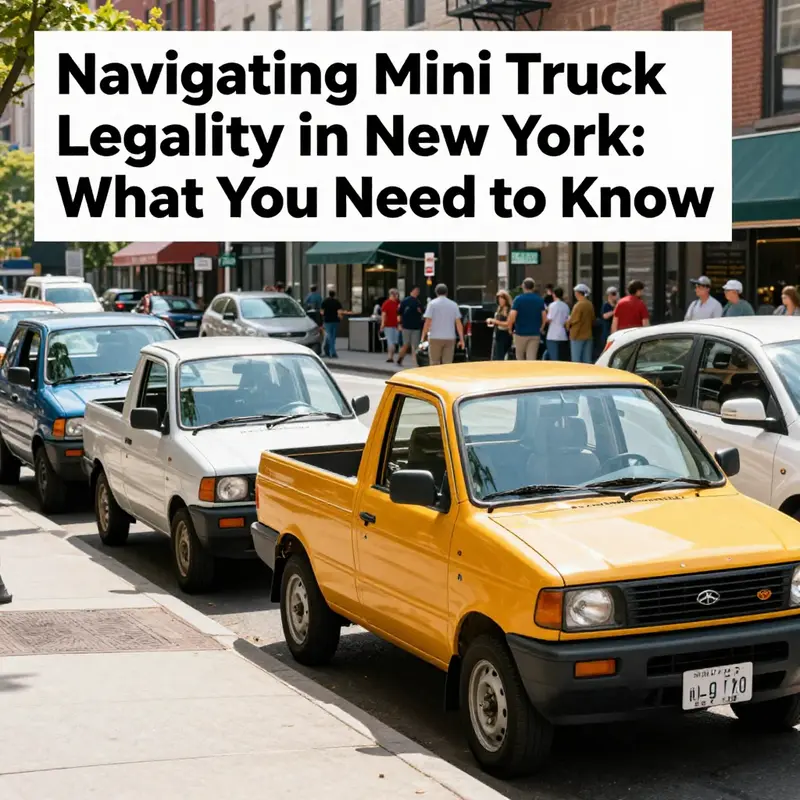
If you’re a small business owner, a property owner, or just a mini truck enthusiast in New York, understanding the legal status of mini trucks is crucial. These compact vehicles come with unique regulations that can impact your ability to use them on public roads. This guide will comprehensively cover the legal landscape surrounding mini trucks in New York State, shedding light on low-speed vehicle laws, classifications that could affect your mini truck’s legality, and essential considerations for ownership. By the end, you’ll have a clearer picture of what it takes to navigate mini truck ownership legally and responsibly in New York.
Mini Trucks on New York Roads: Navigating Street-Legal Rules and Realities
Deciding whether a mini truck can legally operate on New York streets requires navigating a layered regulatory framework. In practice, a compact utility vehicle may fall into several distinct categories, each with its own rules for use, licensing, and registration. The outcomes depend on the vehicle’s design, its intended use, and where you plan to drive. Understanding the core logic behind the state guidance helps explain why there is no simple yes or no answer.
At the heart of the matter is how New York defines a motor vehicle and the conditions under which a vehicle can be operated on public roads. A mini truck typically ends up in one of a few pathways: a low-speed vehicle (LSV), a motorcycle or off-highway vehicle in certain circumstances, or a vehicle used for agricultural or limited-commercial work. Each path carries its own requirements for safety features, title and registration, and the type of license needed to operate it.
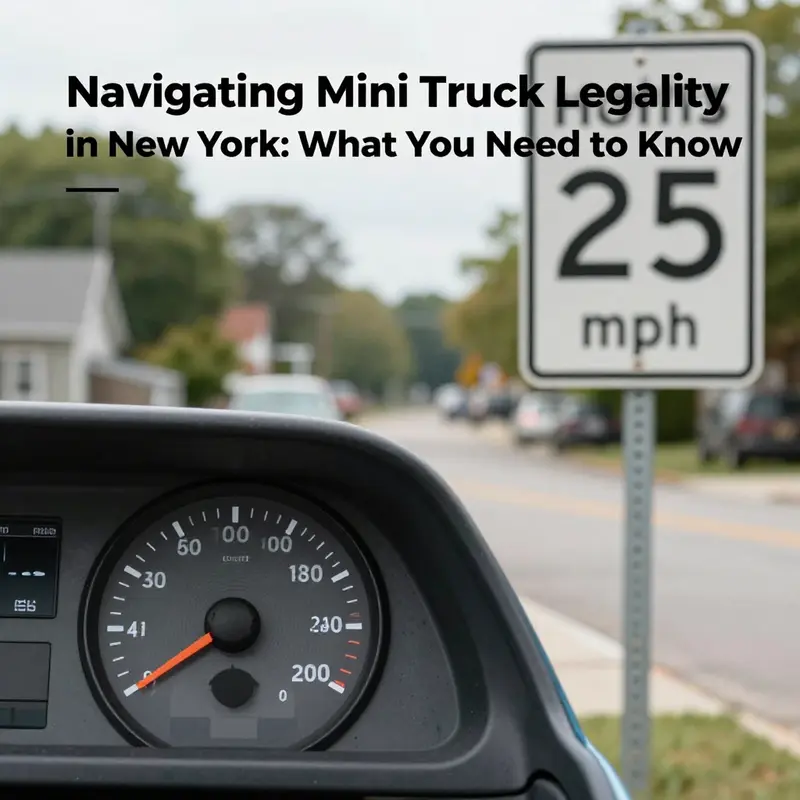
Low-speed vehicles are a common starting point in New York. An LSV is designed for slower speeds, generally around 20 to 25 mph, and is intended for roadways with posted speeds no higher than 35 mph. The limits reflect a safety principle: the vehicle should travel in a traffic environment whose speed characteristics align with its own performance. In New York, LSVs must meet federal safety standards applicable to these vehicles and include features such as working lights, functional brakes, seat belts, and emissions controls. They must be titled and registered in the same way as other street-legal vehicles, but they cannot be used on interstate highways or other major arterials where speeds routinely exceed their capability.
Some mini trucks can be treated as motorcycles or off-highway vehicles depending on design and use. Vehicles that resemble a motorcycle, often with three or more wheels but lacking standard passenger car safety features, may require a motorcycle license and registration instead of a standard driver license. The precise outcome depends on construction, seating, braking, and crashworthiness. This classification shift affects insurance, inspection, and even where the vehicle can be legally driven. If the vehicle does not meet thresholds for a conventional passenger vehicle, it may not be suitable for regular street use in New York unless properly classified and equipped.
A third pathway covers vehicles used for agricultural work or certain commercial tasks. Some utility vehicles used on farms or for specific work may be exempt or treated differently, particularly if the primary use is off road or on private property. When such vehicles are brought onto public streets for work-related reasons, the operator must still observe applicable state and local road-use rules. Exemptions, if they exist, are narrowly drawn and do not grant blanket permission to drive on any public road at any time. The overarching safety and regulatory framework still applies.
Beyond classifications, the state imposes baseline safety expectations for any vehicle on public roads. New York’s DMV requires that vehicles entering the public road network meet safety standards, including properly functioning lighting such as headlights and turn signals, reliable brakes, seat belts, and emissions controls. For LSVs, the baseline aligns with federal standards, but the practical operating envelope remains restricted to lower speed roads. Misclassification can expose owners to fines, impoundment, and greater liability in the event of an accident. The DMV urges buyers to verify how a vehicle is classified before purchase, and to confirm that the vehicle’s title and insurance align with its use.
Licensing adds another layer of complexity. Operators must hold a valid license appropriate for the vehicle type. If the vehicle fits into the motorcycle or off-highway category, the operator may need a different license than a standard driver’s license. Licensing status can influence insurance costs, registration steps, and where a vehicle may be operated, so it is essential to determine the correct category before purchase and operation.
Registration and insurance form another axis of legality. Depending on classification, some mini trucks can be registered as conventional street vehicles, while others may be restricted to special arrangements or private property use. Where a vehicle meets the standards for street use, conventional title and registration apply; otherwise, the path to lawful operation becomes narrower and may require specialized documentation or exemptions.
Local considerations can further shape legality. Even if a vehicle meets state criteria, towns, villages, and cities can impose extra limits or permit requirements that affect where and when a vehicle can be used. Always check for municipal restrictions that could impact routine operations, especially in dense urban areas or near pedestrian-heavy corridors.
A practical takeaway is that not every mini truck is automatically street-legal in New York, and classification matters as much as the vehicle itself. The safest approach is to verify the vehicle’s official classification with the NY DMV, ensure that title and insurance align with its use, and check for local restrictions before driving in public spaces. Consulting a licensed dealer can also help verify that a model is properly classified and equipped for street use.
For those seeking official guidance, the NY DMV’s vehicle classification resources provide the authoritative baseline. They outline the criteria for street-legal status and explain how mini trucks may be registered for road use when they meet the applicable standards. Links to these resources, along with careful due diligence, can help buyers navigate the realities of New York’s regulatory landscape without compromising safety or compliance.
If you want extra context, consider reputable industry resources and official DMV pages for the most up-to-date rules. The landscape evolves as safety technology and vehicle designs change, and staying informed reduces the risk of misclassification, fines, or liability. In the end, the goal is to enable practical utility on a safe and predictable basis, balancing innovation with the responsibilities of sharing New York’s roads.
null
null
On the Road, Yet Regulated: How New York Classifies Mini Trucks as Motorcycles and Off-Highway Vehicles
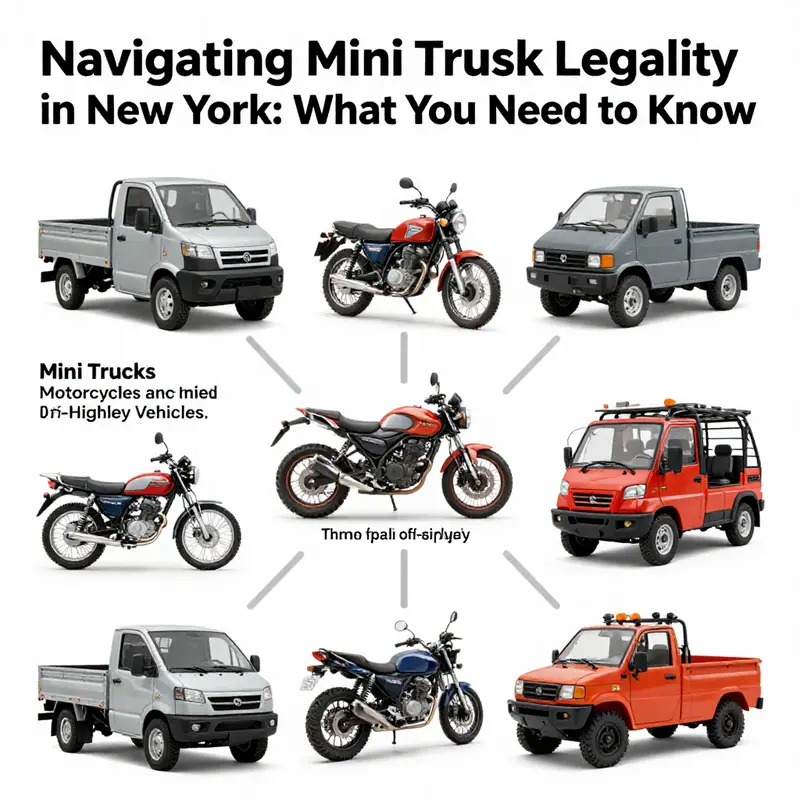
In New York the road legal status of a mini truck depends on its classification. The state divides on road viability into low speed vehicles LSVs, motorcycles, and off highway vehicles OHVs. LSVs are limited to roughly 20 to 25 mph and allowed on roads with speed limits up to 35 mph, provided they meet federal safety standards. If a vehicle cannot meet those standards, it cannot be registered for on road use. Some mini trucks with three wheels or motorcycle like features may be treated as motorcycles, requiring a motorcycle license, registration and insurance and subject to motorcycle safety rules. OHV classifications apply to vehicles designed for off road use with restricted operation on public streets except under special permits. The key for buyers is to verify the DMV classification, ensure the vehicle meets safety standards, and obtain the correct title, registration, and insurance before road use. Marketing terms that describe a vehicle as mini or city friendly do not guarantee street legitimacy in New York. When unsure consult the DMV ATV information page for official guidance. This cautious approach helps protect drivers and other road users while aligning with state and federal safety requirements.
Road Rules and Realities: Navigating Insurance, Safety, and the Public-Lane Question for Mini Trucks in New York
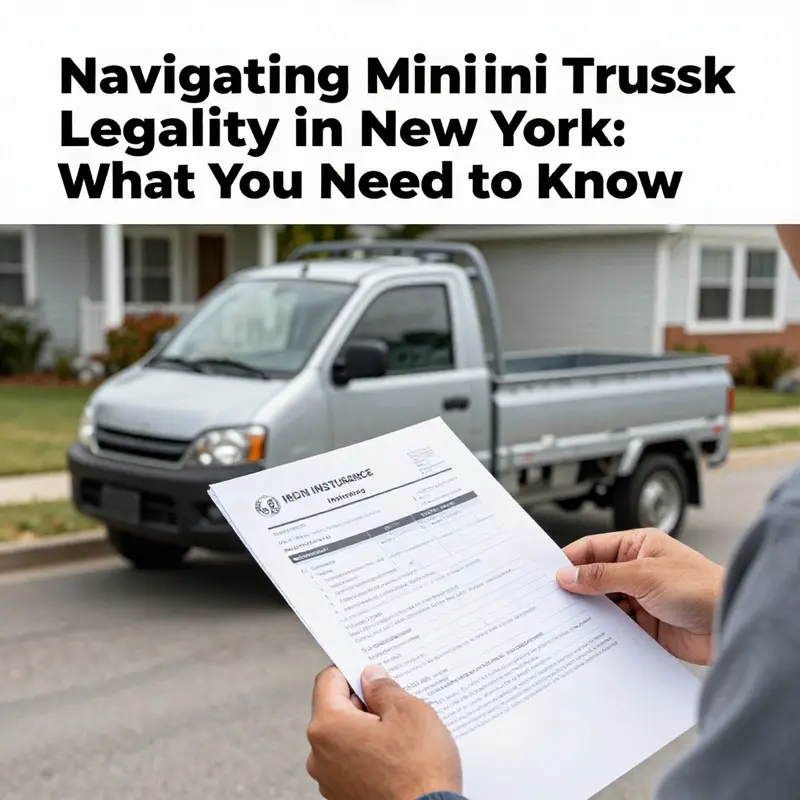
On the crowded avenues and narrow side streets of New York, a compact, work-ready vehicle can feel like a practical lifeline for everything from small deliveries to weekend projects. Yet the question of whether mini trucks are legal to drive on public roads in the state is more nuanced than a simple yes or no. The umbrella answer is often no for most of the miniature pickup designs that pepper online marketplaces, because legality hinges on how the vehicle is classified by the New York State Department of Motor Vehicles and by the federal safety standards that govern vehicle design and safety. To the uninitiated, a “mini truck” might look like a clever solution to the city’s space constraints, a small win for efficient urban logistics. But the laws that apply to consumer cars, utility vehicles, and farm or commercial machinery do not automatically grant permission to roam the same streets. In practice, the path to lawful operation is less about the color of the paint and more about the vehicle’s alignment with specific categories while meeting safety and insurance requirements that the state enforces for all street-legal modes of transportation. The broad framework is not a single statute that reads mini trucks out of compliance; instead, it is a lattice of classifications, each with its own set of conditions. The most common routes—if a vehicle is to be used on public roads—are to categorize the device as a low-speed vehicle, a motorcycle-type vehicle, or a special-purpose, off-road, or agricultural vehicle, and then to ensure it either meets or is exempt from certain safety benchmarks. The low-speed vehicle path, for example, promises operation on roads with slower traffic and lower speed limits, but it requires adherence to federal safety standards that some the more utilitarian or budget-minded mini trucks simply do not meet. In a city where roadways, crosswalks, and bike lanes demand predictable performance, the idea of a vehicle that can only crawl along at a fraction of highway speeds raises practical questions. If you’re seeking a vehicle to dodge urban bottlenecks or haul light loads across a campus, a LSV might seem attractive—yet only if the specific model you have in mind carries the right safety certification, and the right title, registration, and insurance arrangements. The other avenue—treating the vehicle as a motorcycle or a three-wheel variant—brings its own set of licensing and registration realities. In New York, classification as a motorcycle or other special vehicle can trigger requirements for a motorcycle license, a distinct form of registration, and insurance provisions tailored to two- or three-wheeled configurations. The risk here is not merely a paperwork checkpoint, but a fundamental shift in how the vehicle is expected to behave on public roads, how it protects its occupants, and how it interacts with other roadway users who are accustomed to conventional passenger cars and larger trucks. The third path, often more relevant to commercial or agricultural use, sets a road-usage framework that may exempt certain non-highway tasks. These exemptions are typically tied to the vehicle’s primary function and the environment in which it is operated. A compact vehicle that is designed and certified for heavy off-road or off-public-road use may be allowed in limited, specific roles; still, even then, the vehicle’s roadworthiness, lighting, braking, and occupant protection must align with the standards the DMV expects of any vehicle allowed on public streets. The practical upshot for most mini trucks sold as pickup-style utility vehicles is that they arrive on the market without highway-certified safety features. They may lack essential components such as seat belts designed to meet particular standards, airbags that meet the FMVSS (Federal Motor Vehicle Safety Standards), side-impact protection, robust crash structures, and appropriate lighting and signaling that are expected for a vehicle sharing lanes with cars, buses, and pedestrians in urban environments. Without these features, the vehicles do not meet the criteria to be registered for street use in New York, which means insurance and registration do not align in a way that would keep the vehicle legally road-credible. This is not a statement against innovation or utility; it is a reminder that state law, federal safety rules, and the practical realities of urban driving intersect in ways that require careful navigation before a mini truck is summoned to public streets. For anyone drawn to the allure of a compact, nimble workhorse in a city of tight corners and heavy traffic, the wisest first step is to seek clarity from the DMV about how a particular model would be classified if you intend to register it for street use. The department’s guidance can clarify whether a vehicle qualifies as a low-speed vehicle, a three-wheeled motorcycle-type vehicle, or a special-purpose vehicle, and what the implications would be for licensing, registration, and insurance. When a vehicle is not certified to meet the necessary standards, the obvious consequence is that it cannot be legally operated on public roads in New York. The range of potential penalties includes fines, possible impoundment, and complicated liability questions in the event of an accident. The financial risk is not limited to fines; it also extends to insurance, where typical coverage may be unavailable or non-compliant for a non-registered, non-insured, or misclassified vehicle. The discussion that follows centers on two core concerns that often determine whether a mini truck can exist on the public road with any sense of security: insurance and safety standards. Insurance, in particular, acts as a kind of financial barometer, signaling the state’s expectation that any vehicle with street exposure has an ongoing, recognized financial obligation to cover damages and injuries that could occur in a crash. In New York, the requirement is explicit: insurance must stay in force for as long as a vehicle’s registration exists. This means that even if the mini truck sits idle in a driveway, the owner is still responsible for maintaining liability, and in some cases physical damage coverage, for the life of the registration. The practical effect of this rule is far-reaching. It obliges owners to plan ahead financially, not just for the upfront purchase, but for the ongoing costs that accompany street-legal use. It forces consideration of monthly premiums, the potential for increases tied to risk factors, and the administrative burden of keeping coverage active during periods when the vehicle might not be used. The reality is that insurance tokens are not a mere administrative overhead; they reflect a broader truth about road safety and public responsibility. If a vehicle is ever to be driven on public roads, it must be supported by an insurance policy that recognizes that risk, allocates it to a policyholder, and provides the necessary coverage in the event of a collision, theft, or vandalism. The decision to own a mini truck in New York, therefore, becomes a balancing act between utility and obligation. The safety landscape of these vehicles is equally consequential. The safety and mechanical performance of mini trucks, especially newer electric or “e-mini” versions, are governed by stricter standards as the technology advances. The allure of electric propulsion lies in reduced emissions and potential operating efficiency, yet the transition to electrified mini trucks introduces its own set of safety considerations. High production costs and the heavy investment in safety systems that meet modern safety expectations can be a barrier for some buyers. The market today features a spectrum of configurations, with some vehicles designed around minimalist safety features and others built with robust protections in mind. In the urban context, where speed and acceleration are limited and maneuvering is intricate, the stakes of safety are high. A vehicle that lacks secure seat belt anchors or a reliably rated braking system does more than jeopardize occupant safety; it increases the risk for everyone on the road. The challenge is compounded by the realities of charging infrastructure. For electric mini trucks, access to dependable charging stations becomes a factor in both operation and safety planning. The prospect of relying on a few scattered charging points in a dense metropolitan environment raises questions about range, downtime, and the logistics of recharging during regular work cycles. If charging is inconsistent or the vehicle’s range is uncertain, operators may be tempted to push limits, which can lead to unsafe operating practices. The safety ecosystem also extends to design choices related to hydrogen or other alternative fuels, if used. Hydrogen storage presents its own sets of safety concerns, including proper containment, venting, and crashworthiness. These concerns reinforce the reality that even as technology pushes forward, the safety standards and regulatory expectations remain carefully calibrated to protect not only the operator but the broader traveling public. The broader economic picture adds another layer to the discussion. Buyers must weigh high upfront costs against long-term savings from lower maintenance or fuel costs. However, the total cost of ownership for a vehicle that is not easily registered or insured for street use can be disproportionally high. The reality is that a vehicle designed for light-duty, off-road, or commercial tasks might offer compelling utility for a small business or for personal use in a restricted setting, but its street legality in New York is a separate, significant hurdle. As such, prospective owners often discover that the most financially prudent path involves aligning their vehicle ambitions with the realities of regulation and safety. This means either choosing a vehicle that is already certified for street use, with the appropriate safety features and insurance readiness, or accepting the implications of proceeding through a more defined regulatory route that might involve modifications or different classifications. The endgame is a decision about where and how the vehicle will operate. If the vehicle is to be registered for street use on public roads, the owner should plan for compliance with the full spectrum of requirements: a proper title, a registered status, and an insurance policy that remains active for the duration of the registration. If, instead, the vehicle will be kept in off-road or limited-use scenarios, it may still be legally compliant within that sub-environment, but it will not be a substitute for a road-legal vehicle in a city setting. For readers who are balancing the appeal of compact utility with the realities of New York’s regulations, the takeaway is straightforward, yet practical. Do not assume highway legality by appearance or by a seller’s claims. Do not overlook the regulatory friction that can arise if a vehicle is misclassified or if safety features are not aligned with the standards that govern street-legal vehicles. Do not underestimate the ongoing insurance requirement, even when the vehicle sits idle. And above all, consult the DMV’s official guidance, verify the exact classification of a given model, and seek confirmation about title, registration, and insurance before attempting to operate a mini truck on public roads. The DMV’s website and its insurance guidance offer a reliable compass for navigating these complex questions. For those who still want to explore the landscape, the internal resource at minitrucksocala.com/blog/ provides a deeper look at how hobbyists and small-business owners think about these vehicles in a broader context, including practical considerations that go beyond the strict letter of the law. As the urban transport mosaic continues to evolve, understanding the rules—and the practical implications of those rules—will help ensure that a compact, capable vehicle remains a useful tool rather than a legal or financial liability. The road to legal operation in New York is not a single step but a sequence of confirmations: classification, safety compliance, title and registration, and active insurance. When all these elements align, a mini truck can become a legitimate contributor to urban mobility; when they do not, the vehicle becomes a reminder of the boundaries that public roads impose. For now, the cautious approach remains the wisest. Treat a mini truck as a potentially useful instrument, but only under the umbrella of proper classification, verified safety features, and dependable insurance coverage. If your goal is practical urban utility, the state’s framework continues to favor vehicles with clear, standardized roadworthiness and a transparent financial responsibility. This stance is not a verdict against the concept of mini trucks but a clarion call to approach ownership with a disciplined, informed plan that respects both the letter and the spirit of the law. External resources below offer additional context for readers who wish to further investigate the regulatory environment and the practical implications of insurance requirements. For more context on ongoing discussions within the broader mini-truck community, see the internal resource at minitrucksocala.com/blog/. External resource: https://dmv.ny.gov/insurance
Final thoughts
Understanding the legal status of mini trucks in New York is vital for anyone interested in owning or operating these vehicles. From navigating low-speed vehicle laws to recognizing their classifications and ensuring compliance with safety standards, there’s much to consider. By staying informed and checking with local regulations, you can enjoy mini trucks responsibly while benefiting from their utility—whether for business or personal use.