
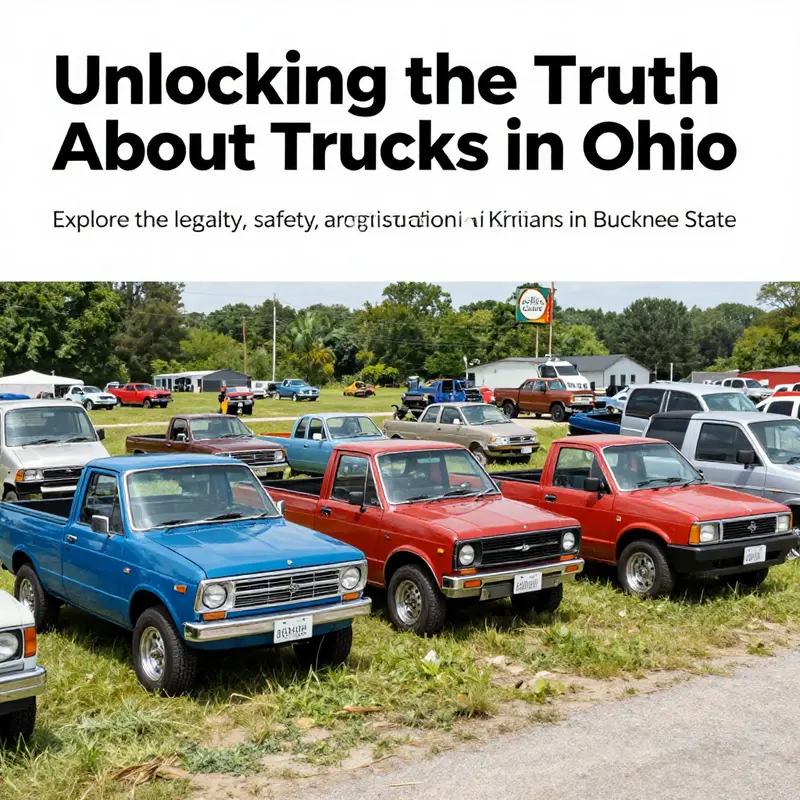
Mini trucks, particularly Kei trucks, have gained notoriety and a dedicated fan base across the United States. For local small business owners, residential property owners, and avid mini truck enthusiasts in Ohio, understanding the nuances of owning and operating these compact vehicles is crucial. From legal regulations to safety standards, insurance considerations, and the special evaluation process these trucks need, each chapter delves into vital aspects of legal compliance. Together, we will clear the path for you to navigate the regulations surrounding mini trucks so you can enjoy your ride without worry.
On the Road in Ohio: Navigating the Legal Landscape for Mini Trucks and Kei Trucks

Ohio welcomes a wide range of vehicles, and among the most talked-about are mini trucks, including Kei trucks, those pint-sized workhorses that Japanese streets long ago proved practical for tight spaces and light-duty hauling. The question that routinely surfaces is simple in form but complex in practice: are these mini trucks legal to own and to drive on Ohio roads? The answer, while generally affirmative, carries important caveats. Ownership and sale are permitted for residents and non-residents alike, but using a Kei or any mini truck on public highways is governed by Ohio’s motor vehicle laws. Those rules are designed to balance the distinctive ergonomics and capabilities of these compact vehicles with the safety and efficiency expectations that Ohio policies aim to uphold. The legal path from purchase to pavement is less about a single checkbox and more about ensuring the vehicle passes a certified evaluation and meets a set of standards that keeps the street environment predictable for all users. This chapter traces that path, outlining how ownership becomes road-legal operation, what standards must be met, and why the process sometimes feels labyrinthine even for careful buyers who know their way around a port of entry or a state BMV desk. It threads together the practical considerations with the regulatory framework, avoiding jargon-heavy detours while remaining precise about what must be aligned to a vehicle’s status on Ohio’s public roads. For readers who want a broader picture of how mini trucks are discussed and evaluated in the community, a good starting point is the overarching minitrucks blog hub, which gathers practical notes, user experiences, and comparative thinking in a single place: minitrucks blog hub.
Ownership and sale form the first, most straightforward layer. Ohio law does not impose special restrictions on the mere possession or sale of Kei trucks or other mini trucks for residents or visitors. This openness is important because it signals that the market for these vehicles can circulate much like any other used or light-duty import. Yet the moment ownership crosses the threshold from personal interest to highway use, the vehicle becomes subject to the state’s motor vehicle system. The Ohio Department of Public Safety and the Ohio Bureau of Motor Vehicles (BMV) are the two bodies most directly involved in determining if a given mini truck can be legally registered and operated on public roadways. The DPS’s remit includes enforcing vehicle size, weight, emissions, and safety standards, while the BMV handles registration, titling, and the practical side of determining whether a vehicle meets the state’s criteria for road use.
A critical distinction emerges here: owning a Kei truck is not the same as driving one on a state highway. The latter requires compliance with several regulatory pillars. First, there is the operational standard. Vehicles that meet Ohio’s safety framework—such as functioning lights, reliable signaling devices, seat belts, and the ability to meet certain performance-related benchmarks—are candidates for registration. Mini trucks that were designed for off-road or industrial use sometimes present a challenge in this area, because they may lack features that are standard in typical passenger vehicles, such as continuous daytime running lights or integrated turn signal systems. There can also be questions about crash safety features and how those features align with U.S. federal expectations. When a European, Japanese, or other non-U.S. specification compact truck is brought into Ohio, the onus falls on the importer and the owner to demonstrate that the vehicle can be certified for on-road operation.
To navigate this, Ohio requires a mechanical and safety appraisal. In practice, this means an evaluation by the BMV or by a licensed vehicle importer who specializes in foreign vehicles. The goal of the evaluation is clear: determine whether the mini truck can be registered and insured and thus legally driven on the state’s public roads. This is not merely a rubber-stamp exercise. It is a structured review that considers size, weight, braking performance, lighting, visibility, and the presence and integrity of basic safety systems. For example, a compact truck that is small enough to be categorized as a passenger-type vehicle but lacks essential safety features could fail the road-legal test. Conversely, a well-equipped mini truck that offers proper lighting, reflectors, seat belts, and a compliant braking system can move toward registration. The evaluative process acknowledges the vehicle’s specialized nature while insisting that it still meets essential safety and reliability benchmarks that Ohio expects from any vehicle operating on its roads.
Those who follow the process closely will note that the rules are not intended to stifle unique, efficient transportation options. Instead, they aim to preserve a predictable regulatory landscape where all vehicles, regardless of size, contribute to traffic safety and environmental standards. The emission regime is an example. Ohio, like many states, has established emission checks and standards that can apply to smaller engines and unconventional drivetrains. Some mini trucks, particularly those with nonstandard configurations or engines not originally certified for U.S. markets, may require adjustments or documentation to prove compliance with state emission requirements. The DPS’s enforcement role in this area ensures that environmental performance does not drift out of step with broader state air-quality goals. The practical upshot for owners is that even if the chassis and body are compact, it does not guarantee automatic on-road eligibility; a vehicle must clear emissions thresholds or be shown to operate within acceptable limits.
As the road-legal status hinges on a successful evaluation, potential buyers and owners should treat the BMV’s determination as a pivotal milestone. The Ohio BMV’s pathways often involve presenting import documents, construction or modification records, and proof of compliance with safety standards. In some cases, this can include conformity documentation from the importing entity, a detailed parts list for critical safety components, and potentially third-party inspection results. The process is not purely administrative; it requires a vehicle to be ready for public operation under Ohio rules, which mirror the expectations set for other light-duty vehicles. For owners who want to avoid missteps, the simplest route is to begin with a reputable importer who has practical experience with Ohio registrations. Importers who specialize in foreign-market vehicles are aware of the typical hurdles, from verification of emissions compliance to the installation of compliant lighting and signaling systems, and they can guide buyers through the paperwork corridor with fewer detours.
This regulatory landscape also must be understood in the context of safety features that are common in larger, U.S.-market vehicles. Seat belts, turn signals, brake lights, and proper lighting are not optional in the eyes of Ohio safety enforcement; they are prerequisites for road use. Some mini trucks, especially those designed for off-road environments, may be built with rugged durability in mind but without all the features that a standard street-legal vehicle would carry. When a vehicle lacks one or more critical safety components, the pathway to registration may require supplementation or modification to bring the vehicle into compliance. In some instances, an owner might need to add or upgrade lighting circuits, install front and rear turn signals, or install seat belts in appropriate seating positions. The exact requirements vary with the vehicle’s design and the intended use, so the message is practical: plan for these enhancements as part of the process if your goal is to register a mini truck for on-road driving.
The complexity of these requirements is one reason why the import route is often described in tandem with the registration route. A licensed vehicle importer who specializes in foreign-market vehicles can be a valuable ally. They understand the cadence of Ohio’s regulatory steps, the kinds of documentation the BMV will expect, and the typical adjustments needed to achieve compliance. They can help assess whether a specific mini truck is a viable candidate for on-road registration and, if so, what modifications or documentation will likely be required. With that in mind, a practical approach for most prospective owners is to perform an upfront due diligence assessment. This includes a careful review of the vehicle’s safety and emissions equipment, a check of whether the vehicle has the necessary, or upgradable, standard features, and a preliminary talk with a licensed importer to establish a realistic timeline and budget for the registration process.
In considering these steps, it is useful to keep in mind the broader architecture of Ohio’s road-usage rules. The Ohio Department of Public Safety enforces vehicle size, weight, emissions, and safety standards for vehicles operating on public roads. The interplay between these factors means that even a vehicle with a compact footprint can face practical road-use limitations if its design diverges from what Ohio considers acceptable for public safety and environmental stewardship. Some vehicle types, particularly those designed for off-road or industrial activity—with limited or no seat belts, insufficient lighting, or other missing features—may have further constraints. In those cases, the on-road use may be restricted or conditional, emphasizing the need for careful evaluation and adherence to any stipulated requirements during registration. The bottom line is that ownership and sale are straightforward, but road operation depends on a vehicle’s alignment with safety, lighting, and emissions standards—and on a formal determination by the BMV or a qualified importer.
For readers who want a practical sense of how this plays out, it helps to know where to check official guidance. The Ohio DMV portal is the definitive source for registration processes, safety standards, and the procedural steps to determine whether your mini truck qualifies for on-road use. The site lays out the general framework for applying for title and registration, outlines the typical documentation required for non-standard vehicles, and provides contact points for getting clarification on specific models and configurations. Because laws and administrative practices can shift in response to safety findings or policy updates, a direct consultation with the state’s official resources is always prudent. In addition to state sources, engaging with an experienced importer or retrofit specialist who is familiar with Ohio’s criteria can help translate the regulatory language into concrete next steps, including what upgrades or verifications may be needed to satisfy the BMV’s review.
The practical implications for Ohio residents who own or consider owning a mini truck are clear, though not simplistic. If the goal is to drive the vehicle on public roads, there is a non-negotiable threshold: the vehicle must be demonstrably compliant with the standards that Ohio enforces for safety, emissions, and general road-worthiness. Ownership alone does not guarantee access to the public roadway system. The evaluation, documentation, and potential modifications become the gatekeeping steps that determine whether a mini truck can wear Ohio plates and participate in normal traffic. Because the process can involve both state-level scrutiny and private-sector expertise, prospective owners should expect to invest time and a modest amount of money into professional assessment and, where necessary, modification work. The upside is a unique, efficient, and compliant vehicle that can navigate narrow corridors, local roads, and even some light urban delivery routes with a footprint that aligns with pragmatic mobility goals rather than sheer raw power.
In terms of consumer experience and decision-making, the regulatory framework encourages careful planning rather than impulsive purchases. The right approach is to begin with a realistic assessment of how you intend to use the mini truck: as a daily commuter in a dense city corridor, as a light-duty work vehicle on a farm or a small business site, or as a hobbyist project that will occasionally hit public streets. Each use case maps differently onto the regulatory requirements. If the vehicle is intended mainly for off-road recreation or private property use, owners should be mindful of any local ordinances or land-use restrictions that might apply to driving on public or shared pathways beyond state rules. If the vehicle will operate on public roads, plan for the BMV-evaluation stage and potentially the installation of safety upgrades. In short, owning a mini truck in Ohio is legally permissible, but turning ownership into road-legal operation requires respect for the framework that protects road safety, environmental quality, and compliance with the state’s motor vehicle system.
For readers seeking a concise procedural spine, the route is essentially this: verify whether the specific mini truck model or configuration can be evaluated positively by the BMV or an authorized importer; prepare documentation that demonstrates safety features, emissions alignment, and any required modifications; undergo the official evaluation; complete registration and insurance requirements; and finally, maintain the vehicle in a state of compliance through regular inspections and up-to-date documentation. While this path may demand careful preparation and some patience, it is well trodden by enthusiasts who value the efficiency and character of these compact machines. Above all, keep in mind that rules evolve. By staying informed through official channels and experienced importers, owners can confidently navigate the process and enjoy a legal, safe, and practical mini-truck experience on Ohio roads. The broader takeaway is straightforward: legality in Ohio hinges on compliance, not merely ownership, and the door to road use opens only after a rigorous, transparent review that honors both vehicle capability and community safety.
External resource: For formal guidance and the most current rules, consult the Ohio DMV information hub at https://www.dmv.state.oh.us. This link is provided as a reference point to official standards and should be used in conjunction with advice from a licensed vehicle importer or the Ohio BMV when planning to bring a mini truck onto public roads.
null
null
Small, Legal, and Ready for Use: Navigating Insurance, Registration, and Road Use for Mini Trucks in Ohio

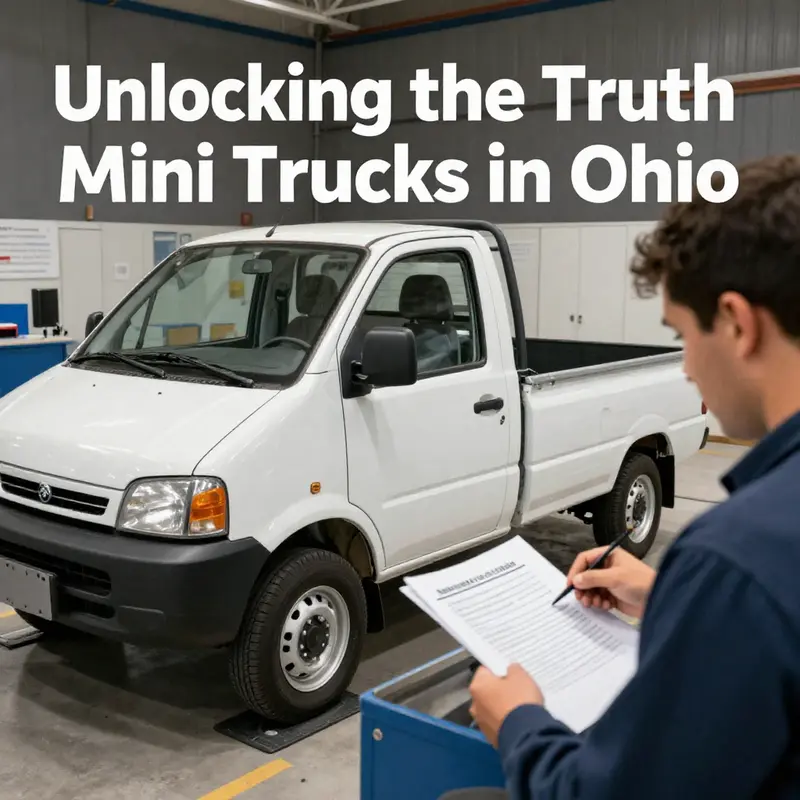
Ohio’s roads have always welcomed a variety of vehicles, from full-size pickups to compact cars. In recent years, a new question has moved from curiosity to practical consideration: are mini trucks legal in Ohio? The straightforward answer is yes—ownership is permitted, and many people see these compact, utilitarian vehicles as a flexible option for farming, maintenance work, rural errands, or private-property tasks. Yet the real story unfolds once you shift from possession to operation. The law treats ownership as one thing and on-road use as another, especially for smaller, lighter vehicles that were not originally designed for wide U.S. highways. In Ohio, as in many states, the decisive factors are how the vehicle is registered, what safety and emissions standards it meets, what insurance coverage is available, and whether the vehicle can be legally driven on public roads under current regulations. The result is a nuanced landscape where practical use, safety, and legality intersect, and where careful due diligence pays off in seamless operation rather than stray regulatory concerns.
From the moment someone contemplates bringing a tiny, Japanese-style utility vehicle into Ohio, the first checkpoint is legality of ownership and importation. There are no blanket prohibitions on owning a mini truck in the state, and Ohio generally does not impose special possession or sale restrictions for residents or non-residents. However, the day-to-day life of owning a mini truck is governed by a chain of requirements designed to ensure roadworthiness and accountability on public streets. The Ohio Bureau of Motor Vehicles (BMV) becomes the gatekeeper here. They are tasked with evaluating whether a specific mini truck model can meet state standards for registration, title, and operation, given that some models were not originally engineered to U.S. federal safety specs. This is not an indictment of the vehicle’s utility or charm, but a reminder that the road-legal status of any vehicle in Ohio rests on its compliance with a blend of state and federal requirements. In practical terms, this means that prospective owners should plan for an evaluation by the BMV or a licensed vehicle importer who specializes in foreign vehicles before attempting to register a mini truck for road use.
A central thread in the Ohio legal tapestry is the distinction between owning the vehicle and driving it on public roads. The practical pathway begins with registration. Like any other motor vehicle, mini trucks must be registered so they can be legally titled and licensed. Registration is not a one-and-done formality but an ongoing duty that ties the vehicle to the owner, confirms the vehicle’s identity, and documents its use under Ohio law. The exact requirements—records, VIN verification, and the necessary paperwork—may vary depending on the vehicle’s origin, modifications, and condition. In addition, registration is the anchor that makes insurance possible. Insurance coverage for a mini truck isn’t guaranteed by default; insurers typically assess a set of factors that reflect the vehicle’s size, weight, and intended use. They evaluate how the vehicle’s performance characteristics align with standard auto policies. The outcome can range from standard auto coverage to specialized policies or, in some cases, limited or excluded coverage if the vehicle presents unique risks due to its design or usage profile.
Insurance considerations deserve careful attention. Insurance providers every day weigh the realities of a compact, light-duty vehicle against the traditional risk models of more common passenger cars and larger trucks. For mini trucks in Ohio, the premiums are influenced by several elements: the size and weight of the vehicle, the engine specifications, and the intended use—whether it will be deployed for personal transportation, commercial delivery, property maintenance on a farm, or a private community setting. Even though a policy may exist, it is essential to confirm with the insurer that the exact mini truck model qualifies for standard auto insurance rather than requiring a specialty policy. The inscrutable fact is that not all insurers automatically extend coverage to non-traditional vehicles, and some may require additional endorsements, higher deductibles, or add-on protections. A proactive approach is to contact potential insurers early in the process, share precise technical specifications, and obtain written confirmation about eligibility for standard policies, liability limits, and any exclusions that might apply.
The compliance landscape extends beyond registration and insurance into safety and emissions standards. Ohio’s regulatory framework includes both state and federal components. Vehicle safety standards, crashworthiness, lighting, braking systems, and occupant protection all play roles in determining whether a mini truck can be legally operated on public roads. Emissions compliance is another axis of scrutiny, particularly for vehicles imported from abroad. In some cases, mini trucks designed for markets with different emission controls may not automatically meet U.S. federal standards, and the Ohio BMV must evaluate whether the vehicle can be registered for road use. This is where the practical reality emerges: some mini trucks may be eligible for registration after modifications, inspections, or documentation that demonstrates adherence to applicable safety and emissions norms. Other models may be restricted to private property, controlled environments, or certain road classes where speed and weight constraints better align with their design. The precise path depends on the model, its specifications, and how closely it aligns with Ohio’s classification and safety expectations.
When considering operational use, most mini trucks shine in situations where urban, campus, eco-tourism, agriculture, or maintenance tasks do not demand full-speed highway performance. Their compact dimensions, tight turning radii, and efficient fuel use make them ideal for narrow lanes, gated communities, farm lanes, and service corridors where larger vehicles simply cannot maneuver as easily. Yet these advantages do not automatically translate into unfettered access to all public roads. In Ohio, as in many states, there are practical and regulatory constraints tied to a vehicle’s characteristics—weight, top speed, braking performance, and compliance with established road-use standards. Operators have to weigh whether their specific use falls within permitted operations on public streets and whether the model can be registered as a motor vehicle under the applicable codes. The operational reality, then, is a balance of capability and compliance: a mini truck can be a dependable workhorse, but it may be subject to limitations that someone using it for a high-speed commute or long highway trips would find constraining.
A particularly important facet of the road-use question concerns the vehicle’s classification. Ohio Revised Code § 4501.02 provides the framework for how vehicles are classified, which in turn informs registration requirements, licensing, and the rules of operation. Meanwhile, § 4503.01 clarifies registration and operation obligations for motor vehicles on Ohio’s roads. These references are not mere legal trivia; they are the scaffolding that alerts owners to what is feasible and permitted in the everyday life of driving a mini truck on public infrastructure. Understanding these codes helps prevent the common misstep of assuming that a vehicle’s local acceptability equates to easy on-road permission. The BMV’s assessment of a given mini truck’s eligibility for a road registration is inextricably tied to these code provisions. The process may involve inspections, documentation of emissions compliance, and proof of insurance, all arranged to confirm that the vehicle can safely and reliably participate in Ohio’s traffic ecosystem.
This is why practical guidance emphasizes a two-step path: first, verify eligibility with the Ohio BMV or a licensed importer who specializes in foreign vehicles, and second, coordinate with an insurer who can articulate coverage options for the vehicle’s specific configuration. In many cases, the importer or dealer can help with the pre-registration evaluation, ensuring that the vehicle meets the necessary safety and emissions benchmarks or is prepared for any required modifications. Prospective buyers or builders should approach this process with a clear understanding of the costs and time involved, recognizing that the result—road-legal registration—depends not only on the vehicle’s current state but also on how closely it aligns with Ohio’s regulatory expectations.
Beyond the paperwork, there is value in connecting with a community of operators who share practical experience navigating the Ohio regulatory landscape. Engaging with a network of enthusiasts can illuminate common obstacles, such as documentation gaps, the specifics of VIN verification, or the details insurers request when evaluating a non-standard vehicle. These conversations often reveal pragmatic considerations that official guidance may not fully convey, such as the paperwork trails for importation, potential modifications required for compliance, or the timing and steps for a smooth registration process. For those who are curious about how various mini trucks perform in real-world settings, the hands-on perspectives of owners and operators can be a helpful compass. A practical way to access this community is to explore the broader mini-truck conversation available in online forums and blogs that focus on small-vehicle use and maintenance. For readers seeking a consolidated view of industry perspectives and enthusiast experiences, the Mini Trucks Ocala Blog provides a centralized resource with articles that capture the nuances of owning and operating these vehicles in everyday life. Mini Trucks Ocala Blog
In parallel with regulatory navigation, potential owners should consider the broader utility and lifecycle of a mini truck within Ohio’s landscape. The decision to register and operate a mini truck is not just a legal check. It is also a cost-benefit equation: the price of obtaining registration, the cost of insurance, the anticipated maintenance or modification expenses to meet safety and emissions standards, and the vehicle’s resale value should all be weighed against the intended use and benefits of owning a compact, maneuverable, fuel-efficient work vehicle. For farmers and landowners who need nimble transport across fields and orchard rows, the small footprint and simple maintenance can translate into tangible savings and improved efficiency. For city-based maintenance crews, the compact size can ease parking constraints and access to tight service corridors. For recreational or eco-tourism applications, a mini truck can deliver unique utility while minimizing the environmental footprint. Still, these positives come with the caveat that the vehicle’s on-road legality is contingent on the compliance framework described above, and responsible ownership means staying current with any regulatory updates or changes in BMV policy.
All of this underscores a broader truth: the question of whether mini trucks are legal in Ohio is not a binary yes-or-no decision. It is a process that begins with owning the vehicle and unfolds through a structured pathway of registration, insurance, and safety compliance. It requires patience, clear communication with regulatory and insurance professionals, and a readiness to document the vehicle’s specifications and capabilities in detail. It also invites a practical mindset: if a particular model cannot be registered for road use without substantial modifications, then its best utility may lie in controlled environments where on-road exposure is limited. Conversely, a model that clears the regulatory hurdles, with a demonstrable safety and emissions profile, can become a legitimate, responsive tool for work and daily tasks in Ohio’s varied terrains and communities.
To anyone embarking on this journey, the reliable route is to engage early with the Ohio BMV and to consult a licensed importer who specializes in foreign or non-standard vehicles. They can provide the most current interpretation of how a given mini truck will be classified, registered, and insured, and they can help map the steps needed to bring the vehicle onto Ohio’s roads without friction. Insurance considerations should be pursued in tandem, with detailed discussion about the vehicle’s size, weight, engine, and intended use. By aligning registration, insurance, and safety compliance from the outset, owners can avoid last-minute surprises that complicate on-road operation and potentially impose costly delays.
For readers who want to explore practical perspectives and experiential insights from people who have navigated these exact questions, the Mini Trucks Ocala Blog offers a repository of posts that touch on ownership, maintenance, and real-world use. This resource can provide a grounded sense of how a mini truck performs in daily life, complementing the formal guidance from the BMV and insurers. It is worth noting that while blogs can illuminate practical considerations, they do not replace official regulatory advice. Always verify current requirements directly with the Ohio BMV and with a licensed importer or attorney who specializes in vehicle compliance. For the most authoritative guidance, consult the Ohio BMV’s official website and engage with professionals who can provide jurisdiction-specific advice.
In summary, mini trucks can be legally owned and operated in Ohio, but their road legitimacy depends on meeting registration, insurance, and safety standards established by state and federal authorities. The process may require a wary eye toward regulatory specifics and a willingness to complete inspections or modifications as needed. The value, once the process is complete, is a versatile, efficient vehicle that fits unique tasks and spaces, paired with the reassurance that its on-road status is solidly anchored in compliance. The balance of careful preparation, professional guidance, and practical use defines the journey from curiosity to capability on Ohio’s roads. And as with any nuanced regulatory space, keeping pace with updates and maintaining open dialogue with the BMV and insurers will help ensure that the road ahead remains clear and compliant.
External resource for official rules: Ohio BMV official site. Ohio BMV Official Website.
Law in Miniature: Navigating Kei and Mini Trucks Within Ohio’s Road Rules
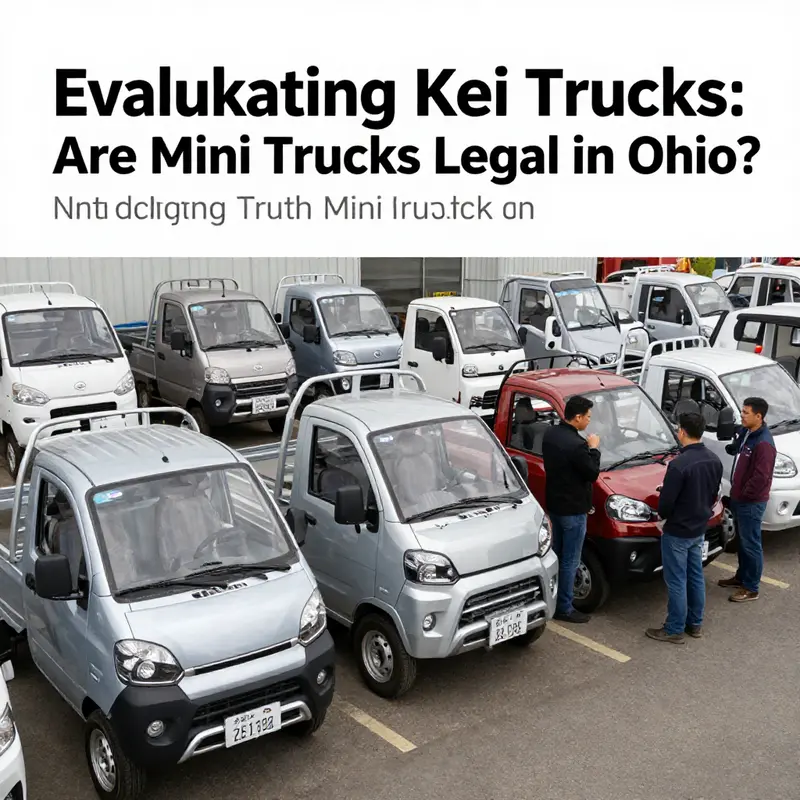
In Ohio, the tiny footprint of a kei or mini truck sits at a curious crossroad where personal ownership is allowed, but turning that ownership into lawful road use requires careful alignment with state standards. The conversation around these compact machines often starts with a simple question: are they legal to own here? The straightforward answer is yes. Ohio does not bar residents or visitors from possessing a kei or similar mini truck. Yet ownership is only the first mile on a longer road. The real test comes when an owner plans to bring a tiny workhorse onto public streets, highways, or even work sites that fall under the state’s motor vehicle framework. The law does not grant universal street-legal status to every compact truck with a neat profile; it requires a process that reconnects the vehicle to the stringent safety, emissions, and registration requirements that Ohio uses to govern any vehicle that shares the road with farm equipment, delivery vans, and everyday passenger cars alike.
This distinction between ownership and road use is not merely technical. It reflects a broader truth about how states balance innovation, utility, and safety. Mini trucks—often designed and tested for markets with different regulatory priorities—do not always line up neatly with U.S. standards for roadworthiness. Ohio’s approach, while pragmatic, tacitly acknowledges the diversity of design in these compact vehicles. Some kei trucks can meet the state’s safety and emissions requirements, especially after evaluation by the Ohio Bureau of Motor Vehicles (BMV). Others may be restricted to private property or designated off-road trails because, in their current form, they fail to satisfy the essential criteria to operate on public roads. The practical upshot is that ownership is not synonymous with road legality, and the path from purchase to plate can be as much legal navigation as it is mechanical modification.
The BMV serves as the gatekeeper in this process. It is the agency charged with interpreting how a vehicle, even one imported from abroad, can align with Ohio’s standards for on-road use. The BMV’s assessment covers several dimensions. First is safety: the vehicle must meet minimum protections for drivers, passengers, and vulnerable users such as pedestrians and cyclists. Then there is emissions: Ohio’s environmental rules require that motor vehicles meet certain limits, or be demonstrably compliant through approved testing and documentation. Finally, registration and insurance form the legal backbone: a vehicle must be registered in the state, and a valid insurance policy must be in place before it may be operated on public roads. These three pillars—safety, emissions, and insurance—frame the practical realities of owning a kei or mini truck in Ohio.
Understanding the import dynamic further expands the picture. In many jurisdictions, vehicles that are twenty-five years old or older can be imported without undergoing federalization or extensive modifications. This “age-based” principle, common in several regions, can simplify the entry of a kei truck into the United States and, by extension, into Ohio. Yet age alone does not guarantee road legality. Even if a truck arrives in Ohio with historical status, it still must align with the state’s own inspections, safety standards, and emissions requirements. In practice, this means the vehicle must be evaluated and, if necessary, modified to reach compliance levels that satisfy the BMV. The 25-year benchmark can ease the import journey, but it does not waive the ongoing responsibility to prove roadworthiness under Ohio law. When a prospective owner navigates this space, the prudent course is to engage early with an Ohio-licensed importer or directly with the BMV to map out a concrete path toward compliance rather than relying on a generalized assumption about historic status.
The step-by-step journey from curiosity to compliance tends to unfold along a sequence that blends regulatory consultation with practical assessment. A typical first move is to establish the vehicle’s origin, its provenance, and its current condition. The import route matters: a right-hand-drive configuration, unusual lighting, or nonstandard braking systems can complicate or even derail the road-legal objective if those elements fail to meet U.S. standards. The next phase involves a formal inquiry with the Ohio BMV or a licensed vehicle importer with specialization in foreign vehicles. This step is essential because it anchors expectations in official guidance rather than anecdotal interpretations. The BMV may require a mechanical inspection, emissions testing, or a review of safety equipment to determine whether the vehicle can be registered and insured for street use. Importantly, the decision may hinge on how state regulators view the vehicle’s classification. A kei truck might be treated as an off-road vehicle, a non-highway vehicle, or a standard light-duty vehicle depending on its design and the state’s interpretation at the time of the evaluation. This variability underscores why prospective buyers should not assume a path to license plates simply because the vehicle is small and economical.
The practical implications ripple through everyday life as well. For industry and hobbyists who see these nimble vehicles as versatile workhorses, the potential is compelling: a compact vehicle that can haul light loads, navigate tight spaces, or access remote sites where full-size trucks struggle. But the Ohio framework tempers that promise with the reality of compliance costs and administrative steps. The necessary insurance, for instance, may be harder to secure or more expensive than for a typical passenger vehicle, given the vehicle’s unique configuration and market standing in the state. Likewise, registering such a vehicle can demand documentation that proves its compliance with Ohio’s safety and emissions expectations, possibly accompanied by modifications to lights, braking systems, or tires to align with U.S. specifications. The combined effect is a scenario in which the allure of a tiny, fuel-efficient work vehicle meets the steady discipline of regulatory validation.
In this landscape, the private-property option often represents the simplest use-case for many owners. A kei truck that cannot meet the on-road standards might still have significant value on a motor-friendly property—farmed fields, construction plots, or private estates where road exposure is either rare or non-existent. In those contexts, the vehicle can serve as a practical tool within the boundaries of private use, provided it remains off public roadways. The distinction is not merely about legality; it speaks to the broader philosophy of how states balance enthusiasm for novel or foreign-designed machines with the imperative to keep public roads safe and uniformly regulated. It is a reminder that, in Ohio, the thrill of owning a compact, efficient truck can coexist with the sober routine of compliance checks, registrations, and periodic inspections—that triad that keeps the motor vehicle ecosystem functioning for all.
For readers who are actively considering importing a kei or mini truck into Ohio, there is value in understanding the potential pathway before making commitments. It starts with recognizing that the age rules, while favorable in some cases, do not guarantee road status. Then comes a candid assessment of the vehicle’s current condition and a realistic appraisal of what changes might be necessary to meet U.S. standards. Some owners opt for a phased approach: begin with private-property use and, as possible, pursue the necessary steps to achieve road-legal status. Others may decide that a kei truck is best enjoyed as a specialty vehicle, a collector’s item, or a project vehicle whose primary value lies in the unique driving experience rather than broad public-road utility. Either way, the decision should be anchored in clear information from authoritative sources and guided by a plan that anticipates the regulatory milestones ahead.
In the broader context of the United States, Ohio’s stance on kei and mini trucks reflects a mosaic of state-level interpretations about how to classify vehicles that arrive from international markets. While some states have embraced a more permissive stance toward certain classes of micro-trucks, Ohio’s approach emphasizes due process and verification. This means potential owners should not rush into purchase decisions based on a single anecdote or a competitive pricing advantage. Instead, cultivate a Delphi-like clarity about the steps needed to achieve legal operation on public roads. The path is navigable, but it is not automatic. It requires engagement with regulatory authorities, documentation of compliance, and perhaps modest vehicle modifications intended to bridge the gap between the vehicle’s original design and the expectations of U.S. road safety standards.
Throughout this exploration, it helps to keep in mind the practical reality of Ohio’s regulatory environment. The BMV’s role is not to restrict innovation but to ensure that any vehicle sharing the road meets a baseline of safety, reliability, and environmental responsibility. The law accommodates a wide range of vehicle types and configurations; it simply requires that each be demonstrated to fit within the state’s framework. Owners who approach the process with patience and good information are often rewarded with a clear path to registration, insurance, and lawful operation. Those who encounter roadblocks along the way should view them as signals to reassess the vehicle’s configuration, seek specialized guidance, or consider alternate uses that respect the law and preserve the vehicle’s value for the owner or community it benefits.
If you are pursuing a practical, legally compliant use of a kei or mini truck in Ohio, a cautious, informed approach is essential. Start with an honest inventory of the vehicle’s specifications, its intended use, and the regulatory hurdles that may apply. Reach out to the Ohio BMV or a licensed importer early in the process to confirm the latest requirements and to learn whether a formal assessment or modest modifications could unlock road access. Document everything meticulously: purchase records, provenance, any prior inspections, and a plan for emissions or safety-related updates. With a clear roadmap in hand, the journey from curiosity to lawful operation becomes less about guesswork and more about precise navigation through the state’s motor vehicle system. In the end, the question is less about whether the vehicle is small and fancy and more about whether its on-road presence can be responsibly aligned with Ohio’s safety and environmental standards.
For readers who want to explore related conversations about how compact work vehicles fit into American driving culture and regulatory frameworks, a broader discussion is available at minitrucksocala.com/blog/. This resource offers context about how enthusiasts view kei-style designs and how communities balance the benefits of smaller, versatile trucks with the requirements of compliance and road safety. It can help frame expectations and provide practical perspectives as you weigh whether ownership should translate into road use, private-site tasks, or a carefully planned transition to road-legal status. (Internal link: minitrucksocala.com/blog/)
In sum, Ohio welcomes ownership of kei and mini trucks, but it does not grant universal road legality to every compact truck that originates abroad or from a different regulatory culture. The pathway to driving on public roads involves a structured evaluation by the BMV, potential modifications to meet U.S. safety and emission standards, and the establishment of proper registration and insurance. The journey can be as enlightening as the vehicle itself, revealing how state agencies translate complex, cross-border vehicle designs into a coherent, safe, and fair framework for all road users. Whether your aim is to use a kei truck on private property, on designated off-road trails, or someday to enjoy a fully compliant on-road experience, the key is to approach the process with clear information, professional guidance, and a readiness to adapt the vehicle to Ohio’s standards. For those who navigate this path thoughtfully, the payoff is a vehicle that reflects both the efficiency and the ingenuity of compact design, firmly integrated into the state’s orderly road system.
External reference for further official context: https://worldlawdigest.com/are-kei-trucks-legal-in-ohio/
Final thoughts
So, are mini trucks legal in Ohio? Absolutely, they are! But they come with the caveat of needing to follow certain regulations concerning safety, registration, and insurance. For small business owners, residential property owners, and mini truck enthusiasts alike, understanding these points ensures that you can enjoy the many benefits of mini truck ownership while remaining compliant with state regulations. As you embark on this exciting journey, equip yourself with accurate information to make the most informed decisions. Drive safe, and happy trucking!