
Mini trucks, particularly the popular Kei trucks from Japan, have gained a devoted following in Pennsylvania. Whether you’re a small business owner looking for an efficient vehicle, a property owner interested in versatile transportation, or an enthusiast eager to learn the ins and outs of mini truck legality, it’s essential to understand the regulations governing these unique vehicles. This guide highlights the key aspects of mini truck ownership in Pennsylvania, breaking down ownership regulations, safety standards, registration and insurance requirements, the challenges of road use, and the importance of consulting with the Pennsylvania Department of Transportation. Let’s drive into the details to ensure you’re well-informed as you navigate the world of mini trucks!
Owning and Rolling a Mini Truck in Pennsylvania: Navigating Ownership, Regulation, and Road Use
Interest in tiny pickups has grown, but in Pennsylvania there is no separate legal status for a ‘mini truck’. Vehicle classification is weight-based, and most compact trucks that stay under the light-duty threshold (generally 10,000 pounds gross vehicle weight) are treated as light-duty trucks. Ownership is not prohibited based on size, as long as the vehicle can be registered and insured and meets safety and emissions standards. The absence of a distinct mini-truck tag means the same basic ownership rules apply as for other light-duty work vehicles.
Classification details: Pennsylvania categories for registration include passenger vehicles, light-duty trucks, and commercial vehicles. A compact, lightweight truck under 10,000 lb GVWR typically falls into light-duty. This framework supports ownership by individuals or entities, provided the vehicle has proper title and registration and passes emissions and safety checks.
From ownership to operation: if the vehicle is registered, titled, and insured, ownership is straightforward; however, using it on public roads requires compliance with safety standards. Imported kei-style trucks may require parts changes or a certification process to demonstrate conformity with state requirements. The necessary steps may include updating lighting, braking, seat belts, and emissions systems.
Registration and regulation: PennDOT governs registration and titling; you must provide VIN, proof of ownership, and demonstrate compliance with lighting and emissions. The PennDOT website offers forms and fee schedules; consider an initial inspection or consultation with a compliance professional.
Practical guidance: connect with local owners and mechanics experienced with kit or kei trucks to understand common inspection outcomes and maintenance needs. For definitive guidance, consult PennDOT’s Vehicle Registration and Fees portal at https://www.penndot.gov/VehicleRegistration/RegistrationFormsAndFees/Pages/default.aspx.
Safety Standards at the Edge of Legality: Navigating Mini Trucks in Pennsylvania
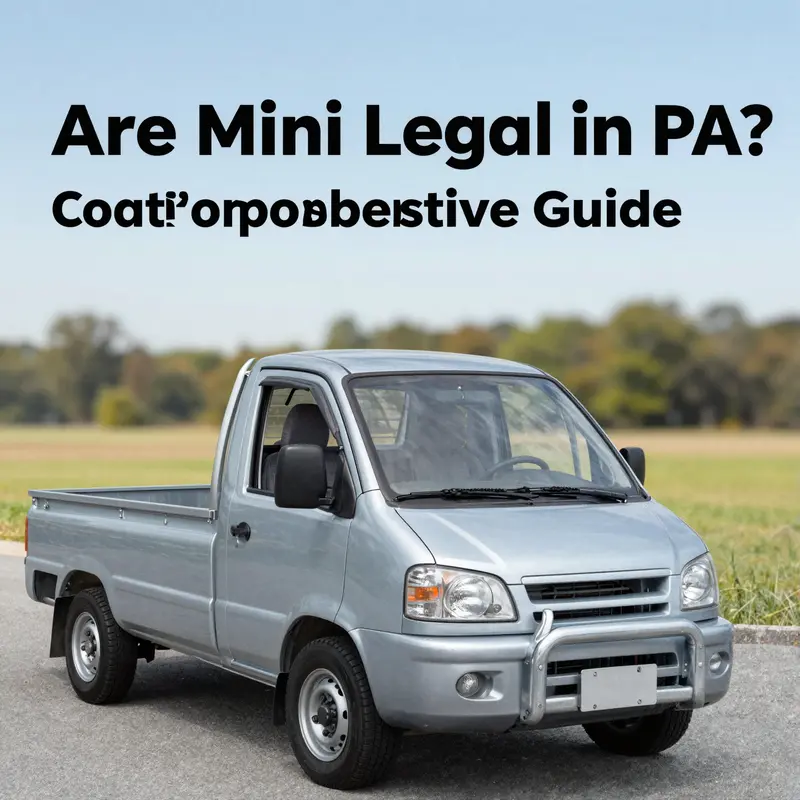
In Pennsylvania, the charm of a compact, capable workhorse meets the precision of a complex legal framework. Mini trucks—often described in broad terms as small utility vehicles or low‑speed vehicles—spark curiosity because they can be owned with relative ease, yet their day‑to‑day use on public roads is governed by stringent safety and regulatory standards. This tension between practicality and compliance is not merely a matter of personal preference; it is what determines whether a driver can legally roll a mini truck onto a PA street, a curb, or a farm lane without facing penalties. The path from ownership to lawful operation travels through federal safety rules adopted by the state and then through the lens of Pennsylvania’s road rules, registration requirements, and insurance obligations. The result is a layered picture where legality is contingent on meeting a set of concrete standards rather than a single, simple designation.
At the core of the legality question lies the federal category known as low‑speed vehicles, or LSVs. Under National Highway Traffic Safety Administration (NHTSA) guidelines, LSVs are designed to operate at low speeds and are not classified as typical passenger cars. This distinction immediately shapes the regulatory terrain. LSVs must be capable of a maximum speed within a narrow band, roughly 20 to 25 miles per hour, which aligns with the realities of shared urban and rural roads but sets clear boundaries for where these vehicles can safely operate. The speed specification is not a decorative feature; it underpins the entire framework of equipment requirements and road usage. If a mini truck’s performance exceeds that threshold, it risks being treated more like a conventional motor vehicle, thereby triggering a different and more demanding set of compliance obligations.
The equipment list that accompanies the LSV designation is precise and practical. A vehicle in this category must provide basic safety equipment that makes it visible and safe to interact with other road users. Headlights and taillights, brake lights, and turn signals establish visibility in varying lighting conditions and signaling intent to other drivers. Seat belts are not negotiable; they are essential for occupant protection, especially given the close quarters typical of compact utility vehicles. Windshield wipers help maintain visibility in rain or fog, while rearview mirrors ensure the driver can monitor traffic behind and to the sides. Reflective materials, too, play a role in night visibility. Taken together, these features are not cosmetic extras; they are the minimum standard that allows a mini truck to be seen, recognized, and understood by other road users in a speed‑restricted vehicle category.
Yet safety standards are only part of the story. Pennsylvania’s approach to mini trucks is anchored in the recognition that these vehicles are not passenger cars by default. They are a distinct vehicle class with specific development histories, performance envelopes, and use cases. Because of this, the state, through PennDOT, requires registration and proof of liability insurance. Simply owning one is not enough; the vehicle must be properly registered, and the operator must demonstrate financial responsibility through insurance. The registration process is a formal acknowledgement that the vehicle will be driven on public roads, not merely stored on a farm or tucked away in a utility yard. Registration also serves as a record that the vehicle has met the state’s basic requirements, a prerequisite for any lawful operation on PA roads.
Even with registration and safety equipment in place, the permissible roads for mini trucks are clearly delimited. In most cases, these vehicles are restricted to roads with speed limits of 35 mph or less. They are not permitted on highways or interstates where higher speeds and heavier traffic compose a very different risk calculus. This restriction is not merely a suggestion; it’s part of a standardized approach designed to minimize exposure to road environments where the speed mismatch could endanger occupants and other motorists. The practical implication for owners is straightforward: plan routes with local streets and county roads in mind, avoid arterial corridors that routinely push travel speeds into levels that exceed the LSV design parameters, and be mindful of local traffic patterns and posted restrictions.
With these rules in mind, the question of usage becomes concrete. Mini trucks can serve agricultural, construction, or utility roles, among other practical applications. They are well suited to tasks that require frequent stop‑and‑go movement, short trips between sites, or efficient transportation of tools and materials within a defined work zone. The key is to ensure that each use case aligns with the vehicle’s safety profile and with the road environment. The notion of functional usefulness does not override safety; rather, it informs the contexts in which these vehicles can operate without contravening state or federal rules. Operators should approach each potential use case with a careful assessment of speed, traffic density, road type, and the presence of other vehicles sharing the same route.
A practical path to lawful use also involves understanding the potential friction points that can arise in real‑world settings. In some situations, an imported mini truck may not automatically meet all state emissions standards or braking requirements. While the NHTSA framework provides a baseline, many vehicles from outside the domestic market require careful inspection, verification, and sometimes modification to ensure compatibility with the regulations now binding in PA. The trend toward stricter compliance is not unique to Pennsylvania; it mirrors broader national efforts to standardize low‑speed vehicle performance, emissions, and safety features. For buyers and operators, this means that the journey from purchase to road liability can involve more steps than expected, including potential adjustments to lighting, braking systems, or emissions controls to satisfy both federal guidance and state inspection practices.
The final piece of the compliance puzzle is the administrative process. Even when a mini truck meets the safety equipment requirements and performance constraints, it must be properly documented. Registration through PennDOT is not a mere formality; it is the official record that grants the vehicle access to public roads under the conditions set by law. Proof of ownership, liability insurance, and adherence to the vehicle’s intended use are among the necessary components of the registration. Moreover, the operator’s age matters: the typical rule requires drivers to be at least 16 years old, a condition reflecting general traffic safety expectations and the practical realities of operating a vehicle with limited speed and acceleration.
For readers seeking practical, real‑world guidance, a broader discussion of these issues can be found in community resources that discuss mini trucks in a general sense while acknowledging Pennsylvania’s regulatory stance. Within these conversations, one can find a synthesis of compliance considerations, practical experience, and regulatory cautions that help frame the decision to acquire and operate a miniature utility vehicle on PA roads. For readers who want a sense of the ongoing dialogue, the Mini Trucks CaLa blog offers a concise entry point: minitrucksocala.com/blog/. This resource captures the everyday questions that arise when owners weigh ownership against the realities of safety standards, registration, and road use. While the blog is not a legal authority, it serves as a community touchstone for drivers navigating the patchwork of rules and local practice that accompanies these vehicles in different parts of the state.
Ultimately, the road to lawful operation in Pennsylvania blends the clear criteria of federal safety standards with the precise requirements of state administration. The equipment list—headlights, taillights, brake lights, turn signals, seat belts, windshield wipers, rearview mirrors, and reflective materials—forms the baseline that makes a mini truck visible and safe. The speed cap and road restrictions place meaningful constraints on where these vehicles can be used, while registration, insurance, and age requirements ensure accountability and financial responsibility. The agricultural, construction, and utility use cases illustrate that these compact machines can fulfill legitimate work needs when employed within their designed limits. But the essential caveat remains: approaching the law with an understanding of both safety expectations and administrative duties is the only reliable path to lawful operation.
For anyone contemplating ownership, the prudent steps are clear. Inspect the vehicle for compliance with the night‑time visibility and signaling requirements, verify the braking performance, and assess emissions considerations if the vehicle comes from outside the domestic market. Confirm that the vehicle can be reliably registered and insured in Pennsylvania, and plan routes that stay within the legal speed and road‑type restrictions. Before turning the ignition, check with PennDOT for the latest rules and any special permits that might apply to a specific use case or locale. The regulatory landscape can evolve, and staying informed is part of responsible ownership. For ongoing updates and practical discussions, the path through community resources remains a valuable companion on the journey toward safe, legal operation on PA streets and byways. As a final reminder, the most authoritative guidance will always come from the official state portal of PennDOT and related regulatory resources. For a direct reference, the official site provides current specifics and contact points for clarification and registration procedures: PennDOT.
Navigating the Paperwork Trail: Registration, Insurance, and the Road to Legality for PA Mini Trucks
Across the nation, small pickup-style vehicles known as mini trucks or Kei trucks have captured attention for their compact footprint and practical payloads. In Pennsylvania, these little workhorses sit in a gray area that can feel murky to a first-time buyer. They are not outright illegal, but their use on public roads is tethered to a set of strict rules. The balance between utility and compliance resides in two pillars: how the vehicle is classified under state law, and how it is equipped and documented for road use. The state’s stance is not a simple yes or no; it is a conditional framework that hinges on a precise match between the vehicle’s characteristics and the regulatory requirements that Pennsylvania imposes on motor vehicles when they meet the road threshold. For many owners, the journey toward legality involves a careful assessment of the vehicle’s purpose, its construction, and the extent to which it can be brought into compliance with federal and state standards. This is not a question of whether a mini truck is capable of traveling on a PA highway; it is a question of whether the vehicle can be registered, insured, and safely operated on public roads without running afoul of the law. The real-world implication is clear: buyers should enter the process with eyes open to the possibility that significant modifications or specialized permits may be necessary, and with a plan to verify regulatory requirements directly with the official sources that oversee vehicle registration and insurance in Pennsylvania. The practical upshot is that while ownership is possible, the road-dwelling life of a mini truck in Pennsylvania often demands more than a simple title transfer or a standard insurance policy. It requires a careful, step-by-step alignment with state policy, and a willingness to accommodate the standards that keep PA roads safe for everyone. This is the kind of issue where the details matter as much as the dream of owning a small, nimble utility vehicle. The chapter that follows unpacks those details, weaving together classification questions, registration steps, and the insurance framework in a way that helps readers gauge whether a particular mini truck can truly become a road-legal asset in Pennsylvania. The starting point is to understand how Pennsylvania defines a motor vehicle and where a mini truck may fit within that framework. If a vehicle is determined to meet the definition of a motor vehicle under state law, it becomes subject to the same registration and safety regimes that apply to other street-legal cars and trucks. If, on the other hand, the vehicle is seen as a farm implement, a construction tool, or an off-road-only device that operates exclusively on private property, then it may fall outside the standard road-use regime. Either path carries consequences for licensing, registration plates, and the ability to carry insurance on public roadways. And in Pennsylvania, the consequences are not merely administrative. They have real implications for liability, coverage, and the potential penalties that come with driving unregistered or uninsured on a public street. The importance of understanding this framework cannot be overstated, because it sets the boundary between a clever, economical utility addition and a legal liability that can affect a driver, a lender, and the community around them. To illuminate this boundary, consider the typical journey an owner might take from purchase to road-ready operation. The first question is whether the mini truck will be classified as a motor vehicle for purposes of registration and licensing. This determination hinges on several factors: the vehicle’s size, weight, engine type, and intended use. If it is deemed a motor vehicle, it becomes accountable to PennDOT’s registration process. If it is not, or if it operates strictly on private property, the owner may avoid registration altogether. The distinction might seem subtle, but it carries legitimate consequences. Registration is not just about having a plate on the back; it is about establishing a legal identity for the vehicle on public roads, enabling the vehicle to be tracked for safety inspections, emissions compliance (where applicable), and insurance licensing. The next layer involves the practicalities of registering a vehicle that is not a conventional passenger car or pickup. In Pennsylvania, the registration process requires several concrete steps. You must establish ownership and provide proof of that ownership, which could be a title or a bill of sale, depending on the vehicle’s history. A Form MV-1 application is typically involved in standard motor vehicle registrations, and the corresponding fees must be paid to complete the process. A safety inspection is often part of the registration puzzle, depending on the vehicle’s classification and the local PennDOT district’s interpretation of the rules. This inspection is designed to verify that basic mechanical and safety standards—such as lighting, brakes, and general roadworthiness—are present and functioning as required by state law. The process is not merely bureaucratic theater; it is a public safety measure intended to reduce the risk of accidents involving less familiar, smaller-scale vehicles that nonetheless share lanes with conventional cars and trucks. Insurance, the other essential pillar, operates in parallel with registration. In Pennsylvania, operating a vehicle on public roads without valid liability insurance is not permissible. The state’s minimums are designed to cover typical injury and property damage scenarios and form a baseline that protects both drivers and pedestrians. The standard minimum coverage—often summarized as 15/30/5—translates into a requirement for bodily injury coverage of $15,000 per person, $30,000 per accident for bodily injury, and $5,000 for property damage. While this is a standard baseline, the unique risk profile of a mini truck, especially one that might be imported or modified to fit a smaller footprint and performance envelope, can influence the cost and availability of insurance. Insurance providers will consider the vehicle’s intended use, expected mileage, and the potential for performance-related risk when quoting premiums. As a consequence, some owners discover that obtaining insurance for a mini truck is more complex than anticipated. It is not unusual for insurers to request documentation demonstrating the vehicle’s compliance with federal and state safety standards, or to require specific safety equipment be installed and maintained. Noncompliance—such as driving without insurance or failing to maintain a valid policy—carries stiff penalties. Fines, license suspensions, and even impoundment can follow, depending on the severity and persistence of the violation. It is not merely a matter of paying a premium; it is about maintaining continuous coverage aligned with the shared responsibility of road safety. In practice, many imported Kei trucks present a dual challenge. Their compact build is perfect for tight urban spaces or restricted property access, yet the same small footprint can complicate compliance with lighting, braking, weight distribution, emission control, and safety certification standards. Some models may require modifications to meet lighting standards or to bring braking systems up to par with Pennsylvania’s expectations for on-road use. Others may struggle to meet emission or noise standards that are enforceable on public rights of way. These modifications, while technically feasible, can be costly and may alter the vehicle’s original design in ways that affect warranty and resale value. The decision to pursue road legality thus becomes a cost-benefit analysis. A practical and prudent approach starts with a candid assessment of what the mini truck will be used for. Will it ferry tools between worksites, haul small loads within a farm, or simply serve as a neighborhood errand vehicle? Each scenario demands a different regulatory perspective. If the vehicle will be used exclusively on private property—on a farm, in a workshop, or within a gated site—the registration and license plate may be unnecessary. In these cases, the focus shifts to ensuring the machine can operate safely on site, with attention to worker safety, ignition sources in hazardous environments, and proper storage of fuel and fluids. However, once public roads enter the equation, the game changes. The vehicle has to be registered, insured, and equipped to meet the safety criteria that Pennsylvania imposes on any motor vehicle intended for street use. The paperwork then stops being a mere formality and becomes a foundational requirement for lawful operation. For readers seeking clarity on the process, the best route is to consult the official PennDOT resources and, importantly, to verify the vehicle’s classification early in the decision-making process. The intricate details—proof of ownership, MV-1 forms, registration fees, and inspection schedules—are not ultimately obstacles but guardrails that help ensure safety and accountability on shared roadways. In addition to the formal processes, prospective owners often benefit from engaging with communities of like-minded buyers who have walked this path. A good starting point is to explore the broader body of information available through industry blogs and knowledge hubs. For readers who want a centralized hub of ongoing news, stories, and practical guidance, a dedicated online resource can provide a steady stream of updates, practical tips, and peer experiences. This content can serve as a practical companion to the official requirements, helping readers navigate common questions about the registration timeline, required documentation, and the realities of insurance pricing for these unusual vehicles. For further reading that delves into the broader world of mini trucks and their community, the Minitrucks Blog provides a useful repository of discussions and articles that can illuminate practical considerations beyond the statutory text. You can explore that resource here: Minitrucks Blog. As you gather information, remember that the regulatory landscape can shift with new safety standards, emission guidelines, and enforcement priorities. The most reliable source for up-to-date information remains the Pennsylvania Department of Transportation, along with the state’s motor vehicle code. The official knowledge base and its published documents will reflect any changes that affect how mini trucks can be registered, what equipment is required for street use, and how insurance requirements are interpreted for these unconventional vehicles. Before committing to a purchase, plan a conversation with a licensed agent who understands Pennsylvania’s unique positioning on small, non-standard on-road vehicles. Ask about the exact documentation needed for registration, the expected inspection criteria, and how particular vehicle configurations—such as engine type, lighting arrangements, and braking systems—might influence the final registration outcome. It is not enough to be enthusiastic about a compact vehicle’s utility; one must also be prepared to demonstrate that the vehicle meets the safety and legal expectations that protect everyone who shares the road. The structural reality, then, is that mini trucks in Pennsylvania exist in a conditional regime. They can be owned and, with the right steps, can be made road-legal. But the path is seldom straightforward. It requires a disciplined approach to classification, a thorough plan for registration and inspection, and a dependable insurance strategy that aligns with the vehicle’s purpose and usage. For those who seek the compact solution without compromising on legality, patience and due diligence are the most valuable parts of the journey. And when questions arise, the official channels—the PennDOT guidelines and the state’s formal registration processes—offer the clarity that a curious buyer needs to move from curiosity to compliance. In sum, the road to owning and operating a mini truck in PA is workable, but the path hinges on a precise compliance framework rather than a casual workaround. The last mile—driving legally on public streets—depends on turning a compact curiosity into a fully documented, properly insured, and safety-conscious vehicle that meets state and federal expectations. External resources, including the state’s official pages, remain essential touchpoints as regulations evolve. For the most current official details, consult PennDOT at https://www.dmv.pa.gov.
Road-Ready or Roadblocked: The Legal Landscape for Mini Trucks in Pennsylvania
Curiosity about tiny, boxy workhorses that combine nimble maneuvering with surprising cargo capacity has drawn many Pennsylvanians toward mini trucks. These compact vehicles, often nicknamed kei trucks in other markets, carry the promise of efficiency and practicality. Yet in Pennsylvania, the dream of cruising down a suburban street in a small utility vehicle sits beside a host of legal questions. Ownership is not the same as road use, and the path from a compact work truck to a road-legal vehicle is shaped by a maze of federal and state standards. The story is not simply about size; it is about whether the machine can meet the duty of a vehicle that shares the road with cars, bikes, trucks, and pedestrians, all within a legal framework that emphasizes safety, accountability, and environmental responsibility. For many people, the initial impulse is excitement, but the destination—legal operation on public roads—requires careful navigation through rules that were designed with much larger, traditional vehicles in mind.
One of the first realities to confront is classification. In many cases, mini trucks arrive in Pennsylvania classified not as standard street-legal automobiles but as off-road or utility devices. This distinction matters because it often determines which safety features are legally required for on-road operation. The visual cues are familiar: headlights, brake lights, turn signals, and seat belts all serve as visible reminders that a vehicle sharing the highway is designed to be controllable in traffic, predictable to other drivers, and capable of meeting minimum safety standards. When a vehicle is marketed primarily as a work tool for private land, farms, or off-road adventures, those signaling and protective systems may be incomplete or absent. The consequence is a public-road prohibition that is not always obvious to new owners until they attempt to register the vehicle or operate it in traffic. The practical takeaway is straightforward: before any on-road attempt, verify whether the specific model has the certification or an approved configuration sufficient to satisfy Pennsylvania’s road-use requirements.
Emissions and environmental considerations also shape the road-legal equation. Pennsylvania’s regulatory environment, like many other states, maintains standards intended to curb pollution and ensure that vehicles meet certain emissions criteria. The compact footprint of a kei truck does not automatically guarantee compliance with these standards, especially if the vehicle’s origin and design do not align with U.S. or Pennsylvania-specific tests. A vehicle that is imported with a different engine management system or exhaust configuration can fail to meet the necessary thresholds. The result is not only the potential for failed inspections but also the broader consequence of higher operating costs and the risk of penalties if a vehicle is found to be noncompliant while in use on public roads. In short, emissions compliance is as much a gatekeeper as the presence of headlights or seat belts.
Registration and insurance form another critical threshold. In Pennsylvania, a motor vehicle that will be used on public roads generally must be registered with the state and insured. When a mini truck does not carry a valid title, VIN, and the necessary emissions and safety certifications, it often cannot be registered or insured through conventional channels. The practical effect is that the owner could find themselves unable to legally title or insure the vehicle for on-road use. Without proper registration and insurance, the vehicle cannot be legally operated on public roads, and attempting to do so can expose the driver to fines, towing, and, in more severe circumstances, criminal charges. The stakes are not merely administrative; they are legal and financial, with real-world consequences if law enforcement encounters an vehicle that lacks the proper paperwork or fails to meet on-road standards.
Beyond paperwork and standards, there is the everyday reality of safety on busy Pennsylvania roadways. Mini trucks, by their design, can present handling and speed characteristics that differ markedly from those of typical passenger cars or larger trucks. They often have lower top speeds and less stable handling on highway grades or in adverse weather. While that profile might be advantageous for narrow farm lanes or urban alleys, it becomes a liability in high-speed traffic scenarios. In the eyes of law enforcement, the combination of limited acceleration, potential visibility challenges, and less sophisticated brake systems can raise concerns about compatibility with standard traffic flow. Officers may observe a vehicle that is technically capable of fulfilling its original on-road purpose only with modifications or special permits and conclude that it is not yet a safe fit for general highway use. This practical risk assessment feeds into the broader regulatory narrative: the journey from ownership to street-legal operation is not only about compliance on paper but about demonstrable safety in the daily rhythm of Pennsylvania streets.
For enthusiasts who still hope to drive a mini truck on public roads, the path to compliance starts with verification. It is essential to determine whether the specific model has been approved by PennDOT for on-road use or whether substantial modifications would be necessary to meet the state’s road-legal standards. In some rare cases, manufacturers or sellers may offer variants that are adjusted to align with safety and emissions requirements. However, this is not common, and the burden of proof rests squarely on the owner to document that the vehicle meets all applicable standards before attempting registration or operation. The process often involves ensuring that the vehicle bears an appropriate title and VIN, has functioning lighting and signaling systems, seat belts installed and functioning, and that emissions controls meet governing standards. The burden of proof is not a mere formality; it is a practical checklist that can determine whether a vehicle can even begin the long process of a road-legal conversion.
As the layers of regulation converge, the responsible owner understands that the weight of compliance lies with them. The lay of the land is clear: you must confirm the model’s road-worthiness with official channels, consider modifications that bring the vehicle into compliance, and anticipate the administrative steps required for title, registration, and insurance. The consequences of ignoring these steps are not simply bureaucratic friction; they are tangible, with the potential to disrupt ownership plans and to expose the operator to penalties and risk when a noncompliant vehicle is used in traffic. The call for due diligence is not a cautionary note but a practical imperative: the public-road landscape in Pennsylvania is designed to ensure that every vehicle sharing the highway can be safely managed in the context of other drivers, pedestrians, and the variability of weather and road conditions.
The journey toward road legality also invites a broader reflection on the role of owners and the responsibilities that accompany vehicle ownership. The owner becomes the steward of compliance, responsible for ongoing maintenance, proper registration, and the documentation that will allow inspections and potential future approvals. In a state that prizes standardized safety and predictable enforcement, the decision to operate a mini truck on public roads invites ongoing attention to whether the vehicle remains compliant over time. Changes in regulations, updates to emissions testing, or modifications made by the owner can shift a vehicle from a legally permitted on-road status to a noncompliant state, with all that implies for insurance, liability, and road safety.
For readers who want a practical starting point, a trusted resource to consult is the Pennsylvania Department of Transportation’s guidance on street-legal vehicles. Its framework outlines the essential requirements for vehicle registration and the kinds of safety and emissions criteria that are typically evaluated for road use. This guidance acts as a road map for owners weighing the feasibility of bringing a mini truck onto Pennsylvania’s public roads. It also helps set expectations for what kinds of modifications or official approvals might be required to meet the state’s standards. In the broader sense, the policy framework reminds us that road legality is not a single checkbox but a holistic assessment of a vehicle’s design, its integration into traffic, and the ongoing ability of the owner to maintain compliance over time. For readers seeking a starting point on official requirements, the PennDOT page on street-legal vehicles provides the authoritative reference that anchors this journey in current regulation.
To connect this navigation to broader communities and practical perspectives, many enthusiasts turn to dedicated online spaces where owners share experiences about converting or adapting small utility vehicles for on-road use. A useful touchstone for those who want to explore real-world experiences, vehicle setups, and community feedback is the comprehensive, user-generated content found in industry-focused blogs. For readers seeking ongoing updates, discussions, and photos from other Pennsylvania residents who have walked this path, the Mini Trucks Cali Blog offers a repository of insights, practical considerations, and evolving opinions about how these vehicles fit into everyday life and work in the region. This resource provides a sense of the community around mini trucks, including the trade-offs, costs, and timelines often involved in attempting to align a kei-style truck with Pennsylvania’s road standards. It is a helpful companion when weighing the feasibility of pursuing road-legal status against the realities of the regulatory environment.
Despite the appealing practicality of mini trucks, the road to legal operation in Pennsylvania is framed by a careful balance between ownership freedom and safety accountability. The conditions under which a mini truck can be driven on public roads are not merely a theoretical concern; they shape what is possible in everyday use, what kinds of modifications are reasonable, and what steps a potential owner must take to stay compliant over time. While the prospect of a compact, efficient work vehicle is attractive, the reality is that road legality is achieved only by aligning the vehicle with established standards and by maintaining that alignment through ongoing compliance. The result is a landscape where buyers must proceed with thorough research, deliberate planning, and an understanding that official channels and formal approvals are indispensable parts of the journey. For the curious reader, a careful examination of PennDOT’s guidance, coupled with consultations with local authorities and, when applicable, with manufacturers offering compliant configurations, can illuminate the path forward and help prevent costly missteps.
External resources can provide concrete guidance on the regulatory framework and the practical steps involved in getting a vehicle approved for street use. For a comprehensive overview of the official requirements and the legal implications of operating a vehicle on Pennsylvania roads, consult the state’s street-legal vehicle page. This resource consolidates the essential standards and forms a baseline for anyone considering road-legal adoption of a mini truck. As with any significant vehicle decision, the key is to anchor your plans in current regulations and to approach modifications, registration, and insurance with diligence and transparency. In that spirit, the legal landscape remains navigable, even if it demands patience, careful documentation, and a willingness to explore compliant configurations rather than assuming that a compact form automatically guarantees street legitimacy.
External resource: https://www.penndot.gov/VehicleRegistration/RegistrationRequirements/StreetLegalVehicles.aspx
Internal resource: For community experiences and practical perspectives from other enthusiasts, explore the Mini Trucks Cali Blog, which offers a broad view of why and how owners pursue or reassess road-legal status for compact utility vehicles on Pennsylvania roads. Mini Trucks Cali Blog
Seeking Clarity in the Commonwealth: Navigating the Legality of Mini Trucks on Pennsylvania Roads
The question people ask when they first encounter these compact workhorses is deceptively simple: are mini trucks legal in Pennsylvania? The reality, as many readers discover, sits in the space between ownership and operation. You can own a compact, lightweight vehicle that resembles a tiny pickup, but using it on public roads is not a blanket green light. The state’s regulations emphasize conformity to established rules about vehicle classification, safety standards, and emissions. In practice, this means that while ownership may be permitted, the road-worthiness of a foreign-built, lightly engineered, or non-traditionally sourced mini truck hinges on a careful alignment with Pennsylvania’s code and the federal standards it references. The outcome is a landscape that rewards thorough due diligence, a measured plan for compliance, and a willingness to adapt the vehicle to meet rules that were never written with these kinds of imports in mind.
Pennsylvania does not recognize a formal, widely used category called “mini trucks” within its traffic or vehicle regulations. The term itself is more a colloquial label for small, boxy, utility-oriented light vehicles often originating from overseas markets. Because the state classifies vehicles using weight, dimensions, and defined use, a so-called mini truck must still slot into an existing framework. The result is a practical hurdle: the vehicle must meet specific criteria for weight and dimensions to be registered for on-road use, and it must satisfy safety and emissions standards that fall under both federal and state jurisdiction. This is not an abstract concern. It affects every step from purchase to pavement, from how the vehicle is equipped to how it is inspected and insured. The outcome hinges on technical details—wheelbase length, overall height and width, gross vehicle weight, brake systems, lighting, seat belts, and the emissions package—any one of which can become a stumbling block if not addressed before a vehicle crosses the state border or attempts to join the daily traffic stream.
The practical implications extend beyond compliance paperwork. A mini truck that does slip through the regulatory cracks may still face a practical ceiling: many imported or converted units lack components that are certified for US roads. Components such as lighting kits, braking assemblies, or emission controls may not meet Pennsylvania’s thresholds for on-road operation. The conversion process, therefore, frequently becomes a study in not just accepted practice but sanctioned practice—modifications undertaken with the aim of fulfilling the letter of the law while preserving the core utility that draws people to these compact vehicles in the first place. In other words, the journey from an import to a legally operable machine on PA highways often looks more like a carefully choreographed sequence of upgrades than a straightforward registration.
This regulatory texture is not merely a matter of mechanics. It touches the fundamentals of ownership, insurance, and daily use. A vehicle that would be perfectly acceptable in another state could encounter disqualifications here if it cannot be properly titled and insured under Pennsylvania law. Insurance companies, in particular, scrutinize the vehicle’s classification, its customization, and its compliance with safety standards. A lapse or ambiguity in any one of these areas can complicate coverage, raise premium costs, or even trigger reluctance to insure a vehicle that does not fit neatly into standard categories. The consequence is a practical caution: before contemplating road use, prospective owners need to prepare a transparent, well-documented case that explains how the vehicle meets or can be made to meet the list of requirements that PA law imposes.
The most consequential takeaway from the current regulatory discourse is public clarity. There is no easily accessible public record of a formal PennDOT consultation specifically addressing mini trucks as a distinct category. The absence of a published dialogue does not imply the absence of regulation; rather, it underscores a more general reality: Pennsylvania relies on broad vehicle classifications and a comprehensive set of safety, weight, and emissions criteria that apply across a spectrum of small and light vehicles. The lack of a formal, named category for mini trucks means that every potential road-legal path must be navigated within the existing framework. It also means that the regulatory answer can evolve as officials update interpretations, enforcement practices, or inspection criteria. For curious readers who want the most current, authoritative guidance, the path is to engage directly with PennDOT, to compare state requirements against the vehicle’s specifications, and to verify whether any updates to policy might affect a specific build or configuration.
The recommended approach for anyone weighing this path begins with a clear, organized assessment of the vehicle’s alignment with the Pennsylvania Vehicle Code. The Vehicle Code governs how a vehicle is classified, registered, and operated. It sets out exacting criteria for weight limits, dimensional standards, and safety features. In this light, the challenge is not simply about being allowed to own a compact truck; it is about proving that the machine can be safely integrated into the public transportation network without compromising other road users. That means a careful audit of the vehicle’s safety systems—head and tail lighting, turn signals, brake systems, seat belts, airbags where applicable, and the integrity of the structural safety features. It also includes a careful audit of emissions—ensuring that the engine and exhaust configuration meets applicable federal and state air quality standards. For any owner contemplating the practicalities of road use, this audit is not optional; it is the central hinge on which on-road legality swings.
Beyond these technical checks lies the often overlooked practical reality: the vehicle’s registration and insurance status. In Pennsylvania, a vehicle must be properly registered, titled, and insured to operate legally on public roads. Importantly, an imported or converted mini truck may involve a multi-step process to achieve a legitimate title. The titling question is not merely administrative; it reflects the vehicle’s conformity with the state’s safety and environmental expectations. Insurance providers may require documentation of the vehicle’s conformity with safety standards or may request additional modifications or assurances before issuing coverage. These steps, taken together, shape the lived reality of whether a mini truck can actually be used on PA streets or limited to private property or off-road settings. The tension between ownership and road use invites a patient, methodical approach: gather the exact specifications from the vehicle, compare them against Pennsylvania’s criteria, produce a paper trail of compliance, and maintain openness with insurers and authorities about the vehicle’s modifications and intended use.
For readers who want to situate these concerns within a broader, more communal context, there is value in exploring how enthusiasts discuss these vehicles. A steady stream of informal conversations and shared experiences exists in the broader mini-truck community. These discussions can provide practical insights—from surprising compatibility issues to creative, regulation-aware modifications—but they should never replace official sources. If you are curious about community perspectives and how peers frame the legality question, you can consult more general discussions in the Mini Trucks Blog. It offers a space where readers exchange practical considerations, experiences with inspections, and what steps have helped others pass or fail the regulatory checks. Mini Trucks Blog
Ultimately, the question of legality blends two threads: objective regulatory requirements and the practical realities of how those requirements play out in everyday vehicle use. The best-informed path is to pursue direct, authoritative guidance from the state. Engage PennDOT with specific, documented questions about your vehicle’s weight, dimensions, emissions package, lighting, braking, and seating configurations. Obtain clear answers in writing whenever possible, and, if necessary, request a formal evaluation or guidance on any proposed modifications. A direct inquiry matters because it not only clarifies eligibility but also shapes the steps you will take to achieve compliant operation. If a formal consultation or ruling is eventually published, it will be the type of information that helps convert a niche interest into a legitimate, everyday option for PA drivers.
For those exploring the possibility from a business or agricultural perspective, there may be additional exemptions or use-case considerations, such as farm vehicle rules or designated-use allowances. These paths often involve additional documentation and justifications, and they emphasize the need for an integrated plan that aligns vehicle capabilities with regulatory expectations. In all cases, the core message remains consistent: ownership is one thing; road-legal operation requires verification, compliance, and sometimes thoughtful adaptation of the vehicle to meet PA’s standards.
As readers move toward decisive action, the practical steps coalesce into a straightforward sequence: document the vehicle’s exact specifications, verify how each specification maps to Pennsylvania’s requirements, outline any modifications needed to satisfy safety and emissions standards, secure the appropriate registration and insurance, and confirm with PennDOT that the plan meets on-road legal criteria. The absence of a dedicated PennDOT consultation record does not invalidate this pathway; it simply underscores the importance of personal due diligence and direct, official confirmation. In pursuing this route, you turn a curiosity about a compact, utility-focused vehicle into a legally compliant reality on Pennsylvania’s roads.
External resource: For official guidance, see the PennDOT site at https://www.penndot.pa.gov.
Final thoughts
Understanding the legality of mini trucks in Pennsylvania can seem daunting at first, but with the right knowledge, you can navigate the landscape confidently. From ownership regulations to safety standards, registration, and the challenges of public road use, each element plays a crucial role in your mini truck experience. Always consider reaching out to PennDOT for clarity and assistance. Whether you’re driving around town, using your mini truck for work, or enjoying it as a hobby, being informed makes all the difference. Stay safe and enjoy your journey with mini trucks in PA!