
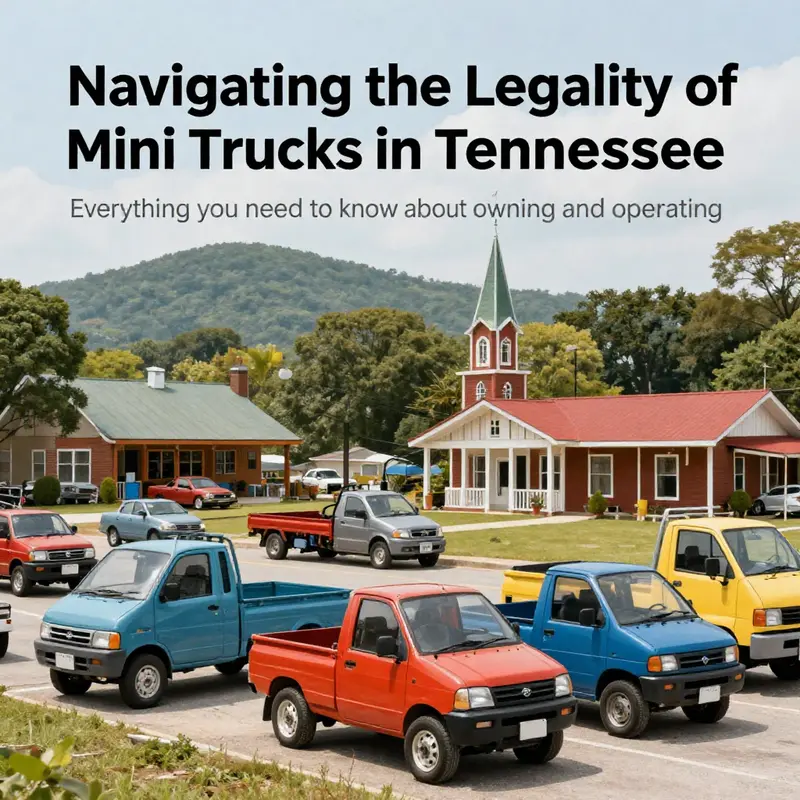
Mini trucks, especially the popular Kei trucks from Japan, have sparked interest among different groups in Tennessee, including local business owners, residential property owners, and mini truck enthusiasts. Understanding the legal landscape surrounding these compact vehicles can feel a bit daunting. This article aims to clarify the legality of mini trucks in Tennessee, explore the regulations and restrictions that come into play, and provide practical insights into ownership and everyday use. By knowing what to expect, you can confidently navigate these regulations, tapping into the unique benefits that mini trucks offer while staying compliant with local laws.
null
null
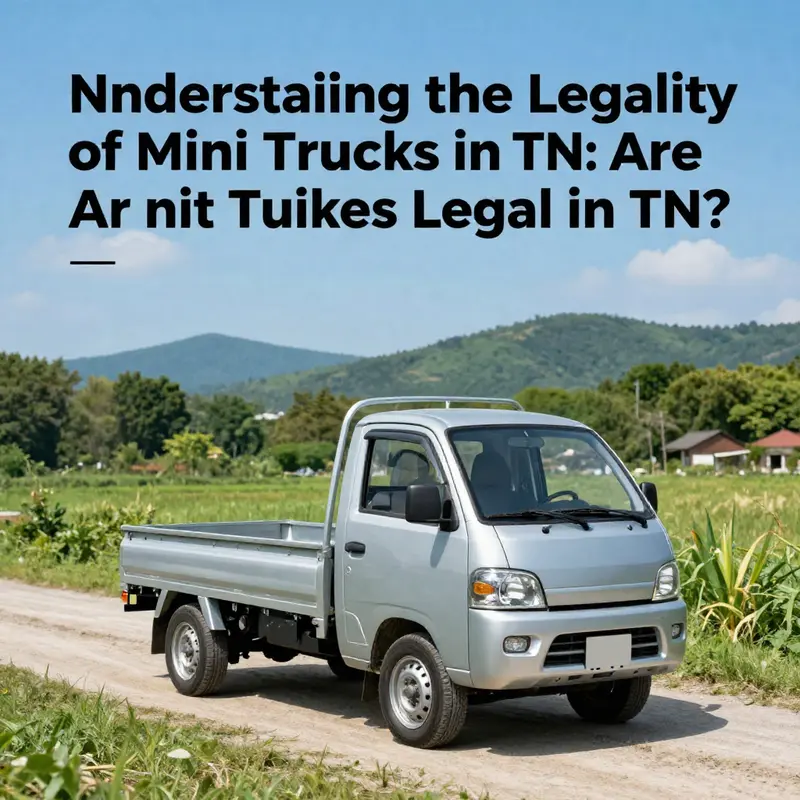
Tiny Titans on Tennessee Roads: Navigating the Legal Boundaries of Mini Trucks in TN
Across rural hills and cultivated fields, a small, utilitarian vehicle can feel almost perfect for the job. Its compact frame, light weight, and surprising maneuverability give it a sense of efficiency that larger trucks rarely deliver. In Tennessee, that appeal translates into legitimate ownership for private-property use, yet the moment the same machine aims for a public highway, the rules tighten with surprising precision. The chapter that follows isn’t a simple yes-or-no verdict on whether mini trucks exist in Tennessee traffic. It’s a careful map of where ownership is allowed, where operation on public roads is restricted, and what steps are required if a person actually hopes to register and lawfully drive one on Tennessee’s streets. The careful balance between practicality and compliance is at the heart of this topic, because the state treats these diminutive vehicles as legitimate pursuits for certain uses while insisting they meet the same core safety, emissions, and roadworthiness standards that govern larger, more conventional automobiles. To understand the landscape, it helps to start with the distinction between ownership on private property and use on public roads, because the two share a common backbone—the need to align with state and federal requirements—yet diverge sharply in practice and consequence.
Ownership, at its most straightforward, is permissible for private property in Tennessee. A person may possess a small vehicle designed for utility and use it on their own land or farm without triggering the full weight of road-legal compliance intentions. The practical advantage of private-property ownership is clear: a machine that can traverse narrow paths, haul light loads, or assist with farm chores remains a valuable asset. But private ownership does not automatically confer permission to set that vehicle loose on the public thoroughfares that weave through towns, counties, and beyond. When it comes to public-use credentials, the Tennessee Department of Safety and Homeland Security (TDOSHS) steps in with a sober checklist. The state’s regulatory framework is designed to ensure that any vehicle considered roadworthy has passed safety inspections, met emissions standards, and conformed to size and weight parameters that support predictable performance in traffic. The logic is not merely bureaucratic. It reflects a broader commitment to road safety, where the small size and light weight of many Kei trucks—small, Japanese-origin vehicles that have earned a global following for their efficiency—raise legitimate concerns about crash protection, occupant safety, and compatibility with U.S. regulatory expectations. This is not a matter of taste; it is a matter of how Tennessee aligns with federal expectations for vehicle safety and how the state’s roadways can accommodate a diverse mix of vehicle types without compromising safety or environmental rules.
To understand what must happen to move from private ownership to lawful public-road operation, one must follow the sequence the state envisions. The first step is a clear acknowledgment that owning a Kei truck is not the stumbling block; rather, the challenge lies in registration and subsequent operation on public roads. The TDOSHS requires a vehicle to pass safety inspections that assess fundamental protections like seat belts, lighting, braking, and crashworthiness, along with confirming structural integrity suitable for regular traffic situations. Next comes emissions compliance. Federal and state emissions standards are not optional cutouts for foreign or small-displacement vehicles. They form a core part of whether a vehicle can be registered for road use. In Tennessee, the vehicle must meet these standards or be certified to operate within the state’s environmental framework. The process doesn’t stop at emissions; it also includes verifying that a vehicle meets minimum size and weight specifications appropriate for shared highways. A machine designed primarily for off-road or private-property tasks may not naturally meet these thresholds, particularly if its frame dimensions, load-bearing capacity, or occupant protection features diverge from what Tennessee considers acceptable for public roads.
This is where the design realities of Kei trucks become especially relevant. These vehicles, while highly capable in certain roles, often present configurations that were not engineered with U.S. FMVSS (Federal Motor Vehicle Safety Standards) in mind. Typical Kei trucks feature compact frames, reduced crash protection, and sometimes limited or nonstandard seating arrangements. These design choices, while granting advantages in maneuverability and efficiency, can complicate compliance with the broader safety expectations applied to road-going vehicles in Tennessee. The result is a practical barrier to registration for general highway use. In most cases, such trucks are not readily approved for regular public-road operation because they fail to satisfy the safety and crash-optimization standards that the state must uphold for the safety of all road users. This mismatch between the vehicle’s original design and the expectations of federal and state safety doctrines creates a reality in which many mini trucks are legal to own, but not always legal to drive on public roads.
The importation angle further complicates the issue. For someone outside the United States, bringing a Kei truck into Tennessee space requires compliance with U.S. Department of Transportation (DOT) and Environmental Protection Agency (EPA) regulations. A common pathway for importation exists for vehicles that are at least 25 years old, which can qualify for importation without undergoing full compliance testing. However, even with that age-based exemption, registration remains a distinct hurdle. Tennessee’s roadworthiness standards may still present an obstacle: a vehicle that is legally imported under the 25-year rule may fail to meet the state’s specific requirements for road use. In other words, an older vehicle may clear the import-screening hurdle only to face another barrier when attempting to become a road-legal Tennessee vehicle. This layered process underscores why many potential owners feel compelled to seek professional guidance from a licensed vehicle inspector or the TDOSHS itself. The path from private property ownership to lawful public-road operation is not a single stamp of approval; it is a multi-step process that can require adjustments, documentation, and sometimes hard decisions about the vehicle’s ultimate road status.
In practical terms, what does all this mean for someone who loves the idea of a tiny, versatile vehicle for both farm work and occasional highway travel? It means recognizing that the private-property use case is the gateway, but the public-road adventure carries a basket of conditions. The vehicle must pass safety checks, demonstrate compliance with emissions rules, and fit the size and weight profiles that the state considers acceptable for public operation. If a Kei truck cannot be brought into line with these standards, it remains a farm or off-road asset rather than a highway vehicle. The dynamic nature of these rules is why many enthusiasts seek out reliable guidance early in the process. They want to know not only what is legally permissible but also what practical steps they would need to take should they decide to pursue road use. The process can involve working with inspectors who understand the intricacies of foreign-origin, compact-vehicle configurations and how those configurations translate into Tennessee’s regulatory lens.
Within this context, community resources can serve as valuable companions. While official guidance is essential, practical, experience-based knowledge from owners who have wrestled with similar questions can illuminate everyday corners of the process. For readers seeking such perspectives, Mini Trucks blog offers a space where enthusiasts discuss not just the hardware, but the legal navigation around road use, inspection experiences, and the realities of emissions testing. The blog posts can provide a narrative that complements the regulatory framework by translating it into a real-world journey—what to expect during inspections, how to prepare, and what kinds of documentation others have found useful along the way. This kind of community insight helps bridge the gap between theory and practice, offering practical tips while keeping readers grounded in the legitimate constraints of Tennessee law.
Importantly, the road to legality is not a guaranteed shortcut. The state’s approach emphasizes safety and reliability on roadways that accommodate a wide variety of vehicles—from compact, domestic cars to larger trucks designed specifically for highway performance. The unique criteria that a Kei truck must meet to become road-legal can include aspects that owners might not anticipate at first glance. For example, a vehicle born into a different regulatory ecosystem may lack certain features deemed essential within Tennessee’s safety paradigm, such as specific crash-absorption characteristics, standardized seating and restraint systems, or consistency in lighting and signaling that aligns with FMVSS expectations. When these gaps appear, they can become pivotal in the decision-making process: is it feasible to modify the vehicle to meet the standard, or is it wiser to limit its use to private property and off-road contexts where roadworthiness requirements are not triggered in the same way? The answer, as with many regulatory questions, varies with the specifics of the vehicle, the nature of its intended use, and the commitment of the owner to pursue a compliant path that stands up to inspections and environmental reviews.
The practical takeaway is straightforward in principle, even if it requires careful judgment in practice. If you own or want to own a mini truck in Tennessee for legitimate daily work on private property, you can proceed with confidence that ownership is permissible. If, however, you plan to operate on public roads, you must be prepared to meet a battery of standards that safeguard road users and protect the environment. You should anticipate a process that may include a safety inspection, verification of emissions compliance, and confirmation that the vehicle’s dimensions and weight meet the state’s road-use criteria. You should also be aware that even with an importation pathway, the ultimate road status of the vehicle will depend on whether it satisfies the details of Tennessee’s rules, which can be nuanced and specific to the vehicle’s configuration and history. The prudent route is to engage with the TDOSHS or a licensed vehicle inspector early, to understand which barriers exist for your particular vehicle and to map out a feasible plan—whether that plan involves modifications to the vehicle, an alternative use on private property, or simply acknowledging that the vehicle will remain a private- property asset.
From a broader perspective, the Tennessee approach reflects a common tension in many states: the desire to welcome diverse, efficient vehicle concepts that can meet practical needs, while maintaining uniform road-safety and environmental standards that protect all users. Mini trucks, with their undeniable utility for farming, landscaping, and light-duty tasks, represent a fascinating case study in how a state balances innovation and safety. This balancing act is not about denying innovation; it is about ensuring that innovation travels on a highway system designed for predictable performance. The legal reality in Tennessee thus emerges as a layered reality: ownership on private property is permissible; road use is possible but contingent on passing a series of inspections and standards; and the import path, while offering potential avenues for older vehicles, does not guarantee road eligibility regardless of age. The best approach for any prospective owner or user is to start with a clear-eyed assessment of what the vehicle can and cannot do within the bounds of state law and to consult official channels to avoid costly missteps.
To close the loop: if your plans include any use beyond your own land, reach out early to the state’s safety and inspection authorities. They can provide the most current information on whether your specific vehicle model and configuration can be certified for public road use, and what documentation or modifications might be necessary. The official guidance from the Tennessee Department of Safety and Homeland Security remains the most reliable compass for navigating these decisions. For official guidelines and up-to-date requirements, you can visit the state’s safety website: https://www.tn.gov/safety.
In this dynamic regulatory landscape, the story of mini trucks in Tennessee is less about a blanket prohibition or blanket permission and more about a thoughtful, rules-based path that recognizes the unique value of these compact machines while preserving the safety and environmental standards that keep Tennessee’s roads secure for everyone. The practical implication is clear: if you intend to drive on public roads, you must be prepared for a process that respects both your needs and the public good. If you intend to use the vehicle only on private property, the door remains open, with the caveat that its practical usefulness on a larger scale will be limited by the same rules that shape private-property vehicle use and the potential need for specialized equipment for any future move toward road use. The balance of ownership and operation thus hinges on clarity about the intended use, informed by official guidance and supported by community experience that helps translate regulatory language into workable, real-world practice.
From Private Lot to Public Road: The Legal Reality of Kei Trucks in Tennessee
Across the rural and industrial landscapes of Tennessee, a small, boxy vehicle with a big reputation in other parts of the world often turns up in conversations about practicality, cost efficiency, and urban efficiency. The kei truck, a type of mini truck born in Japan, captures the imagination of farmers, landscapers, and hobbyists who prize maneuverability, payload capacity in a compact frame, and a certain charm that comes with a vehicle designed for narrow lanes and tight workspaces. Yet for all its appeal, the legal status of owning and, more importantly, using such a vehicle in Tennessee is not a straightforward yes or no. It sits at the intersection of personal ownership, private-property utility, and the complex, sometimes rigid, set of rules that govern what can legally travel on public roads. Understanding this nuance requires looking beyond the glossy brochure of a compact utility vehicle and into the shadows of statutes, regulations, and administrative interpretations that shape everyday decisions about what to drive down county roads or state highways.
To begin with, owning a kei truck in Tennessee is generally permissible. The ownership question is layered with practical implications but not a categorical prohibition. In the eyes of state law, a person may possess a small, lightweight vehicle designed for utility work, and there is nothing inherently illegal about the act of ownership itself. This basic permissibility matters, because it opens the door for individuals who see a kei truck as a tool rather than a novelty. It means a farmer can evaluate a kei truck for hay bale tasks, a landscaper can consider it for transporting mulch and tools around a campus or industrial park, and a construction crew can imagine using it to ferry materials across a site where maneuverability exceeds what a larger and heavier pickup could provide. The crucial caveat, and where the landscape shifts considerably, is that ownership alone does not grant the right to operate the vehicle on public roads in the same way a full-size truck or car would.
The moment the kei truck leaves a private lot and enters public streets or highways, the regulatory framework tightens. Tennessee, like many states, has a set of registration, safety, and emissions standards that vehicles must satisfy to be publicly operable. The practical effect of these rules is to carve out a distinction between ownership on private property and lawful operation on public roads. In many cases, kei trucks may not meet the general criteria that Tennessee uses for standard passenger vehicles and light trucks. This mismatch can arise from a combination of factors: the compact dimensions and lower curb weight that are advantageous in off-road or private-property tasks may translate into concerns about crash protection, crashworthiness, and compliance with modern highway-use standards. The result is a reality in which a kei truck exists legally as an item that can be owned, stored, and used in controlled settings, but its ability to be driven legally on public roads is constrained by a constellation of requirements that may feel foreign to those buying a vehicle for a small footprint or a tight budget.
A central consideration in public-road eligibility revolves around emissions. Tennessee, like many states, enforces emissions standards designed to minimize the environmental footprint of vehicles traveling on public roadways. Kei trucks, with their compact engines and often older or nonstandard configurations, frequently fall outside the scope of the state’s current emissions framework. This divergence is not simply about whether a vehicle is clean or dirty; it is about whether the engine technology, exhaust aftertreatment, and overall emissions profile meet the thresholds that allow registration for highway use. In practice, a kei truck that runs beautifully across a private property may fail to receive the green light for highway operation if its emission system cannot be demonstrated as compliant with state standards. The result is that many kei trucks end up serving on-site tasks, where emissions are controlled by the owner’s site environment and where the vehicle’s operations do not trigger the same regulatory scrutiny as a highway-ready automobile might.
Beyond emissions, safety equipment forms another robust barrier to public-road operation. Standard highway vehicles are designed with a suite of safety features—seat belts, crashworthy structures, energy-absorbing zones, and often airbags—arranged to mitigate the consequences of a collision at typical highway speeds. Kei trucks, particularly when sourced from overseas markets, may not arrive with a full complement of such safety features, or they may integrate a design that is optimized for off-road or private-property use rather than for the high-speed, high-stress demands of public road travel. The presence or absence of seat belts, the integrity of the cabin structure, rollover protection, and other safety attributes each contribute to a regulatory assessment of whether the vehicle can be approved for street use. When a kei truck lacks certain safety components or when modifications would be required to bring it into compliance, the practical decision becomes clear: keep the vehicle on private property or invest heavily to retrofit it to highway standards, a process that can be both technically challenging and financially prohibitive for some owners.
Structural integrity and the design philosophy of kei trucks also play a role in regulatory decisions. The hallmark of a kei truck is its compact footprint, short wheelbase, and light weight, all of which are intentional design choices that promote agility and efficiency in tight spaces. However, these same design characteristics can raise concerns from regulators about stability at higher speeds, the ability to withstand highway conditions, and the adequacy of the vehicle’s protective envelope in the event of a collision. Regulators assess how a vehicle’s frame, suspension, braking system, and steering respond under the demands of public-road operation. When there is a gap between the Kei truck’s design assumptions and the state’s highway-safety expectations, the vehicle may be deemed unsuitable for public-road use unless substantial modifications are undertaken. The practical upshot is that private-property use remains the primary and most straightforward use case for many kei trucks in Tennessee, while public-road operation remains the exception rather than the rule.
All of this does not leave owners without guidance. The state’s licensing and safety authorities provide a pathway to clarity, though it often requires careful documentation and a candid assessment of what is feasible for a given vehicle. The Tennessee Department of Safety and Homeland Security is the central hub for questions about registration and operation. They can confirm whether a particular kei truck can be registered for street use and what standards it must meet. They can also outline what inspection agencies or processes are available to verify compliance with applicable emissions, safety, and structural requirements. For those who want to explore the scope of possibilities before committing to a purchase, an informed call is best made with this state authority in hand, alongside a talk with a certified vehicle inspection facility that understands both the letter of the law and the practical realities of retrofitting a compact, lightweight vehicle for the demands of public highways.
The topic inevitably leads to questions about what the practical use case looks like in Tennessee. For many people, private-property usage remains the sweet spot. Kei trucks can excel on a farm, in a nursery, or within a large industrial campus where tasks involve moving materials, tools, and small loads over short distances. On such properties, enforcement limitations are far less stringent, because the vehicle remains within a controlled environment where traditional highway safety concerns are minimized. The tractor-drawn utility role these vehicles can play on a farm is a natural fit, and their compact size allows for navigation through narrow lanes, tight gates, and uneven terrain that would challenge larger trucks. The noise level, fuel economy, and maintenance costs are often attractive incentives for owners who judge a kei truck as a pragmatic workhorse rather than as a passenger car.
But the story does not end at private-property efficiency. There are individuals who consider kei trucks for light-duty tasks that spill beyond the farm fence—industrial yards, construction sites with limited space, and even urban settings where tight backstreets or limited parking encourage smaller, more nimble equipment. The appeal, in these contexts, rests on the trade-off between on-site utility and the legal risk of operating on public roads. Some operators attempt to navigate this by designating the vehicle as a non-highway vehicle or by seeking a special-use permit that would permit limited public-road operation under controlled conditions. These options, though not universal, illustrate that the boundary between permitted use and prohibited use is not simply a fixed barrier; it is a negotiated space that depends on the vehicle’s capabilities, the owner’s purpose, the location of operation, and the ability to demonstrate compliance with a set of regulatory criteria.
In making sense of all this, it is worth noting how information sources frame the topic for readers who are weighing the realities of ownership and operation. Publicly available resources often emphasize the legal caveats, reminding prospective owners that ownership does not automatically translate into a green light for street driving. A comprehensive source on the matter highlights the same phenomena—the permissibility of private ownership alongside stringent or nuanced road-use restrictions that hinge on emissions, safety, and structural standards. It is precisely this layered reality that makes the decision to own a kei truck in Tennessee one that benefits from careful planning, informed consultation, and a willingness to adapt either the vehicle or its use to the legal framework that governs public roadways. For readers who want to explore more firsthand discussions and practical considerations from people who have navigated similar questions, the minitrucksala blog offers ongoing insights into how enthusiasts view and adapt to the regulatory landscape. You can visit the community hub at the minitrucksala blog to see how owners balance work needs with compliance considerations, and to get a sense of the kinds of real-world adjustments people consider when they pursue private-property efficiency without courting compliance disputes.
For those who want a direct, formal sense of the legal landscape beyond personal anecdotes and forum-style discussions, a broader external resource provides a structured overview of Tennessee’s approach to kei trucks and similar micro-vehicles. It is important to study such materials to understand where the lines are drawn between ownership, operation on private property, and permissible public-road use. The general takeaway is that ownership is likely unobjectionable, but operation on public roads remains constrained by a combination of emissions standards, safety equipment requirements, and structural criteria. The nuance here is vital because it shapes planning for any potential purchase: if the aim is to use the kei truck exclusively on the job site or in a private setting, the path to use is straightforward; if the goal involves any roadway travel, a more rigorous review and potential modification plan becomes essential.
In summary, Tennessee’s stance on kei trucks reflects a common regulatory pattern found across many states. The vehicle can be owned and stored by private individuals or businesses, particularly for on-site tasks where space is tight and maneuverability is prized. However, reaching a point where the kei truck can legally travel on public roads typically requires a matching set of compliance criteria—emissions alignment, safety provisions, and structural sufficiency—that may not come standard with the vehicle as imported. This dual reality—easy ownership, complicated road-use—drives a practical approach: cultivate an on-site workhorse, understand the limits of public-road operation, and engage with state authorities and qualified inspectors early in the decision-making process. As you consider your own circumstances, it helps to review the latest guidance from the Tennessee Department of Safety and Homeland Security or an authorized vehicle inspection agency, which can confirm what is legally feasible for your specific kei truck, your intended use, and your location within the state.
You can also look to community discussions and practical reflections from other owners as additional context. For readers curious about practical considerations and ongoing conversations within the kei-truck community, the minitrucksala blog serves as a useful touchstone for understanding how enthusiasts navigate ownership, use, and regulation in real-world settings. It provides a window into the lived experience of people who balance efficiency and compliance in a way that reflects the realities of working with compact equipment in a state with a diverse landscape and a robust regulatory framework. To deepen your understanding, consider reading through the discussions and practical notes on the blog, which can complement the formal regulatory guidance and help you form a grounded plan for any potential kei-truck investment.
External reference: For a broader legal summary and perspective, see World Law Digest’s overview on kei trucks in Tennessee: https://www.worldlawdigest.com/are-kei-trucks-legal-in-tennessee/
Final thoughts
Owning a mini truck in Tennessee is not only feasible but can offer unique advantages for local small businesses and property owners alike. While Kei trucks enjoy legality in terms of ownership, their use on public roads is subject to specific regulations that must be followed. As you explore the potential benefits and practical applications of mini trucks in your life, staying informed about the legal requirements and safety standards will help streamline your experience. Whether using them for work or play, mini trucks can truly add value to your lifestyle. Always ensure you’re compliant, so you can focus on enjoying your mini truck to its fullest.