
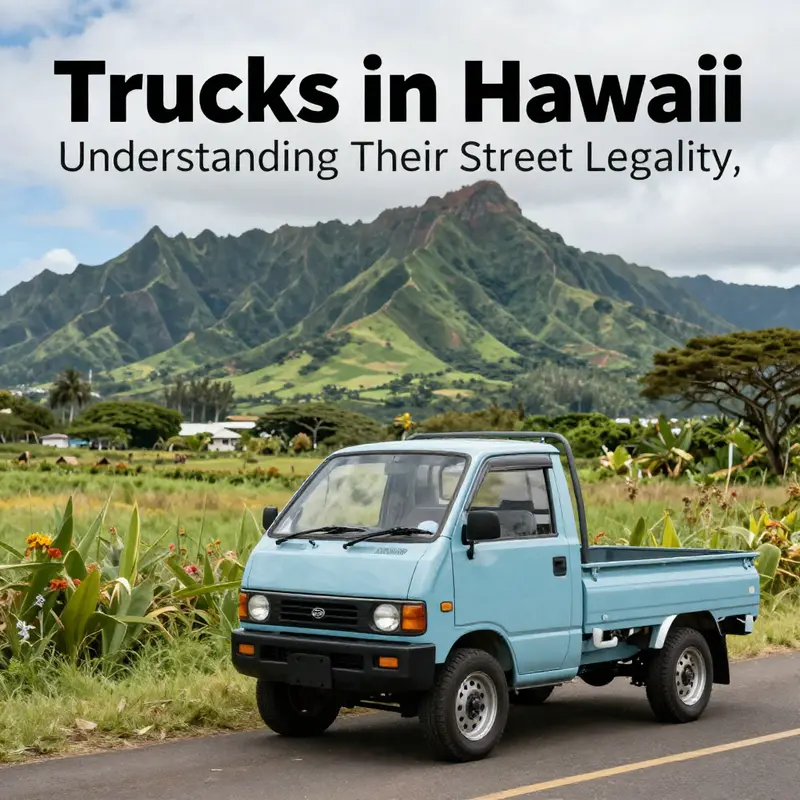
Mini trucks, particularly those modeled after the Japanese Kei truck design, are a source of curiosity for many local small business owners, residential property owners, and mini truck enthusiasts in Hawaii. While these compact utility vehicles can be fun and practical for various applications, a common question arises: are mini trucks street legal in Hawaii? This article will break down the important regulatory compliance requirements, emissions and safety standards, registration and insurance necessities, and the vital role the Hawaii Department of Transportation plays in the process. Whether you’re considering using a mini truck for your small business or simply as a personal vehicle, understanding these nuances will help you navigate the legal landscape effectively.
From Kei to State-Size: The Legal Hurdles for Mini Trucks on Hawaii Roads
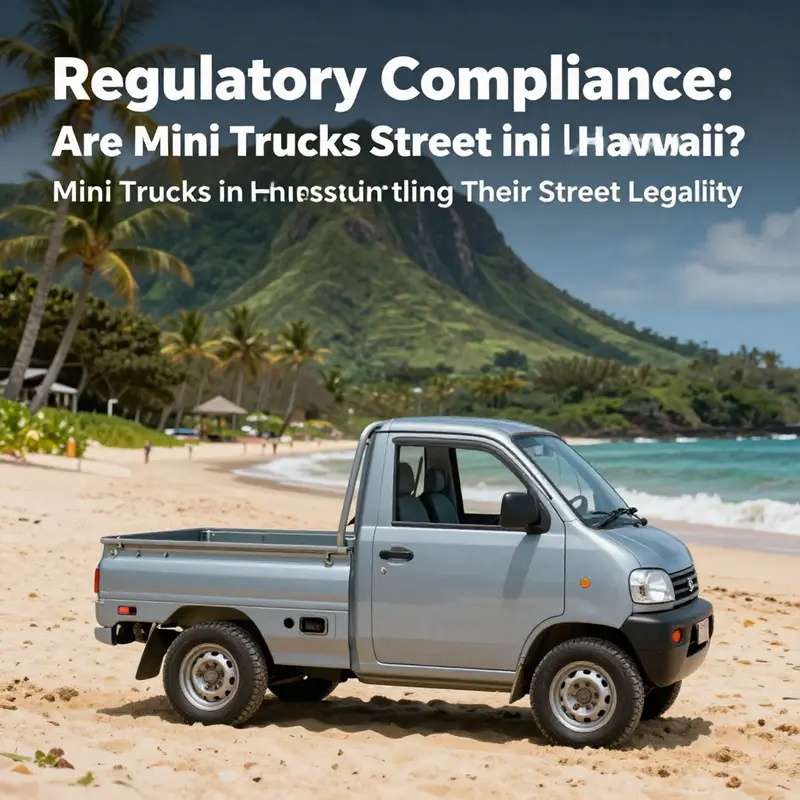
In Hawaii, the idea of steering a compact, boxy Kei-style mini truck along a sun-washed coastal road comes with a certain lore. The image taps into practicality and nostalgia at once: a vehicle that feels perfectly scaled for narrow lanes, tight parking, and the island’s frequent, slow-paced roadways. Yet the romance runs up against a set of gatekeeping rules that are specific to this state and to the broader framework of federal standards. Mini trucks, while appealing in concept for farmers, small-business operators, or weekend enthusiasts, are not automatically street-legal in Hawaii. The path from shipyard to sidewalk is paved with compliance checks that touch on safety, emissions, size, weight, and the essential paperwork that proves a vehicle belongs on public roads. For anyone considering importing, modifying, or registering a Kei-style mini truck in Hawaii, a straight-forward belief in practicality isn’t enough; you need a careful reading of regulatory terrain and a willingness to align with state and federal expectations. The island context matters, too. Hawaii’s geography and population density shape how the state views vehicle use, powertrains, and road safety. The Department of Transportation (HDOT) and the Hawaii Vehicle Inspection Program (VIP) are the custodians of these gatekeeping standards. They evaluate how a tiny, engine-limited vehicle translates to real-world safety, air quality, and road-sharing realities. This chapter stitches together the regulatory threads that determine whether a Kei-inspired truck can share Hawaii’s public ways. It is not a verdict on the vehicle’s design or its potential utility; it is a practical map of what it takes to be on the road legally in this particular place and time. The answer, in short, is nuanced and highly contingent on the specifics of the vehicle and how closely its build aligns with both state and federal directives. The broader logic remains consistent with the United States’ convention that motor vehicles used on public highways must conform to established safety and environmental standards, regardless of size or origin. The Kei design, prized in Japan for its compactness and economical performance, is fundamentally designed for a very different regulatory landscape. Without modification and a formal certification process, the same vehicle that may pass a Japanese inspection or be taxed as a light-duty or micro-vehicle there is very unlikely to meet the FMVSS (Federal Motor Vehicle Safety Standards) and EPA (Environmental Protection Agency) requirements that Hawaii applies to vehicles operated on its roadways. Hawaii, like other states, aligns with federal safety and emissions rules to ensure a baseline of crash protection, occupant restraint, and exhaust management. The sticker you may see on a new vehicle indicating compliance with FMVSS and the corresponding EPA approvals becomes a central reference point for any importer or registrant. A vehicle that cannot demonstrate compliance to those standards typically cannot be registered for public road use. The regulatory puzzle, then, is not simply about how small the vehicle is; it concerns whether the vehicle is built, modified, and certified to meet those exacting criteria. The complexity grows because Hawaii imposes its own layer of scrutiny through its own vehicle inspection and registration processes. The VIP, Hawaii’s program dedicated to vehicle safety checks, is the practical gatekeeper for roadworthy status. Even if a vehicle seems to meet basic federal standards, Hawaii will demand proof of compliance that is verifiable through documentation, testing, and, in some cases, retrofitting. This is not about stalling progress; it is about ensuring safety and environmental stewardship, especially in a climate where corrosion from humidity and salt air can threaten vehicle systems. The size and weight regulations are a frequent sticking point. Hawaii’s Department of Transportation has precise rules regarding how a vehicle’s dimensions and weight interact with highway design, parking infrastructure, and pavement wear. Kei trucks, with their compact footprints, can still exceed the state’s thresholds if ballast or cargo adds substantial weight, or if their overall dimensions combine with certain attachments to exceed thresholds that trigger special inspections or permit requirements. The size standard is not a mere formality. It translates into how a vehicle maneuvers in practice—how sharp a turn can be made on a given street, how quickly a vehicle can stop, how predictable it is to other road users, and how the vehicle’s impacts are absorbed in the event of a collision. Emissions compliance is another critical hinge. In Hawaii, as across the United States, vehicles on public roads must satisfy EPA emissions standards. Many Kei trucks in their stock form run on engines that either do not have U.S.-certified emission equipment or rely on older configurations that do not map cleanly to the modern testing regimes. The practical implication is that owners often face costly retrofits if they intend to pursue road use rather than off-road or private-property operations. The retrofit path is not merely a matter of swapping a few parts. It frequently involves upgrading exhaust systems to meet particulate and hydrocarbon limits, installing or upgrading evaporative control components, and sometimes reprogramming engine management to conform to U.S. specifications. All of these steps must be documented and verifiable, not merely claimed. The safety standards are equally exacting. FMVSS literacy is essential. This encompasses seat belts, occupant protection, crash energy management, lighting requirements, and visibility features such as mirrors and signaling devices. In practice, many Kei-style trucks do not come with a complete set of required features when they arrive from abroad. For Hawaii’s inspectors, the absence of appropriate lighting, reflective markings, proper crash protection, or even adequate seat belts can derail a registration attempt. Thus, the path to compliance often involves a careful retrofit program designed to preserve the vehicle’s intent while bringing it squarely into line with U.S. safety expectations. The registration and title process adds another layer of scrutiny. Even after a vehicle passes an inspection and is deemed capable of meeting safety and emissions standards, the road to legal ownership in Hawaii continues with title verification and registration. The Hawaii MVD (Motor Vehicle Division) requires a clear chain of title, proof of ownership, and insurance that reflects the vehicle’s status as a road-legal motor vehicle. Insurance is not merely a transfer of risk; it supports the basis on which the vehicle can be indexed for liability in the event of a crash, property damage, or theft. This is a practical reminder that road legality hinges on more than the engineering or the paperwork; it hinges on the broader ecosystem that underpins safe and responsible vehicle use. The entire process—from import considerations to modifications, from inspections to registration—can be lengthy and costly. It is not unusual for an importer to encounter multiple rounds of testing, reinterpretation of documentation, or additional modifications to satisfy VIP and HDOT requirements. This is a space where patience, diligence, and a willingness to collaborate with state authorities are nearly as valuable as mechanical ingenuity. The fundamental takeaway is that a Kei-style mini truck is not a guaranteed entry to Hawaii’s street network. It is a candidate that can become legally operable only through a structured pathway that demonstrates compliance with FMVSS, EPA, and state-specific rules, accompanied by a robust documentation trail that passes VIP’s scrutiny and the MVD’s title and registration checks. Those who pursue this route will often engage in a dialogue with state officials early and iteratively, to understand at the outset which aspects of the vehicle’s build will require attention and which modifications are non-negotiable. An expert tip is essential here: before importing or purchasing a mini truck for use in Hawaii, consult directly with the Hawaii Department of Transportation (HDOT) and the Hawaii Vehicle Inspection Program (VIP). They can provide the most accurate information on whether a specific vehicle model can be legally registered and operated on public roads. This upfront guidance helps avoid costly missteps and reduces the guesswork that often accompanies importing a vehicle with a novel configuration. For the most up-to-date and official guidance, visit the Hawaii Department of Transportation website: https://www.hawaiiodot.gov. In addition to HDOT, potential registrants should consider engaging with the Hawaii MVD early in the process to clarify title requirements, insurance coverage, and any state-specific disclosures that might affect the vehicle’s registration. The long arc of compliance can be demanding, but it rewards those who prioritize safety, accountability, and transparency. The overarching lesson is that Hawaii’s street-legal path for mini trucks is less about the vehicle’s charm and more about aligning with a precise regulatory matrix. The road to legality is a carefully documented journey that balances practicality with the public-interest goals of road safety and environmental stewardship. To keep readers oriented, it helps to anchor expectations in two practical realities. First, not all Kei-inspired mini trucks will meet the bar for street use, even after modifications. Second, achieving compliance is more viable when the vehicle’s system architecture—engine, fuel system, electrical network, and safety features—can be demonstrated as homologated for U.S. traffic. Across the spectrum of potential users—from small farm operators to contractors who value compact utility—honest appraisal of the vehicle’s intended use remains central. If the aim is to operate on public roads, plan for a feasibility assessment that covers emissions retrofitting, safety enhancements, and the administrative effort required for registration and insurance. If the goal is primarily off-road or private-property work, Hawaii’s rules can be navigated with a different regulatory posture, often focusing on use-case limitations and local permits rather than full on-road compliance. This nuanced landscape underscores why early, direct engagement with HDOT and VIP is indispensable. A careful initial consultation can reveal whether your specific model, with anticipated modifications, has a practical pathway to becoming road-legal or whether it will remain better suited to private land or controlled environments. For readers seeking practical context and case discussions that illustrate the journey from import to on-road operation, the MinitrucksOCala blog offers a broad spectrum of perspectives and experiences in this niche area. You can explore related discussions at minitrucksocala blog. While individual experiences vary and laws evolve, the underlying principle remains stable: knowledge and preparation are the most valuable tools in translating a Kei-inspired concept into a legitimate Hawaii road experience. Finally, for official guidance and the most current regulatory stance, refer to the Hawaii Department of Transportation’s vehicle registration information. The official vehicle registration page provides the formal framework for the requirements described here and is the authoritative source for any updates or clarifications essential to a safe, compliant, and legally registered vehicle. External resource: https://www.hawaiidot.gov/vehicles/registration/
Gatekeepers on the Road: Emissions, Safety, and Hawaii’s Mini Trucks
Hawaii favors small, efficient vehicles that can handle narrow streets and steep grades without excessive fuel use. But street-legal status for a mini truck depends on meeting size, weight, emission, and safety standards, plus registration requirements. Kei-style mini trucks bring practicality and low upfront cost, yet in Hawaii they must be evaluated against state rules before they can operate on public roads.
The emissions picture: Hawaii adopts stricter California standards to protect air quality. Imported mini trucks must meet CARB or EPA requirements. Depending on age and propulsion, certification might label a vehicle as LEV or ZEV, or require retrofits. Evaporative controls and regular inspections ensure fuel vapors do not degrade air quality. Routine smog and safety checks are part of ownership and road use in Hawaii.
The path to compliance is challenging. Some vehicles meet origin-country standards but need modification to meet U.S. EPA or CARB rules. Owners face choices: install proper emission-control hardware and obtain certification, or limit use to non-public settings. If a vehicle can be documented as LEV/ZEV compliant, on-road use becomes possible with registration and insurance.
Safety requirements align with FMVSS. Vehicles must have functioning brakes, lighting, tires, steering, and occupant protection. In Hawaii, periodic inspections and strict safety standards accompany registration renewals, so a mini truck’s integrity must be demonstrable in real driving conditions.
State-specific rules further shape use. Hawaii’s Safety Belt Law requires seat belts for all occupants; child restraints and distraction-control measures also apply. The interior must accommodate appropriate restraints and ergonomics, and the vehicle’s controls should minimize distraction.
The journey from import to on-road use involves documentation, testing, and careful coordination with regulators—HDOT and VIP are central contacts. They help determine eligibility, required retrofits, and the documentation needed to certify compliance. Prospective owners should begin by verifying eligibility and then pursue emissions and safety upgrades before the inspection and registration steps.
For readers seeking practical context, community resources and blogs discuss how mini trucks are used and built, complementing official guidance. The broader context helps explain how owners approach the street-legal challenge while Hawaii’s rules remain the ultimate authority.
Ultimately, street legality is not a single threshold but a process—one that balances emissions, safety, and registration. With careful planning and compliance, a mini truck can be a legitimate, road-ready part of Hawaii’s road system while preserving air quality and safety for all.
Keystones of Legality: Navigating Registration and Insurance for Hawaii’s Mini Trucks
The appeal of mini trucks in Hawaii lies in their compact footprint and practical utility, but street legality is not automatic. Hawaii requires registration and proof of insurance before a vehicle may operate on public roads. Registration begins with ownership documents such as a title or bill of sale, a completed MV-1 application, and payment of base fees, taxes, and a title fee. The Hawaii Department of Transportation, via the county Motor Vehicle Division, manages the process and online options can save time. Insurance is mandatory to meet Hawaii’s financial responsibility requirements, with minimum limits of 20/40 for bodily injury and 10 for property damage. Many owners choose additional coverage, but the state only requires the minimum liability for registration. Proof of insurance must be presented to the DMV and the insurer must be licensed in Hawaii. Changes in ownership, address, or coverage require updates to keep coverage valid. The Hawaii Vehicle Inspection Program may apply for vehicles from outside the state. A practical path is to gather documents, complete MV-1 accurately, review fees including use tax if applicable, arrange a Hawaii-licensed liability policy, obtain proof of coverage, and submit everything to the appropriate DMV. Experts recommend confirming model eligibility with the Hawaii DOT and VIP before importing or purchasing and staying current with policy notices. The official regulatory base is housed with the Hawaii Department of Transportation, and staying informed helps minimize missteps and delays. Ultimately, street legality hinges on timely, accurate documentation, appropriate insurance, and ongoing compliance rather than on a trick or exemption.
null

null
Final thoughts
As you can see, the road to making mini trucks street-legal in Hawaii is filled with specific compliance requirements and steps that need to be meticulously followed. From understanding the nuances of size and weight regulations to ensuring that your vehicle meets emissions and safety standards, being well-informed is essential. Registered and properly insured vehicles are not just a formality; they’re your key to enjoying the benefits of a mini truck responsibly in your community. With the right resources and guidance from the Hawaii Department of Transportation, you can navigate this landscape effectively, making your mini truck dreams a reality.