
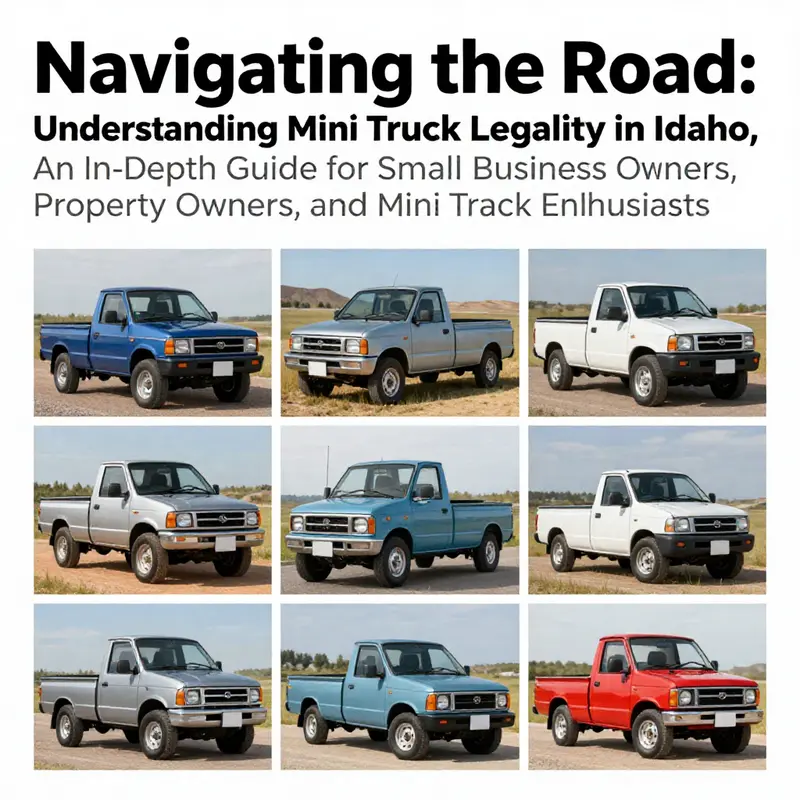
Mini trucks, including the popular Japanese Kei trucks, offer a unique blend of utility and charm. Ideal for small businesses and rural living, these compact vehicles have gained a loyal following among enthusiasts in Idaho. However, many local small business owners, residential property owners, and hobbyists are unsure about their legal standing on Idaho roads. This comprehensive guide explores the legality of mini trucks in Idaho, outlines essential regulations, and provides insight into emissions compliance, insurance, and practical considerations for ownership. By the end, you’ll have a clearer understanding of how to navigate the landscape of mini truck legality in the Gem State, ensuring a smooth ride for your adventures.
Crossing the Line: How Idaho Regulates Mini Trucks and What It Takes to Be Street-Legal
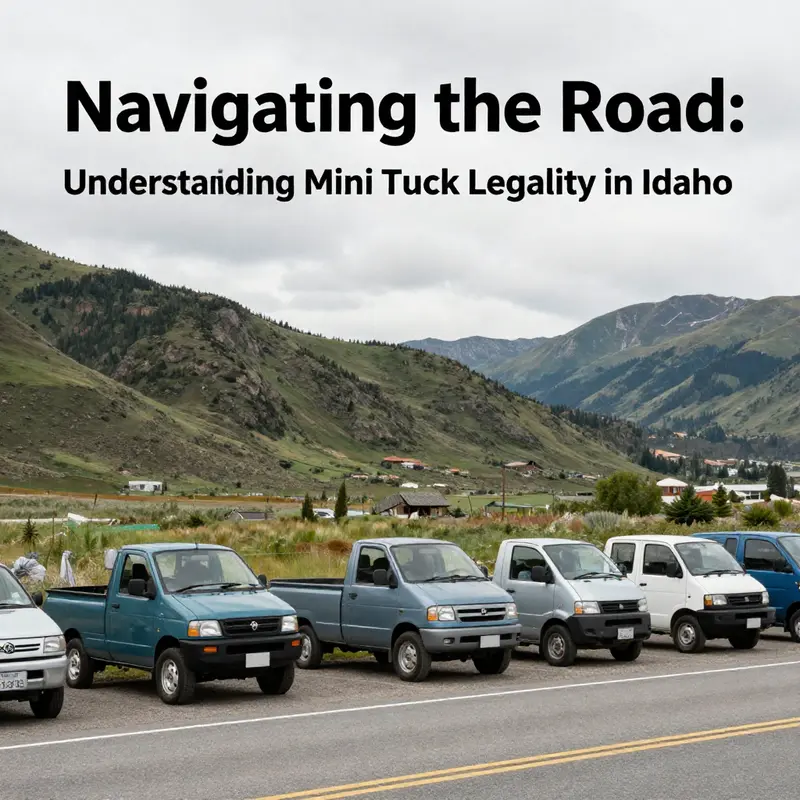
When a driver asks whether a mini truck can legally roam Idaho’s public roads, the straightforward answer is nuanced. Idaho does not publish a neat, one-line rule for a New Wave of compact Japanese utility vehicles or kei-style mini trucks. Instead, the state applies its broad vehicle regulations to determine how each vehicle fits into the road-use framework. In practice, the legality of a mini truck hinges on how it is classified, how it is equipped, and how thoroughly it is registered and inspected. The upshot is simple in intent but complex in execution: if you want a petite, capable workhorse to operate on Idaho streets, you must first align the machine with the state’s standards for safety, emissions, and licensing, and you must complete the process through the correct state agencies. The process can feel arcane, but it has a logic that centers on the same principles that govern any roadworthy vehicle: the vehicle must be safe, it must be properly documented, and it must meet the environmental and road-use expectations Idaho sets for its motorists. To understand what that means in practical terms, one must read the state’s system as a continuum rather than as a single on/off switch. A mini truck might be treated as a light-duty truck, a low-speed vehicle, or sometimes a special-use vehicle, depending on its specifics—the engine displacement, gross vehicle weight, top speed, and the intended role on the road. This means the safety equipment and regulatory requirements you must satisfy can look very different from one mini truck to the next, even if the two vehicles share similar outside dimensions. In Idaho, the classification drives the registration path, the insurance requirements, and the compliance checks that determine whether a given machine, once altered, can legally share the lane with cars, pickups, and larger trucks. The critical point is not the vehicle’s country of origin or its size alone, but how it meets Idaho’s safety and emissions standards when used as a road vehicle. The state recognizes Canada, Japan, and other regions as sources of compact utility vehicles, but those vehicles cannot simply be wheeled into traffic because they arrive with off-road or limited-street configurations. The transition from off-road or rural utility use to public-road operation often requires substantial modification, a formal inspection, and official titling and registration. The roadworthiness test is not cosmetic; it is designed to ensure that a small truck behaves like a road vehicle in critical domains—stopping, signaling, lighting, occupant protection, and emissions. Those domains become the lens through which a mini truck is measured when a owner seeks to register it in Idaho. The result may be a vehicle that is functionally a mini truck on the ground, yet legally a light-duty truck, a low-speed vehicle, or another classification that best reflects its capabilities and configuration. The nuance matters because it dictates the path to legality: a straightforward registration and a standard insurance policy are possible in some cases, while other configurations might require specialized paperwork or additional approvals from the Idaho Transportation Department (ITD) and the Idaho Department of Motor Vehicles (DMV). If the vehicle’s weight and speed characteristics push it toward commercial classifications, the rules shift again, signaling that a driver might need a commercial license, compliance with Department of Transportation rules, and more stringent registration or inspection steps. The practical implication for readers is not simply “buy, modify, and go.” It is, rather, “verify, document, and register,” with the real gatekeeper being ITD and DMV: those agencies determine whether the vehicle can legally operate on Idaho streets after all modifications have been completed and all paperwork is in order. As a starting point, owners and prospective owners should be prepared to address three pillars: registration, safety compliance, and weight-based regulation. Registration is foundational. A mini truck, regardless of its origin, must be titled and registered with the Idaho DMV, and it must display valid license plates when driven on public roads. This step establishes the vehicle’s legal identity on paper and ties it to the owner. Safety compliance follows. Idaho adheres to federal and state standards that govern occupant protection, lighting, braking, and emissions. Even modest modifications—such as upgrading lighting, installing proper mirrors, or adding seat belts—do not automatically render a vehicle road-legal. Each component must withstand inspection and conform to the requirements that Idaho applies to all road vehicles. Emissions and noise considerations are not mere afterthoughts. Idaho follows federal Environmental Protection Agency guidelines, and vehicles with certain engine sizes or configurations may require certification or testing to ensure they meet emission standards. The exact thresholds can hinge on the vehicle’s displacement and its intended use, but the underlying principle is consistent: the vehicle’s operation along public roads cannot be louder or dirtier than the standards Idaho enforces. Then there is the matter of weight. Weight is a subtle but potent determinant of the legal path. If a mini truck’s gross vehicle weight crosses a threshold—often around the 10,000-pound line—the vehicle may fall under commercial vehicle regulations, which can transform the licensing requirements for the driver, as well as the inspection and insurance regime. In some scenarios, the driver might need a Commercial Driver’s License and must comply with Department of Transportation rules that apply to commercial vehicles. This is not an abstract consideration; it can change who may operate the vehicle and under what conditions. Because of the variety of possible configurations, the best approach is to seek official guidance from the ITD and the Idaho DMV. The ITD’s vehicle registration and titling framework, coupled with the DMV’s registration steps, creates a clear but careful path toward legality. The process typically involves obtaining the correct title, submitting proof of ownership, arranging an inspection, ensuring that all safety equipment and emissions controls are in place, and paying the necessary fees and taxes. It is also a reminder that the road- legality of a mini truck is not guaranteed by any glimmer of modification alone. The state examines the vehicle in its road-ready form, and only after a thorough review can a mini truck be licensed for street use. The practical takeaway for anyone considering operating a compact Japanese utility vehicle on Idaho highways is to approach the project with patience and a readiness to adjust. Start by contacting the Idaho DMV and ITD for the latest rules, requirements, and interpretations. Gather the vehicle’s specifications, including weight, engine displacement, and top speed, and prepare a detailed list of all modifications. This will help the inspecting official determine the correct classification and the appropriate compliance path. It is essential to maintain clear documentation about emissions equipment, lighting upgrades, seat belts, mirrors, braking systems, and all other safety features. Insurance is another non-negotiable ingredient. Even after a vehicle passes inspection and obtains registration, it must be insured like any other motor vehicle in Idaho. Insurance requirements can vary based on the vehicle’s classification and its intended use, so it is prudent to confirm coverage needs early in the process to avoid gaps that could complicate registration or lawful operation on public roads. In short, the road to legality for mini trucks in Idaho is not about a single checkbox or a magical loophole. It is a careful orchestration of compliance steps, state inspections, and proper documentation that align the vehicle with Idaho’s broad safety, emissions, and road-use standards. As you navigate this landscape, remember that official guidance is the authoritative compass. The Idaho DMV’s vehicle-registration pages and the ITD’s guidelines provide the concrete criteria and procedural steps you must follow. If you want to continue learning about practical considerations, owner experiences, and the evolving landscape of mini trucks, you can read more in the micro‑community blog that covers the daily-life and customization stories of compact trucks. For broader discussion and ongoing updates, see the mini truck blog. mini truck blog. For readers who want to verify a state-level stance and see the official formalities, the Idaho DMV and ITD resources are the definitive sources. In the end, the road to legality is a partnership with state agencies, not a DIY patchwork of modifications. To assist with due diligence and formal compliance, consult the official pages before making any purchase or mechanical changes intended to enable street use. External resources and government guidance provide the bedrock that ensures the vehicle you bring into Idaho will meet the standards required to share the road with larger traffic without compromising safety, environmental performance, or legal status. External resource: Idaho Department of Motor Vehicles — Vehicle Registration & Titling (https://www.dmv.idaho.gov/vehicle-registration/).
Between Backroads and Bureaucracy: Decoding Idaho’s Mini Truck Road-Readiness
On the surface, a compact, nimble mini truck seems tailor-made for Idaho’s mix of wide-open rural lanes, winding mountain byways, and the occasional urban stretch. The appeal is plain: excellent maneuverability, practical cargo space, and a footprint that edges toward efficiency in a state famous for its outdoor lifestyle and long stretches between towns. Yet when the question shifts from “Can I drive this on public roads?” to “Is this vehicle legally permitted to share the pavement with full-size cars and semis?” the answers quickly grow more nuanced. Idaho’s regulatory stance on street legality for mini trucks sits at the intersection of general vehicle standards and the state’s administrative reality. In practice, a mini truck—whether a Japanese Kei truck or another compact utility model—will not be treated as street-legal by default. It becomes eligible only if it is carefully aligned with Idaho Transportation Department (ITD) requirements. Those requirements cover a spectrum that touches every journey from the driveway to the highway: proper lighting, functioning mirrors, safety belts, emissions and noise controls, and the essential paperwork of title and registration. The core message is straightforward, even if the path to compliance is rarely quick or simple. A mini truck must be brought up to the same baseline standards that apply to any vehicle operating on public roads. The ITD is explicit about the fact that compliance is not optional; it is the gateway to lawful operation. This is not a matter of opinion or a specialized policy for oddball vehicles. It is the standard mechanism that preserves safety, accountability, and consistency across Idaho’s roads. When a owner begins to consider the legal highway life of a mini truck, the first step is to understand what those standards require and how a vehicle might meet them without losing its unique character. The practical reality is that most kei-style or other compact utility trucks originate in contexts far removed from Idaho’s road-safety framework. They were designed for different markets, different regulatory ecosystems, and in many cases different performance envelopes. That origin matters because it informs both the potential hurdles and the modifications a buyer might contemplate. It also underscores the importance of treating the process as a formal regulatory journey rather than a playful DIY project. The ITD’s vehicle-registration and title framework is the map through which any attempt to go from off-road or farm-use to street-ready travels. It begins with the basics: a valid title, proof of ownership, and the evidence that the vehicle’s identity is correctly entered into the state system. It continues with the operational essentials that most drivers take for granted but must be verified for every vehicle on the road. Proper lighting is not a decorative feature; it is a safety-critical system. Headlights must illuminate ahead, brake lights must signal stops to following traffic, and turn signals must clearly communicate intentions. Mirrors, too, have to be functional and correctly positioned to provide the driver with adequate rear and side visibility. Seat belts are not optional accessories; they are a foundational element of occupant safety that Idaho, like most states, requires by law. Then there are emissions and noise compliance. Idaho adheres to federal EPA guidelines, a framework that ensures vehicles meet environmental and public-health standards. Vehicles with certain engine sizes or configurations may trigger certification requirements, especially if the engine’s displacement or the emissions profile deviates from what the ITD expects for a road-going vehicle. It is not simply about whether a car can run; it is about whether it can run responsibly within the state’s environmental and public-safety expectations. A key practical nuance emerges here: a mini truck might be physically capable of running on the road, but whether it can be registered hinges on its ability to demonstrate compliance to the ITD’s satisfaction. The path to compliance typically involves modifications, inspections, and formal documentation. Owners often begin by addressing the most visible and technically defined requirements—highlighting the vehicle’s lighting to meet road-use standards, installing or upgrading mirrors for proper visibility, and ensuring seat belts are present and functional for all occupants. Since many kei trucks were not designed for prolonged highway use, some owners also consider performance-related modifications that address Idaho’s speed and emissions expectations. The common, though not universal, practice includes removing or neutralizing speed governors and updating the exhaust or emissions systems to align with Idaho’s environmental rules. However, even after these modifications, an overarching rule remains: legality is earned through an official ITD inspection process and the completion of registration. In many parts of the country, a car might be kept operational and drivable without a formal inspection, provided it passes a basic safety check. Idaho, by contrast, requires inspectors to verify that the vehicle meets all applicable standards before it can be registered and insured as a road vehicle. The distinction is essential. It is not enough to know that a mini truck exists and can be operated in certain conditions. The driver must secure the necessary approvals that transform a vehicle into a registered member of Idaho’s motor-vehicle fleet. The slower, more deliberate pace of this transformation is not merely bureaucratic overhead. It is a safety and accountability framework that serves the broader public and ensures that any vehicle sharing Idaho’s streets does so under predictable, auditable standards. For individuals contemplating this journey, there is value in learning from those who have pursued similar paths. The community around mini trucks—often built on a foundation of shared experiences, practical know-how, and a collective willingness to adapt—offers a reservoir of real-world insight. Some owners speak about the incremental nature of the process: managing expectations about what can be achieved through modifications, planning for the time and costs involved in inspections, and recognizing that the journey may require adjustments beyond what was initially envisioned. It is a story of balancing passion with procedure, utility with compliance, and the practical realities of a state that prioritizes road safety and environmental stewardship. The narrative echoes a broader lesson: the question is not simply “Can I drive this on Idaho’s roads?” but “What steps will turn this vehicle into a legally compliant road vehicle?” The answer lies in a careful, staged approach that respects ITD’s framework. It begins with a thorough inventory of the vehicle’s current state—lights, mirrors, belts, exhaust, and documentation—and moves toward a plan that addresses any gaps. The plan may reference specific modifications, but the underlying priority is always compliance verified through inspection and registration. As a reader curious about the interplay between a vehicle’s character and the state’s rules, it is worth turning to the practical resources that help translate regulatory requirements into a concrete, step-by-step path. For enthusiasts seeking a sense of how such journeys unfold in broader communities, community blogs and forums often host stories of adjustments, receipts, and milestones. They can provide a sense of what other owners have faced, what steps proved most effective, and how a legally compliant road-legal status ultimately comes to fruition. If you want a starting point for the larger conversation online, you can explore general discussions in the mini truck community at the dedicated blog hub for enthusiasts and hobbyists. In this context, a simple entry point is the mini truck-focused blog that aggregates posts, reviews, and maintenance discussions. It can offer a sense of the kinds of modifications that are commonly discussed and the practical steps owners have taken as they edge toward compliance. For readers who want a direct route into the broader conversation, see the resource at minitrucksocala.com/blog/. Here, the community shares ideas, troubleshooting tips, and narratives about bringing these compact vehicles into compliant use, albeit with the caveat that each state’s rules may differ from one region to the next. That reminder—every jurisdiction has its own standards—helps set expectations for Idaho’s precise framework. It also underscores the importance of not assuming a universal solution merely because a vehicle passes a generic set of modifications in another state or country. The Idaho-specific path remains anchored in ITD’s official guidance, which emphasizes the importance of formal inspection, proper documentation, and consistent adherence to safety and environmental standards. In the end, the question is not about the inherent value or charm of mini trucks. It is about the disciplined process that turns a vehicle built for a different regulatory landscape into a lawfully operated asset on Idaho’s public roads. For someone who loves utilitarian design and the idea of a small, capable machine that can haul gear to a trailhead or service a remote property, the road to legality may be worth the effort. It offers a clear line between passion and compliance, a boundary that protects everyone who shares Idaho’s roads—from the operator who wants reliability and predictability to the neighbors who rely on safe and auditable traffic norms. The chapter’s essential takeaway is simple in its core message, even as the journey remains complex in practice: if you want a mini truck on Idaho’s streets, you must engage with the ITD process, address the vehicle’s safety and emissions requirements, secure a formal title and registration, and be prepared for an inspection that confirms your work. The road to lawful operation is as much about documentation and verification as it is about mechanical modifications or ownership history. With patience and diligence, a mini truck can become a legitimate participant in Idaho’s traffic ecosystem, sharing the road with larger vehicles, while carrying with it the story of careful adaptation and adherence to the state’s standards. External resource: For definitive guidance, consult the Idaho Transportation Department’s official vehicle-registration and title requirements page at https://www.idahotransportation.gov/vehicle-registration. This resource provides the formal framework that governs how a vehicle—from a modest mini truck to a more conventional light-duty truck—becomes eligible to operate on Idaho’s public roads. If you want a broader sense of community experience while staying aligned with official policy, the internal link to the mini truck community blog can be a helpful companion: minitrucksocala.com/blog/.
Breathing Easy on Idaho Roads: Emissions Rules and the Road-Worthiness of Mini Trucks
When people imagine a miniature pickup rumbling along Idaho streets, they often assume size alone grants a smoother path through the law. In reality, street legality for mini trucks in Idaho rests on a precise set of standards that govern emissions, safety equipment, and proper paperwork as much as on the vehicle’s footprint. This chapter traces how Idaho’s regulatory framework shapes whether a tiny workhorse can safely and legally share the road. It does not pretend that the question is simple; it presents the regulatory anatomy, explains where the emissions conversation fits within broad transportation policy, and maps a practical route for anyone who wants to operate a mini truck with legitimacy on Idaho’s public roads.
At the core of Idaho’s on-road requirements is a triad of fronts: the vehicle must meet state vehicle standards, carry the right title and registration, and pass an inspection that confirms essential safety and emissions criteria. The Idaho Transportation Department (ITD) lays out basic expectations for all vehicles used on public streets. Vehicles must have proper lighting, mirrors that function, and safety belts that operate as intended. They must also meet emissions and noise standards that align with federal guidelines. This framework is not optional; it is the gateway that determines whether a vehicle can be legally titled, registered, and insured for street use. Mini trucks, often built for off-road or rural service in their country of origin, enter Idaho with a distinct set of compliance hurdles. Modifications can sometimes bridge gaps, but they do not inherently confer legality. A vehicle can be physically altered and still fail the official inspection or the ITD registration process if the changes do not bring it into line with Idaho’s safety and emissions rules.
A key piece of the puzzle is emissions, which ties directly into Idaho’s broader air quality objectives. Idaho follows federal Environmental Protection Agency (EPA) guidelines to determine acceptable emission levels for road-going vehicles. This means that, for most mini trucks, the heart of the legal question concerns engine emissions, exhaust configuration, and related performance characteristics. In practice, engines under or around certain thresholds may require certification, while larger or more powerful engines used in some kei-style mini trucks could trigger stricter scrutiny or even disqualify a vehicle from standard on-road use unless a compliant upgrade is achieved. The line between an exempt off-road vehicle and a street-legal passenger or light-duty vehicle often centers on the engine’s displacement, the presence of proper catalytic converters and sensors, and a verified emissions profile that the ITD can accept during inspection and registration.
The situation becomes clearer when we translate it into a step-by-step pathway. First, a mini truck must be evaluated for compliance with emissions standards used in Idaho, which are aligned with federal EPA requirements. If the engine and exhaust system do not, on their face, meet those standards, owners sometimes pursue modifications. These can include adding a proper exhaust system with emissions-compliant components, installing or upgrading catalytic converters and sensors, and addressing any mandatory emissions control devices. Second, owners must verify that the vehicle can be legally driven at Idaho speeds and on Idaho roads. Speed and performance considerations matter because a vehicle that cannot reach the minimum throughput on a public road or that poses a safety risk due to its mechanical limitations is unlikely to pass inspection or be assigned a standard title and registration. Third, a successful path to legality requires meeting the ITD’s paperwork requirements: a valid title, correct registration, and proof of insurance that demonstrates the vehicle will be operated in a conventional manner on public highways. It is precisely this combination of technical readiness and administrative legitimacy that separates a hobbyist project from a street-legal vehicle.
Even if a mini truck is outfitted to meet lighting, mirrors, and safety belt requirements, and even if it passes the mechanical and emissions checks, there is another regulatory layer that looms large. In Idaho, continuous monitoring and regional air quality planning influenced by the Idaho Department of Environmental Quality (DEQ) contribute to the broader environment in which on-road vehicles operate. While the DEQ itself does not issue vehicle registrations, its role in monitoring air quality and evaluating nonattainment areas means that the cumulative impact of all mobile sources—including smaller vehicles with low-capacity engines—feeds into statewide strategies and potential future refinements to how emissions are measured and mitigated. In this sense, even a tiny, well-tuned mini truck is part of a larger environmental conversation. Debates and plans formed at the DEQ level can influence future testing, certification, or permitting requirements that apply to on-road vehicles, especially if air quality concerns intensify in a given region.
The broad transportation policy context in Idaho is further enriched by historical and current enforcement patterns, and by the way environmental regulation engages with industrial and municipal emissions. In Kellogg and the surrounding Silver Valley, the legacy air quality challenges connected to heavy industry have led to stringent environmental controls, continuous monitoring, and modern pollution control technologies at facilities such as smelters. While these large sources of emissions operate under a different regulatory regime than light-duty vehicles, the overarching goal—cleaner air and safer communities—infuses state policy. The Bunker Hill Company’s approach to emission reductions, including advanced control technologies and process adjustments, illustrates how regulators seek measurable improvements in air quality over time. Though there is no direct one-to-one link between a single mini truck and a large regional contributor, the cumulative effect of all regulatory decisions matters when the state evaluates nonattainment areas, targets mitigation measures, and calibrates the balance between transportation efficiency and air quality.
For readers seeking context on how emissions policy can shape on-road realities, the connection is less about a single vehicle and more about the system in which that vehicle operates. The DEQ monitors air quality across the state and uses data to inform strategies that can tighten or relax rules over time. When a community experiences air quality concerns, regulators may consider transportation emissions alongside industrial sources, vehicle inspections, and compliance programs. That is not to say mini trucks are the pressure point of policy, but rather that every vehicle category contributes to a broader trajectory. Idaho’s approach emphasizes that street legality is not solely a matter of mechanical fitness; it is also a matter of environmental responsibility, where even small engines must be accounted for within the state’s emission control framework.
The practical implications for someone who owns or contemplates owning a mini truck in Idaho are straightforward, if not always simple. Start with due diligence: contact the Idaho Transportation Department to confirm what emissions standards are currently applicable to your vehicle’s exact engine size and configuration. The ITD’s official vehicle registration page outlines what documents you need for a title and registration and what inspections you should expect. The process might involve demonstrating that the vehicle can meet lighting, mirror, and safety belt requirements, while also presenting a clean emissions profile. It is equally important to secure appropriate insurance and maintain the vehicle in a condition that can endure a formal inspection. This is not a process to shortcut; it is designed to ensure that the vehicle is safe for the operator and for others sharing Idaho’s roads.
As part of the ongoing conversation about mini trucks and emissions, it helps readers to see the topic within a broader ecosystem. A well-maintained mini truck that adheres to safety standards and an approved emissions profile reduces the risk of trouble at inspections and increases the likelihood of obtaining the necessary registration. The path may require technical work, careful documentation, and perhaps a few conversations with professionals who understand Idaho’s specific requirements. The ITD website, along with the DEQ’s air quality initiatives, can provide clear guidance on the current rules and any recent changes that may affect older or imported compact utility vehicles. While the steps are concrete, the underlying philosophy is holistic: street-legal status in Idaho is earned through compliance that respects both road safety and air quality.
For readers who want a practical snapshot of the landscape and to explore broader discussions about mini truck ownership and modification culture, the site’s broader coverage offers valuable context. If you’re curious about how these vehicles are discussed in the community and how owners balance customization with compliance, a quick look at the Mini Trucks Blog can be insightful. It presents a range of perspectives on practical modifications that stay within legal boundaries, along with updates on regulatory trends that might affect future registrations. Mini Trucks Blog.
In closing, the answer to whether mini trucks can be street-legal in Idaho is not a fixed yes or no. It hinges on a careful alignment of emissions profiles, safety compliance, and administrative legitimacy. The regulatory architecture is designed to ensure that any vehicle on public roads contributes to safe driving conditions and to the state’s ongoing air quality commitments. Owners who approach compliance with a complete and honest assessment—from engine and exhaust to lighting and insurance—stand the best chance of turning a compact vehicle into a legitimate participant in Idaho’s traffic mix. For definitive guidance, always check directly with the Idaho Transportation Department and review the latest state and federal requirements. If you want a broader sense of how these discussions unfold in real-world communities and how enthusiasts navigate the intersection of culture, modification, and regulation, the external landscape of environmental policy—such as the EPA’s regional materials on the Kellogg area—offers deeper context and continued relevance. See the EPA documentation on the Bunker Hill Company and Kellogg, Idaho, for broader environmental context and regulatory history: https://www.epa.gov/region10/bunker-hill-company-kellogg-idaho
Insurance and Registration: The Keys to Legality for Idaho’s Mini Trucks
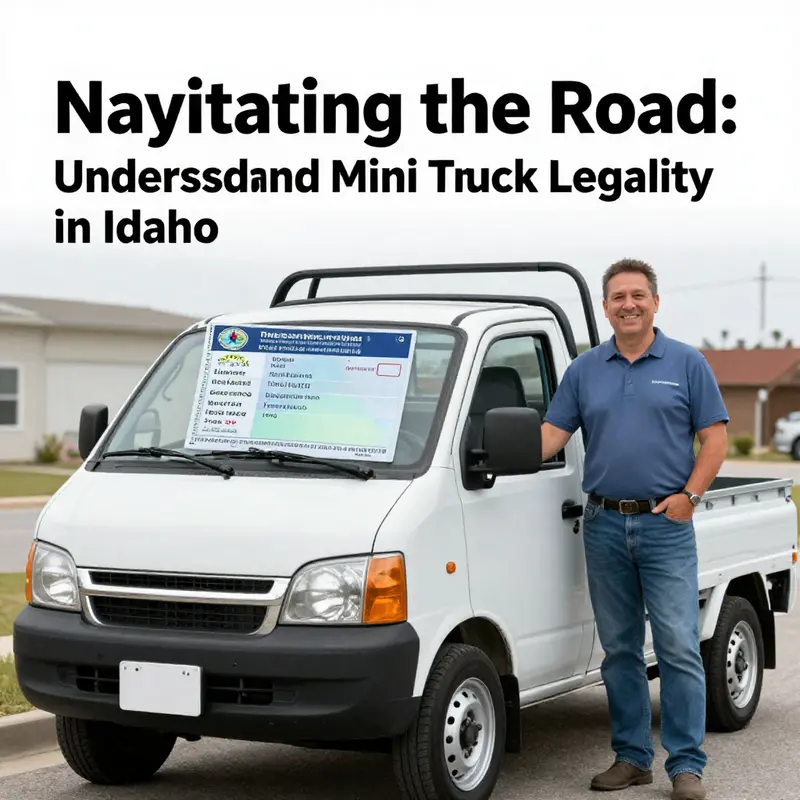
Across Idaho, the appeal of compact, versatile vehicles is clear. Mini trucks, with their small footprints and practical beds, promise utility in both rural work and tight urban spaces. Yet on the question of whether they can legally roll on public roads, the answer is nuanced. Insurance and registration are the gatekeepers that separate a hobbyist build from a vehicle that can share the lane with regular cars. The state treats these machines differently from standard passenger cars, reflecting their design and typical use. When you listen to those gatekeepers, you hear a steady call for documentation, compliance, and a clear understanding that legality is an ongoing process, not a one-time achievement. This is where the chapter’s focus on insurance and registration becomes crucial, because without them a mini truck cannot be confidently counted among Idaho’s on-road fleet, no matter how ready it seems for everyday work or weekend adventures.
Registration options set the first line of demarcation. To operate on public roads, a mini truck must be registered with the Idaho Transportation Department (ITD). The common misconception is that any modified vehicle can be slapped with a title and a plate after a quick inspection. Idaho’s rules are more exacting. Some minis are classified as motorized off-highway vehicles, MOHVs, because of their compact frame and off-road heritage. MOHVs are not eligible for standard passenger-vehicle registration. Instead, they often require MOHV registration, valid for one year, and priced around $15. This designation allows operation on designated public roads and trails, but not on every road, and it comes with compliance expectations for safety and emissions. Prospective owners must anticipate inspections and proof of compliance with emissions and safety standards during the registration process. For a more general sense of how Idaho manages vehicle registration for these quirky rigs, you can explore the broader blog coverage at minitrucksocala.com/blog.
Emissions and engine size form another crucial axis. Idaho aligns with federal EPA guidelines. Vehicles with engines over 50cc may require a certification to prove conformity with emissions standards. Kei trucks and other compact rural designs are often powered by small engines, which can complicate compliance once they come onto public roads. The MOHV pathway is partly meant to reflect that some of these vehicles were never optimized for on-road emissions profiles and wind-noise compliance. Even when a vehicle passes its on-road test, it must still meet Idaho’s emissions norms. Owners should be prepared for emissions testing or documentation to satisfy ITD inspectors.
Speed and performance norms also shape the landscape. The state expects road-legal light-duty vehicles to meet minimum performance criteria, including speed. If a mini truck’s top speed exceeds Idaho’s minimum thresholds for on-road operation, it may be deemed unsuitable for traditional registration. In practice, that threshold has been described as roughly 25 mph in informal guidance, although actual determinations hinge on specific vehicle configurations and ITD’s interpretation. This doesn’t mean every low-speed mini truck is automatically legal; it means the vehicle must be capable of safe highway-sharing and respect Idaho’s traffic laws. A slow-but-steady utility machine still needs the right registration and insurance to be legitimate on public highways.
Insurance requirements are the other half of the equation. Idaho requires liability insurance for any motor vehicle that operates on public roads. Even if a mini truck is used primarily off-road, once it is driven on public highways it must carry coverage. The state’s minimums are commonly stated as 25/50/15: $25,000 per person for bodily injury, $50,000 per accident for bodily injury, and $15,000 for property damage. Insurance policies can be placed with standard auto insurers, but coverage varies by how the vehicle is classified and used. If the vehicle is registered as a MOHV, some insurers may require you to keep the vehicle on designated routes or trails, or they may impose higher deductibles or different limits. The key point is to verify with a chosen insurer whether the policy covers a MOHV or any vehicle operated on public roads. Failing to carry valid insurance can bring fines and penalties, even for vehicles that otherwise meet registration requirements. The safety net here is straightforward: carry the state-mandated liability protection, and ensure your coverage aligns with Idaho’s registration status.
Registration and insurance are not one-and-done steps. They are ongoing commitments. After you register, you must maintain the vehicle’s compliance with safety equipment—headlights, brake lights, turn signals, mirrors, seat belts—and keep documentation of emissions conformity and modifications. If you modify the vehicle later—such as upgrading the lighting, adjusting the emissions system, or altering the braking setup—you may trigger another round of checks. ITD inspectors will want to see evidence that changes do not compromise safety or emissions standards. In some cases, owners have to re-verify compliance after a significant modification or a shift in usage pattern, such as moving from strictly private property to broader public-road operation. For those navigating these waters, the process can be eased by contacting ITD directly to confirm if a particular build qualifies for MOHV status or if it needs a different path to registration.
The practical reality is that local jurisdictions add their own layers of rules. Some counties or municipalities require additional lighting, slower-speed zones, or restrictions about operating on certain public rights-of-way. Before you pull into a public road with a MOHV or a registered mini truck, check with the county sheriff’s office or the local police department to ensure you meet any local ordinances. Keeping a log of compliance documentation, insurance communications, and any correspondence with ITD helps in case of a roadside check. The dynamic nature of these rules means that a vehicle once built for off-road tasks can become road-ready or a legal risk, depending on how well its paperwork tracks its actual use and capabilities.
For those weighing options, the broader lesson remains consistent. The road legality of Idaho’s mini trucks rests on a careful balance of classification, compliance, and ongoing maintenance. Toward that end, a compliance-first mindset makes a big difference. It is tempting to see a compact truck as a quick path to on-road utility, but the road checks and insurance requirements ensure the vehicle remains predictably safe for all users. A partially modified machine might look the part, yet fail to satisfy ITD standards without a complete inspection and official titling. Even when a vehicle passes inspection and receives MOHV registration, it may still be restricted from certain lanes or highways, depending on its engine size and speed capabilities. In other words, legality is not a single checkbox; it is a bundle of verified traits—vehicle identity, emission seriousness, safety features, insurance coverage, and an official registration status. With that bundle intact, Idaho’s roads can accommodate these compact workers without compromising safety or the integrity of the state’s traffic system.
Enthusiasts and prospective buyers should approach a mini-truck project with a clear view of the steps involved and the potential constraints. It is not merely a matter of cost or appearance; it is about ensuring the vehicle is treated as a regulated asset on public roadways. The route from curiosity to road-ready status passes through the ITD’s registration gate, where MOHV status, emissions documentation, and proof of insurance are weighed against Idaho’s safety and road-use standards. While the allure of a nimble, affordable workhorse is strong, the reality is that many mini trucks will remain off-road or on designated routes until a deliberate conversion and proper registration take place. For readers seeking more practical guidance, the journey includes staying informed about state and local regulations and recognizing that modifications alone do not guarantee legality. The ITD’s policies and the rules in your county can change, so staying in touch with official sources is essential. For a clear sense of how the state’s approach translates into everyday decisions, consult the official ITD vehicle registration resources and keep your documentation up to date.
For precise steps and forms, consult the official Idaho Transportation Department page dedicated to vehicle registration.
External resource: https://www.idahotransportation.gov/vehicle-registration
Small Wheels, Big Road Rules: The Practical Realities of Owning a Mini Truck in Idaho
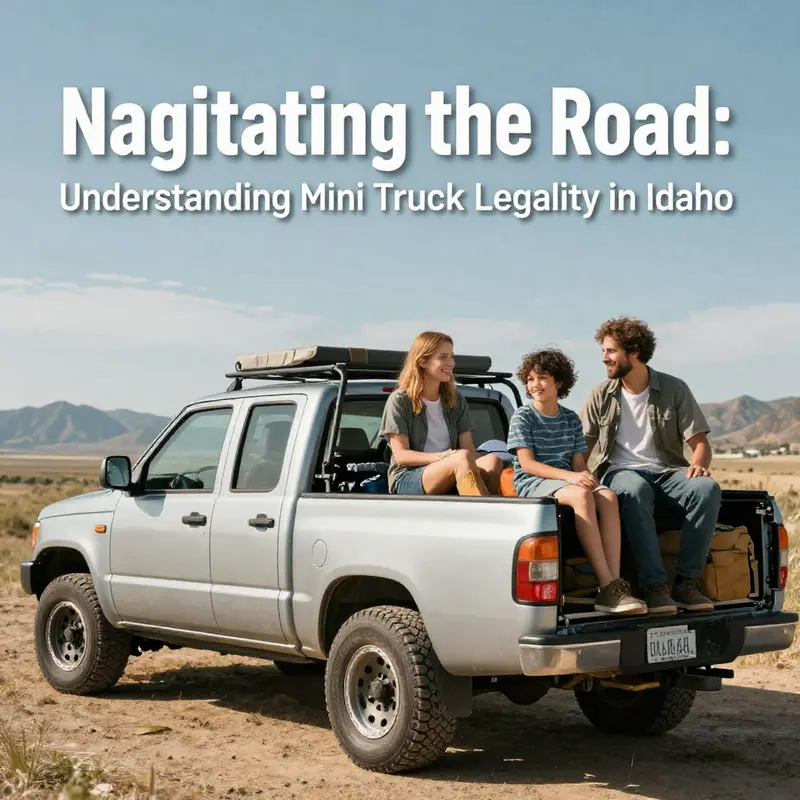
Idaho’s wide horizons and varied terrain tempt many into thinking a tiny truck could replace a full-sized workhorse. The idea is simple: a compact vehicle with a nimble footprint, low operating costs, and enough bed space for small deliveries or farm chores. Yet turning that idea into a legitimate, roadworthy machine in Idaho is less a leap of faith and more a careful dance with regulation, inspection, and practical design. The state’s roads are not designed as a testing ground for unregulated cargo platforms; they are governed by a framework that prioritizes safety, emissions, and accountability. For anyone considering a mini truck as a practical solution for Boise’s urban couriers, Coeur d’Alene’s seasonal roads, or rural delivery routes across the Treasure Valley, the first question is not whether the vehicle can fit a particular task, but whether it can operate legally on public streets. In Idaho, that legality is earned through compliance with standards set by the Idaho Transportation Department, or ITD, and through a process that ensures every vehicle on the road meets basic safety, noise, and emissions requirements. While the appeal of these compact units is understandable, the regulatory reality is specific: most mini trucks imported from overseas, especially those designed for off-road or rural use, are not street-legal out of the crate. They may be physically capable of moving on asphalt, but without modification, inspection, and official titling and registration, they are not permitted to operate on public roads. This distinction matters for anyone trying to balance cost savings with the responsibilities of road use, insurance, and compliance. The path to legality begins with a clear understanding of the core requirements: proper lighting that enables visibility and signaling for other motorists; functional mirrors that provide adequate rear and side awareness; safety belts that protect drivers and passengers; emissions compliance consistent with federal and state guidelines; and a title and registration that tie the vehicle to a legal ownership record. In addition, the vehicle’s noise profile and overall design must align with Idaho’s rules on road-vehicle standards. The ITD’s guidance emphasizes that obtaining lawful operation is not merely a matter of adding a few aftermarket parts; it is a formal process that culminates in an inspection, a title, and registration. The practical upshot is that, while a mini truck can be made to look and function like a conventional street vehicle, its street legitimacy rests on meeting specific criteria that apply to any other car, truck, or light-duty vehicle in the state. The emphasis on standardization across lighting, mirrors, seat belts, and emissions is not incidental. Idaho’s approach reflects a broader federal framework, but it adds its own state-specific requirements that must be satisfied before the vehicle earns its road-going status. This is one of the central tensions for owners: the vehicle might be appealing for its size and efficiency, yet the path to legality involves a careful alignment with standards, rather than a rough-and-ready customization that speeds the vehicle onto the street. The process, therefore, is both a technical and a logistical undertaking, requiring a willingness to engage with regulators, secure proper documentation, and anticipate the potential for additional costs and time. The practical considerations extend beyond legality to everyday use. Idaho’s geography—mountainous ranges, rolling farmland, and long stretches of rural road—creates real differences in how a mini truck performs in the field, in the city, or on the highway. In urban centers like Boise or Coeur d’Alene, the compact footprint and high maneuverability of these left-hand-drive units can be an advantage. They slip through narrow corridors, turn tight corners, and park in spaces that would challenge a full-size pickup. For last-mile delivery operations, this can translate into quicker loading, easier navigation through dense traffic, and the potential to reduce fuel costs in urban routes. Yet the same compact design often comes with trade-offs. Cargo and towing capacity in mini trucks is limited compared to traditional light-duty pickups, which can constrain their utility for contractors, farmers, or service fleets that routinely haul heavy equipment or large loads. In rural Idaho, where road surfaces can vary and often demand more robust traction, braking performance, ground clearance, and suspension travel become more than just comfort features. They influence the vehicle’s ability to handle snow, ice, mud, and gravel without compromising safety or service uptime. The winter months in northern Idaho and mountain communities can be severe. Snowpack and icy roads test a vehicle’s stability and tire performance in ways that may exceed what a small, open-bed truck was designed to handle. The lack of weather protection in open or semi-enclosed mini truck configurations is another critical factor. For delicate cargo—produce that can perish quickly, pharmaceuticals that require constant temperature, or electronics that are sensitive to moisture—open cabins, even with basic thermal blankets, are not a reliable solution during harsh winter months. The practical approach for year-round operation is to consider specialized configurations that address climate control and cargo protection. A refrigerated or climate-controlled compartment transforms the utility profile of a mini truck, turning it from a simple transport tool into a mobile cold chain asset. Such a configuration helps maintain product integrity for temperature-sensitive deliveries and supports consistent performance across Idaho’s seasonal fluctuations. However, this enhancement adds complexity and cost. It also demands greater attention to electrical load management, insulation quality, and reliability of cooling systems in cold weather. In other words, the more you customize for climate control, the more you must ensure that the vehicle remains compliant with safety and emission standards, and that the added systems do not undermine the vehicle’s basic street-legal status. The decisions around features like all-wheel drive, traction control, or more capable braking systems are not merely about comfort. They directly influence the vehicle’s ability to cope with Idaho’s road conditions. A compact truck with good winter traction, appropriate tire tread, and a proven braking setup is more likely to provide reliable service through heavy snow and ice. At the same time, it remains crucial to balance these capabilities with the legal requirements and the costs of compliance. Any modification that affects the vehicle’s electrical system, emissions, or structural integrity can complicate an inspection and the titling process. This is not a discouraging paragraph; it is a practical reminder that the path to legality intertwines with performance. The ITD’s road-usage framework is designed to prevent scenarios in which a vehicle that does not meet safety or emissions benchmarks operates on public roads. Therefore, prospective owners must plan for an inspection that verifies all critical systems—lighting, mirrors, seat belts, and emissions—meet minimum standards. The inspection is a checkpoint that ensures the vehicle’s safety features perform reliably under Idaho conditions and that the vehicle’s advertised capabilities do not outpace its actual compliance. Insurance is another essential pillar of readiness. Even if a mini truck passes inspection and earns a title, it must be insured like any other motor vehicle. This means working with an insurer that understands the vehicle’s configuration, its modifications, and its anticipated usage. The insurance arrangement must reflect both the risk profile of a smaller, lighter vehicle and the particular commercial or personal-use duties it will fulfill. License and registration fees, annual renewal, and potential property taxes tied to the vehicle’s value are real ongoing costs that influence the total cost of ownership and the viability of adopting a mini truck for daily operations. If a business is evaluating a mini truck as a logistics solution, a careful calculation of total cost of ownership is essential. The purchase price, the cost of needed modifications, the cost of compliance testing and inspections, annual insurance, registration renewals, and maintenance must all be weighed against the anticipated savings in fuel and the potential gains in maneuverability and route efficiency. In practice, achieving a compliant, road-ready mini truck in Idaho is a sequencing exercise. Start with a clear definition of intended use and route profile. Then engage with ITD resources to determine whether a given vehicle model can meet federal and state emissions standards and how much modification might be required. Plan for a professional inspection and a formal titling process, and include a realistic budget for insurance and ongoing compliance costs. Throughout this journey, it is helpful to reference the broader community of owners, fleets, and operators who are navigating similar challenges. There is value in learning from peers about best practices for lighting upgrades, seat belt retrofits, and weatherproofing strategies that do not undermine compliance. For readers seeking practical guidance and ongoing discussion about mini trucks, the community resources and blogs in the broader mini truck ecosystem can offer useful perspectives. To explore more about practical usage, maintenance, and regulatory considerations from a community perspective, you can visit the Mini Trucks Blog hub. minitrucksocala.com/blog/. As you map out a plan for Idaho, keep in mind that the path to road legality is not just about what you can do to a vehicle, but about aligning your operations with Idaho’s regulatory framework. If your goal is to leverage a mini truck for city deliveries, farm tasks, or small-scale construction support, you will likely find it essential to invest in a model that offers not only compact dimensions and a capable bed for light cargo but also robust safety features, reliable weathering, and proven compatibility with the state’s inspection requirements. The practicality of such a vehicle in Idaho hinges on a careful synthesis of design choices, regulatory readiness, and a clear understanding of the terrain you intend to traverse. The question of street legality is not a hurdle to be avoided, but a milestone to achieve through deliberate planning, professional modification, and a formal regulatory process. With the proper steps, a mini truck can transition from a promising concept to a reliable, road-legal asset tailored to Idaho’s distinctive mix of urban corridors, rural frontiers, and winter extremes. External reference: for a deeper dive into technical standards and applications of refrigerated mini trucks in similar climates, see this external resource: https://www.dongfengtruck.com/en/vehicle/k01-mini-truck.html
Final thoughts
Understanding the legality of mini trucks in Idaho is essential for current and prospective owners. By knowing the regulations and requirements set forth by the Idaho Transportation Department, ensuring emissions compliance, and adhering to insurance requirements, you can confidently enjoy the benefits of owning a mini truck. Whether for business, fun, or utilitarian purposes, these compact vehicles can drive your daily adventures in Idaho. Remember to verify your vehicle’s compliance to ensure a smooth ride.