
The allure of mini trucks, especially those unique Kei models, has grown among enthusiasts and small business owners in Kentucky. As more folks consider these compact and versatile vehicles for both commercial and personal use, understanding the legal framework becomes crucial. In 2018, several aspects, including safety regulations, emissions compliance, insurance, and local laws, impacted the street legality of mini trucks in the state. Whether you’re a residential property owner wanting to enhance your garage, a local business owner looking for utility, or simply a mini truck aficionado, we’ll break down the important aspects here so you feel equipped to make informed decisions regarding your mini truck ownership.
Bluegrass Street-Legal: Making Kei Trucks Roadworthy in Kentucky
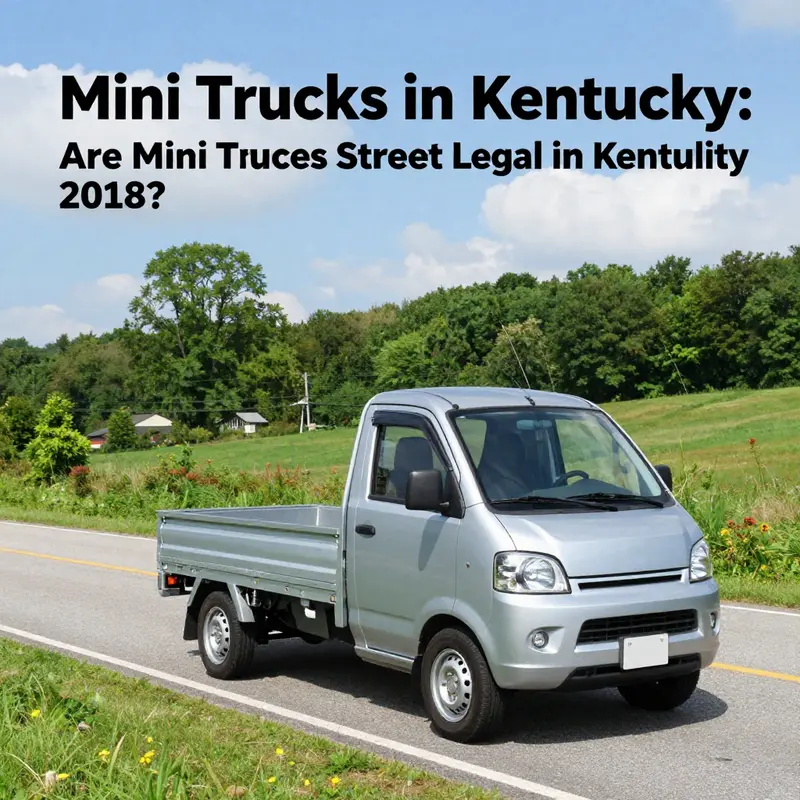
In Kentucky, kei-style mini trucks are not granted a separate legal category. To be street-legal, they must be properly registered and insured, pass a roadworthiness inspection, and meet state requirements for lighting, safety, and emissions. The process relies on documenting the vehicle’s specifications and any modifications, and consulting the Kentucky Transportation Cabinet and local authorities to confirm current rules, as regulations can evolve. In short, ownership may be permissible, but road use requires conformity to the same standards that apply to other motor vehicles.
Safe Roads, Small Footprint: Safety, Emissions, and Street-Use Rules for Kentucky’s 2018 Mini Trucks
In Kentucky, the appeal of compact, low-profile mini trucks—often arriving from far-off markets as Kei-style workhorses—rests on practical advantages: ease of maneuvering in tight spaces, frugal fuel consumption, and a surprising willingness from rural and urban drivers to adopt a vehicle that is small in stature but capable in function. Yet the path to legally operating a mini truck on public roads in 2018 is less about a distinct row in a state registry and more about matching a vehicle to a framework built on federal standards. The state does not maintain a separate category for mini trucks; instead, it enforces the same broad requirements that cover all roadgoing passenger and light-duty vehicles. In practice, this means the licensed ownership of a mini truck is straightforward enough, but road-legal operation relies on evidence that the vehicle complies with both federal safety and emissions mandates and with Kentucky’s registration and inspection processes. The dynamic is simple in theory but layered in practice: the vehicle must be legally born into the market, legally born again in Kentucky through registration, and then legally proven roadworthy through inspection and, where applicable, emissions testing. For anyone considering a 2018 mini truck as a daily driver, the central question is not merely “Can I own this vehicle?” but “Can I own and operate this vehicle in a way that satisfies the full spectrum of state and federal standards?” The answer, shaped by the 2018 regulatory landscape, is that a mini truck can be street-legal in Kentucky, provided it earns pass marks in federal safety standards, federal emissions standards, and the state’s own road-usage checks. To navigate this landscape with confidence, it helps to understand the interplay of federal rules and state administration, and to recognize how a 2018 mini truck aligns with the expectations of the Kentucky Transportation Cabinet and the inspection regime that keeps roads safe for everyone. For those seeking a broader sense of how these vehicles are treated within the state’s evolving conversation about mini trucks, the primary state and local resources remain the official touchpoints, and the official guidance pages are the most reliable starting place. If you want a reader-friendly, ongoing discussion about the variety of mini-truck configurations, maintenance considerations, and user experiences, consider visiting the internal resource hub that regularly curates practical insights about mini trucks and their practical use in everyday life. minitrucksocala.com/blog
Emissions and safety converge in 2018 with a clear alignment to federal standards. The Environmental Protection Agency’s Tier 3 standards, which phased in over the preceding years and achieved full implementation by 2018, set ambitious expectations for tailpipe pollutants. Mini trucks sold or imported into the United States in 2018 are required to meet these standards just like any other light-duty vehicle. The Tier 3 framework targets reductions in pollutants such as nitrogen oxides (NOx), carbon monoxide (CO), and particulate matter (PM). While these targets primarily influence what manufacturers can bring to market, the practical effect for Kentucky residents is that a compliant mini truck must carry the emissions certification that demonstrates its conformity to Tier 3 rules. This certification is not a decorative badge; it is a fundamental prerequisite for registration and for keeping the vehicle on the road as a compliant, legal option for everyday use. The result is a baseline of environmental responsibility that aligns the miniature workhorse with the broader slash-and-burn of urban air quality improvements and rural air quality maintenance.
On the safety side, the Federal Motor Vehicle Safety Standards (FMVSS) upheld by the National Highway Traffic Safety Administration (NHTSA) define a broad matrix of safety requirements designed to protect occupants and other road users. For the 2018 model year, mini trucks had to demonstrate compliance with these federal standards in areas ranging from braking performance and stability to occupant protection. Features such as electronic stability control (ESC), modern crashworthiness from airbag systems, and robust lighting and crash energy management are all part of the standard that the 2018 generation of mini trucks had to meet. The practical upshot is that a 2018 mini truck, when it arrives in Kentucky, should be a vehicle that has already been engineered to a baseline level of safety that aligns with the expectations for any passenger vehicle or light truck used on public streets. Kentucky itself does not impose a new layer of safety mandates beyond these federal requirements; instead, the state enforces compliance through its vehicle registration and roadworthiness inspections. The state’s approach is to ensure that what you drive on Kentucky roads carries the official marks of compliance, rather than to reinvent safety standards from first principles at the state line.
Age and modification are important lenses through which ownership must be viewed. The 2018 model year is a practical milestone because it sits at a point where manufacturers had to demonstrate Tier 3 compliance and meet FMVSS expectations for crashworthiness and occupant protection. If a mini truck is imported or assembled with significant modifications, the onus falls on the owner to verify that those modifications do not erode the vehicle’s compliance status. In some scenarios, inappropriate changes to critical systems—such as braking, suspension geometry, or airbag compatibility—could challenge an inspection or prevent registration. The rules are not about restricting creativity in customization so much as preserving road safety and environmental stewardship. An owner who invests in equipment like a utilitarian bed, a camper shell, or a rugged set of tires should expect to document that such changes have not compromised the vehicle’s compliance credentials. The inspection and registration process in Kentucky serves as the final gatekeeper, confirming that all safety features function as intended and that the vehicle continues to meet the applicable standards.
To navigate this landscape with clarity, a prospective buyer or owner should start with the basics: confirm the vehicle’s emissions certification that proves Tier 3 compliance, verify that the vehicle’s safety features align with FMVSS expectations for the model year, and ensure that the vehicle’s dimensions and configurations do not trigger exemptions or special registrations that would complicate road use. In Kentucky, there is no separate mini-truck category that would exempt a model from standard checks, meaning that even a small truck must ride the same regulatory rails as any other roadworthy light vehicle. This is a point of reassurance for many drivers: the rules protecting air quality and occupant safety apply equally to the smallest utility vehicle as they do to the largest pickup truck. If you want to dive deeper into the emissions framework and understand how Tier 3 shapes the landscape for all vehicles, including compact imports, the EPA’s official resources provide explicit guidance and context. For a concise overview of the emissions standards landscape, consult the EPA’s Vehicle Emissions Standards – Tier 3 page.
For readers seeking practical guidance based on real-world experience and ongoing discussions within the mini-truck community, a useful starting point is the long-running internal resource hub that collects posts about ownership experiences, repairs, and regulatory considerations. It provides a grounded picture of how owners interpret the rules in daily life, how inspections and registrations are typically pursued, and how modifications are balanced with compliance needs. If you visit that hub, you’ll encounter discussions about model-year selection, maintenance cycles, and the kind of documentation that helps smooth the path from showroom floor to public road. The linked internal resource is a helpful companion for readers who want to see how the general principles described here play out in actual ownership stories, rather than relying solely on regulatory summaries. minitrucksocala.com/blog offers a window into the ongoing, practical dialogue surrounding these vehicles, from initial inspections to long-term upkeep.
In practical terms, the registration and inspection processes act as the gatekeepers that can either validate or complicate street-legal status for a 2018 mini truck in Kentucky. The state’s approach emphasizes compliance over categorization, which means you should expect to present documentation that demonstrates the vehicle’s conformity to EPA emissions standards and FMVSS safety standards when you apply for title, license plates, and registration. You may also need to show proof of insurance, a numbered VIN, and a clean bill of health from a safety inspection. These steps are not burdensome to the compliant owner; in fact, they provide a transparent framework that ensures every vehicle on the road has been evaluated against a shared baseline of safety and environmental responsibility. The outcome is a regulatory environment that respects the practical benefits of mini trucks—their compact size and their utility—while not compromising a broader commitment to road safety and air quality.
The broader narrative of 2018 Kentucky street legality for mini trucks thus rests on two pillars: federal standards that set the non-negotiable baseline for emissions and safety, and state administration that enforces those standards through registration and inspection. The absence of a distinct Kentucky mini-truck category does not create a loophole; rather, it places mini trucks squarely within a universal compliance framework. In 2018, that framework is robust enough to accommodate the specific characteristics of mini trucks while ensuring that emissions performance and safety features meet widely accepted benchmarks. For anyone curious about how these principles coalesce in everyday practice, a quick review of the official federal standards provides background on why the 2018 model-year configurations were designed as they were. The Tier 3 standards, in particular, reflect a national commitment to cleaner air, a commitment that Kentucky reinforces by ensuring those standards are part of the registration story for every vehicle that enters the road network.
For readers who want to cross-check details with state guidance, the Kentucky Transportation Cabinet and related state pages remain the most reliable sources for current procedures, fees, and inspection schedules. Meanwhile, the federal reference points—emissions standards and safety standards—continue to anchor the legal viability of mini trucks on Kentucky streets. The synergy between federal and state oversight helps maintain a balance between practical utility and public safety, allowing owners to enjoy their compact vehicles without sacrificing the reliability and predictability of road regulations. And for those who prefer to see these ideas demonstrated in real-world examples and community discussions, the internal hub mentioned above keeps readers informed about how owners interpret the rules in practice, what inspections typically entail, and how to address common questions that arise during ownership and use.
In summary, the 2018 era of Kentucky street legality for mini trucks is defined by compliance rather than categorization. Emissions must meet Tier 3 standards, safety systems must align with FMVSS requirements, and state authorities must recognize the vehicle through standard registration and inspection processes. The combination ensures that these small but capable vehicles can share the road with larger trucks and cars alike, provided they come with the same assurances of safety and environmental responsibility. If you want a high-level reference to emissions standards as they apply to all vehicles, including mini trucks, the EPA provides authoritative guidance on Tier 3 that underpins these requirements and explains their rationale. The practical implication for Kentucky drivers is straightforward: verify emissions certification, verify safety features, complete registration, and proceed with the reassurance that your 2018 mini truck can be a legitimate, roadworthy part of the state’s transportation system. For ongoing reading and context about community experiences with mini trucks, you can explore the linked internal resource above, which captures a broad spectrum of ownership insights over time. And for the official, external standard reference, the EPA’s Tier 3 documentation is available at the following external resource: https://www.epa.gov/air-resources-inventory/vehicle-emissions-standards-tier-3
Road Rules, Paperwork, and the Kentucky Mini-Truck Question: A 2018 Guide to Insurance, Registration, and On-Road Viability

The appeal of a tiny, utilitarian vehicle sits at the intersection of practicality and nostalgia. In Kentucky, where farm lanes meet county roads and small-town errands often require a nimble approach, the idea of a mini truck—compact, efficient, and able to haul cargo without the bulk of a full-sized pickup—echoes a sensible kind of mobility. Yet the same charm that makes these vehicles attractive can raise complex questions about legality and road-worthiness. The broader article is built on the premise that while ownership of micro or kei trucks may be open to enthusiasts, taking one from private land to public pavement requires navigating a web of size standards, safety expectations, and emissions rules. In 2018, as in years before and after, Kentucky did not single out a dedicated mini-truck category. Instead, it treated these vehicles as potential members of the general class—vehicles that must register, carry insurance, and pass inspections to be legally operated on public roads. The path from curiosity to street legality is paved with two irrevocable anchors: the vehicle’s compliance with state definitions of a motor vehicle, and the certainty that it meets both federal and state safety and environmental requirements. This context matters because the line between a hobby vehicle on private land and a road-going utility is defined by paperwork as much as by performance. When one contemplates a Kei truck in Kentucky, the first checkpoint is always the question of use. Private, non-road applications—like agricultural work, farm maintenance, or limited off-road tasks on property you own—may be legal without registering or insuring the vehicle, provided the vehicle remains off public streets. The moment the intent shifts toward public road travel, the vehicle crosses a regulatory threshold. The state’s regulations assume that any vehicle operated on public highways must be a “motor vehicle” by statutory definition, and thus subject to registration, a basic minimum level of insurance, and proof of roadworthiness. The practical upshot is clear: private land use is permissive in certain circumstances, but public-road operation triggers a more formal process. This is not merely a bureaucratic hurdle; it is a framework designed to ensure that vehicles sharing Kentucky’s roadways do not pose undue risk to occupants, other drivers, or the environment. For the responsible owner, the 2018 landscape asks for due diligence, not surrender of the dream. The pathway to compliance begins with recognizing the distinct realities of miniature trucks. Kei trucks, celebrated for their compact dimensions, light weight, and efficient engines, often have specifications that diverge from typical American-market light trucks. Their length, width, wheelbase, and even engine displacement can sit outside what would be considered standard for most U.S. vehicles. This divergence does not automatically render them illegal; rather, it underscores the likelihood that some models, or certain configurations, may fail to meet Kentucky’s registration or safety criteria without modification. The state does not categorically ban such vehicles from streets, but it does require that they meet the same fundamental tests as any other road vehicle. The overarching principle is simple: you can own the vehicle, but to drive it legally on public roads you must demonstrate compliance with both federal safety standards and Kentucky’s environmental and road-use requirements. Within this framework lies a practical checklist that any prospective operator in 2018 would do well to follow. The first step is to verify that the vehicle meets the basic statutory definitions of a motor vehicle under Kentucky law. This is not a question of whether the vehicle is cute or practical; it is a question of whether it is capable of being driven on public streets and highways in a manner consistent with safety laws. If the vehicle falls inside the definition, then registration and insurance become non-negotiable prerequisites. If it sits outside, there may still be a path to on-road use, but that path typically involves demonstrating that the vehicle can comply with emissions standards, FMVSS requirements, and any state-specific safety provisions that apply to road-going motor vehicles. The 2018 state guidance makes clear that registration is not optional for street use. Registration is the gateway to legality. It implies a promise to meet certain financial and safety obligations—namely, carrying a minimum level of automobile liability insurance and proving that the vehicle is roadworthy. In Kentucky, that minimum liability coverage has historically been framed in terms of bodily injury and property damage. A typical baseline cited in regulatory summaries is something along the lines of $25,000 per person for bodily injury and $50,000 per collision for property damage. These figures, while sometimes updated, have long represented the floor of what motorists can expect in terms of financial responsibility. They establish a standard of protection for other road users and reflect a broader principle: even the smallest vehicle on Kentucky’s streets shares responsibility with larger, more conventional vehicles for safety and accountability. Insurance is the second indispensable pillar. Beyond merely obtaining coverage, owners must provide proof of insurance at the time of registration. The interplay between insurance and registration ensures that a driver who operates a mini truck on public roads has the financial backing to cover potential damage or injury. It also introduces a practical dimension to the vehicle’s upkeep: if the policy lapses, the registration can be suspended. This linkage between insurance and road use is a reminder that the road system is built on mutual obligation—owners, insurers, and the state all contributing to a framework of responsibility. The third pillar concerns compliance with safety and emissions standards. The modern vehicle safety framework—often referred to in shorthand as FMVSS, or Federal Motor Vehicle Safety Standards—imposes requirements around structural integrity, occupant protection, lighting, braking, and other core systems. For a Kei truck or any micro vehicle to be road-legal, it must demonstrate conformity with these federal standards. In 2018 Kentucky, as elsewhere, state regulators would also assess whether the vehicle meets applicable state emissions requirements. Emissions testing and verification are especially relevant for vehicles that depart from the typical U.S.-market design. Some Kei trucks, with engines tuned for very different markets or with exhaust and emission control configurations not aligned with U.S. standards, could face significant hurdles in passing a state emissions test or in qualifying under the emissions regulations that Kentucky enforces. The practical implication is that not every Kei truck will automatically breeze through the process. The vehicle must be evaluated on its own terms, with a focus on its technical specifications and any modifications that could affect compliance. Once the vehicle passes the necessary inspections and meets the regulatory criteria, registration proceeds. The registration itself is more than a tag and a number; it is a formal acknowledgment by the state that the vehicle has met the baseline safety and environmental expectations required to circulate on public roads. The process involves submitting documentation that proves the vehicle’s identity, ownership, and compliance with applicable standards, as well as paying registration fees and possible taxes. In many cases, the assessment of a Kei truck’s eligibility for street use will hinge on the specifics of the vehicle’s design and any modifications. Heavier bumpers, altered suspension geometry, or changes that affect bumper height and lighting alignment can prompt questions about safety and compliance. The state’s evaluation focuses on whether the vehicle, as configured, can be operated safely without posing unacceptable risks to others. Even with registration and insurance in place, operations can be constrained by local and statewide rules that reflect both road safety concerns and the unique characteristics of micro-trucks. Some jurisdictions, for example, may require certain lighting configurations, reflectors, or tire specifications. Others may restrict the vehicle from certain roads or from traveling at higher speeds due to its powertrain and dynamics. In practice, this means that a 2018 Kentucky scenario would emphasize careful alignment of the vehicle’s equipment with the standards, not merely its appearance or its capability to haul. The practical takeaway is that many Kei trucks, by virtue of their compact frame and atypical dimensions for the U.S. market, will demand careful scrutiny prior to registration. It is not unusual for owners to encounter a review process that assesses dimensional limits, safety features, and emissions compliance before a vehicle is deemed roadworthy. The insistence on compliance also extends to modifications. If a vehicle has been altered after purchase, those modifications may need to be re-evaluated to ensure that they do not compromise essential safety features or violate emissions requirements. The line between acceptable modification and disqualifying alteration can be nuanced. It is not merely a matter of taste or preference; it is a regulatory question about whether the modification preserves or enhances safety and environmental performance. To navigate this terrain, an owner in 2018 would benefit from a practical, methodical approach. Begin with a careful comparison of the Kei truck’s specifications against the regulatory expectations for a motor vehicle in Kentucky. Confirm that the wheelbase, track width, overall length, and height stay within any published thresholds that could influence eligibility. Gather evidence of compliance with FMVSS and the state’s emission standards. Prepare for a potential inspection or verification process that confirms the absence of non-conforming features or dangerous modifications. Present this documentation during the registration process, along with proof of insurance and any required fees. The cost of compliance is, in practice, an investment in longer-term freedom to use the vehicle on public roads. Without registration and insurance, a Kei truck remains a private-property curiosity, legal only where no public roads are involved. With proper documentation and conformity, it becomes a road-legal utility that can serve farming operations, urban errands, or flexible transportation needs, all while meeting the same overarching obligations that apply to other motorists in the state. The story, then, is not simply about a vehicle’s size or power; it is about aligning a distinct, compact machine with the broader framework that keeps Kentucky’s roads predictable and safe. Local nuances also matter. Kentucky’s towns and counties can impose their own conditions for street-legal status, within the boundaries set by state law. A vehicle that clears the state-level tests might face additional scrutiny in a particular county or city that seeks to regulate unusual vehicle types on certain corridors. The prudent path is to check not only the state’s vehicle pages but also any county clerk’s or local zoning office’s guidance about use of nonstandard vehicles on public roadways. In 2018, the guidance available on the Kentucky Transportation Cabinet’s official vehicle pages remained the clearest and most authoritative source for these topics. It is where owners would verify whether a Kei truck, in its specific configuration, could be legally registered, insured, and operated on the public road network. For readers who want a broader sense of how mini trucks intersect with everyday life, the micro-truck community and its builders often discuss practical considerations beyond the bare minimum required by law. A resource such as a community blog can provide anecdotal insight into the kinds of build choices, safety concerns, and regulatory hurdles that real owners encounter. For readers exploring the wider world of micro-trucks and their street-legal journeys, the following resource offers a community perspective: minitrucksocala.com/blog/. This link serves as a touchpoint to understand how enthusiasts think about modifications, daily use, and the balancing act between custom builds and compliance. Of course, the technical and legal specifics remain anchored in official guidance. The Kentucky Department of Vehicle Regulation and the Kentucky Transportation Cabinet’s websites are the primary sources for definitive requirements. The overarching message for 2018 is straightforward: if you want to operate a mini truck on Kentucky roads, you must treat it as a motor vehicle that must be registered, insured, and proven roadworthy. The state does not grant an automatic exemption simply because the vehicle is small or economically efficient. Instead, it requires a thorough demonstration of compliance with federal safety standards and applicable state rules, including emissions. The end result, for the diligent owner, is a usable, street-legal vehicle that can perform local work and daily tasks with the same accountability that governs any other vehicle on Kentucky’s public roads. For a final, practical reminder: if your Kei truck is intended for on-road use in 2018 Kentucky, begin by confirming its eligibility with the official sources. Review dimensions, weight, and engine specifications against regulatory expectations. Prepare documentation showing FMVSS compliance and emissions conformity. Obtain and document insurance that meets or exceeds the minimum limits and complete the registration process through the appropriate state office. If modifications are planned, consult the regulatory framework to ensure that changes do not jeopardize eligibility. And finally, remember that beyond the state-level rules, local jurisdictions may add layers of requirements, so a quick check with the county or city clerk can save time and prevent later headaches. With careful attention to these steps, a mini truck can join Kentucky’s streets in a way that is responsible, safe, and legally sound—an ideal blend of small-scale utility and civic compliance that reflects the practical, down-to-earth ethos of Kentucky’s roadways. For the authoritative guidance on the current rules, consult the Kentucky Transportation Cabinet’s vehicle pages and related official resources: https://www.ky.gov/dot/vehicles/.
Street-Ready Kei: Navigating Kentucky’s 2018 Rules for Mini Trucks
Kentucky does not ban mini trucks, but it does require that any vehicle operated on public roads meet motor vehicle safety and emissions standards, be properly registered, and carry valid insurance. Because Kei-derived trucks come from a different regulatory regime, many require modifications or official certifications to bridge the gap between their original design and U.S. criteria before they can be driven legally in Kentucky. The path to street legality typically involves verifying safety features (seat belts, lighting, reflectors), ensuring emissions compliance, completing inspections, and obtaining title and registration from the Kentucky Transportation Cabinet along with mandatory liability insurance. Given county-level variations in interpretation, prospective owners should consult with local officials and qualified technicians to document modifications and obtain necessary certifications. A careful, stepwise approach—model evaluation, planned modifications, professional testing, and proper registration—helps transform a niche import into a compliant, road-legal vehicle in Kentucky.
Final thoughts
Owning a mini truck in Kentucky can be a rewarding venture, provided you navigate the necessary legal requirements. As we’ve explored, ensuring compliance with safety and emissions standards, completing registration and securing insurance, and understanding local regulations are vital steps. With this knowledge, whether you’re planning to use your mini truck for business or pleasure, you can enhance your ownership experience and connect with the local mini truck community. Keep informed, stay compliant, and enjoy the journey ahead!