
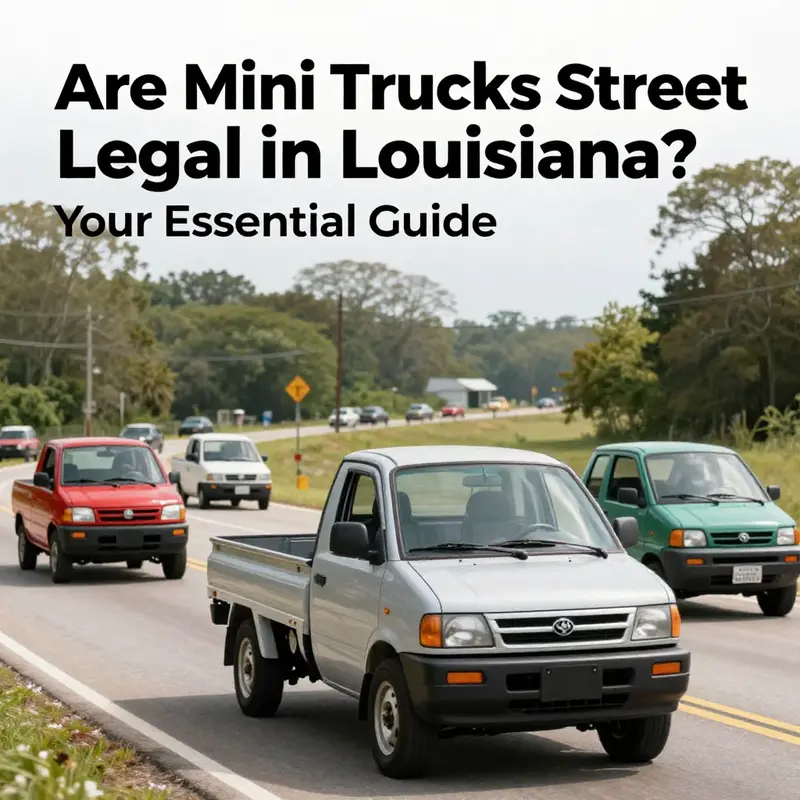
Mini trucks have become a popular choice for local small business owners, residential property owners, and hobbyists in Louisiana. Their compact size and versatility make them suitable for various tasks, whether it’s hauling cargo or enjoying off-road adventures. However, the question of their street legality is paramount. This guide will navigate through the essential aspects of mini trucks’ legal status, including safety standards, registration requirements, and distinctions between on-road and off-highway use. By the end, you’ll have a comprehensive understanding of what it takes to legally drive a mini truck in Louisiana.
Street-Ready in the Pelican State: Louisiana’s Guide to Street-Legal Mini Trucks
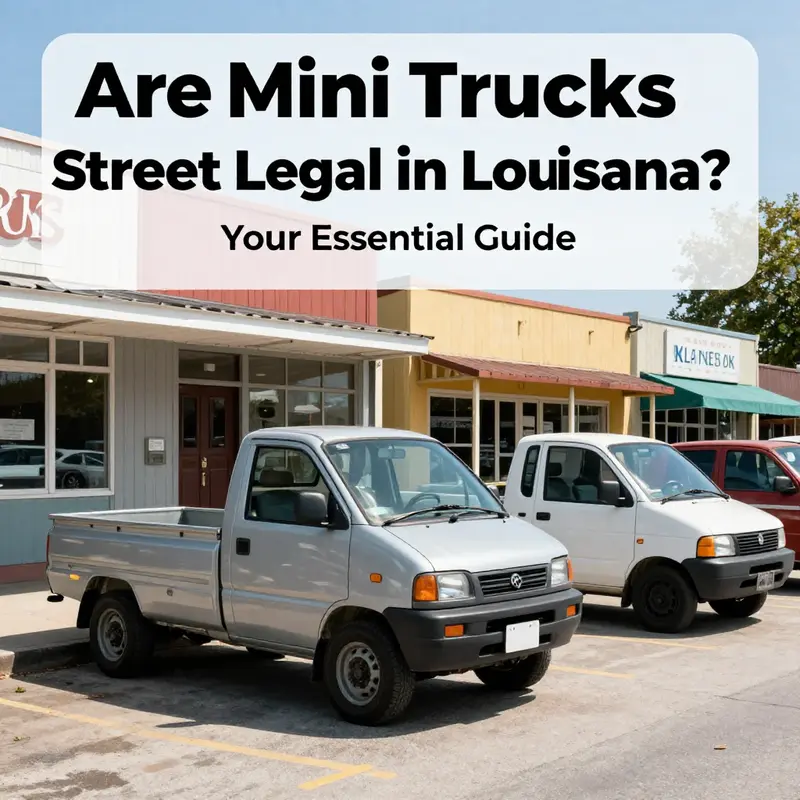
Louisiana treats a mini truck as a light-duty vehicle if its GVWR is 10,000 pounds or less, with registration, insurance, and safety equipment requirements that align with other passenger and light-duty trucks. To be street-legal, ensure proper titling and registration with the Louisiana DMV, display current plates, and maintain liability insurance. Safety basics include working headlights, taillights, turn signals, mirrors, and seat belts; a functional horn is also important for interacting with other road users. Local jurisdictions can impose additional rules, so check parish or city requirements for inspections or modifications that might affect on-road use. If using a mini truck for commercial purposes, prepare for potential extra requirements, such as emissions considerations or commercial vehicle rules. Always verify the vehicle’s GVWR on the VIN plate or the manufacturer’s documentation and confirm with the Louisiana DMV or State Police for the most current guidance.
On the Level: Safety Standards and the Street-Ready Path for Louisiana Mini Trucks
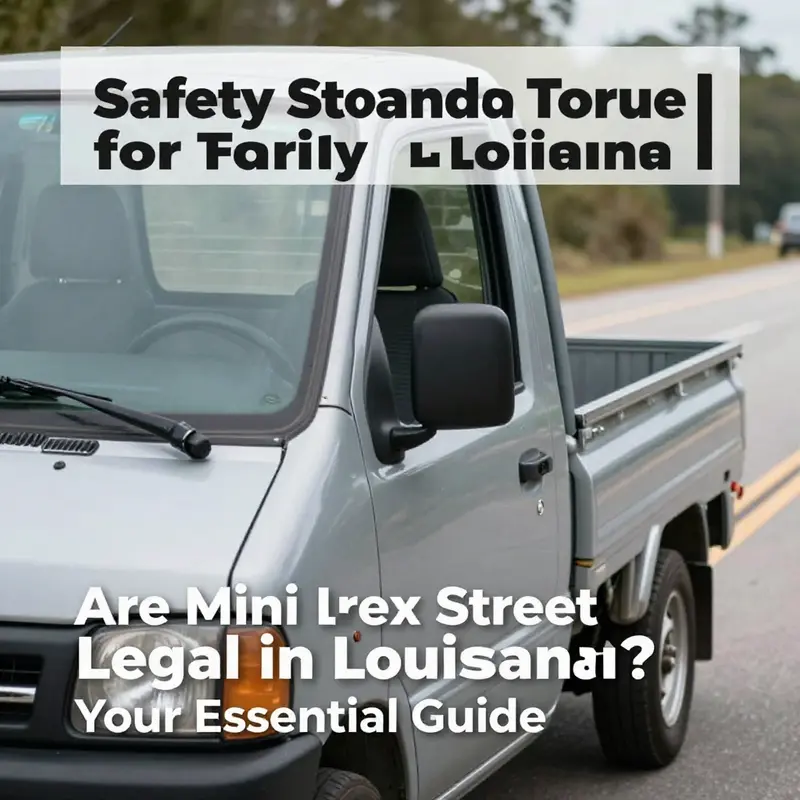
In Louisiana, the appeal of compact, agile mini trucks sits beside a practical set of rules that govern how, where, and under what conditions these small workhorses can share the road with full-size vehicles. The state draws a clear line between on-road use and off-road enjoyment, and the onus is on the vehicle owner to prove that a mini truck is prepared to meet safety expectations, registration requirements, and insurance obligations. This is not simply a matter of personal choice; it is a framework designed to ensure that these small machines, which can ride closer to motorcycles in their footprint and closer to passenger cars in their responsibilities, behave predictably in traffic. A crucial starting point is recognizing that mini trucks can be street legal in Louisiana only when they satisfy a blend of federal safety standards and state-specific regulations. The interplay between federal guidance from the National Highway Traffic Safety Administration and the Department of Public Safety & Corrections at the state level creates a path that owners must follow from the moment they bring a vehicle onto Louisiana soil.
At the federal level, mini trucks that are classified as low-speed vehicles (LSVs) or as certain off-road family members are expected to comply with the Federal Motor Vehicle Safety Standards, or FMVSS. This is not a bureaucratic formality; it is a baseline that touches the most concrete features of everyday driving. The FMVSS framework, administered by the NHTSA, covers essential safety elements that anyone who has driven a road-going car would recognize: lighting, signaling, occupant protection, and visibility. In practice, what this means for a Louisiana mini truck owner is that the vehicle should be designed and manufactured with a set of built-in safeguards intended to reduce risk during urban and suburban operation, not just on a private trail or a secluded plot of land. The standards apply in a broad sense to vehicles that are intended for street use, and they translate into what can be expected when a state inspector looks at a mini truck before it is allowed to mingle with other traffic.
Louisiana’s approach then adds a second, equally important layer: the state’s own safety and regulatory requirements. The Department of Public Safety & Corrections, through its Licensing and Registration mechanisms, enforces a set of on-road criteria that must be satisfied for legal operation. This is more than a nominal registration. It entails that the mini truck be properly titled, registered, and insured—just like any other motor vehicle that rolls along public streets. The practical implication is that drivers cannot simply convert an off-road favorite into a road warrior with a wink and a prayer. They must go through the official channels to obtain plates, evidence of registration, and proof of insurance. The idea is straightforward but powerful: road safety is anchored not only in machine compliance with FMVSS but also in the administrative process that records who is operating the vehicle and that the vehicle exists within the legal framework that governs all street-legal automobiles.
A point of nuance that deserves emphasis is the distinction between vehicles that are explicitly built for street use and those that are primarily off-road by design. In Louisiana, as in many states, not every mini truck on the market qualifies for on-road operation. Some models are classified as off-highway vehicles, or OHVs, and are intended for private property use or designated trails. For such OHVs, public street operation is typically outside the allowed scope unless the vehicle has received explicit on-road approval and includes the required equipment and insurance. This nuance matters especially for buyers who might be attracted to the compact size, the nimble handling, or the affordable upkeep of a vehicle that was not originally designed for street travel. The fate of a given mini truck—whether it will be a neighborhood workhorse or a weekend conqueror of back roads—hinges on the vehicle’s classification and the specific approvals it holds for on-road use. A careful owner will confirm, before any drive down a public lane, that the model is approved for street use and that it aligns with both FMVSS expectations and Louisiana’s registration requirements.
When a mini truck is cleared for street operation, several core safety features become non-negotiable. The emphasis on visibility and signaling is particularly important in traffic-dense environments where compact vehicles must operate alongside larger, faster cars, trucks, and SUVs. The on-road package for an approved Louisiana mini truck typically includes headlights that illuminate the road ahead, brake lights that signal deceleration to trailing drivers, and turn signals that clearly communicate lane changes and turns. Reflectors are another simple yet effective safety feature that helps other roadway users notice the vehicle in low-light conditions or from a distance, reducing the chance of a collision. The requirement for seat belts is especially worth underscoring. Unlike some purely recreational OHVs, street-legal mini trucks in Louisiana are expected to protect occupants with reliable restraint systems that can mitigate injury in the event of a crash. The importance of a horn cannot be overstated either; it provides a direct, audible means to warn others when a driver needs to make space or alert pedestrians and cyclists in shared spaces. These elements—headlights, brake lights, turn signals, reflectors, seat belts, and a horn—collectively form the baseline safety package that aligns with both state expectations and the broader national safety framework.
Insurance and titling are two practical realities that often determine whether a mini truck can be legally enjoyed on everyday roads. In Louisiana, as in most states, proof of insurance is a prerequisite for registration and operation. This requirement is not merely a bureaucratic hurdle; it ensures that when things go wrong, there is financial recourse to address damage and injuries. The titling process establishes ownership and helps secure the vehicle’s legal identity in public records, which in turn supports registration, inspection where applicable, and the vehicle’s ability to be parked on private property or on public streets. The process of titling and registering a mini truck mirrors that of larger passenger cars and trucks: it creates a clear linkage between the owner, the vehicle, and the road network. It also means that the mini truck will be subject to renewals, potential inspections, and the ongoing obligation to maintain insurance coverage—factors that encourage responsible ownership and operation.
From a regulatory perspective, the Louisiana experience reflects a broader reality in which on-road viability depends on compatibility with both federal safety standards and state administrative practices. The result is a practical framework that helps prevent situations in which a low-cost, compact vehicle might otherwise enter traffic unprepared to meet basic safety norms. It also means that owners who simply want a keep-it-simple, street-legal solution will benefit from engaging with the process and ensuring every box is checked before they take to the road. The combination of FMVSS compliance and state registration, insurance, and title requirements provides a coherent path toward lawful operation. It is a reminder that the regulatory landscape for mini trucks, while nuanced, is not an obstacle course so much as a safety-first checklist that, when followed, enables a more predictable and safer driving experience for everyone on Louisiana roads.
For readers who want to explore how different models approach the safety and feature package, there is practical value in reviewing general guidance on on-road suitability rather than relying on impressions alone. A concise comparative resource on mini truck models can help illustrate how feature sets translate into street-ready reality without naming specific products in a way that distracts from the central point. See the discussion linked here in the context of broader safety considerations: comparing mini truck models. This link serves to provide a neutral, model-agnostic sense of how features such as lighting, seating, and control ergonomics intersect with safety expectations and regulatory requirements, rather than offering endorsements of any particular on-road configuration.
Ultimately, Louisiana’s safety standards for mini trucks emphasize a balanced approach: respect the FMVSS framework, meet state registration and insurance obligations, and ensure that the vehicle’s equipment and overall design support predictable, safe operation on public streets. The on-paper requirements translate into a real-world practice that reduces risk for drivers and pedestrians alike. For owners, the practical takeaway is straightforward: before you consider driving a mini truck on Louisiana’s roads, confirm that your vehicle is approved for on-road use, verify its compliance with the required safety features, complete the registration and titling steps, and secure the appropriate insurance coverage. When in doubt, touch base with the Louisiana DMV and DPS&C resources to ensure you are current with any updates to rules and procedures. The official DMV portal remains the best consolidated source for the latest forms, fees, and procedural steps, and it is wise to review those details early in the purchase and registration process to avoid surprises later on. For those who want further context on on-road suitability and safety feature expectations, the Louisiana DMV site provides guidance that aligns with the regulatory framework described here and helps bridge the gap between a vehicle’s capabilities and its lawful street status. For broader, practical insights into how features translate into real-world driving, consider visiting the linked comparative guide as you plan a purchase or a retrofit. Additionally, consult official sources for the final, legally binding requirements that govern registration, insurance, and on-road eligibility, so you can enjoy a compliant, safe, and practical driving experience with a mini truck in Louisiana. External resources, including state-level guidance, are essential to ensuring that your on-road transition remains smooth and compliant: Louisiana DMV.
Paperwork, Plates, and Policies: Registering and Insuring Mini Trucks for Louisiana Roads
Registration and Insurance: The Practical Rules for Driving Mini Trucks in Louisiana
Owning a mini truck and planning to drive it on Louisiana streets means handling more than repairs and parking. It requires following the state’s registration and insurance framework. These rules are designed to place mini trucks into the same legal structure as other motor vehicles. That ensures accountability, road safety, and clarity about when a vehicle is allowed on public highways. The following narrative presents the practical steps and obligations owners face. It blends the paperwork you will need, the physical standards the vehicle must meet, and the insurance protections Louisiana law requires.
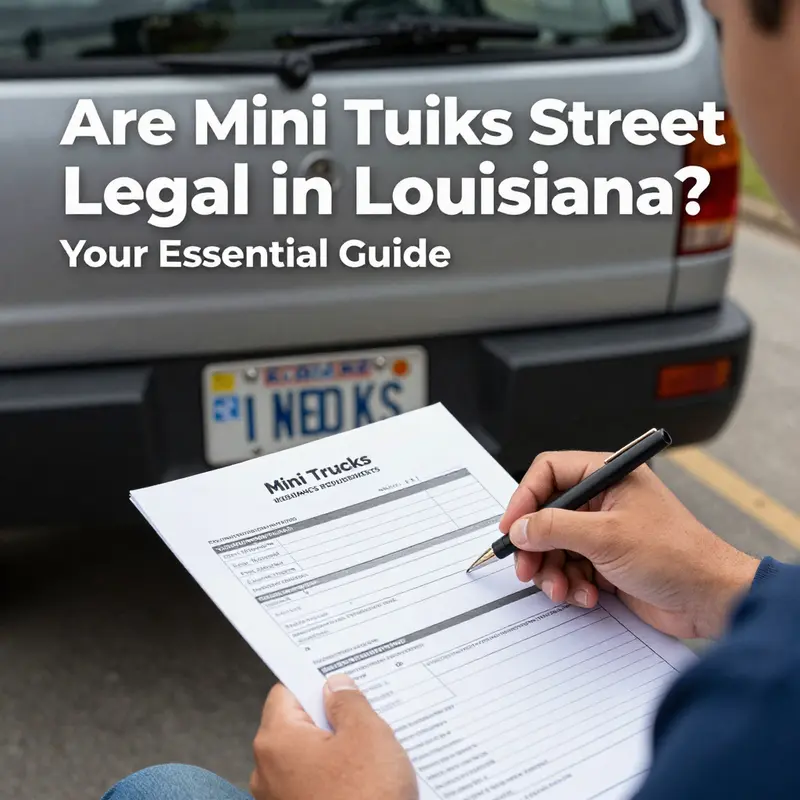
Before a mini truck can wear Louisiana plates, it must be tied to a legal owner. The title or bill of sale is the starting point. If the vehicle is new, the Manufacturer’s Statement of Origin or an equivalent document serves as proof of ownership. For a used vehicle, a clear title or a properly completed bill of sale is necessary. The state relies on that documentation to establish who can register and insure the vehicle. You will also need valid proof of identity when you apply for registration.
The Department of Motor Vehicles processes registrations. When you visit, expect to present ownership proof, identification, and insurance information. Registration fees vary. Factors such as the truck’s weight, model year, and whether it will be used commercially influence cost. Some mini trucks fall into unusual weight or utility categories. That can change the fee structure and the registration classification. The DMV clerks can clarify which class applies and what fees you must pay.
A vehicle title is not merely paperwork. It is the legal instrument that links a particular truck to a person or business. If you buy a mini truck from a private seller, make sure the title is properly signed and includes the odometer disclosure when required. If the truck was previously titled in another state, you will need to apply for a Louisiana title. The DMV may require inspection or verification of the vehicle identification number. Keep copies of all bills of sale, lien release documents, and any odometer statements. These documents simplify the registration visit and help avoid delays.
Plates and tags follow registration. Once registered, the vehicle receives license plates that must be displayed as required. Temporary tags may be available if you need short-term legal operation while processing permanent registration. If you change ownership, move to a new address, or alter the vehicle’s use category, update the registration promptly. Driving with expired or incorrect plates is a common cause of citations.
Tying the vehicle legally to an owner is only part of the story. Louisiana requires that all vehicles carry minimum liability insurance. For a mini truck to be legally driven on public roads, you must maintain at least the state’s liability limits: $15,000 per person for bodily injury, $30,000 per accident for bodily injury, and $25,000 for property damage. These baseline limits are mandatory. Insurers typically offer policies that meet or exceed them by default, but you must verify coverage before driving.
Liability insurance covers the financial consequences of bodily injury and property damage to others when you are at fault. It does not pay for damage to your own vehicle unless you add collision or comprehensive coverage. Many owners consider carrying higher liability limits. Mini trucks can cause the same damage as larger vehicles, and medical bills or repair costs can quickly exceed minimum policy limits. Choosing higher limits reduces the risk of personal liability after an accident.
Aside from liability, the insurance marketplace offers additional forms of protection. Collision coverage pays to repair or replace your truck after a crash. Comprehensive coverage handles non-collision events, such as theft or weather damage. Uninsured or underinsured motorist coverage protects you when the at-fault driver lacks adequate insurance. If your mini truck is used for business, a commercial policy may be necessary. Commercial policies often include higher liability limits and broader coverages tailored to business exposures.
When shopping for insurance, be candid about the vehicle and its use. Modifications, engine swaps, or nonstandard accessories can affect premiums and coverage eligibility. Insurers expect accurate disclosures. Omitting material facts risks claim denial. Ask insurers if your mini truck qualifies for standard private passenger coverage. Some insurers treat mini trucks differently from typical cars. If an insurer treats the truck as a commercial vehicle, the premium and policy terms will reflect that classification.
Insurance is not optional. Driving without the required minimums can produce severe consequences. Penalties include fines, license suspensions, and vehicle impoundment. Reinstatement often requires paying fees and providing proof of insurance. Repeated or prolonged lapses in coverage usually trigger harsher penalties. Keep your insurance documents current and readily available. Many drivers carry digital proof, but ensure your insurer’s electronic documents meet state acceptance rules.
Beyond title, registration, and insurance, the truck itself must meet applicable safety and emissions standards. Louisiana aligns with federal safety regulations. Mini trucks intended for on-road use must be equipped with basic safety items. Expect headlights, brake lights, turn signals, mirrors, seat belts, and a functional horn to be required. Some trucks, especially those imported or originally sold as off-highway vehicles, may lack this equipment. Bringing such a vehicle into compliance may require retrofitting.
Emissions rules vary by locality. Some parishes and municipalities maintain emissions testing programs for certain classes of vehicles. If your mini truck is registered in a parish that enforces emissions checks, the vehicle must meet local requirements. Consult local authorities or the DMV to determine whether your registration is affected. Compliance may mean a current emissions test or certification that the vehicle meets federal emissions standards.
If your mini truck began life as an off-highway vehicle, the path to street legality can be longer. OHVs typically lack required lighting, safety glass, or emissions controls. To convert an OHV for street use, you will need to add or upgrade equipment to meet on-road standards. The DMV may require an inspection or certification that the conversion was completed correctly. Keep receipts and documentation for any modifications or installations, because the DMV will want proof that the vehicle now meets legal standards.
Commercial use introduces additional layers. A mini truck used for deliveries or heavy-duty work might require commercial registration and insurance. Commercial registration often carries different fees and may impose additional safety or equipment standards. Commercial insurance must reflect the frequency, type of use, and cargo being transported. Discuss your intended use with both the DMV and insurance agents to avoid surprises.
Temporary situations deserve attention too. If you plan to drive a mini truck across state lines, note that other states apply their own rules. A vehicle legal in Louisiana may not be legal elsewhere. When moving into Louisiana with an out-of-state mini truck, start the titling and registration process quickly. Many states allow a window—often measured in days—before you must re-title your vehicle. Check with the DMV to understand the specific timeline and required documents.
Record-keeping is practical and legal. Carry the vehicle’s registration, proof of insurance, and current title or bill of sale when you drive. If you perform modifications to meet road standards, keep invoices and certificates. These documents speed DMV interactions and help resolve disputes. If a citation arises, having paperwork handy can sometimes prevent escalation.
Finally, think of registration and insurance as ongoing obligations. Renew registration before it expires. Maintain continuous insurance coverage at or above minimums. Notify the DMV and your insurer when ownership changes, or when you alter the vehicle’s primary use. Doing so keeps the mini truck legally operable and protects you from unnecessary penalties.
For the latest, authoritative guidance during your registration or insurance steps, consult both the state DMV and specialized community resources. A practical place to start for owner-focused information and real-world insights is the Mini Trucks SoCal blog. It collects ownership tips and conversion stories that can help when you plan registration and equipment upgrades: Mini Trucks SoCal blog.
For official, up-to-date requirements and forms related to titling, registration, and insurance, review the Louisiana Department of Motor Vehicles website: https://www.dmv.la.gov
Road or Ranch: How Louisiana Treats Mini Trucks for Street and Off-Highway Use
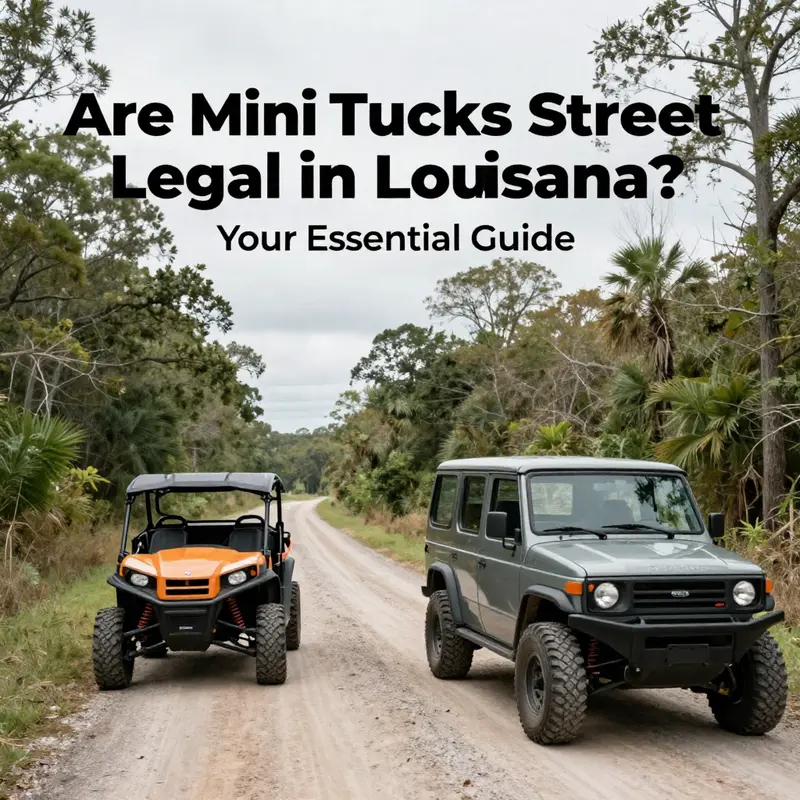
Understanding On-Road Versus Off-Highway Status for Mini Trucks in Louisiana
Mini trucks occupy a unique space between utility vehicle and passenger car. In Louisiana, that distinction matters. The state’s rules draw a clear line between vehicles approved for public roads and those restricted to private land or designated off-road areas. Whether you plan to run a mini truck across town or keep it on a farm, the vehicle’s classification determines what you must do to stay legal and safe.
The first, most important point is simple: not every mini truck is street legal in Louisiana by default. Some models meet the standards for on-road operation. Others are built for off-highway use only. The difference depends on construction, equipment, and official classification. Understanding how the law treats your vehicle prevents violations and reduces liability after an accident.
On-road eligibility begins with registration. A mini truck must be registered with the Louisiana motor vehicle system to operate legally on public streets. Registration requires a valid title and proof of ownership. You will also need to obtain license plates and carry insurance that meets state minimums. These steps mirror the obligations for larger vehicles. They also subject the mini truck to the same expectations for operator responsibility and financial accountability.
Beyond paperwork, the vehicle itself must meet safety standards imposed by state and federal rules. Louisiana follows Federal Motor Vehicle Safety Standards in many respects. That means certain equipment is non-negotiable for on-road use. Required items commonly include headlights, taillights, turn signals, effective brakes, mirrors, and seat belts. In practice, many imported or purpose-built mini trucks arrive without full lighting packages or standardized seat belts, and those omissions must be corrected before registration.
Another common compliance need is braking capacity. Roads demand reliable, certified brakes that can stop the vehicle within regulated distances. If a mini truck’s braking system falls short, the state can require upgrades. Similarly, lighting must meet brightness and placement requirements for visibility at night and during adverse weather. Adding certified components can transform an off-road unit into one that satisfies on-road standards.
Engine displacement and weight can also influence classification. If a mini truck lacks the mass or engine size to fall within passenger vehicle categories, the DMV may deem it inappropriate for certain roads. That classification matters for titling, registration fees, and permissible uses. Misclassification is not merely a bureaucratic detail: operating a vehicle on public roads when it is legally designated as off-highway invites fines, impoundment, and civil exposure if an incident occurs.
Insurance is another practical difference between on-road and off-highway status. Public road operation requires insurer coverage that recognizes road use. Policies for off-highway vehicles often exclude on-road claims. If you drive an OHV on a public road without correct coverage, you risk uninsured liability and denied claims after an accident. Confirm your insurer understands how you intend to use the vehicle before you sign anything.
Off-highway use, by contrast, is less restrictive in paperwork but still bound by rules. A vehicle restricted to private property, farms, construction sites, or designated off-road parks does not need registration for street use. However, that freedom is not absolute. Safety and environmental guidelines apply. Operators should follow common-sense practices for occupant protection and vehicle maintenance. Local parish ordinances may control where and when off-road vehicles can operate. In addition, noisy or polluting units can draw regulatory scrutiny, especially in sensitive areas like wetlands.
Environmental oversight can be significant. The Louisiana Department of Environmental Quality monitors emissions and noise in certain contexts. A mini truck used in or near protected habitats may trigger restrictions. For example, wetlands and wildlife zones often have specific rules to protect ecosystems. If you plan to use an off-highway mini truck near protected lands, check with local and state environmental authorities. Small engines can have outsized impacts when used intensively.
Converting an off-highway mini truck to street legal status is feasible in many cases. Owners commonly add certified lights, mirrors, seat belts, and upgrade braking systems. A title must be issued or amended, and the vehicle must pass any required inspections. Some conversions also require emission controls. The conversion process varies by vehicle and by the local DMV office. It usually entails documentation proving the installed equipment meets regulatory standards.
Before starting any conversion, confirm the vehicle’s current classification with the DMV. A helpful step is to obtain a written or documented determination. That prevents unnecessary expense on vehicles that cannot meet road standards due to fundamental design constraints. When the vehicle can be modified, keep receipts and certification for all parts and services. Those documents smooth the registration process and help if your vehicle’s status is later questioned.
Costs for conversion and compliance vary. Simple lighting and mirror additions are relatively inexpensive. Brake upgrades or emission system retrofits cost more. If the vehicle requires structural changes, such as modifications to seating or frame reinforcement, costs can increase substantially. Factor in inspection fees, registration charges, and any local taxes. Weigh these expenses against the practical benefits of public-road access. For many owners, keeping a mini truck as a purely off-highway vehicle remains the most cost-effective choice.
Enforcement and penalties matter. Police and local code enforcement officers can issue fines for improper operation of off-highway vehicles on public streets. Persistent violations may lead to vehicle impoundment. In accident scenarios, operating an off-highway vehicle on a public road can complicate liability and insurance claims. Even if you have partial coverage, insurers may deny claims for events that happen outside the policy’s permitted uses.
Beyond legal compliance, practical considerations influence how you use a mini truck. Mini trucks are not always suitable for high-speed travel. Many models have top speeds well below typical highway limits. Use them for short trips, local errands, farm work, and light hauling. Avoid highways and interstate travel where speed differentials pose safety risks. If you must cross busier roads, choose low-traffic times and plan short, safe routes.
Driver readiness and visibility are critical. Mini trucks sit lower and smaller than full-size trucks, making them less visible to other motorists. Use reflective markings, proper lighting, and defensive driving practices. Seat belts should always be worn, and passengers kept in appropriate seating. Remember that a registered mini truck on public roads must meet the same occupant safety expectations as larger vehicles.
Local context matters deeply in Louisiana. Parish ordinances can limit where off-highway vehicles operate within municipal boundaries. Rural parishes may be permissive, while urban areas restrict usage near residential zones. Before operating a mini truck on local roads, confirm parish rules. Municipal code offices and local law enforcement provide clarity on permitted routes and times.
If you are buying a mini truck with the intent to drive it on public roads, ask the seller for documentation. Request any invoices for compliance work, titles showing past registration, and records of any modifications. If the vehicle was previously registered as a road vehicle in another state, the path to Louisiana registration may be easier. Imported or recently manufactured off-road units will require more proof and potential upgrades.
Finally, when in doubt, seek official guidance. The Louisiana Department of Motor Vehicles offers resources for vehicle classification and registration. Getting a clear answer from state authorities avoids costly mistakes. For practical tips, community resources such as local specialty shops often help owners navigate mechanical upgrades and inspections. You can also find general community discussion and local expertise on the Mini Trucks SoCal blog for broader practical perspectives.
For authoritative details on vehicle classification, registration requirements, and the specific standards a mini truck must meet to be operated on Louisiana public roads, consult the Louisiana Department of Motor Vehicles official resource: https://www.dmv.louisiana.gov
Final thoughts
Understanding the legalities surrounding mini trucks in Louisiana is vital for anyone looking to own or operate these versatile vehicles. By adhering to state regulations regarding registration, safety standards, and usage rights, drivers can enjoy their mini trucks on public roads confidently. Whether you’re a business owner looking for a reliable work vehicle, a property owner needing extra utility, or a mini truck enthusiast, knowing the laws will help you make informed decisions. Now, get ready to hit the roads of Louisiana legally and safely!