
Mini trucks, particularly those known as Kei trucks, have gained popularity among small business owners and vehicle enthusiasts in North Carolina. However, the legal landscape surrounding their use on public roads can be quite complex. This article seeks to clarify the legal requirements for mini trucks, the necessary safety and emissions standards they must meet, and the distinctions between ownership and road use. Additionally, we’ll guide you on how to consult the North Carolina DMV for compliance, ensuring you can enjoy your mini truck while adhering to local laws.
Navigating the Road: Ensuring Mini Truck Compliance on North Carolina Streets
In North Carolina, the world of mini trucks, often known as Kei trucks, merges a distinctive blend of practicality and regulatory oversight that creates a fascinating narrative for vehicle enthusiasts. Owners and prospective drivers find themselves navigating a maze of legal requirements that transform what might initially appear as a niche interest into a broader discussion on vehicle safety and environmental stewardship. This chapter explores in depth the laws, regulations, and standards that these small yet dynamic vehicles must meet to be considered street legal, weaving together a story of innovation, compliance, and the responsibility of being part of the state’s road network.
One of the central aspects of achieving legal road status in North Carolina hinges on meeting stringent safety standards. The state, along with federal guidelines, imposes a comprehensive set of requirements to ensure that every vehicle that joins the public roads can protect both its occupants and other motorists. Even though mini trucks are smaller than many other vehicles, their construction must pass crashworthiness tests, install proper lighting systems, and incorporate seat belts and other mandated safety equipment. This is not merely a box-ticking exercise but rather a commitment to ensuring that advances in vehicle design do not come at the expense of basic safety. When a mini truck meets these standards, it becomes part of a narrative that values both distinctive design and the preservation of life and property.
Meeting the safety criteria is just the beginning on the journey towards legal compliance. Emissions regulations represent another critical pillar of North Carolina’s approach to vehicle standards. Mini trucks, though compact in design, still produce exhaust gases that must be controlled to avoid detrimental environmental impacts. Emissions testing is a mandatory process whereby the truck is evaluated under conditions that verify it does not exceed pollution thresholds. The rigorous standards tie in with the broader environmental policies of the state, underscoring a commitment to clean air and a sustainable future. Every owner who decides to operate a mini truck is thus making a pledge to abide by environmental standards that protect local communities and natural ecosystems.
Registration is another indispensable component of the legal framework. Before a mini truck can be seen on North Carolina roads, it must be registered with the Division of Motor Vehicles (DMV), a process that involves the submission of detailed documentation, proof of compliance with state regulations, and the payment of various fees. This process not only helps the state track all vehicles on its roads but also serves as an indicator that the vehicle is maintained in accordance with safety norms. The registration process reinforces accountability among owners and ensures that every vehicle adheres to guidelines that have been carefully crafted by transportation and safety authorities.
Insurance, though often seen as a routine administrative requirement, plays a significant role in the narrative of responsible vehicle ownership. Legal operation on public roads necessitates that the owner carries valid and adequate insurance coverage. This requirement acts both as protection for the driver and as a safety net for other road users in the event of mishaps or unforeseen incidents. The insurance mandate is a testament to the collective responsibility that underpins the interactions on North Carolina’s roads. It reminds owners that while the allure of driving a unique mini truck is strong, the legal framework insists that everyone shares in the burden of ensuring road safety.
Beyond the fundamental requirements of safety, emissions, registration, and insurance, additional nuances exist that make the story of mini truck legality particularly compelling. In some instances, certain Kei truck models may not fully meet the minimum specifications required by North Carolina for public road use. Whether due to differences in design, technology that may not align with modern safety expectations, or unique features that diverge from standard regulatory norms, some models might fall short of the established criteria. For these vehicles, the regulatory process becomes a detailed and technical exploration, where modifications or specific certifications might be necessary for legal operation. This aspect of the compliance process opens up a broader dialogue about how innovation and tradition coexist within the automotive world, particularly in a state known for its pragmatic regulatory approaches.
This particular narrative of conditional acceptance reflects a broader understanding within policy circles: that while mini trucks possess a certain charm and utility, they must be closely monitored to ensure they pose no undue risk. For many owners, the pursuit of legal compliance is not a burdensome imposition but rather a journey toward integrating a cherished vehicle with a modern legal and environmental schema. In this respect, the procedures set forth by North Carolina serve as both gatekeepers and facilitators, ensuring that every mini truck on the road is a symbol of careful stewardship and responsible ownership.
The process of verification is not an abstract concept. Prospective and current mini truck owners are encouraged to verify that their specific model satisfies all legal requirements before taking their vehicle out onto public roads. This verification usually involves a careful review of the vehicle’s construction, safety equipment, emissions control systems, and other crucial features. Many owners have found it helpful to consult resources such as the mini truck community blog available online, where an array of topics relevant to compliance, customization, and performance are discussed in detail. One can always visit the mini truck blog for insights, where enthusiasts and experts dissect these regulatory challenges and share practical advice on navigating them effectively. Such community-driven resources are instrumental in disseminating the nuances of compliance in clear, everyday language that demystifies the regulatory process.
In many ways, owning a mini truck in North Carolina is as much about the regulatory journey as it is about the vehicle itself. Regulations evolve over time, often spurred by advances in technology, shifts in environmental policy, and changes in public safety perspectives. With every new standard, owners are reminded that the safety of all road users and the protection of the state’s environment remain paramount. This dynamic regulatory landscape ensures that the mini truck community remains engaged not only in the maintenance of their vehicles but also in understanding the broader implications of regulatory compliance. Such ongoing dialogues between the vehicle owners, regulatory authorities, and the community at large create an environment of continuous learning and improvement.
Consider also the role that inspections and periodic testing play in the overall maintenance of road safety. Beyond the initial registration process, periodic inspections help ensure that compliance is not a one-time achievement but a sustained practice. Inspections may cover a wide array of vehicle aspects, from lighting and brake performance to tire integrity and emissions control. Every test passed is a reaffirmation that the vehicle is safe, environmentally friendly, and legally authorized to be on the road. Consequently, these inspections act as both a remedial and preventive measure, inspiring owners to keep their mini trucks in optimal condition while staying aligned with evolving regulatory standards.
For many, the initial excitement of owning a mini truck is tempered by the realization that careful adherence to legal requirements is essential to enjoy this unique vehicle responsibly. The integration of specific safety features—such as the installation of seat belts that meet rigorous standards, the requirement for properly functioning headlights and taillights, and even the need for robust braking systems—forms the cornerstone of an effective safety strategy. This careful attention to detail affirms that while mini trucks might represent a departure from conventional automobiles, they are nevertheless embedded in a regulatory tradition that cherishes safety and accountability.
Emissions testing, a cornerstone of ensuring that vehicles align with today’s environmental directives, stands out in this regulatory framework. Mini trucks, though built to be compact and efficient, are not exempt from the environmental requirements that govern larger automobiles. As cities across North Carolina combat issues related to air quality and emissions, every vehicle on the road, regardless of size, is expected to contribute to a broader strategy that diminishes harmful pollutants. In this context, the emissions testing process is meticulously designed to ensure that mini trucks do not become unintended culprits in environmental degradation. Through rigorous testing protocols, state authorities reinforce the idea that economic utility and environmental stewardship are not mutually exclusive but are, in fact, mutually reinforcing principles in modern vehicle regulation.
The narrative of regulatory compliance for mini trucks also intersects with broader discussions concerning technological innovation and the future of transportation. As automotive design evolves, many of the features that have traditionally characterized mini trucks are subject to revision and improvement. Advancements in safety technology—such as improved sensors, automated braking systems, and enhanced crashworthiness—are increasingly integrated into vehicle designs. These innovations, while promising enhanced safety and performance, simultaneously impose new challenges for regulatory bodies tasked with ensuring that every aspect of a vehicle meets established legal standards. The dialogue between technology and regulation is a dynamic one, replete with forward-thinking ideas and a shared commitment to making roads safer for everyone.
In North Carolina, the balance struck between regulatory scrutiny and the encouragement of innovation creates a unique environment for mini truck enthusiasts. It encourages a culture where owners are not simply passive recipients of regulations but active participants in a collective journey towards safer and more environmentally sound transportation practices. This dialogue often finds its echo in community forums, where enthusiasts debate the merits and challenges of various models, share experiences of passing safety inspections, and explore modifications that might help their vehicles meet evolving standards.
From a legal standpoint, the responsibility falls on both the state and the individual. While North Carolina’s regulatory framework is designed to safeguard public well-being, the role of the vehicle owner is crucial. Maintaining the operational integrity of a mini truck involves regular upkeep, immediate remedies to any detected issues, and a proactive approach to adhering to updates in legal standards. In this light, compliance transcends the narrow confines of legal obligation. It transforms into an ongoing commitment to a set of values that prioritize safety, environmental responsibility, and community trust. By embracing these values and exercising due diligence, vehicle owners contribute to a safer, more efficient road environment where every participant has a role in ensuring mutual well-being.
Moreover, many vehicle enthusiasts highlight that the process of ensuring compliance is deeply intertwined with a respect for the heritage of the mini truck itself. These vehicles often carry a storied past marked by ingenuity and adaptability, characteristics that have allowed them to remain relevant even as automotive norms have shifted dramatically. In North Carolina, where the blending of modernity and tradition is emblematic of the state’s culture, mini trucks serve as a reminder that progress and preservation can coexist. The evolving legal criteria are not seen as obstacles but as stepping stones towards a future where these quintessential vehicles continually reinvent themselves while staying true to their core identity.
While the regulatory processes might seem daunting, they offer significant rewards. For those who have successfully navigated the requirements, there is a sense of accomplishment that extends beyond the simple ability to drive legally. It is an acknowledgment that every safety test passed, every emissions check completed, and every paperwork detail secured contributes to a larger picture of responsible citizenship and care for one’s community. This perspective transforms the act of legal compliance into an endeavor that benefits not only the individual owner but also society at large.
Home to many passionate communities, North Carolina has seen a rise in groups dedicated to sharing knowledge about the safe and legal operation of mini trucks. These groups often organize events, workshops, and online discussions where members can learn about new regulations, share tips for meeting inspection standards, and even exchange experiences on how best to modify their vehicles if needed. It is not uncommon for an owner to spend hours discussing the nuances of emissions technology or the specifics of local safety requirements with fellow enthusiasts. Such interactions enrich the overall experience of owning a mini truck, ensuring that it remains a well-informed and community-supported activity.
This landscape of shared knowledge and mutual support is further enriched by the availability of online resources and official documents provided by state agencies. For instance, the official North Carolina DMV website offers a treasure trove of information that can help owners understand the precise requirements and navigate the registration process with ease. By encouraging owners to consult these resources, state authorities aim to reduce ambiguities and streamline compliance efforts. Armed with updated guidelines and expert advice, owners can approach the challenges of legal compliance with confidence and a sense of empowerment.
It is helpful to note that while the process may seem exhaustive, it ultimately seeks to serve a higher purpose. Every step, whether it is installing a high-quality lighting system or ensuring that a mini truck passes its emissions test, is designed to safeguard not only the owner but also every other driver on the road. The vision is one of broad-based safety — a vision where even the smallest vehicle is held to a high standard of care and accountability. This commitment to uniform standards reinforces the idea that every vehicle, regardless of size or origin, contributes to an integrated and secure transportation network.
In practice, the journey towards full legal compliance involves a series of checks and balances. Owners must keep abreast of any changes in local or state laws that might affect their vehicle’s status. They must remain engaged with the community, often tapping into both official updates and informal advice from experienced peers. This proactive stance enables them to adopt necessary modifications or schedule periodic maintenance sessions in line with the latest requirements. Such vigilance proves especially beneficial in a regulatory environment where changes occur in response to shifting technological landscapes and public safety discoveries.
A notable aspect of this narrative is how the legal process intersects with the culture of customization that many mini truck enthusiasts cherish. The very elements that might be seen as deviations from a standard automobile—including unique body modifications or specialized enhancements—require careful review to ensure they do not compromise safety or emissions standards. The interplay between creative freedom and adherence to official guidelines invites owners to think critically about how best to blend personalization with compliance. In doing so, they not only preserve the unique character of their vehicles but also honor the broader commitments laid out by regulatory authorities.
This dynamic is particularly evident in the way many owners approach the task of retrofitting their vehicles. Upgrading a mini truck to ensure it meets safety standards can involve installing new braking systems, changing tires, or even integrating modern lighting configurations. Each modification, though undertaken with personal style in mind, must pass inspection to verify that it does not undermine the essential protective measures mandated by law. It is a process that calls for creativity tempered by responsibility, a balance that speaks to the heart of what it means to be a conscientious driver in today’s regulatory climate.
Underlying all of these technical and regulatory details is a deep-seated respect for the laws that govern North Carolina’s roads. The legal standards are part of a broader social contract — one that prioritizes road safety, environmental protection, and community welfare. For many mini truck enthusiasts, these regulations are not seen as limitations but as invitations to participate in a collective endeavor aimed at enhancing overall quality of life. They are the practical embodiment of a shared commitment to progress and safety, reminding every owner that the privilege of driving comes with inherent responsibilities.
In summary, the story of mini truck compliance in North Carolina is one marked by multifaceted challenges and profound rewards. From meeting the fundamental safety standards and adhering to emissions protocols to navigating the registration and insurance processes, each step demands attention, diligence, and a willingness to adapt. The narrative unfolds as an ongoing dialogue between tradition and modernity, between individual passions and collective regulations, ultimately forging a path that honors both innovation and safety.
For those embarking on this journey, it is crucial to remain well-informed and proactive. Regular consultations with knowledgeable sources, community interactions, and continuous updates are indispensable tools in ensuring that the mini truck remains a vehicle of pride and safety, not an outdated relic struggling to meet contemporary standards. Further details and the most current updates on compliance processes can be verified by visiting the official North Carolina DMV website, a resource that encapsulates the regulatory essence of this comprehensive process.
As the regulations continue to evolve, so too does the community’s approach to sustaining the charm and utility of mini trucks. Their story is one of resilience, innovation, and a shared commitment to responsibility. It is a narrative that acknowledges the law not as a limitation, but as a framework that enhances the intrinsic value of every vehicle on the road. Therefore, the journey towards achieving and maintaining legality is not just about meeting a list of requirements—it is a celebration of the harmony between individuality and public duty.
By embracing this path, mini truck owners in North Carolina contribute to the vibrant tapestry of the state’s road culture. Their vehicles serve not merely as modes of transportation but as icons of careful craftsmanship and community-focused responsibility. Every inspection passed and every compliance measure met are milestones in a continuous process of ensuring that these unique vehicles meet the highest standards of safety, environmental responsibility, and legal integrity. For enthusiasts and regulators alike, this journey reinforces the belief that the roads we share are sanctuaries of mutual respect and diligent upkeep.
In closing, the regulations that govern mini trucks in North Carolina are emblematic of a broader commitment to safer, cleaner, and more accountable transportation. For those who revel in the distinctive appeal of Kei trucks, the process of achieving full legal compliance is far more than an administrative hurdle. It is a testament to the values of innovation, environmental awareness, and a respect for the law that binds the community together. As mini truck owners uphold these standards, they not only secure the future of their distinctive vehicles but also help create roads that are safer and more welcoming for everyone. This delicate balance between individual passion and regulatory diligence holds the promise of continued progress—a promise that each mini truck, no matter how small, contributes to the ongoing story of North Carolina’s commitment to excellence on its streets.
Navigating North Carolina’s Rigid Safety and Emissions Compliance for Mini Trucks
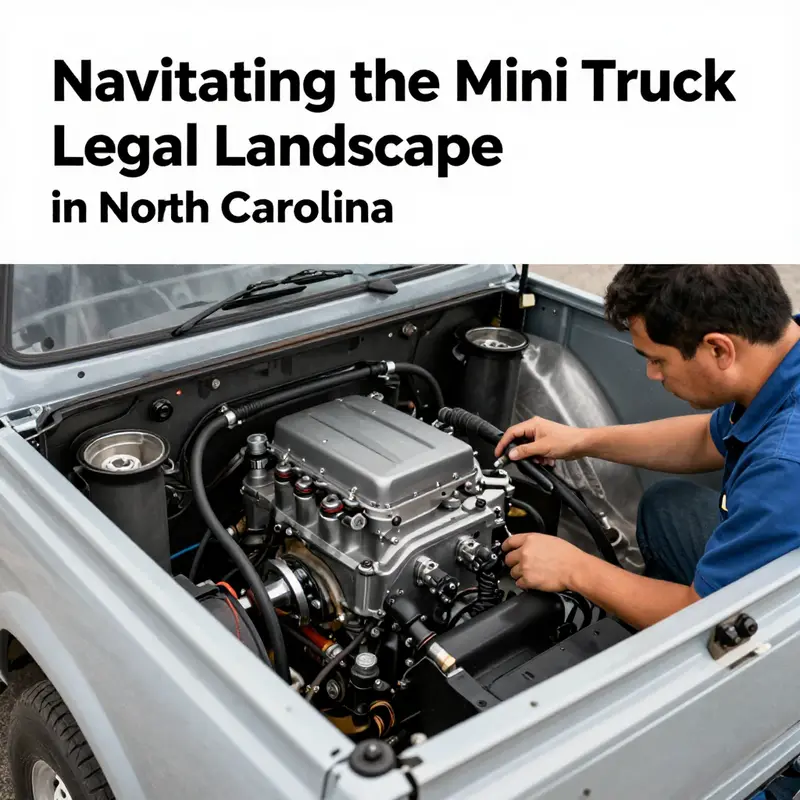
Mini trucks in North Carolina are intriguing vehicles that require diligent attention to safety and environmental details. Owners of these compact trucks, often known as Kei trucks, must abide by state standards if they wish to use them on public roads. The regulations in North Carolina are strict, but they offer clear guidance to ensure that these vehicles operate safely and responsibly.
When a mini truck is to be used on the road, it must meet robust safety requirements. Each vehicle is inspected to verify that all essential safety features are operational. Functional lights, reliable brakes, and secure seat belts are only a few of the requirements. An owner must check that each light is working, that the brakes respond correctly, and that seat belts are in place and meet prescribed durability tests. These measures protect the driver, passengers, and all other road users. Every detail matters in preserving safety standards.
The focus on safety extends to vehicle construction as well. Mini trucks must be designed and modified in a way that protects occupants during unforeseen events. This focus on upfront safety helps to reduce the risks associated with accidents. Owners need to review the manufacturer’s specifications closely. Many keen truck enthusiasts explore options to upgrade safety features further. However, any modifications must remain within the boundaries defined by the North Carolina Division of Motor Vehicles (DMV).
Emissions must also fall under both state and federal scrutiny. North Carolina enforces a set of emissions standards that align with the Environmental Protection Agency (EPA) guidelines. These mandatory emissions criteria ensure that the trucks do not contribute negatively to the environment. Vehicle owners must verify that the engines and exhaust systems meet established emissions thresholds. If a mini truck does not pass the emissions test, it can be barred from highway use until it is modified. This dual scrutiny of safety and environmental impact sets a high bar for vehicle compliance.
The emissions guidelines are designed to minimize air pollution and promote public health. Exhaust systems of these mini trucks must be maintained diligently. Regular inspections are required to monitor the consistency of engine performance. Running an engine that emits too many pollutants can harm the environment and result in legal consequences. Mini truck owners should plan for routine emissions testing and necessary repairs. Compliance is essential to keep the vehicle roadworthy and legal under state law.
For many mini truck owners, adherence to safety and emissions standards is not merely regulatory; it is a point of pride. These vehicles trace their origins to innovative designs found overseas, and North Carolina’s requirements ensure they remain both fun and reliable. Owners invest significant effort in aligning custom trucks with local standards. They appreciate that the state’s strict enforcement ensures that every vehicle performs consistently in terms of safety and environmental responsibility. By doing so, they help maintain the overall integrity of transportation regulations.
The effective enforcement of these standards requires the full cooperation of multiple state agencies. The North Carolina Division of Motor Vehicles oversees much of the process. This agency provides detailed guidelines for registration, inspection, and correction of any non-compliant features. The DMV stands as the enforcer of laws that bridge safety and environmental protection. For anyone considering a mini truck for daily use or recreational purposes, familiarizing themselves with these processes is essential. It is advisable to review materials on the official North Carolina DMV website to avoid any complications. In fact, additional information can be found through the official resource at the North Carolina DMV, which details the specifics for vehicle registration and compliance, including modifications and inspections.
An important consideration for mini truck owners is the certification process for any modifications. Customizations may add personal style but must be executed within legal boundaries. Any deviations from the original design that affect safety or emissions can result in the vehicle being declared non-compliant. This certification process ensures that every altered component adheres to state standards. Owners must document these modifications, including updates such as new lighting systems, upgraded brakes, or altered exhaust assemblies. Legal compliance is not only about meeting standards at certification but also about maintaining those standards throughout the vehicle’s operational life.
Moreover, the government performs periodic checks to ensure continued compliance. Periodic inspections reduce the risk that a vehicle that once complied with standards will deviate over time due to wear or modifications. These inspections help identify issues before they lead to accidents or environmental hazards. It benefits owners to schedule regular maintenance and inspection drives. This proactive approach mitigates risks and ensures that any emerging issues are addressed early. Maintaining the certification protects both the owner and the general public from unforeseen problems.
Beyond the technical requirements, the regulatory framework also emphasizes education and support for mini truck enthusiasts. North Carolina provides various resources to help owners understand the intricate details that come with modifying and maintaining a mini truck. Many local clubs and online forums share best practices and first-hand experiences regarding safety upgrades and emissions modifications. These communities are invaluable for learning about the nuances of local laws. An enthusiast might visit a trusted resource such as a comprehensive article on mini truck maintenance found at mini trucks blog. Information exchanges in these communities often include insights on balancing personalization with compliance, enabling owners to make informed choices. The synergy of community expertise and official guidelines fosters an environment where innovation and safety coexist harmoniously.
Mechanically, mini trucks demand regular upkeep in order to remain compliant. The safety systems must be checked after any long journey or after significant weather exposure. Road hazards, like debris or sudden temperature shifts, can impact the condition of brakes and lights. Even the seat belts require routine checks to ensure they are not worn or frayed. With a schedule of regular maintenance, owners detect problems before they escalate. Applying preventive measures is key to achieving and maintaining regulatory approval. These systematic checks not only enhance the vehicle’s lifespan but also ensure that it provides reliable protection during operation.
Every detail in a mini truck contributes to its functionality on public highways. This includes the tires, which must have the correct tread and pressure as prescribed by state law. Tire wear can greatly affect a vehicle’s braking and handling capabilities. It is crucial that owners monitor tire health and replace them as soon as they show signs of deterioration. Ensuring every component from lighting to tires is in compliance reflects the overall integrity of the vehicle. A thorough approach to vehicle maintenance helps prevent accidents and secures the vehicle’s street legal status.
In addition to meeting specific physical requirements, mini trucks must also comply with registration mandates. The registration process verifies that the vehicle meets all safety and emissions standards. During registration, documentation of inspections and modifications is reviewed. This process reassures state regulators that each vehicle adheres to all legal requirements. Any deviations or omissions in documentation can result in delays or denials of registration. Therefore, owners must be meticulous in maintaining accurate records. The success of this process depends on accurate documentation and proactive engagement with local DMV offices.
Given the rigor of these standards, the decision to own and operate a mini truck in North Carolina involves thoughtful planning. A prospective owner must consider not only the inherent charm of these vehicles but also the obligations that come with ensuring their compliance. Every detail must be scrutinized to confirm that modifications align with safety and environmental guidelines. This careful process means that individuals invest time and resources in making sure that their mini truck represents both personal style and a commitment to public welfare. The dual focus on safety and environmental performance stands as a hallmark of responsible vehicle operation.
The interplay between safety features and emissions control also points to a holistic view of public transportation. These regulations are designed to work together to safeguard communities. Safety standards prevent accidents and minimize injury during crashes. In parallel, strict emissions protocols support cleaner air and a healthier environment. Together, they underpin North Carolina’s wider goals of promoting safe, sustainable travel. The systematic enforcement of these standards is rooted in the belief that every vehicle on the road has a responsibility beyond just its operator. The conscientious design of these rules promotes a balanced approach to transportation.
Innovations in vehicle technology further enhance the safe operation of mini trucks. Automated sensors and monitoring systems are increasingly becoming part of many vehicles, including mini trucks that have modern modifications. These improvements provide additional layers of safety assurance. However, the integration of technology is only beneficial if it complies with established state standards. Owners of advanced mini trucks must confirm that new systems do not interfere with mandated safety and emissions features. Compliance verification requires collaboration with certified mechanics who are knowledgeable about both traditional vehicle components and modern technology. This added layer of oversight ensures that even innovative modifications contribute positively to the overall safety and environmental profile.
Beyond the practicalities of technology and maintenance, the regulatory landscape inspires a commitment to continuous improvement. Owners are encouraged to keep abreast of updates to state laws. The pace of technological change often necessitates adjustments in regulations. For instance, new lighting technologies or improved braking systems might prompt the DMV to revise safety recommendations. In such cases, forward-thinking owners adapt quickly. This dynamic environment fosters a culture of learning and adaptation among mini truck enthusiasts. As standards evolve, community discussions often illuminate the best and most practical approaches to compliance.
Legal experts recommend that mini truck owners maintain close communication with local DMV offices. This proactive engagement helps preempt misunderstandings regarding vehicle modifications or usage. Communication with the DMV offers clarity on ambiguous scenarios and personalized advice on complex issues. It also provides timely updates on changes in regulations or enforcement practices. Knowing whom to contact and when to seek clarification is as important as routine vehicle maintenance. This partnership between the owner and regulatory bodies creates a framework where safety and innovation meet regulatory expectations. The guidance from state officials is a vital resource for every mini truck owner planning to navigate North Carolina’s roadways safely and legally.
Owners also benefit from understanding the fines and penalties associated with non-compliance. Violations of safety or emissions standards carry potential legal consequences that can range from fines to restrictions on road use. These measures are in place to protect everyone who shares the road. A single oversight in maintenance or registration can result in significant financial and legal burdens. It is imperative to approach vehicle modifications and annual inspections with utmost seriousness. Fines or delayed registration not only cause inconvenience but can also diminish the vehicle’s overall value. Thus, preemptive care and strict adherence to guidelines are seen as investments in long-term vehicle integrity.
The detailed regulatory framework that North Carolina enforces on mini trucks is also clear about exceptions and special cases. Certain older models or culturally significant vehicles might receive different treatment under the law. However, such exceptions are rare and usually require additional documentation and scrutiny. The DMV will often provide the necessary guidelines for securing a special permit, but the process is not guaranteed. For many, the standard compliance route remains the most straightforward and reliable pathway to achieving street legality. Individuals considering any special cases are advised to consult directly with legal or DMV professionals to understand the specificities involved.
Over the years, the state has refined its regulatory measures to suit modern traffic conditions. Today, the focus on detailed inspections and rigorous standards reflects broader goals of safety and environmental stewardship. The rules governing mini trucks are part of larger initiatives that promote cleaner air and safer roads. This comprehensive approach ensures that even vehicles that are unconventional in size or design do not compromise public well-being. The spirit of the regulations is to blend personal freedom with a commitment to collective responsibility.
As mini trucks continue to evolve with technological and design enhancements, the criteria for safety and emissions will also remain subject to review. The future may see changes in acceptable standards as innovations become widespread. However, the fundamental principles of safety and environmental respect will endure. The essential purpose of the guidelines is to ensure that every vehicle, regardless of its size, aligns with the overarching goals of road safety and environmental soundness. The evolution of these standards is guided by both scientific progress and accumulated practical experience.
Whether new to the world of mini trucks or a seasoned owner, staying compliant is an ongoing challenge that ultimately benefits everyone. The collaborative spirit between enthusiasts, mechanics, regulatory bodies, and the wider community sets the stage for continual improvements. Careful attention to every detail during modifications and routine maintenance underscores the responsibility that comes with owning a mini truck. This dual focus on safety and emissions reinforces a commitment to a better, safer, and cleaner road environment.
The regulatory pathway may seem daunting at first. However, many find that adherence to these standards enhances the overall driving experience. The additional effort invested in modifying a mini truck pays off by ensuring that the vehicle performs optimally and safely. The process creates a stronger bond between owner and machine, one that is built on trust, accountability, and shared goals for road safety. As vehicle enthusiasts invest in improvements, they simultaneously contribute to the wider public good by reducing environmental impact and increasing safety margins on the road.
Every aspect of these regulations is designed to create a balance between embracing innovative vehicle designs and faithfully safeguarding public interests. The safety features, emissions standards, and periodic inspections are not arbitrary but stem from a deep concern for community health and security. This integrated perspective has been refined over years of experience and legislative evolution. An owner who recognizes the importance of meeting these detailed requirements is one who respects the rules of the road and the well-being of all who travel on it.
In conclusion, operating a mini truck on North Carolina roads is both a privilege and a responsibility. Each vehicle must conform to strict safety protocols and environmental standards, ensuring it is suitable for public use. The DMV plays a pivotal role in this process, providing clarity and enforcement to bridge the gap between innovation and regulation. Whether you are performing routine maintenance or planning a custom modification, every step must be taken with care and precision. While the regulatory process can be intricate, the resulting assurance of safety and environmental quality is invaluable for all road users.
The journey toward compliance involves understanding the interplay of technological advances, community support, and ongoing maintenance. Whether you drive a brand-new mini truck or an older model with updates, the same rigorous standards apply. Maintaining these vehicles in accordance with the law helps preserve their charm while ensuring they contribute positively to safe and sustainable travel. This respect for regulations embodies the spirit of responsible mobility in North Carolina.
By investing in regular inspections, detailed documentation, and proactive communication with state authorities, mini truck owners solidify their commitment to safety and environmental stewardship. Embracing these responsibilities allows them to enjoy the unique appeal of mini trucks while ensuring that every ride is both legally compliant and secure. The framework that North Carolina provides stands as a model for balancing innovation with strict regulatory oversight. It is a testament to the state’s dedication to protecting its residents and maintaining high standards on its roads.
Ultimately, the balance of safety features and environmental considerations serves as a cornerstone for modern transportation regulation. Mini truck owners who recognize and uphold these standards help ensure that their vehicles are not only a source of personal enjoyment but also a responsible element in the public transportation network. In this way, every ride reaffirms a commitment to a shared future that emphasizes both advancement and accountability.
Straddling Boundaries: Navigating Ownership and Road Use Restrictions for Mini Trucks in North Carolina
In North Carolina, the allure of mini trucks, especially those modeled after Japanese Kei trucks, presents a narrative of passion intertwined with regulatory constraints. The appeal of these compact workhorses is undeniable to enthusiasts who appreciate their efficient design and off-road capabilities. However, the state’s framework distinguishes sharply between the right to own these vehicles and the privilege of operating them on public roads. This delicate balance is designed to safeguard both individual interests and public welfare while ensuring that vehicles meet established safety and environmental standards.
Enthusiasts and prospective buyers often find themselves at the crossroads of admiration and frustration. Ownership of mini trucks is, in itself, a celebrated pursuit, yet the opportunity to drive them on public highways is curtailed by the specific regulatory criteria enforced by the state. North Carolina law mandates that any vehicle used on public roads must comply with a strict set of standards including robust safety features, proper lighting, emissions controls, and other performance requirements. The compact design inherent to most Kei trucks—engineered primarily for efficiency in densely populated markets—often prevents them from meeting these mandates. Consequently, while a dedicated individual can legally own a Kei truck and enjoy its features on private property, the same vehicle falls short of being classified as street legal under the current legal framework.
At its core, the issue pivots on a critical distinction: ownership does not equate to road use eligibility. For many in the mini truck community, this dichotomy is both a legal and philosophical conundrum. On one hand, owning a mini truck provides a sense of freedom, allowing admirers to express their individuality through unique vehicle choices. On the other hand, the state’s regulatory apparatus demands compliance with safety and environmental measures that these vehicles were never originally designed to meet. North Carolina’s motor vehicle registration laws are explicit; any vehicle plying public roads must conform to a prescribed standard of construction and performance. This includes, but is not limited to, proper seat belts, functioning headlights, adequate brake systems, and emission controls. These specifications are carefully tailored to ensure that every vehicle on the highway does not compromise the safety of others or harm the environment.
The reality for most mini truck owners is that while they enjoy the privilege of ownership, they must restrict their driving to private property. In rural areas, where expansive farmlands and personal estates are common, the use of mini trucks in off-road contexts fits well with the local lifestyle. When a mini truck is driven strictly on personal land—be it a farm, a private driveway, or a ranch—the stringent laws that affect public road operation do not apply. This provision offers a legal haven for enthusiasts, allowing them to enjoy the unique blend of efficiency and ingenuity that mini trucks offer without falling foul of regulatory infractions. Yet, this exception does not extend to any public road, highway, or right-of-way. For those hoping to integrate their mini truck into everyday road travel, the contrast between ownership rights and road use restrictions is both stark and consequential.
From a regulatory perspective, the requirements imposed on vehicles operating in North Carolina have clear public safety implications. The state has set these standards not arbitrarily, but to ensure that every vehicle on the public road has passed an array of rigorous safety tests. For example, proper lighting ensures that vehicles are visible in low-light conditions, while adequate braking systems and tires are critical to prevent accidents. Emission regulations further stress environmental responsibility, a priority that has seen increased importance in modern vehicle legislation. The typical Kei truck, with its compact form factor and minimalist design, often does not include these essential features. Even if an enthusiastic owner has a deep appreciation for the vehicle, the fact remains that the engineering of these trucks was never oriented toward full public road safety. This inherent design limitation makes modifications extremely challenging and sometimes economically unfeasible.
The legal consequences for attempting to use a non-compliant mini truck on public roads can be severe. North Carolina law is unambiguous: vehicles that do not meet the prescribed statute will face penalties that range from fines to the impounding of the vehicle, and in some cases, additional legal action. Such outcomes serve as a strict deterrent for those who might otherwise be tempted to circumvent the rules. The transformation of a Kei truck into a roadworthy vehicle would not merely involve superficial modifications; it would necessitate a thorough overhaul of various components, fundamentally altering the vehicle’s design. This transformation brings with it additional costs, challenges with insurance, and the potential voiding of warranty protections. As a result, potential buyers are urged to conduct thorough research and consult with local authorities, ensuring that their expectations align with legal realities.
Stepping into the realm of personal choice and regulatory compliance, prospective mini truck owners must navigate a maze of requirements that touch upon every facet of vehicle operation. Beyond the immediate modifications necessary for road use, owners need to be cognizant of periodic inspections and certification by the North Carolina Division of Motor Vehicles (DMV). This process can be both time-consuming and costly. The DMV plays a pivotal role in the enforcement of these standards, serving as a gatekeeper who ensures that every vehicle adheres to the mandated specifications. It is not uncommon for a vehicle that may have performed admirably in one jurisdiction to fall short when scrutinized under North Carolina law. Accordingly, purchasing a mini truck, specifically one designed for markets like Japan, requires more than a simple transaction; it demands a deep dive into the intricacies of state-specific regulations and an acknowledgment of the vehicle’s limitations.
For those who own or consider owning a Kei truck, the decision to restrict the vehicle’s use to private property is often as pragmatic as it is necessary. Operating a mini truck on private land reduces the pressure to retrofit the vehicle to conform with public road standards. Instead, owners can focus on optimizing the vehicle for off-road performance, ensuring that it remains a fun and practical option for personal use without the burdens of full regulatory compliance. This delineation between private and public usage is essential to understand: while the thrill of owning a unique vehicle is an intrinsic part of the appeal, the broader implications for public safety and regulatory adherence cannot be overlooked. Many enthusiasts find solace in online communities, such as those sharing insights on various mini truck modifications and usage tips. For instance, a visit to a dedicated blog on mini truck enthusiasts, like the insightful discussion found on the mini truck community page, can offer guidance and camaraderie to those navigating similar challenges.
A nuanced understanding of the legal landscape helps shed light on why these regulations exist. The original design parameters of Kei trucks, optimized for the constrained environments of dense urban centers in Japan, are not easily adaptable to the expansive and diverse roads of North Carolina. The compact size, while an advantage in terms of maneuverability and parking, is also a liability when it comes to the rigorous crash-test and safety benchmarks required for public road use. Over time, the trade-off becomes evident: enthusiasts can delight in the vehicle’s unique qualities without stepping into the sphere of public road responsibilities, thereby preserving the spirit of innovation while upholding community safety.
The regulatory framework, therefore, should not be seen as a punitive measure aimed at curtailing personal choice, but rather as a well-considered approach to harmonize individual enthusiasm with collective welfare. Each regulation, from brake functionality to emissions control, is designed to mitigate risks that could potentially arise on mixed-traffic roads. These measures ensure that every vehicle interacting on public roads does so with the reliability and foresight that comes from rigorous scrutiny. In contrast, vehicles operating strictly on private property do not pose the same risks, allowing owners more leeway to experiment, personalize, and enjoy their trucks in a controlled environment.
For many, the decision to invest in a mini truck is fueled by a desire to break from the norm. It is an opportunity to challenge conventional standards and embrace an alternative mode of mobility. However, this choice comes with an inherent responsibility. The state of North Carolina makes it clear that while the purchase and ownership of a miniature kei truck are celebrated, the privilege of driving it on state roads remains a right that must be earned through compliance. This legal hurdle reinforces the idea that any vehicle sharing public road space must meet a common understanding of safety and reliability. In this light, the legislation reflects a broader societal commitment to ensure that the excitement of individual innovation does not come at the expense of communal safety.
The conversation surrounding mini trucks in North Carolina is also a reflection of the ongoing evolution of motor vehicle design and urban planning. As automotive technology continues to advance, the gap between the innovative features of compact vehicles and the regulatory standards of public road use may gradually narrow. While current regulations remain stringent, the potential for future modifications and improvements cannot be discounted. Technological advancements might eventually allow manufacturers to design mini trucks that, while retaining their compact charm, can seamlessly integrate into the rigorous safety and emissions benchmarks required by modern transportation laws. Until such a convergence occurs, however, mini truck owners and enthusiasts must navigate the present limitations with a clear understanding of the legal distinctions that separate ownership from road use.
The private ownership of mini trucks has also led to a vibrant culture among enthusiasts who celebrate the ingenuity behind these little vehicles while acknowledging the practical constraints of public road use. This culture is marked by gatherings on private estates, off-road rallies, and social media groups where experiences and modifications are shared. These gatherings serve as incubators for creative ideas—ways to harness the potential of the mini truck without contravening state regulations. Such community engagement not only reinforces the identity of mini truck owners but also helps spread awareness regarding the legal implications of attempting to use these vehicles beyond private property. These communities are invaluable resources for veterans in the field, and a casual perusal of dedicated mini truck blogs can provide both newcomers and seasoned enthusiasts with insights on everything from creative customizations to the nuances of local law.
It is important to reiterate that the legal status of these compact vehicles hinges on adherence to state-imposed standards, and any deviation risks severe repercussions. The enforcement of these rules is by no means lax. Law enforcement in North Carolina is particularly vigilant about ensuring that only vehicles that meet the required safety and construction benchmarks are allowed on public roads. This enforcement is not merely bureaucratic oversight; it is a critical component of a broader strategy to reduce accidents, protect pedestrians, and maintain environmental sustainability. The state’s thorough approach means that vehicle owners must exercise due diligence and perhaps even seek professional advice before considering any modifications aimed at making their mini trucks road legal.
In many instances, the pursuit of making a mini truck road legal can turn into an extensive process. The modifications may include installing additional lighting, upgrading braking systems, and retrofitting the vehicle with modern safety features—all of which can lead to considerable expenses and technical challenges. Furthermore, even after such modifications are made, there is no guarantee that the North Carolina DMV will approve the vehicle for public use. This inherent uncertainty acts as a deterrent for many prospective owners who might otherwise be captivated by the unique charm of KEI trucks. The balance between personal satisfaction and regulatory compliance is a tenuous one, underscoring the need for prospective buyers to fully appreciate the implications of their purchase.
In conclusion, the regulations surrounding mini trucks in North Carolina encapsulate a broader legal and cultural narrative. The state’s stance—allowing the ownership of mini trucks while strictly regulating their use on public roads—embodies a compromise between individual freedom and public safety. This framework allows enthusiasts to indulge their passion in a manner that respects the collective needs of the community while acknowledging the inherent limitations of these compact vehicles. For anyone interested in embracing the mini truck lifestyle, it is imperative to understand that the excitement of owning such a vehicle must be tempered by a rigorous adherence to state safety and registration laws. Knowledge is the key to responsibly navigating this unique landscape, and those keen on exploring further insights can refer to comprehensive resources available online such as the detailed guidance found at North Carolina DMV resources.
Ultimately, the conversation about mini trucks in North Carolina is not simply about vehicle specifications or legal frameworks; it is about reconciling modern engineering with traditional regulatory practices. The journey from ownership to road use reflects a broader dialogue about how best to integrate innovations that challenge conventional design while ensuring that public roads remain safe for everyone. For more precise legal interpretations and updates, interested parties should also consider consulting external resources like the in-depth analysis provided on World Law Digest. The evolving nature of automotive design and safety standards suggests that future regulatory changes may eventually provide a pathway toward greater flexibility, allowing mini trucks more freedom without compromising the essential principles of safety and environmental responsibility. Until then, prospective and current owners must remain informed and diligent, ensuring that their passion for these uniquely compact vehicles is matched by a commitment to the law and community safety.
Navigating DMV Compliance: Ensuring Your Mini Truck Meets North Carolina’s Stringent Standards
In the realm of mini trucks, where efficiency and compact design intersect with practicality and economic use, ensuring that a vehicle is compliant with local regulations is of paramount importance. In North Carolina, the complexities and nuances of vehicle compliance are no less intricate than the design of the mini truck itself. For enthusiasts, owners, and potential buyers, the North Carolina Division of Motor Vehicles (DMV) represents the central authority responsible for ensuring that every vehicle operating on public roads meets rigorous safety standards. This chapter delves into the nuances of consulting the DMV for mini truck compliance, examining every facet that owners of these uniquely small yet purpose-built machines must consider when adapting their vehicles for legal road use.
At the core of the compliance process is the understanding and interpretation of North Carolina’s vehicle regulations. The DMV provides comprehensive guidelines for all vehicles, including mini trucks—often known colloquially as Kei trucks when referring to their Japanese origins. These vehicles, though celebrated for their compact nature and utility, are subject to a rigorous set of guidelines governing attributes such as lighting, braking systems, tire specifications, and overall construction. Central to ensuring that these guidelines are met is the detailed information available on the official North Carolina DMV website.
Understanding the DMV’s protocols requires owners to invest time in reviewing state-specified requirements. The DMV outlines the criteria needed not only for new and standard vehicles but also for modified and imported vehicles, categories into which many mini trucks may fall. For owners of mini trucks, whose vehicles often differ in design from the typical American pickup trucks or sedans, ensuring that every detail aligns with state guidelines becomes both a legal necessity and a source of personal satisfaction. The process of compliance starts with the simple act of visiting the DMV’s resource portal, where official documentation, frequently updated guidelines, and the latest announcements are posted. For individuals seeking detailed insights about how mini trucks are classified, the portal acts as a direct line of communication with North Carolina’s regulatory framework.
The DMV website is not merely an online repository of regulations; it offers an interactive and user-friendly experience. By navigating this authoritative resource, owners can access information related to weight classifications that are central to how a mini truck is perceived under the law. Such classifications determine important aspects including licensing, restrictions on usage, and any modifications that may be legally permissible. With the emphasis on safety, the North Carolina DMV goes beyond rudimentary information by making clear distinctions in categories that reflect the inherent differences between service vehicles, commercial trucks, and personal use vehicles. For a mini truck owner, particularly one whose vehicle skirts the line between recreational utility and commercial application, these nuances are crucial. The state’s requirements for vehicle registration and periodic safety inspections are clearly delineated, and adherence to these standards is not only a matter of legal compliance but also integral to ensuring the safety of all road users.
Owners and prospective buyers are thus urged to consult the DMV regularly and thoroughly before making modifications or even purchasing a vehicle. Changes to state and federal guidelines can occur, and being updated with the latest requirements can mean the difference between a safe, fully compliant vehicle and one that might inadvertently pose risks to its driver and others on the road. In many cases, modifications may be recommended or mandated by the DMV to enhance road safety. For instance, while some mini trucks naturally satisfy basic criteria in areas such as brake performance and tire durability, variations in design and sourcing might mean that additional features, such as updated lighting systems and enhanced emissions controls, are essential. These more specific requirements underscore the role of the DMV as a watchdog and as a facilitator of safe road practices.
Beyond the basic information, the DMV’s guidelines also offer insight into the inspections necessary for mini trucks to be deemed roadworthy. Regular inspections are a cornerstone of maintaining the appropriate vehicle standards, ensuring not just compliance but the ongoing safety of the vehicle in active service. When mini truck owners approach their annual or periodic inspection appointments, they are essentially reaffirming their commitment to meeting every applicable regulation under the state’s purview. The inspection process looks into both mechanical and cosmetic areas, ensuring that every part of the vehicle functions as intended. This includes looking at emission controls which, in an age where environmental considerations assume increasing importance, are key to minimizing the ecological footprint of every vehicle on the road.
A significant and evolving aspect of these regulations pertains to environmental and emissions standards. As environmental consciousness has grown, so too has the need for vehicles to comply with rigorous emissions controls. In North Carolina, these standards directly impact the approval process for certain types of vehicles, including mini trucks that may lack the more robust emissions control systems found on larger, purpose-built trucks. The DMV ensures that even in vehicles that seem less imposing in size, their potential environmental impact is taken into account. This layer of regulatory compliance requires owners to be proactive in ensuring that any modifications made, or any pre-existing conditions of the vehicle, are in line with current environmental policies. A small oversight in this area can lead not only to legal issues but also to challenges in obtaining renewed registration and publication of the vehicle’s safe operating status.
Navigating these regulations often involves interpreting technical sheets and compliance forms that detail every aspect of the vehicle’s specifications. For the non-expert owner, this can be a daunting task, and many have found that consulting the DMV website, along with additional resources, offers a clearer path through the labyrinth of required standards. Moreover, the DMV does not operate in isolation. In circumstances where further clarification is needed, or where the standard documentation may not cover unique modifications or variations in vehicle design, speaking directly with DMV personnel or consulting qualified professionals becomes a necessary step. The ability to clarify doubts, whether they concern weight classification, the legality of certain modifications, or emission standards, provides both reassurance and a concrete path forward in ensuring that a mini truck is fully compliant with state regulations.
For many mini truck enthusiasts, the process of ensuring compliance is also an opportunity to learn more about vehicle safety and the technical aspects of automotive design. The DMV, by making detailed guidelines available, educates vehicle owners on why such regulations exist in the first place. Behind every regulation is a history of lessons learned through years of evolving road safety practices and technological advancements. By understanding the rationale behind the enforced standards, owners can be motivated to maintain their vehicles with care and to respect the vital role that regulations play in protecting public safety. This educational aspect often becomes secondary to the legal necessity, yet it forms an integral part of the overall experience of owning and operating a mini truck in North Carolina.
In this context, a well-informed owner isn’t just a person meeting legal requirements—it is someone who actively participates in the continuous improvement of road safety policies. By consulting the DMV’s guidelines regularly and relying on trusted resources, such owners better appreciate the technicalities and the efforts exerted by state agencies to maintain high standards. The DMV becomes a partner in the sense that it is a vast reservoir of knowledge, readily accessible to those who wish to be informed and compliant. It is within this partnership that the communication between state authorities and vehicle owners is established, creating a dynamic framework where safety and regulation go hand in hand.
Another layer of complexity in the compliance process involves the specific challenges tied to the mini truck’s design. Unlike larger trucks, mini trucks demand a more detailed analysis of their dimensions and build, which may include modifications approved for use in off-road environments. In many cases, what may be acceptable in an off-road setting may need to be re-evaluated once a vehicle is intended for regular road use. As a result, some mini truck owners may find themselves in a position where their vehicle must adapt to two conflicting standards: one for rugged utility in difficult terrains, and another for everyday safety and function on public roads. The DMV plays a critical role as the arbiter in these situations. Vehicles once deemed compliant under specific conditions might require further adjustments before meeting the more stringent criteria imposed on road use.
Given these unique challenges, it is not uncommon to see mini truck owners working closely with both regulatory bodies and experienced technicians. Together, these partnerships examine the minutiae of the vehicle’s operation—from the way power is modulated in the engine to the traction provided by specialized tires—and recommend modifications or improvements requisite for safe operation. It is in this iterative process that compliance and safety protocols merge, ensuring that every nuance of the vehicle is addressed. Owners are encouraged to remain in constant dialogue with technical experts and DMV representatives, as this collaboration ultimately leads to advancements in best practices for vehicle modification and inspection.
Many successful mini truck owners also share their experiences and advice on broader platforms. They often provide invaluable insights into the benefits and challenges associated with compliance. One such resource for those looking to learn more about the practicalities of owning and modifying a mini truck is a detailed guide available on a related website, which offers a wealth of information on the technical and regulatory facets of these vehicles. For more comprehensive information and community insights on mini truck modification, interested readers may want to explore a dedicated collection of articles available on this blog. By sharing their experiences and tips on navigating the maze of DMV requirements, these owners contribute to a collective understanding that benefits everyone in the community.
A significant part of mastering DMV compliance involves an ongoing commitment to regular updates and self-education. Regulations are not static, and as automotive technology evolves and environmental policies become more robust, the criteria for vehicle safety and environmental sustainability will continue to change. Such dynamism is a reminder that adherence to these standards is an ongoing responsibility rather than a one-time checkmark in the ownership process. The North Carolina DMV website is updated regularly with the latest rules and modifications, meaning that even long-time owners must remain vigilant and proactive in updating their knowledge and ensuring continued compliance.
Furthermore, consulting with the DMV in person or over the phone can provide additional clarity on complex situations. Direct engagement in the form of Q&A sessions, guided consultations, or official emails might illuminate aspects of regulation that are not immediately obvious within the printed or digital documentation. In many instances, the DMV offers opportunities to speak with experts who can provide personalized advice on how to meet all necessary standards. Such expert input might prove essential, particularly when dealing with vehicles that have undergone extensive modifications, or when addressing issues that are specific to a unique model or year of manufacture.
As owners explore the intricacies of the DMV guidelines, they often come to appreciate the delicate balance between innovation and safety. Mini trucks, with their unique design that often prioritizes economy and versatility, occasionally push the boundaries of traditional vehicle classifications. This innovative spirit, while welcome, must always be tempered by adherence to state safety standards. This equilibrium ensures that advances in design do not come at the expense of public safety or environmental responsibility. Each modification or compliance effort is ultimately a testament to the synergy between technological progress and regulatory oversight. The North Carolina DMV, by enforcing these standards, plays a pivotal role in maintaining an environment where innovation can flourish safely and responsibly.
Delving deeper into the specifics of compliance, it becomes clear that every detail outlined by the DMV helps create a cohesive picture of what constitutes a safe, roadworthy vehicle. Factors such as proper lighting, adequate braking systems, certified emissions components, and even the correct installation of safety features are all meticulously checked. Each of these elements not only contributes to the legal status of the vehicle on the road but also enhances its overall performance and reliability. A mini truck that meets these standards is not simply legally cleared—it is recognized as a vehicle that embodies the careful planning and consideration given to every aspect of automotive safety. For an owner, achieving this level of meticulous compliance is a milestone that reinforces the benefits of a well-maintained and responsibly operated vehicle.
The DMV process, therefore, extends far beyond simple registration. It is a multi-layered system that ensures every vehicle undergoes thorough scrutiny before being allowed to share the road. This process builds public trust in the standards that govern vehicle operation and reinforces the idea that safety is an evolving goal. By following the DMV’s guidelines, mini truck owners not only conform to legal requirements but also contribute to the broader ethos of road safety. This understanding lends a weighty significance to the act of consulting the DMV before any vehicle is modified or put into regular use.
It is essential for every owner to view the compliance process as an opportunity for continuous improvement. In adhering to the DMV’s strict standards, mini truck owners gain a comprehensive understanding of the intricate relationship between vehicle performance, regulatory oversight, and road safety. Every conversation with DMV personnel, every review of updated protocols, and every inspection session is a chance to further solidify the vehicle’s safety credentials. This iterative process is built on the pillars of diligence, persistence, and a commitment to excellence. As North Carolina continues to evolve its automotive regulations, the lessons learned from each interaction with the DMV serve as a foundation for better practices and improved safety measures in the future.
The road to compliance is undoubtedly challenging, yet it is also a journey filled with learning opportunities. Engaging with the DMV and understanding the detailed requirements is a task that demands attention, clarity, and a willingness to embrace the complex interplay of safety, innovation, and legality. While the process may seem multiplied in its complexity by the unique characteristics of mini trucks, it ultimately culminates in a safer driving experience for everyone. By rigorously ensuring that every mini truck adheres to the state’s exacting standards, North Carolina underscores its commitment to protecting its roads and its citizens.
In conclusion, consulting the North Carolina DMV is not just a bureaucratic step in the ownership process—it represents a necessary, ongoing partnership between the vehicle owner and the state’s regulatory body. Through this partnership, owners are provided with a clear, detailed roadmap on how to ensure that every mini truck meets the stringent safety and performance standards required for road use. For those who recognize the importance of staying updated on shifting regulations and embracing the opportunity to enhance their vehicle’s safety features, the DMV stands as an invaluable resource. For definitive guidance and an authoritative source of all relevant compliance information, please refer to the official North Carolina DMV website at https://www.dmvnc.com for the latest updates and requirements.
By embracing both the responsibilities and rewards of compliance, mini truck owners can take pride in operating vehicles that are not only innovative and versatile but also safe and fully integrated into the fabric of North Carolina’s automotive landscape. This thorough understanding of DMV guidelines and the steps needed for compliance is a vital element in maintaining a dynamic yet safe community of mini truck enthusiasts.
Final thoughts
Mini trucks present an exciting and versatile option for both business operations and personal use in North Carolina. Understanding the legal requirements and compliance standards is crucial for ensuring a smooth experience with your mini truck. Whether you’re a local business owner looking to enhance your operations or a hobbyist passionate about these unique vehicles, ensuring compliance will allow you to enjoy the full benefits of ownership. Stay informed, stay compliant, and embrace the joy of driving your mini truck!