
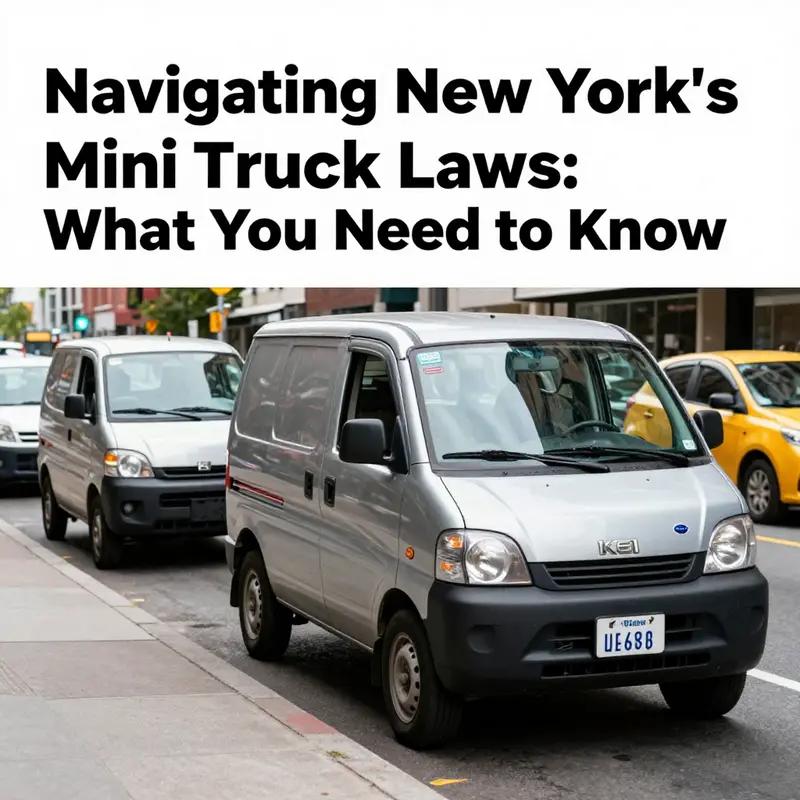
Mini trucks, or Kei trucks, are compact vehicles that have grown in popularity among small business owners and enthusiasts alike. However, their legal status in New York can be confusing. Understanding if these vehicles can legally roam the streets involves diving into various requirements, including certification, emissions standards, safety regulations, and registration processes. This comprehensive guide will help you navigate these complexities, ensuring you stay compliant while enjoying the benefits of mini truck ownership.
null
null
null
null
Are Mini Trucks Street Legal in NY: Safety, Standards, and the Checks That Keep Them on the Road
A pocket-sized pickup buzzing through urban alleys or out along a quiet rural road can feel almost conspiratorially practical. Yet the question of whether a mini truck can legally share New York’s streets is not a simple yes or no. It hinges on a careful alignment of safety, emissions, and registration requirements that govern every vehicle the state allows to operate in public traffic. In practice, a mini truck enters a complex legal ecosystem where origin, age, and compliance determine its fate on the road. To understand the realities, it helps to start with the broader landscape of what these tiny workhorses represent and how federal and state rules shape their legality. Kei trucks—the compact Japanese workhorses that inspire much of the mini-truck conversation—are prized for efficiency and nimbleness. They are typically designed to be under strict size and displacement limits, often with engines under 660cc. But that design intention does not automatically translate into a pass for New York roads. For a vehicle of this class to be road-legal in New York, it must be brought into harmony with federal safety standards and state emission requirements, and it must be properly registered and inspected. As a practical matter, most imported mini trucks are not automatically street legal in New York without substantial modification and formal certification processes that involve federal and state agencies. The path from curiosity to compliance is not paved with a single document; it unfolds through inspections, approvals, and ongoing maintenance that ensure the vehicle is safe for public use. This is not a niche bureaucratic quirk but a core public-safety framework designed to safeguard drivers, pedestrians, and other road users. A useful starting point for readers who want to explore the broader landscape of mini trucks and their regulatory context is to consult the genre’s own informational hub, which collects practical insights, anecdotes, and practical considerations from enthusiasts and professionals alike. For broader context, see the Mini Trucks Blog.
The first layer of the question concerns the basic safety and emissions regime that governs all vehicles registered in New York. Every vehicle that operates on New York streets must pass a safety and emissions inspection at least once every 12 months. This is not a one-off hurdle; it is the ongoing gatekeeper that keeps the vehicle compliant with state standards for brakes, lighting, tires, steering, suspension, and the emissions-control systems that help reduce pollution. The inspection acts as a reality check: if a mini truck’s brakes are spongy, its lights are dim, or its exhaust system leaks, the car will fail and cannot legally drive until those issues are addressed and the vehicle passes a re-inspection. The inspection program is administered through the state’s DMV framework, and the results stay with the vehicle’s registration as long as the vehicle remains in use.
Beyond the generic safety and emissions framework, mini trucks face a more specific delta depending on their age. If a mini truck is less than 25 years old, it must meet current federal safety standards (FMVSS) and EPA emissions standards to be legally driven on public roads in New York. In practice, this means that imports or conversions of kei trucks must be evaluated for federal compliance. The FMVSS cover a broad range of requirements, from occupant protection to crashworthiness and labeling, and the EPA requirements address pollutant limits and control technologies. The reality in the field is that many kei trucks designed for Japan’s market were not originally configured to meet these U.S. standards. Therefore, owners often face a path of modification, testing, and certification to bring the vehicle into compliance. This is not merely a cosmetic update but a functional transformation that may involve updating restraint systems, lighting units, crash structures, airbag compatibility (where applicable), and emissions-control equipment. The process can be intricate and may require documentation, testing, and, in some cases, alterations to the vehicle’s wiring, sensors, or air-management systems. Because of the complexity, prospective buyers are wise to engage with automotive compliance experts or formally consult the National Highway Traffic Safety Administration (NHTSA) and the Environmental Protection Agency (EPA) in the early stages of planning a purchase or conversion. The goal is clear: to ensure that the vehicle’s safety performance and emissions profile will withstand both the regulatory scrutiny and the realities of daily use.
If a mini truck is 25 years old or older, it may qualify for a special registration pathway often described as a classic vehicle option. Classic vehicle status carries its own caveats and benefits. These older vehicles are typically subject to an annual safety inspection but can be exempt from modern emissions testing, provided they are not used for commercial purposes. This exemption is a significant administrative relief for enthusiasts who preserve or occasionally drive vintage, lightly used mini trucks. However, eligibility is not automatic. Owners must verify with the New York DMV whether their vehicle meets the criteria for classic vehicle registration and must adhere to the specific inspection schedule and usage restrictions that accompany that designation. The classic path preserves the vehicle’s character while balancing the state’s safety objectives, but it does not erase the responsibility to maintain critical safety features and to ensure the vehicle remains mechanically sound.
The practical workflow for a prospective owner who is drawn to New York’s urban viability for mini trucks, or to their potential utility in rural or industrial contexts, centers on a multi-step due diligence process. First, determine the vehicle’s age and intended use. If the truck is younger than 25, the owner should anticipate the possibility of pursuing FMVSS/EPA-compliant modifications, which can be substantial in scope and cost. Next, engage with the DMV early to confirm what specific compliance milestones are required to obtain a full registration. This step is essential because it clarifies whether the vehicle can be registered in its current condition or if it must be re-engineered to meet federal standards. A third element involves securing a clear, detailed maintenance and repair plan that aligns with the annual safety and emissions inspection cadence. A vehicle that presents even minor issues during inspection—faulty braking, worn tires, or a malfunctioning emissions control system—will fail, and those problems will need to be resolved before an operator can legally drive on New York roads.
The regulatory narrative for mini trucks in New York is thus anchored in the dual realities of safety and emissions. On one hand, the state’s framework seeks to preserve road safety through robust inspections and compliance checks. On the other, it recognizes that certain classic or specialized vehicles can continue to be enjoyed or utilized under carefully defined conditions. The tension between a vehicle’s intended utility and the safety standards it must meet is the practical hinge on which legality turns. This is why many public discussions around mini trucks emphasize not just whether these vehicles can be driven, but what it takes to drive them legally. The practical upshot is that legality is not a fixed status; it is an ongoing compliance state that requires attention to changes in the vehicle, changes in regulations, and the evolving interpretation of what constitutes a compliant vehicle under federal and state law.
Navigating this path thoughtfully means aligning expectations with regulatory realities. For some owners, the answer is to pursue classic vehicle registration if the truck meets the age criterion, accepting the corresponding inspection framework and restrictions. For others, the route to legality lies in a structured modification and verification program designed to align a newer mini truck with FMVSS and EPA requirements. Either route demands robust documentation, professional assessment, and ongoing maintenance discipline. In any case, the core principles stay consistent: safety first, emissions second, and registration with the DMV as the final step to legality.
The conversation around street legality also invites a broader reflection on how these vehicles intersect with New York’s urban design, traffic patterns, and environmental goals. In dense cities, the appeal of compact dimensions and nimble maneuverability is clear, yet these advantages only translate into real-world legality when the vehicle can meet safety and environmental standards, and when its paperwork is in order. A reader exploring this topic may find that the most practical approach is to research thoroughly, consult the DMV early, and use reliable compliance resources to map out a concrete plan. The goal is not to circumvent rules but to pursue a legitimate and efficient configuration that stands up to inspection, protects occupants, and respects the state’s public safety commitments.
In closing, the road to legality for mini trucks in New York is not a single rite of passage but a series of milestones. Those milestones begin with an honest appraisal of the vehicle’s age and condition, advance through federal and state safety and emissions requirements, and culminate in a registration and inspection routine that keeps the vehicle in good standing on public roads. The process, while potentially demanding, offers a clear framework for responsible ownership and legitimate operation. For readers who want a concise overview and ongoing updates on the broader topic of mini trucks, the internal resource linked earlier serves as a helpful companion reference. It captures a community’s practical experiences, common pitfalls, and practical considerations for owners and prospective buyers alike.
External resource: For official guidance on safety and emissions inspections, and the specific requirements that apply to New York State vehicles, see the NY DMV safety/emissions program page: https://dmv.ny.gov/vehicle/safety-emissions-inspection-program
Mini Trucks in New York: Legal Pathways, Restrictions, and Registration
New York’s rules make street use of mini trucks more complex than their size suggests. These compact vehicles, often called kei trucks, are designed for a regulatory environment different from U.S. roadways and must meet FMVSS and EPA standards before they can be registered for highway use. In practice, most mini trucks entering the U.S. must be tested, certified, and possibly modified to comply with federal safety and emissions requirements. Owners typically pursue one of two routes: classify the vehicle as a low-speed vehicle (LSV) and operate on permitted roads with limited speeds, or pursue full conformity as a passenger vehicle, which can be technically and financially demanding. If neither path is feasible, the vehicle may remain restricted to private property or specialized corridors. The DMV emphasizes proof of compliance, proper titling, and registration, and enforcement can include fines or impoundment for unregistered or unsafe vehicles. For readers considering imports or hobby builds, planning ahead for certifications and local permits is essential, and the New York DMV brochures on LSVs provide practical guidance on allowed operations and required equipment.
Final thoughts
Understanding whether mini trucks are street legal in New York requires familiarity with certification, emissions, safety, and registration. By following the outlined steps, small business owners, property owners, and enthusiasts alike can navigate the complexities of owning a mini truck, ensuring compliance with state laws. Embrace the practicality and fun of these vehicles while being road-ready and legal.