

Tennessee’s landscape, dotted with small businesses and residential areas, raises the question: Are mini trucks street legal here? Particularly known for their compact size and efficiency, mini trucks, especially Japanese Kei trucks, have gained popularity among enthusiasts and property owners alike. However, legality hinges on meeting both state and federal safety and emissions regulations. In this guide, we will explore the nuances of mini truck legality in Tennessee. You’ll find comprehensive insights on safety standards, the registration process, necessary modifications, and the implications of driving non-compliant vehicles.
Smaller, Safer, Street-Ready: Tennessee’s Approach to Mini Trucks
In Tennessee, a mini truck’s street legality isn’t determined by size alone. The state governs these vehicles through a classification framework that balances performance, safety, and registration requirements. A key category is the medium-speed vehicle (MSV), which covers four-wheeled vehicles capable of reaching modest speeds. A mini truck may qualify for MSV status if it can operate at roughly 20 to 25 mph, and, critically, if the surrounding road network accommodates vehicles moving at higher speeds, typically up to 35 mph. This is not a universal permission but a fit between the vehicle’s capabilities and local traffic conditions.
Meeting MSV criteria requires core safety equipment: functional seat belts for all occupants, operational headlights, working turn signals, and a rearview mirror. These elements are not decorative; they align the vehicle with Tennessee’s on-road safety expectations. Registration then becomes the gatekeeper: not every mini truck will qualify, and importers may need to modify or certify the vehicle to meet U.S. standards and Tennessee’s rules. The process often involves inspections and proof that the vehicle complies with lighting, braking, and emissions standards.
Common kei-style trucks may require adjustments to meet DOT and EPA requirements before they can be registered for street use in Tennessee. In some cases, speed-limiting devices or engine controls must be altered to satisfy compliance checks. Costs and practicalities vary, so work with licensed importers or inspectors who understand both federal standards and the state’s requirements. Official guidance comes from the Tennessee Department of Safety and Homeland Security, which provides the current rules and inspection criteria for MSVs and other low-speed vehicles.
Tiny Trucks, Big Rules: Navigating Safety, Emissions, and Registration for Kei-Style Mini Trucks in Tennessee
When the idea of driving a Kei-style mini truck down a Tennessee street comes up, many readers imagine a clever, economical vehicle that slips through traffic with ease. The reality, however, rests on a much more layered set of rules. In Tennessee, the right to operate any motor vehicle on public roads hinges on meeting both federal standards and state-specific requirements. Kei trucks, with their compact frames and tiny engines, are built for efficiency in Japan and other markets, not automatically for the American road system. They may be economical and maneuverable, but their journey to legal street use here begins long before you turn the ignition. A vehicle that lands in Tennessee must satisfy the same safety, emissions, and registration criteria as any other motor vehicle, and a lot of the work happens behind the scenes—through compliance checks, inspections, and, crucially, modifications that align a foreign design with U.S. specifications.
The first and most essential question is whether a Kei truck can be made street-legal in a manner that satisfies federal requirements and Tennessee’s own enforcement framework. The federal layer comes from the Department of Transportation and the Environmental Protection Agency. Vehicles imported from abroad must meet or be certified to meet these bodies’ standards for crashworthiness, lighting, braking, and occupant protection, as well as emissions controls. In practice, this means that a Kei truck may require significant changes before it can be registered for road use. The process often involves removing or altering certain design features that are common in Japanese-market models but not aligned with U.S. regulations. Lighting, for instance, must be upgraded to meet brightness and visibility standards that ensure other drivers can clearly see the vehicle in all conditions. This isn’t merely about brighter headlights; it’s about a complete lighting system that functions reliably for daytime visibility, nighttime safety, and proper signaling at turns and stops.
Beyond lighting, the issue of speed governors comes into play. Many Kei trucks are equipped with speed-limiting devices as a standard part of their design or as a market adaptation. Tennessee’s safety and inspection standards expect vehicles to not only reach but also withstand regular road conditions at speeds appropriate for their size and use. In practical terms, this can mean removing or adjusting a governor to ensure the vehicle’s performance adheres to U.S. expectations. The same attention applies to brakes and tires, which must meet U.S. tolerances and performance standards. Any alteration must be documented and verified through the appropriate inspection channels to avoid a misalignment between a vehicle’s intended performance and what the state will accept for road operation.
Emissions are often the sticking point for Kei trucks. The Environmental Protection Agency and Tennessee’s own environmental authorities have strict limits for pollutants such as carbon monoxide, nitrogen oxides, and hydrocarbons. A vehicle that was designed and calibrated for another country’s standards is not automatically compliant with U.S. emission limits. In many cases, the engine management system, exhaust components, and fuel delivery systems that work in Japan will not pass EPA testing without modifications. The result can be a vehicle that looks ready for the highway but fails an emissions inspection, which is a nonstarter for registration and ongoing operation. This is where the role of qualified automotive engineers and certified inspectors becomes vital: they assess the truck, identify the exact changes needed, and guide the owner through a compliant retrofit or adjustments that bring the emissions profile into line with U.S. requirements.
The Tennessee inspection and registration process adds a final layer of due diligence. Once federal and state safety and emissions criteria have been addressed, the vehicle must undergo a state inspection to verify continued roadworthiness. This inspection isn’t a one-off hurdle; it is the ongoing gatekeeper to keep unsafe or non-compliant vehicles off public roads. The inspectors look for structural integrity, functional lighting, properly anchored seat belts, and a chassis that can withstand the expected stresses of daily driving. They also verify that the vehicle’s safety features align with state definitions of crashworthiness and occupant protection. The experience of owners who have navigated this path shows that a compliant mini truck is not simply a matter of ticking a few boxes; it is a coordinated process that involves documentation, professional modifications, and a readiness to adapt the vehicle to the state’s clear expectations.
For importers and buyers, the path to compliance begins well before the vehicle reaches Tennessee’s borders. It is prudent to work with a licensed import specialist who understands both the federal rules and the practical realities of state-level registration. Such professionals can help anticipate the conversions needed, coordinate with certified shops for the necessary upgrades, and assemble the paperwork that proves the vehicle’s conformity to DOT, EPA, and Tennessee’s inspection standards. Importantly, attempting to circumvent these steps is a risk with real consequences: registration denial, temporary impoundment, or even seizure at the border are possible outcomes for non-compliant imports. The stakes emphasize a core truth: the journey from foreign design to street legality in Tennessee demands diligence, expertise, and a clear understanding of what the car must be, not just what it is.
Owners who pursue compliance often discover that the work is iterative rather than purely additive. It is not simply about adding a spare set of lights or swapping a muffler. The modifications must integrate with the vehicle’s overall safety profile, engine management, and adherence to emission standards. This integration is more than plug-and-play—it requires a coordinated effort among the importer, the shop performing upgrades, and the inspector who will ultimately sign off on the vehicle’s roadworthiness. A well-executed plan will document each change, show how the vehicle now aligns with DOT and EPA requirements, and provide the inspection history that Tennessee authorities expect to see when the time comes for registration. The importance of documentation cannot be overstated; without it, even a well-modified truck can face hurdles at the point of registration.
Readers who want a practical sense of how these considerations play out in the broader market can explore how compact imports compare in design expectations and regulatory considerations by visiting industry discussions that dissect specific model features and compliance pathways. For example, a resource that analyzes model variations and how they stack up against U.S. standards can be instructive, especially when planning inspections and modifications. This kind of comparative insight is valuable because it frames the regulatory conversation in a way that goes beyond theory and into actionable steps. In practice, a well-informed buyer will examine a vehicle’s baseline safety features, identify what must be upgraded, and map those upgrades to the verification steps required by state authorities. This approach reduces guesswork and aligns expectations with the reality of Tennessee’s safety and emissions regime.
If you are approaching this path, consider how to phrase your inquiries and what documentation to gather. Gather proof of compliance testing, a clear bill of sale, and every detail about the modifications performed. It is equally important to review Tennessee’s official resources and stay informed about any updates to the safety or emissions rules, because regulatory standards can evolve. For those who want a concise, practical starting point, a trusted step is to consult official guidance from the Tennessee Department of Safety and Homeland Security and to coordinate with a licensed importer who understands both federal and state rules. The process can be lengthy and exacting, but the payoff is straightforward: it yields a legally operable vehicle that can share Tennessee roads with other drivers without the looming risk of penalties.
For a route-map of practical, model-agnostic considerations, see a discussion focused on comparative model specs and compliance pathways with a detailed, model-agnostic lens. This resource provides a helpful context for understanding which features tend to trigger specific compliance actions and how to approach modifications accordingly. comparing-kingstar-kruzr-models-specs-features. In all cases, the core principle holds: legality comes from alignment with the standards, not from the vehicle’s origin or size alone. The Tennessee path to a safe and legal Kei-style mini truck is about deliberate planning, qualified expertise, and ongoing adherence to safety and environmental rules that protect drivers and communities alike. For those seeking the most accurate and up-to-date information, consult the official Tennessee Department of Safety and Homeland Security resources and keep a vigilant eye on the evolving regulatory landscape.
External resources provide a broader perspective on how these regulations are interpreted and enforced. For a detailed overview that contextualizes Tennessee’s requirements within national emission and safety standards, see World Law Digest’s analysis on Kei trucks and U.S. legality. This external reference helps illuminate the practical implications of compliance decisions and the potential consequences of non-compliance, reinforcing the caution and due diligence required before attempting to register a Kei truck in Tennessee.
Legally on the Move: Navigating Tennessee’s Mini Truck Registration and Road Rules
Questions about whether a small, boxy pickup can legally share Tennessee streets are common among enthusiasts who see a practical, efficient tool in a mini truck. The answer is nuanced and grounded in how Tennessee classifies and regulates these vehicles, what modifications they may need, and where they fall in the broader framework of federal and state safety rules. In Tennessee, a mini truck is not simply a novelty to be parked in a driveway or unrolled from a shipping crate. It is a motor vehicle that must dance within a specific legal choreography: it must be properly classified, inspected, and registered, and it must comply with lighting, braking, emissions, and safety standards that the state and the federal government insist upon. This landscape, while technical, becomes navigable with a clear map of the steps, the requirements, and the practical realities of ownership and operation.
The first hinge of legality is classification. Mini trucks, particularly those designed for urban use in other parts of the world, can be registered in Tennessee under two pathways. They can qualify as Medium Speed Vehicles, a category that Tennessee defines as four-wheeled motor vehicles designed to operate at speeds between 20 and 45 miles per hour. This classification matters because it opens a pathway for operation on public roads within the state, but only if the vehicle adheres to the relevant safety and equipment requirements. The other pathway is a Class I registration, a designation that can apply depending on the vehicle’s specifications and intended use. Each pathway carries its own registration process and its own suite of compliance checks. The common thread, however, is that neither option guarantees automatic street legality; both require careful alignment with federal and state standards. The rules are not designed to restrict ownership as much as they are designed to protect road safety, emissions integrity, and predictable driver behavior on Tennessee’s highways.
As owners begin the journey toward registration, the process unfolds as a sequence of practical steps that read like a well-lit roadmap rather than a maze. The journey starts with proof of ownership. A title or a bill of sale establishes a clear chain of ownership, a necessary anchor for the DMV’s records and for the vehicle’s legal status on the road. Identification follows, ensuring that the person presenting the vehicle for registration is who they claim to be, and that the state can connect the vehicle to a specific individual responsibly. Then comes the application—forms that are typically available online through the Tennessee Division of Motor Vehicles portal. These forms are not mere bureaucratic hurdles; they are the formal request to recognize the vehicle’s status under Tennessee law and to set the framework for its ongoing compliance.
But a title and an application do not complete the process. Safety inspection is a central, non-negotiable gate. The inspection verifies that the vehicle’s critical safety components—brakes, lighting, tires, seat belts, and structural integrity—meet the state’s requirements. For mini trucks registered as Medium Speed Vehicles, there is often an emissions component that depends on the county and model year. Emissions testing is not a universal mandate for all mini trucks, but it becomes a condition under specific circumstances. That ambiguity—when exactly emissions tests apply—reflects the layered nature of Tennessee’s approach to vehicle regulation, where counties and years matter, and where federal EPA requirements complement state rules to create a comprehensive safety and environmental standard.
The path does not stop at inspection and emissions. After passing the necessary checks, the vehicle moves into the realm of registration itself. The Tennessee DMV and the Tennessee Department of Safety and Homeland Security coordinate to issue the official plates and registration that certify the vehicle for public roads. This step is the formal acknowledgment that the kit of safety equipment, emission controls, and structural standards is sufficient for lawful operation on Tennessee streets. It also anchors the vehicle in the state’s regulatory framework, ensuring that the mini truck can be identified, tracked, and tested if needed in the future.
A practical note for readers contemplating import or purchase: many older mini trucks arrive with configurations that were never intended to meet U.S. federal standards. Importers, therefore, must anticipate a process of modification and certification. The core requirements—lighting that aligns with U.S. standards, elimination or adjustment of speed governors, EPA-compliant emissions systems, and a passing state inspection—often require specialized work. It is highly advisable to work with a licensed import specialist who understands both federal and state compliance, because attempting to register a non-compliant vehicle can lead to denial of registration or even seizure at the border. This is not merely a paperwork exercise; it is a safety and compliance procedure designed to prevent vehicles that do not meet U.S. standards from entering or remaining on public roads.
In examining how Tennessee actually implements these rules, one quickly sees that the process is as much about alignment with national standards as it is about local administration. The lighting system, for instance, must meet U.S. standards rather than relying on the original country’s configurations. This can involve installing headlamps, brake lights, and turn signals that conform to the expectations of U.S. road users and safety tests. The speed governance aspect often requires reconfiguring or removing devices that limit speed in the vehicle’s original design, so the operator can demonstrate the vehicle’s compliance with the state’s design and performance criteria. Emissions systems present another layer of complexity. EPA compliance can be a hurdle with older models that were never designed with U.S. emissions requirements in mind. All of these requirements coalesce at the point of registration, where the vehicle is declared fit for public life only after it can demonstrate that it satisfies the total picture of safety, environmental responsibility, and road readiness.
The practical realities of operation follow the legal framework. Even after registration, there are restrictions to keep in mind. Mini trucks, while legal for street use under the right conditions, are not generally permitted on interstate highways or other high-speed roadways. The category of Medium Speed Vehicle is keyed to a vehicle’s ability to operate within certain speed ranges, and the state’s road network and traffic laws reflect that boundary. The result is a vehicle that can be a nimble, economical addition to a local commute or a business task, but one that is legally constrained to certain routes and driving situations. These constraints underscore the importance of planning routes, especially for those who might rely on such a vehicle for regular travel between towns or in commercial applications. The goal is consistent safety and predictability, not merely the avoidance of penalties.
From a broader perspective, the Tennessee pathway for mini trucks mirrors a cautious, patient approach to vehicle classification and road use. It recognizes that these compact vehicles can provide meaningful utility while also guarding public safety and environmental standards. The steps—proof of ownership, identification, application, safety inspection, and emissions testing where required—form a coherent sequence that, while exacting, is navigable with preparation and guidance. The emphasis on compliance does not diminish the appeal of mini trucks; instead, it reframes their use as a carefully considered choice that aligns with the state’s obligations to protect drivers and the environment. For readers who want a sense of how the practical conversation around these vehicles unfolds—covering reliability, customization challenges, and the realities of everyday driving—a deeper look at community discussions and informed perspectives can be instructive. See the broader conversation at the MiniTrucksOcala blog for general discussions about mini trucks and adaptations, which offers perspectives that can illuminate the practical side of ownership minitrucksocala blog.
As this chapter threads through the structural, legal, and practical elements of registering a mini truck in Tennessee, it ties back to the core decision every prospective owner faces: are you willing to undertake the compliance work required to bring a small vehicle into alignment with federal and state standards, in exchange for the benefits of efficient, urban-friendly mobility? The answer, for many, is a qualified yes—a ready balance between responsibility and practicality. The pathway exists, and with due diligence, a mini truck can become a legally compliant, street-appropriate asset rather than a curiosity left to private lots and quiet cul-de-sacs. For official guidance, consult the Tennessee Department of Safety and Homeland Security and the state’s DMV portal to confirm the current procedures, fees, and any county-specific conditions. External resource: https://www.tn.gov/safety
From Tiny Truck to Tennessee Road-Ready: What Kei Trucks Need for Street-Legal Status
Kei trucks capture attention with their compact stance and efficient charm. Yet Tennessee’s rules make clear that size alone does not grant access to the road. The journey from import to on-road approval blends federal safety and emissions standards with the state inspection and registration process. It is a careful, auditable retrofit rather than a single quick change. A successful path depends on documenting credible, verifiable work that a licensed inspector can confirm. The story of a street-worthy kei truck becomes a negotiation between the vehicle’s native design and the requirements of American road use. Lighting is one of the most visible hurdles. Japanese headlight patterns and mounting heights often do not match U.S. expectations. The fix is usually a safety-focused retrofit that restores proper low beam distribution and glare control while preserving adequate forward visibility. Turn signals and brake lights must meet DOT standards in color, brightness, and reliability to communicate intent clearly on crowded Tennessee highways. Safety equipment such as functional seat belts in every seating position, a working horn, and windshield wipers as needed are essential pieces of the compliance puzzle. Emissions compliance adds complexity. The 25 year rule can allow older kei trucks to enter the country, but Tennessee still requires demonstration of emissions compatibility or approved exemptions. If a vehicle cannot demonstrate compliance, registration can be delayed or denied. The registration process itself also matters. After work is complete, the vehicle must pass a Tennessee vehicle inspection, and documentation showing the scope of work, involved technicians, and relevant compliance statements supports the title and registration. Importers should work with licensed specialists who understand both federal and state rules to navigate the process smoothly. For readers seeking practical context, a resource compares kei truck model specifications and safety features across platforms and discusses headlights, signaling, and structure in relation to inspection expectations. The takeaway is that street legality in Tennessee comes from planned, documented, and quality work that aligns the vehicle with U.S. standards while preserving its practical strengths. Always consult the official Tennessee Department of Safety and Homeland Security resources for current guidance on inspection, title, and registration.
The Small Machine, Big Liability: Navigating Non-Compliant Mini Trucks on Tennessee Roads
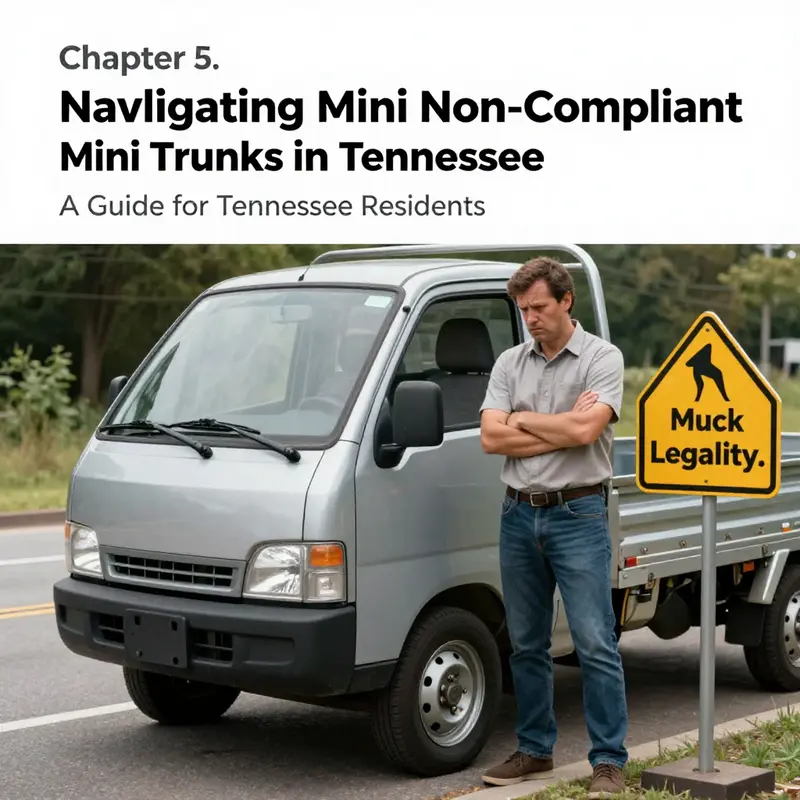
In Tennessee, compact mini trucks raise questions about legality and safety. These vehicles often aim for urban practicality but may fail to meet FMVSS, EPA, and state inspection standards. The process to register and insure such trucks can be lengthy and uncertain. Federal rules set baseline safety and emissions; Tennessee adds registration and inspection requirements that check lighting, occupant protection, brakes, and emissions. Noncompliant vehicles risk fines, seizure, or insurance denial. The chapter outlines how to assess a vehicle, the modifications that may be needed, and best practices for buyers and distributors to navigate conformity, inspection, and proper documentation. It concludes with a note on road safety and the importance of clear guidance for regulators and consumers.
Final thoughts
As mini trucks gain traction in Tennessee, understanding the legal landscape becomes vital for enthusiasts, businesses, and residents alike. These vehicles can be a fantastic asset if they meet the safety and emissions standards set by federal and state authorities. By being proactive about compliance, you can enjoy the benefits of mini trucks without facing fines or registration issues. Engage with knowledgeable import specialists for any modifications needed to make your mini truck street legal. This ensures you can cruise Tennessee roads confidently and legally.