
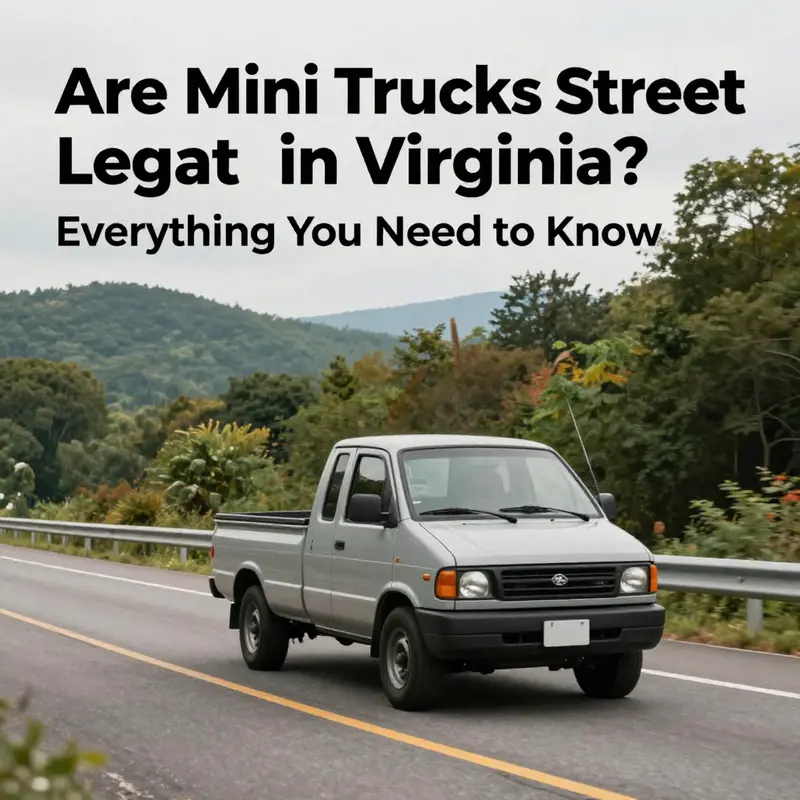
Mini trucks have gained a unique following due to their compact size and versatility, making them popular choices for local small businesses, residential transport, and even as recreational vehicles for enthusiasts. However, their legal status on the roads of Virginia raises essential questions. The laws concerning the street legality of these vehicles differ significantly from state to state. In this guide, we’ll clarify which mini trucks can actually roam the streets of Virginia and what owners need to know about registration, modifications, and compliance. From understanding the types of mini trucks to the stringent safety regulations imposed, we’ll navigate through all the essential aspects to help you make informed decisions.
null
null
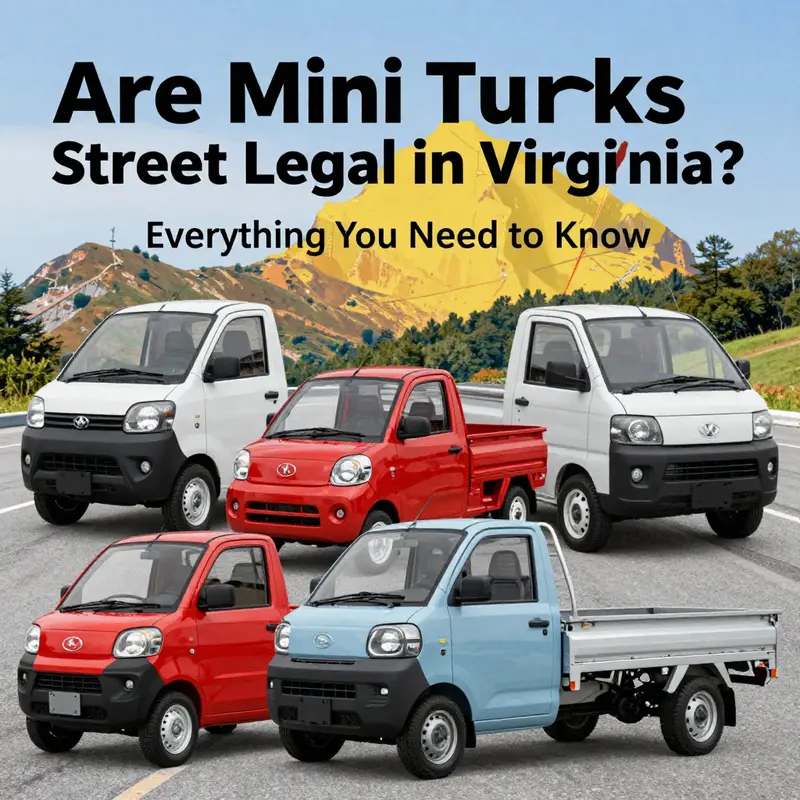
Small Trucks, Big Rules: The Virginia Roadmap to Legal Mini Trucks on Public Roads
Virginia’s roads shape a practical landscape where compact utility machines must prove their fitness for public travel. The question of whether mini trucks can legally share the same lanes as passenger cars is not answered by size alone. Instead, it hinges on a formal classification system administered by the Virginia Department of Motor Vehicles and anchored in safety, speed, and emissions standards that reflect both state concerns and federal benchmarks. In everyday terms, the path a mini truck must travel to become street legal starts with how the vehicle is defined and ends with the required proof that it behaves like a vehicle people can rely on when they share the road with cars, trucks, and buses. For many of these small machines, the defining label is low-speed vehicle, or LSV, a category that captures the essence of their design and their typical use while also signaling important limits. In Virginia, an LSV is generally understood to be a vehicle that can reach a maximum speed of up to 25 miles per hour. The moment a machine can reliably go faster than that ceiling, it steps into a more demanding regulatory category that imposes stricter safety, performance, and inspection requirements. This distinction is not a mere academic exercise; it is the practical difference between being able to register the vehicle, obtain license plates, and operate on public streets, and being restricted to private property or controlled environments. The speed threshold is the hinge that opens or closes the door to road use. If the vehicle remains within the 25 mph cap, Virginia’s process focuses on equipment and conformity rather than a full passenger-car standard overhaul. But if the vehicle is designed for higher speeds, or if it routinely attains speeds beyond the limit, the pathway becomes longer and more demanding, demanding a level of safety equipment, crash protection, and emissions compliance that many mini trucks simply cannot meet without comprehensive modification. The design philosophy behind this approach is straightforward: vehicles sharing public roadways must provide adequate visibility, signaling, braking, and occupant protection, regardless of their compact footprint. The basic features demanded of an LSV are clear enough: dependable headlights and taillights to maintain visibility at night, front and rear turn signals, a rearview mirror or mirrors that offer a usable field of view, a reliable braking system capable of stopping the vehicle within reasonable distance, seat belts for the driver and any passenger, reflective markings to aid nighttime recognition, a functioning horn to alert other road users, and tires and wheels that satisfy standard sizes and load ratings. The intent of these requirements is not to burden small-scale innovators with unnecessary red tape. Instead, they ensure that even a diminutive vehicle can be seen, controlled, and anticipated by drivers in heavier vehicles with greater momentum. In practice, many mini trucks intended for off-road or light-duty use do not carry these features in a way that aligns with Virginia’s standards when they are configured for non-road tasks. The regulatory framework does not exempt the vehicle from certification simply because it is small. It requires a declaration of road-worthiness that is compatible with a broader safety regime. In addition to the safety and equipment standards, registration is a central pillar of legality. A vehicle that sits on Virginia’s public streets must be registered with the DMV and bear license plates. The registration process typically involves presenting manufacturer documentation, confirming the vehicle’s identity, and sometimes providing a complete history for used vehicles. Fees will vary according to the vehicle’s type, engine displacement, and other factors, but the overarching requirement is clear: a vehicle must be officially sanctioned for road use, not just privately owned and parked. The driver who operates the vehicle on public roadways must hold a valid Virginia driver’s license. This requirement helps ensure that the person behind the wheel has the training and accountability expected on roads shared with larger, faster vehicles. For mini trucks that are confined to the lower-speed spectrum, the license requirement is straightforward, but as the speed capabilities and performance profiles increase, so too can the licensing expectations. In some cases, additional driving qualifications or restrictions may apply, particularly if a vehicle’s speed potential edges toward or beyond the 25 mph limit. Even when a vehicle clears equipment and licensing hurdles, operating constraints remain. Interstates and other high-speed corridors are not friendly to slow-speed designs. Executive logic governs that even a legally registered LSV should avoid high-speed thoroughfares, where the mismatch in performance could create dangerous gaps in flow or braking distance. City streets, rural connectors, and community roads represent the intended operating environment for these vehicles, a landscape in which careful speed management, predictable signaling, and consistent braking become the norm rather than the exception. The idea that a mini truck might roam freely on any Virginia roadway overlooks the balance that state regulators have struck between accessibility for small, efficient transport and the non-negotiable safety needs of all road users. The practical takeaway for potential owners is that the notion of simply purchasing a compact vehicle and driving it to a neighborhood store on a Saturday afternoon does not align with reality unless the vehicle has already traversed the DMV’s road-compatibility checks. The DMV’s Low-Speed Vehicle Regulations provide the authoritative backbone for this reality, detailing the path from vehicle classification, through required equipment, to the procedural steps of registration, licensing, and inspection. While the text of these regulations is accessible to anyone, the essence is simple: the vehicle must demonstrate that it will behave in a predictable, safe manner on public roads and comply with standard safety and emissions expectations. For readers seeking a broader perspective on how mini trucks fit into everyday mobility and how the hobbyist or small-business driver navigates these rules, a visit to the ongoing discussions in the mini trucks community can be illuminating. See the broader repository of insights at minitrucksocala.com/blog/.
The path to legality is not an abstraction. It translates into concrete steps: confirm the vehicle’s classification as an LSV by its speed potential, assemble and present the required safety features, secure the proper registration and plates, and ensure the driver’s licensing status aligns with the state’s expectations. Because the operational landscape for LSVs excludes the fastest timetables on major highways, plan for routes that emphasize local streets and winding backroads rather than the highway network. The endgame is not merely being allowed onto the pavement, but participating in a system designed to preserve clarity of intention and predictability in behavior for every traveler. The DMV’s own page on low-speed vehicles remains the most reliable point of reference, and it emphasizes that these vehicles, even when cleverly engineered for efficiency, must pass a set of rigorous standards before they are deemed street legal. It is this blend of practical utility and safety discipline that characterizes Virginia’s approach to mini trucks and similar compact vehicles on public roads. For official guidance, readers may consult the Virginia DMV’s Low-Speed Vehicles section, which outlines the registration, inspection, and operating restrictions tied to street-legal status. External resources provide a complementary view of how these standards interplay with federal guidelines on emissions and safety, reinforcing the careful balance Virginia maintains between accessibility for small, practical transport and the obligations that come with public-road activity. External resource: Virginia DMV Low-Speed Vehicles
Impact of Safety and Emissions Regulations on Mini Trucks in Virginia
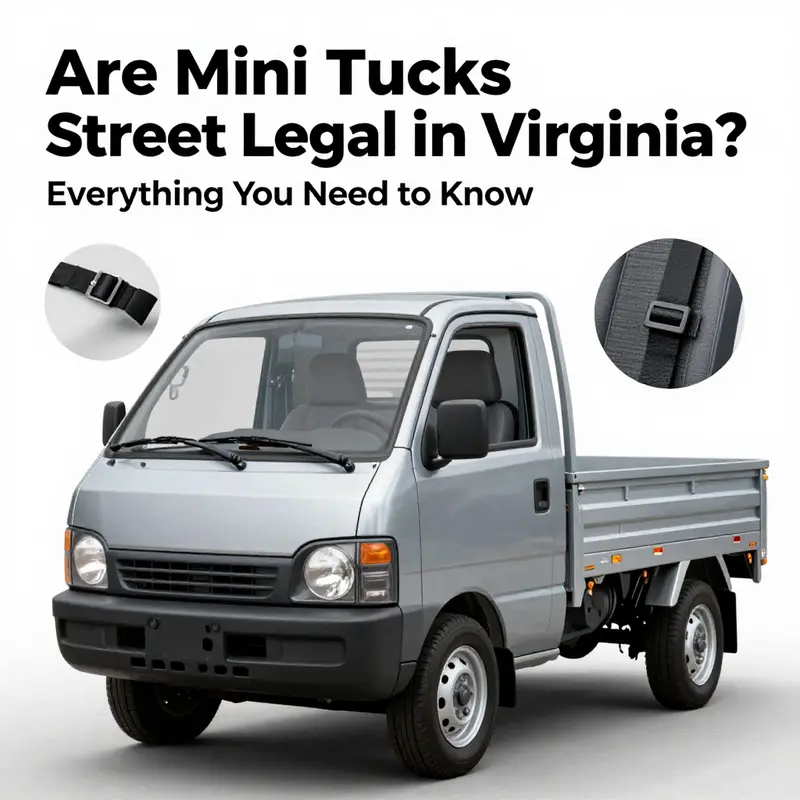
Regulation shapes reality in a way that most people underestimate when they first consider driving a tiny, utilitarian vehicle down a Virginia street. Mini trucks, prized for their compact size and practical payload, sit at a regulatory crossroads where federal safety rules, federal emissions standards, and Virginia’s own vehicle-ownership processes all collide. The result is a framework that makes street use possible in theory, but often impractical in practice for many of the smallest, purpose-built mini trucks. The story begins with the broad system that governs all light-duty and low-speed vehicles in the United States and then narrows to how Virginia applies those rules to vehicles that look like work vehicles but may not have been designed with traditional highway use in mind. From the outset, the issue is not just about speed or style; it is about whether a vehicle can meet the minimum safety and environmental standards that enable it to share Virginia’s roads with commuter cars, delivery vans, and large pickup trucks. In Virginia, as in most states, there is no automatic allowance for a tiny work vehicle to hit public roads simply because it is small or fuel efficient. Every mini truck must meet a baseline of safety equipment and emissions performance that aligns with federal standards and then pass the state’s inspection and registration requirements. The practical effect is that many mini trucks, especially those engineered for off-road or agricultural use or designed as low-speed or kei-type vehicles, face substantial barriers to becoming street-legal without significant modification, certification, and documentation. This reality stays front and center for any Virginia resident who imagines a compact, efficient truck serving as a daily driver or a farm vehicle that doubles as a neighborhood utility hauler. The tension between desire and compliance is continuous, and it shapes how people think about ownership, use, and the economics of keeping a small truck on Virginia’s roads over time. The bottom line remains straightforward: unless a mini truck has undergone the necessary engineering work to align with Virginia’s vehicle code, including safety inspections and proper licensing, it cannot be driven legally on public streets. The path to legality is not a shortcut; it is a carefully navigated process that requires attention to national standards and state procedures alike. For readers who want a sense of how enthusiasts view the regulatory landscape—and how some community discussions frame the balance between flexibility and safety—the mini trucks community blog offers perspectives rooted in real-world experiences and ongoing conversations about compliance, maintenance, and safe operation. See the dedicated blog for broader context and practical considerations: minitrucksocala blog.
The core of the Virginia picture is how federal rules shape state practice. The Environmental Protection Agency establishes emissions standards that limit pollutants such as nitrogen oxides and carbon monoxide from new light-duty vehicles, and states like Virginia enforce these limits through the DMV’s inspections and vehicle-ownership processes. Even when a mini truck appears small on the outside, it must be assessed under the same environmental yardsticks as a standard passenger car or light-duty truck. This means a vehicle must have a compliant emission control system, be tuned to meet applicable limits, and remain within legal parameters for pollutants during operation. The federal safety standard framework, administered by the National Highway Traffic Safety Administration, sets the bar for essential features: brakes that perform reliably, headlights and taillights that function correctly, mirrors that provide adequate visibility, a horn that works, and seat belts that restrain occupants. These are not optional add-ons; they are baseline criteria that must be present, tested, and certified as part of a vehicle’s eligibility to be registered and driven on public roads. In Virginia, the DMV system enforces these standards through a combination of inspections and title or registration requirements, a process designed to ensure accountability and road safety. A mini truck might be praised for its efficiency, but without the safety equipment and emissions performance demanded by FMVSS and EPA, it remains outside the scope of lawful street use. The message is consistent: Virginia does not grant an automatic passport to the street for miniature trucks just because they are compact or unconventional. They must meet the same overarching thresholds that apply to larger, more conventional vehicles.
For many readers, a critical piece of the puzzle is the question of whether Virginia recognizes any special category that could tolerate slower speeds or alternative configurations. The truth is that the state does not grant a broad, permanent exemption for mini trucks; instead, the pathway to legality rests on two pillars: proper modifications to meet safety and emissions requirements, and a formal process of registration and inspection. The minimum speed criterion, often cited in broader discussions of low-speed or neighborhood vehicles, has to be interpreted within the context of Virginia’s licensing and road-use rules. A vehicle must be capable of safely operating at reasonable highway speeds and must be equipped accordingly. In practice, this means that a mini truck that is intended for on-road use must not only be able to accelerate to typical urban speeds but also maintain stable performance under real-world loads, weather conditions, and traffic patterns. If a vehicle’s design prevents it from meeting those performance expectations, or if its safety and emissions packages fall short, it will not clear Virginia’s road-use test. The DMV’s process for testing and certification ensures that a vehicle meets required standards before it can be titled and plated, a safeguard that protects drivers, passengers, and other road users from potentially unsafe or non-compliant machinery. The consequence for enthusiasts is clear: to operate on public roads, a mini truck must be engineered to the same standards as any other vehicle that shares the highway. This is not an area where a clever design or small footprint can compensate for a lack of essential safety features or an inability to pass emissions checks. The implication is that many off-road or kei-type vehicles will be restricted to private property, farms, or controlled industrial environments unless they have undergone substantial modification and certification.
Electric mini trucks add another layer to the conversation. The appeal of electric propulsion—zero tailpipe emissions, reduced operating costs, and the potential to meet increasingly stringent environmental policies—makes them attractive in Virginia’s evolving regulatory landscape. Yet even zero-tailpipe vehicles face the same safety mandates as their internal combustion counterparts. The battery system must be integrated in a way that complies with safety standards for electrical systems and fire risk. The FMVSS guidelines have evolved to address new technologies, including battery integrity, charging protections, and electrical harnessing. A contemporary electric mini truck that seeks street legality will need robust battery safety measures, proper enclosure and protection against short circuits, and indicators such as battery management and thermal controls that function reliably under all typical operating conditions. While electric powertrains can align well with Virginia’s environmental goals, they do not automatically simplify compliance. A vehicle owner must still secure appropriate labeling, ensure safety equipment is up to date, and complete the DMV inspection routine with documentation that demonstrates conformity to federal standards. In this sense, the environmental merits of electric mini trucks are recognized from a policy perspective, but the practical road to on-street use remains a matter of engineering, certification, and regulatory clearance. For readers who want to explore broader conversations about how electric mini trucks are being integrated into the regulatory framework—beyond Virginia’s borders—the community blog remains a resource that captures how owners discuss safety and real-world performance, including the nuances of on-road acceptance. Access the blog for a broader sense of the community’s approach to compliance and use: minitrucksocala blog.
Virginia’s DMV requires that any vehicle used on public roads be registered and inspected periodically. The state’s approach to emissions testing, while centered on EPA standards, varies by region. In more urbanized or densely populated areas—such as the Northern Virginia corridor—emissions testing is more frequently emphasized due to air quality concerns and the desire to minimize pollutants in high-traffic zones. Mini trucks that fail emissions tests receive a temporary hold on registration until repairs are completed and the vehicle once again demonstrates compliance. This dynamic underscores the practical reality that even a vehicle designed for light-duty tasks can become ineligible for street use if it cannot meet the emissions and safety criteria through testing and certification. The inspection also serves as a catch-all safeguard: it ensures that braking performance, lighting, signaling, and occupant protection remain intact, reflecting the state’s commitment to road safety. All of this means that a government-backed, on-the-road guarantee for a mini truck is not automatic; it comes only after a series of verifications that the vehicle is fit for public use. For owners who want to understand how Virginia manages emissions in practice—and how those practices affect mini trucks—the official emissions testing page offers the most authoritative guidance and procedural detail: https://www.dmv.virginia.gov/vehicles/emissions-testing/. The page outlines which vehicle types are eligible for testing, how tests are conducted, and what steps are required if a vehicle does not pass.
The evolving landscape also includes a shifting emphasis on electric and low-emission vehicles. As environmental policy prioritizes cleaner transportation, some jurisdictions and state agencies consider exemptions or streamlined processes for certain low-emission or electric mini trucks. These potential pathways can create real opportunities for owners who invest in compliant batteries, certified safety components, and a vehicle frame that can pass a rigorous inspection. However, these windows of opportunity are not universal, and they depend on the ongoing alignment of federal guidelines with state and local enforcement priorities. For Virginians, this means staying informed through official channels and being prepared to adjust plans if new rules or exemptions emerge. The dynamics of policy, technology, and on-road practicality will continue to shape what is possible for mini trucks in Virginia. They will also shape the conversations within the community of owners and enthusiasts who share real-world experiences about registration, maintenance, and safe operation on public roads. The overall takeaway is that the street legality of mini trucks in Virginia is not a fixed yes or no. It is a conditional status that depends on a vehicle’s ability to comply with federal safety standards and emissions rules, plus Virginia’s own inspection and registration processes. If you want to explore more about how people balance practicality with compliance in this space, the community blog remains a useful resource for insights into real-world builds, safety considerations, and the kinds of adaptations owners pursue to bring small trucks up to code while maintaining their utility and value.
For readers seeking a concise summary of the regulatory landscape and practical steps for evaluating a mini truck’s street-legal potential in Virginia, the core message is straightforward: expect a thorough review of safety features and emissions performance, verification through a state inspection, and a formal registration process. Without those elements, the vehicle remains restricted to private property or controlled environments. The interplay between federal standards and state enforcement means that a tiny truck’s on-road possibilities are defined not by size but by certification, compliance, and documentation. And because policy can evolve with environmental goals and safety priorities, staying current with official guidance is essential. In short, Virginia’s approach reflects a broader national pattern: the street legality of mini trucks is ultimately determined by whether they can stand up to the same tests and inspections that apply to conventional vehicles, even if their size and footprint suggest a different buying or ownership experience. The pursuit of a legal on-road mini truck is thus a project that blends technical modification with regulatory navigation, and it is a reminder that the rights to drive are earned through compliance as much as through engineering ingenuity.
External reference for further official guidance: https://www.dmv.virginia.gov/vehicles/emissions-testing/.
Crossing the Line: Navigating Virginia’s Rules to Make Mini Trucks Street-Legal
In Virginia, the appeal of compact, nimble trucks is evident to homeowners, small-business operators, and hobbyists who prize maneuverability in tight spaces. Yet the pathway from a street-appropriate pickup to a road-legal vehicle is defined by a web of regulatory criteria that Virginia’s DMV enforces with care. The state’s approach hinges on how a vehicle is designed and intended to be used. This means that many mini trucks—those small, utility-focused machines designed for property work, off-road use, or specialized niches—do not automatically qualify for public-road operation. They enter a regulatory landscape where safety, emissions, and road-worthiness cannot be assumed; they must be demonstrated through inspection, certification, and registration. The result is practical clarity: the dream of a compact, highly maneuverable vehicle on Virginia’s streets is attainable, but only when the vehicle is brought into alignment with the state’s standards;
not merely in its capability, but in its fundamental configuration for on-road use.
A central strand in the Virginia framework is performance on public roads. The minimum speed capability that many jurisdictions expect translates into a baseline requirement that a vehicle must be able to reach and sustain traffic speeds on typical streets. In practice, this translates into a target around 25 mph as a floor for highway-appropriate operation. A mini truck may be ideal for narrow alleys or farm lanes, yet when it encounters a merge, a steep incline, or a sudden gap in traffic, its ability to accelerate and maintain a safe pace matters. This is not sheer arithmetic; it shapes the engineering choices behind the vehicle’s drivetrain, gearing, powertrain, and tire selection. The goal is to ensure that the vehicle can respond to traffic dynamics without compromising safety or causing unpredictable behavior for nearby drivers.
Beyond the question of speed lies a robust safety baseline that Virginia applies to every vehicle that seeks public-road status. Working headlights, brake lights, turn signals, and a horn are not ornamental; they are essential life-safety devices. Seat belts must be available for all occupants, and the vehicle must provide reliable mirrors that enable drivers to monitor side and rear areas. The windscreen and glass components must meet visibility standards so that drivers can scan the roadway without distortion. These safety features are supported by inspection regimes and, in many cases, by manufacturer-supplied specifications. If any element—say, a missing or non-functioning light, or an improperly secured seat belt—fails to meet the standard, the vehicle is not granted a street-legal designation until corrective work is completed and re-inspected.
Emissions and safety standards add further layers to the hurdle. As a general rule, mini trucks operating on Virginia roads must comply with the emissions requirements applicable to light-duty vehicles and align with the broader federal safety standards administered by the DOT and EPA. A vehicle that arrives with certifications recognized in other countries or with alternative compliance marks may still require modification to satisfy U.S. regulatory expectations before it can be inspected and registered. The reality here is pragmatic: international certifications do not automatically confer street-legal status in Virginia. To achieve that status, the vehicle must meet U.S.-specific emissions targets and safety verifications that a domestic or properly converted vehicle has undergone. This is not a reflection on ingenuity; it is a measure designed to harmonize street use with environmental protections and nationwide safety norms.
The physical configuration of the vehicle also matters. Virginia law imposes limits on dimensions and certain design features for vehicles that operate on public roads. If a mini truck features oversized tires, a modified suspension that shifts its height or width beyond accepted thresholds, or any alteration that changes its geometry in a way that could affect handling, braking, or stability, those changes must be addressed. The objective is to preserve predictable handling and clearances, ensuring that the vehicle does not pose risks to other road users. In practice, this often means reverting or reconfiguring components so that the vehicle’s footprint and performance align with the state’s established parameters for light-duty, road-going vehicles. The modernization of a vehicle for street use, therefore, becomes as much about physical conformity as it is about software or motor tuning.
Registration—often the most concrete moment in the process—requires proof of ownership, proof of insurance, and evidence that the vehicle has undergone appropriate inspections. The DMV’s inspection functions as a formal gate, confirming that brakes, lighting, steering, tires, and emissions systems are in proper working order. For vehicles that began life as off-road or agricultural tools, the step toward on-road registration can be lengthy, demanding careful documentation of modifications and the rationale behind them. In some cases, the prudent path is to pursue a configuration that mirrors conventional light-duty pickups in their essential safety and emissions characteristics. This approach, while perhaps narrowing the range of custom configurations, provides a clearer, more predictable route to compliance and reduces the risk of later rework.
The practical implication for most enthusiasts is clear: a mini truck is legal to operate on Virginia’s public roads only if it satisfies a defined set of regulatory criteria and a formal registration process. It is not sufficient to rely on the vehicle’s on-property capabilities or its efficiency in off-road contexts. The car must be demonstrably safe, environmentally compliant, and legally registered. The DMV framework is not designed to crush creativity; it exists to ensure safety, reliability, and environmental stewardship across the road network. The art of making a mini truck street-legal, then, is a matter of aligning a compact design with a set of established standards—often through deliberate, well-documented modifications and an orderly inspection sequence.
For readers mapping a practical route from concept to road readiness, the key is a disciplined, stepwise assessment. Begin by evaluating whether the vehicle’s current state can conceivably align with U.S. safety and emissions norms. Identify what components would need upgrading—lighting modules, restraint systems, visibility aids, and perhaps a more conventional braking or suspension configuration. This is not merely a cosmetic overhaul; it is a recalibration of systems to meet legal thresholds. In doing so, owners should document every change with receipts and technical notes so that the DMV can verify the line of compliance in a forthcoming inspection. The process is more straightforward when a vehicle is designed from the outset to resemble a typical light-duty vehicle, because that baseline reduces the number of required adjustments and simplifies the regulatory review.
A crucial point of reference throughout this journey is official guidance from the Virginia DMV. Rules evolve, interpretations shift, and the specifics of what is required can depend on the vehicle’s intended use and its technical configuration. Always start with the DMV’s own vehicle pages for the most current criteria and procedures, and consult professionals when doubts arise about whether a particular modification will pass muster. The broader message remains steady: the on-road viability of mini trucks in Virginia hinges on a transparent, compliant path rather than on the vehicle’s private-use versatility.
For readers who want to connect with a community that shares this journey, there is value in engaging with established conversations around mini trucks and their road-legal adaptations. See the Mini Trucks Blog for discussions about design choices, practical conversions, and the experiences of others navigating similar regulatory terrain. Mini Trucks Blog. This resource offers context and peer perspectives, though it should not substitute the DMV guidance that dictates the formal requirements. The interplay between community-driven experimentation and official standards reflects the broader reality: innovation thrives when it sits within well-understood regulatory boundaries.
In sum, Virginia’s route to street legality for mini trucks is not a barrier to innovation but a disciplined framework that guards safety and environmental integrity. The steps are straightforward in outline—assess, modify, inspect, insure, register—but the specifics require attention to the vehicle’s design, its emissions profile, and its compliance with safety standards. The outcome is not a guaranteed pass for any off-road compact; it is a formal recognition that, with the proper modifications and documentation, a mini truck can become a legitimate part of Virginia’s road system. The journey will feel demanding at times, but it is a navigable path for those who approach it with care, patience, and a clear understanding of the regulatory landscape. Official guidance is available at the Virginia DMV’s Vehicles page: https://www.dmv.virginia.gov/vehicles/
Virginia’s Street-Legal Threshold for Mini Trucks: What It Takes to Get a Mini on Public Roads
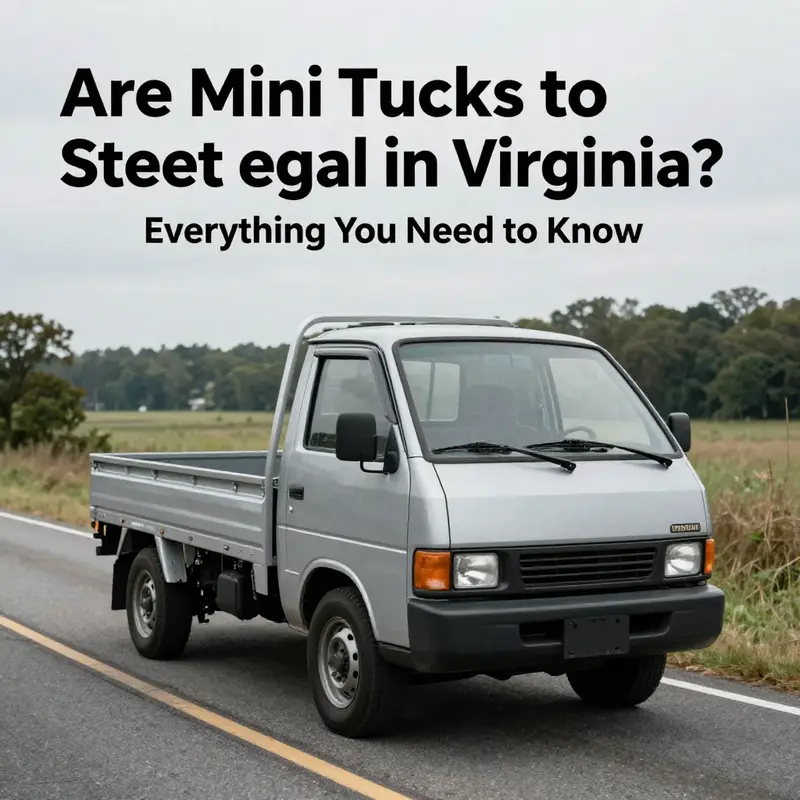
Mini trucks capture the imagination of drivers who want utility in a footprint that fits city streets and tight job sites. They promise nimble maneuverability, low footprint, and the kind of practical versatility that suits everything from campus deliveries to rural chores. But in Virginia, the dream of riding a compact, cross-functional vehicle onto the public road is not simply a matter of ownership or curiosity. It hinges on a precise set of rules administered by the Virginia Department of Motor Vehicles (DMV) that distinguish vehicles designed for everyday on-road use from those built for off-road work or private-property tasks. The distinction matters because it determines whether a vehicle can be titled, registered, insured, and legally driven on public streets, highways, and public rights of way. The general principle is straightforward enough: if a mini truck is not designed and certified to meet the state’s road-usage standards, it is not street legal in Virginia. The details, however, reveal a complex gatekeeping system that blends engineering, safety, and regulatory compliance into a singular test of roadworthiness. To understand why, it helps to start with how Virginia classifies vehicles and what the DMV expects from anything that might share the pavement with more conventional cars and trucks. The DMV’s framework is not simply about size. It looks at design intent, construction, and the vehicle’s ability to meet safety and emissions standards applicable to on-road operation. A small utility vehicle that is marketed or used primarily for off-road adventures or agricultural tasks may resemble a truck in form but still fail to qualify for street use if key criteria are not met. The road-legal question, in other words, is not a purely aesthetic or performance topic; it is a regulatory threshold with real consequences for title, registration, insurance, and the ability to legally traverse public roads. For readers who want a quick anchor, consider the overarching guidance: the road readiness of a mini truck is determined by whether it can pass the DMV’s safety inspection, meet basic safety equipment requirements, and demonstrate compliance with emissions and other federal and state standards. The missing pieces often arise from something as fundamental as whether the vehicle has proper lighting and signaling, seat belts, mirrors, a horn, and working brakes and headlights. In Virginia, these are not optional extras; they are the baseline that separates a vehicle that can legally share the asphalt from one that can only exist behind closed gates or on private property. The practical implication is clear: even if a mini truck looks and feels like a practical solution for certain tasks, it remains outside the public-road framework unless it has been specifically certified to meet the state’s road-use criteria. The DMV’s criteria also extend beyond basic safety equipment. Emissions compliance, a standard often tied to federal and state environmental rules, plays a role in determining whether a vehicle can be registered for on-road use. The distinction is not merely about whether a vehicle can start and stop; it is about whether it conforms to the emissions profile that Virginia enforces in alignment with federal guidelines administered by the U.S. Environmental Protection Agency (EPA). It is easy to imagine scenarios where a mini truck, especially an electric one, could be tempted to head straight onto a city street. An electric mini pickup, with its compact powertrain and electric components, might appear to align with modern urban regulations. Yet even electric powertrains must meet the same basic safety and compliance standards as their internal-combustion counterparts if the vehicle is to be allowed on public roads. In practice, this means the vehicle would need to display a valid title, pass a Virginia safety inspection, and demonstrate that its lighting, signals, brakes, and other safety systems function in accordance with state requirements. The DMV’s rules do not treat all small vehicles equally; they separate those designed for private use, those intended for farm or industrial settings, and those manufactured as true on-road vehicles. The line between these categories is often blurry in the marketplace. A vehicle that looks like a compact pickup might be marketed as a “utility vehicle” and offered with features that make it appear ready for road use. If those features do not align with Virginia’s standards, the vehicle cannot be legally driven on public roads without modifications and formal certification. The practical reality for enthusiasts is that a mini truck is not a free pass into Virginia’s streets simply because it can fit into a garage or a loading dock. The DMV requires more than intent; it requires proof of compliance with the structural, safety, and environmental benchmarks that keep the broader driving environment cohesive and safe. This is why discussions about street legality regularly point readers toward the DMV’s official guidelines and registration resources. It is also why many operators who want to use a mini truck for farm work, campus maintenance, or light-duty tasks in private or restricted areas choose to keep their vehicles on private property or in suitably designated zones within industrial parks or farms. In those contexts, the vehicle remains a practical asset without triggering the regulatory steps that accompany on-road use. For those who want to explore the broader landscape of mini trucks and their regulatory journeys, a useful portal to gather contextual insights is the broader community discussion and documentation found on the Minitrucks blog. There, readers encounter a range of practical perspectives and experiences that illuminate how owners navigate the gray areas between off-road design and on-road compliance. Minitrucks blog. This level of community information can help buyers, hobbyists, and operators understand common pitfalls, recommended inspection checklists, and the sequence of steps needed if a vehicle is ever considered for road use in Virginia. Yet the blog is a companion resource rather than a substitute for official guidance. The Virginia DMV remains the arbiter of what is permissible on public roadways, and its guidelines are the definitive source for determining if a mini truck can be titled, registered, and insured for street operation. The path to legality, for those cases where it is achievable, typically involves a careful appraisal of the vehicle’s design intent, a determination of whether it currently meets the safety standards, and, crucially, the willingness to undertake modifications that bring the vehicle into full compliance. In many circumstances, that means ensuring the vehicle has the necessary safety equipment—working headlights and brake lights, visible turn signals, mirrors arranged to provide adequate blind-spot coverage, a horn, and properly functioning seat belts. It also means verifying that the vehicle’s weight, dimensions, and construction align with the DMV’s thresholds for road use, as some narrow or unusually light vehicles can present safety concerns on busy roads. The emissions and safety standards add another layer of complexity. Emissions compliance, while sometimes more straightforward for conventional gasoline-powered vehicles, involves ensuring that any vehicle running on a public road meets the state’s environmental requirements. For electric mini trucks, the question shifts toward proving that the electrical system, battery safety features, and overall design meet the performance standards expected of modern, road-going electric vehicles. Because the DMV’s evaluation is ultimately practical rather than theoretical, the true test for a mini truck’s street legality is a formal inspection and the successful issuance of title and plates. This is where many enthusiasts encounter the most significant hurdles: the need to demonstrate that the vehicle has been configured for safe operation within Virginia’s traffic environment. It is also where the distinction between a vehicle built for practical daily use and one that remains a specialty or off-road machine becomes a hard boundary. In the absence of such certification, the most common and sensible path for owners is to continue using mini trucks in settings that do not involve public streets—on farms, in industrial zones, or within campus maintenance fleets—where the regulatory requirements are not triggered in the same way. The wider takeaway is that a mini truck’s street legality is not a given; it is a carefully earned status that requires alignment with Virginia’s vehicle code, a successful safety inspection, and appropriate emissions and safety compliance. The DMV website remains the principal source of truth for guidance, and prospective owners should be prepared to pursue a formal process rather than assume on-paper eligibility translates into street permission. For those who want to further explore how the state treats different classes of compact utility vehicles, the DMV’s registration portal offers detailed, plan-step guidance that can help illuminate the exact prerequisites and potential roadblocks you might encounter when seeking a road-ready status for a miniature pickup. Official guidance is available at https://www.dmv.virginia.gov/vehicles/registration. In summary, in Virginia, most mini trucks are not street legal by default. They require specific design intent, safety features, and regulatory certifications that demonstrate conformity with on-road standards. Although there are legitimate pathways for some vehicles to transition into road-legal status through modifications and DMV inspections, many mini trucks remain restricted to private-property use or restricted-zone operations unless and until they meet the comprehensive requirements. The distinction between on-road and off-road use is not merely a matter of preference; it is a matter of legal compliance that protects drivers, pedestrians, and other road users while guiding the ongoing evolution of vehicle design in a state whose rules strive to balance innovation with public safety.
Final thoughts
Navigating the legal landscape for mini trucks in Virginia can seem daunting, but taking the right steps can open the door to safe and legal on-road experiences. Always ensure your vehicle complies with local regulations, including necessary modifications and safety features. This not only enhances your driving experience but also contributes to the safety of all road users. Whether you’re a small business owner looking for practical transport solutions or a mini truck enthusiast passionate about customization, understanding the legal requirements will help you make the best out of your mini truck experience in Virginia.