
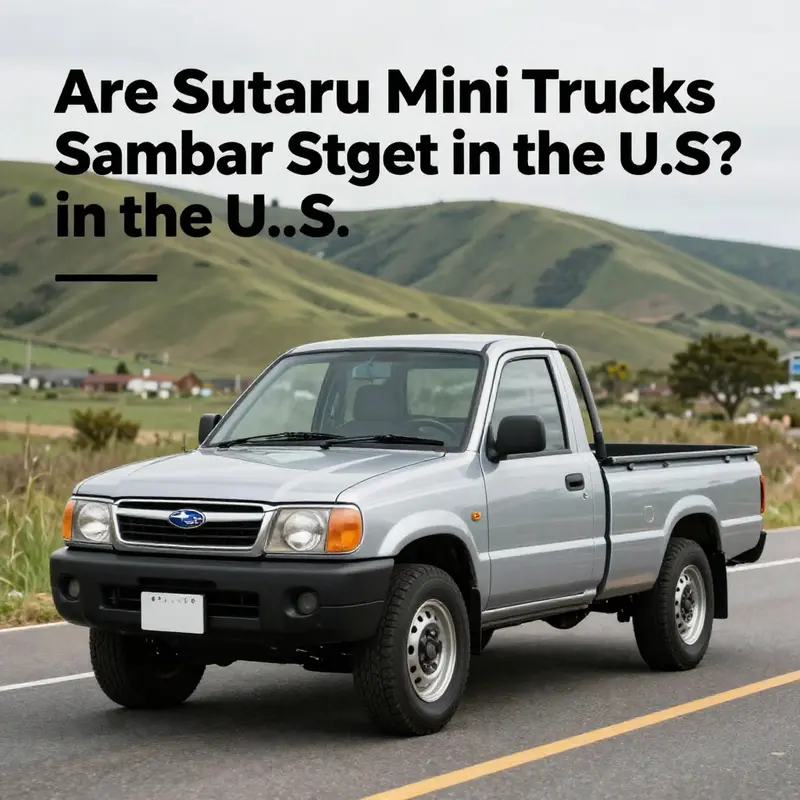
The charm of mini trucks like the Subaru Sambar has captured the hearts of enthusiasts across various terrains. Nevertheless, potential owners in the U.S. face a web of legal, safety, and economic hurdles before they can hit the open roads. From understanding the legal constraints surrounding importation to the safety and emissions requirements specific to U.S. regulations, and even exploring the economic climate influencing ownership, the complexities can be daunting. Our journey will cover how geopolitical factors shape the landscape for these unique vehicles and delve into public perceptions that can sway decisions for local small business owners and hobbyists alike. As you read on, you’ll gain a holistic view of the intricacies involved in possibly navigating toward owning a Subaru Sambar in the U.S.
Roads, Rules, and the Tiny Truck Dilemma: The Legal Path for Japanese Kei Mini Trucks in the United States
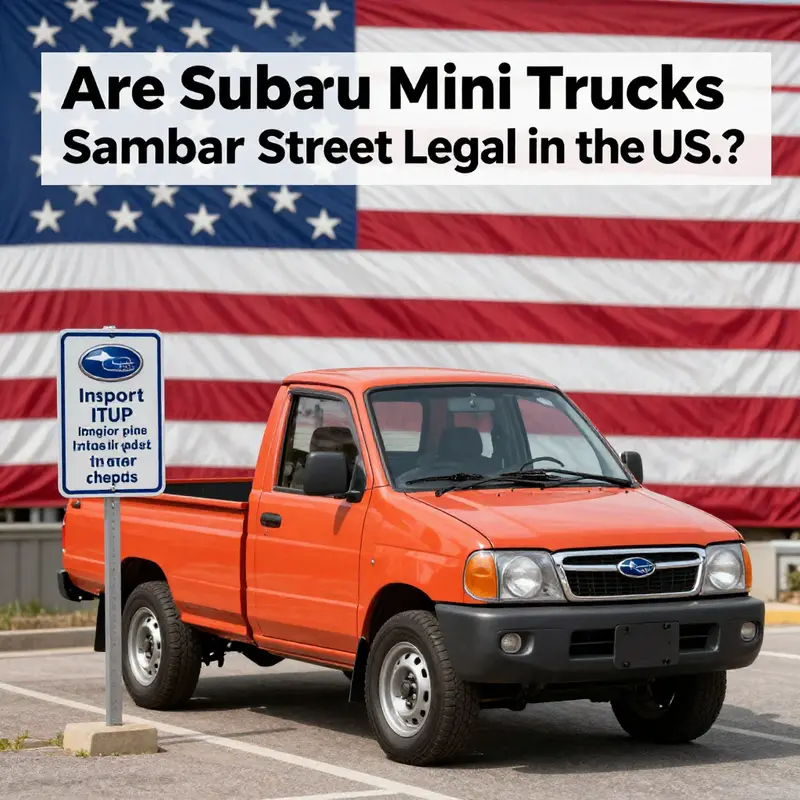
Curiosity has a way of finding its own wheels, especially when a pint-sized utility vehicle from overseas stirs nostalgia and practicality in equal measure. In markets where space is as tight as a grocery store parking lot, a compact, boxy workhorse carries real appeal. But the dream of a street-legal import in the United States runs headlong into a highly structured system built to protect passengers, other road users, and the environment. The fate of a Japanese kei-class mini truck on U.S. pavement is a story of rules that prefer uniform safety and predictable emissions over the romance of a low-slung, kei-sized hauler. To understand why such a vehicle is rarely seen cruising U.S. streets, it helps to follow the chain of requirements that makes up today’s import landscape. At the heart of the matter are three regulatory pillars: safety standards, emissions controls, and the bureaucratic pathways that govern everything from who adds the final bolt to who validates a vehicle’s paperwork. The safety framework is the most conspicuous, because it speaks directly to what a car or truck does when it is involved in a crash. In the United States, the Federal Motor Vehicle Safety Standards (FMVSS) set uniform criteria for crashworthiness, lighting, occupant restraints, crash testing, and many other factors that define modern passenger safety. A compact machine designed for another market often reflects a different approach to front and rear lighting, bumper strength, brake performance, and the way seat belts and airbags are integrated. For a vehicle that never underwent U.S. certification, those gaps are not mere pinpricks; they are barriers that demand substantial redesigns if the vehicle is to be operated on public roads. The same logic applies to emissions. The Environmental Protection Agency (EPA) requires that vehicles meet U.S. pollutant limits for carbon monoxide, hydrocarbons, nitrogen oxides, and particulates, among other metrics. A Japanese market truck frequently uses engine calibrations, fuel systems, and exhaust configurations that simply do not align with U.S. standards. For an import to move from curiosity to on-road reality, it must reconcile every one of these differences, or instead find a way around them through a formal exemption. The most well-known exemption pathway for older vehicles is the 25-year rule. This rule establishes a practical, albeit narrow, corridor: vehicles that are at least 25 years old can enter the United States without meeting the current FMVSS and EPA standards, provided they still comply with other applicable regulations. In this context, a twenty-five-year-old kei truck—older than the threshold by only a breath—enters a different regulatory universe, one where the primary constraint is age rather than alignment with modern standards. This is not a free pass that dissolves safety and environmental concerns; it is a transitional window that acknowledges nostalgia and historical import practices while preserving a framework in which the vehicle can be evaluated in its own right. The year-by-year arithmetic matters: a model from the late 1990s becomes importable only after it crosses the 25-year line, which has gradually opened the door for enthusiasts who value authenticity and inside knowledge about how such vehicles perform when removed from their original regulatory context. Yet even within this window, the process is neither automatic nor simple. Importers must still address the underlying issues that the newer, non-exempt market vehicles must clear. That means filings, demonstrations, and sometimes substantial alterations—processes designed to document a pathway that makes sense for a vehicle that was never certified for U.S. highways. Even when the vehicle earns an import permit under the 25-year rule, it is typically watched through a careful lens by agencies that want to preserve road safety and environmental controls. The practical implication for most would-be owners is that the idea of a plug-and-play import dissolves into a more involved project: assess the vehicle’s current condition, determine what the regulations require if it is to be used legally, and then weigh the financial and logistical reality of achieving that level of conformity. For some, the conclusion is straightforward: it is not a feasible project to chase a street-legal status for a non-certified truck without converting it to meet several FMVSS components and EPA standards. For others, the allure remains strong, and the story becomes a longer, more complex journey that blends import hobby with compliance engineering and regulatory navigation. To those who remain drawn to the idea of a legally operable, small, Japan-origin vehicle on U.S. roads, a recent reminder sits in the background: even with the 25-year rule, the path to a compliant vehicle is not guaranteed by age alone. The legal framework requires a careful, documented assessment of safety features, crashworthiness, lighting schemes, seat belts, airbag configurations, and the vehicle’s emissions profile. Where the majority of practical discussions tend to stall is in the realm of cost and feasibility. It is one thing to obtain a vehicle and another to bring it up to the standard that U.S. roads demand. This often involves substantial modifications and professional oversight—part of why the project, while intellectually appealing, remains out of reach for many casual collectors or weekend enthusiasts. The outcome of such a project hinges on the willingness to invest in documentation, testing, and the iterative process that validates a vehicle against FMVSS and EPA criteria, along with the paperwork required by U.S. Customs and Border Protection. The import process itself adds another layer: duties and fees accrue on top of the purchase price and transport costs, and the timing of entry can be influenced by regulatory checks, compliance verifications, and the availability of qualified facilities to perform necessary alterations. In many cases, the end result is a vintage-tinged machine that is legally export-restricted to use on private property or is effectively reserved for shows and displays, not for daily commuting. The social dimension of this topic is telling as well. A compact Japanese truck captures a certain romance—the sense that engineering from a distant market can be adapted to a U.S. road experience. Yet the enforcement of safety and emissions standards is not a mere bureaucratic formality. It is a living, operational framework that shapes how, when, and if such a vehicle can share the street with larger, purpose-built vehicles. In this light, the conversation often shifts from “can I” to “how would I”—how would the vehicle, after undergoing substantial evaluation and modification, perform in terms of pedestrian safety, rollover protection, lamp performance, and the environmental footprint that U.S. standards demand. The practical upshot is that if a reader’s interest centers on a spontaneous, no-strings-attached import, the landscape is littered with barriers that favor a careful, deliberate approach. The idea of a quick import fades into a longer project—one that requires a clear plan, access to experienced shops, and a willingness to document, test, and return to the authorities if needed. To support readers who want to explore this topic with both caution and curiosity, there is value in turning toward community resources that gather practical insights from people who have walked the path. The online conversations, the tales of trials and triumphs, and the careful accounting of costs and hurdles contribute to a fuller picture than regulatory summaries alone. For readers who want a sense of what the hobby looks like in practice, the Minitrucks Blog provides a window into the broader world of kei-truck enthusiasts, including discussions of restoration, modification, and the realities of keeping a vintage utility vehicle road-ready in different regions. This resource offers a context that complements the formal regulatory landscape, giving a sense of how owners approach safety, aesthetics, and functionality while working within or around the rules. For those seeking more firsthand accounts and practical notes, the blog serves as a useful companion to the regulatory material discussed here, bridging the gap between theory and lived experience, and reminding readers that even with age or exemption, the journey toward road legality remains intricate and deeply human. Readers who want to dive deeper into the narrative and gather real-world perspectives can explore related stories in this community space: Minitrucks Blog. It is in this shared space that enthusiasts weigh the romance of an unobtrusive, efficient work vehicle against the reality of compliance, cost, and safety that the American road system enforces. While the regulatory path can feel rigid, the ongoing dialogue among importers, shops, inspectors, and hobbyists keeps the topic dynamic, evolving as new interpretations of compliance emerge and as older vehicles cross the 25-year threshold with new documentation and demonstrated performance. The result is not a single verdict but a spectrum of possibilities, shaped by the vehicle’s condition, the importer’s resources, and the willingness to align ambition with safety. The legal constraints surrounding the importation and street use of Japanese kei mini trucks in the United States thus present a compelling case study in how modern road networks balance heritage, practicality, and accountability. They remind us that a machine built for a different regulatory environment carries with it a set of responsibilities that extend beyond value, rarity, or charm; those responsibilities are the price of admission to the American street. For readers who want to ground their understanding in official guidance and formal requirements, it is prudent to consult primary sources and current rulings as rules can shift with new interpretations or updates to FMVSS and EPA standards. The regulatory picture remains complex and nuanced, especially for vehicles that sit on the line between import novelty and on-road obligation. In short, the street-legal status of a Japanese kei mini truck in the United States is not a universal yes or no. It hinges on a careful analysis of age, conformity, and the readiness to meet safety and emissions obligations. The most practical takeaway is to approach the idea as a staged project, one that respects the letter of the law while acknowledging the historical and cultural appeal that draws people toward these tiny, capable vehicles. For researchers and enthusiasts alike, the topic continues to unfold as new examples surface, and as the aging of models creates the potential for legal entry under the time-tested 25-year rule—paired with ongoing attention to the all-important compliance standards that ultimately determine whether a road-legal, Japanese-origin mini truck actually belongs on U.S. pavement. External resource: https://www.nhtsa.gov/vehicle-imports
From Kei to Road-Ready: The Regulatory Barriers Keeping Japanese Mini Trucks Off U.S. Streets

When people ask whether a compact Japanese mini truck can legally share the same streets as full-size pickups, the short answer is usually no. In practice, these light, pint-sized workhorses are built for a very different regulatory world than the one that governs U.S. highways. They come from markets where regulatory priorities diverge from American safety and emissions standards, where vehicle design priorities—compact footprint, basic driveline, and efficient urban utility—win favor in regional rules rather than a test bench of crash data and emissions guarantees. The result is a vehicle that may excel in tight urban alleys or rugged, off-road backroads abroad, but which faces a formidable gauntlet of federal and state requirements to become street-legal here. The question is not merely about a vehicle’s size or capability; it hinges on a comprehensive framework that defines what a vehicle must be, and what it must do, before it can legally share the same open roads that Americans rely on every day. In this light, a compact international kei-class truck faces a layered challenge that extends far beyond a simple conversion or a single modification. It is a test of alignment with the nation’s most fundamental road-safety and environmental expectations. And the result, more often than not, is a clear separation between a vehicle that is technically interesting and a vehicle that is legally road-ready.
The bedrock of that separation lies in the two pillars that authorize any vehicle’s presence on U.S. pavement: safety and emissions. The National Highway Traffic Safety Administration (NHTSA) and the Environmental Protection Agency (EPA) set and enforce the standards that determine whether a vehicle can be sold, registered, and driven in U.S. cities, towns, and highways. Vehicles intended for sale in the United States must be certified as compliant with the Federal Motor Vehicle Safety Standards (FMVSS) and the EPA’s emissions regulations. These rules encompass everything from bumpers and lighting to crashworthiness and airbag performance, and from exhaust systems to on-board diagnostics. A vehicle designed for a different regulatory landscape may meet its home country’s requirements, but there is no automatic cross-approval or mutual recognition that would automatically translate that certification into U.S. compliance. The result is a legal gap: a vehicle can exist and perform on foreign soil with a distinct regulatory logic, yet fail to meet the safety and environmental expectations of U.S. roadways.
In the case of the kei-class mini truck in question, that gap is pronounced. The interior layout, powertrain tuning, and body building of these vehicles are optimized for different markets—compact dimensions, short wheelbases, and sometimes off-road or all-wheel-drive capabilities—without the FMVSS-tested elements that have become standard in the United States. Front and rear lighting patterns, required to ensure predictable visibility for other drivers, are not just about brightness; they are about specific geometry, color, and mounting heights that align with U.S. regulations. The same goes for occupant protection: seat belts and airbags in the U.S. have to meet a precise set of performance criteria and are often integrated with vehicle restraint systems, passenger seating layouts, and crash-test data that differ from those used to certify international designs. When a vehicle comes without these elements or when those elements do not meet U.S. testing standards, the path to on-road legality becomes blocked by the requirement to bring the vehicle up to current FMVSS and EPA expectations—an undertaking that is both costly and technically demanding.
Emissions compliance is another critical gatekeeper. The EPA’s rules regulate how a vehicle emits pollutants, how those emissions are monitored, and how the exhaust and after-treatment systems are designed. A small Japanese truck may rely on an emissions approach that is appropriate for its local test cycles and regulatory regime, but not compatible with U.S. testing procedures or fuel standards. Importantly, even if an importer attempts to retrofit an engine control system, catalysts, or exhaust configurations to meet U.S. standards, the process typically involves extensive testing, documentation, and often redesigns to ensure that the entire vehicle remains safe and reliable under FMVSS and EPA rules. The necessary changes can touch everything from the powertrain and fuel system to the electrical architecture, all under the close scrutiny of federal regulators. The financial and logistical costs of achieving compliant emissions performance can be prohibitive, especially when the vehicle’s core design was never created with U.S. regulations in mind.
There is a narrow, legally recognized pathway that some enthusiasts reference—the so-called “Show or Display” exemption. Vehicles over 25 years old may be imported under this rule even if they do not meet current FMVSS or EPA standards. The catch is that the exemption is not a free pass to operate on public roads as if it were a certified new vehicle. Once in the United States under Show or Display, the vehicle must still be used primarily for exhibition in shows or parades, and it faces a rigorous inspection regime to verify that it is safe to be on the road at all. Even with that exemption, many examples struggle to remain road-legal in practice because they still need to demonstrate basic safety compliance, including seat belts, lighting compliance, and other fundamental features. The reality is that while the 25-year threshold can open an import window, it does not automatically translate into a fully certified, street-legal status. And in most cases where exotics and offbeat imports have sought to be street-legal, the scale of documentation, the need for expert engineering adjustments, and the sheer cost of compliance have proved to be substantial barriers that deter all but the most committed projects.
To someone standing at the edge of this regulatory perimeter, the import of such a vehicle can feel like a high-stakes legal puzzle. A buyer might imagine a straightforward, one-step modification to claim compliance. But the truth is more intricate: a single adjustment—say, to lighting or to seat belts—ripple-reads into other parts of the system, including how the vehicle interacts with the braking system, the electrical harness, the instrumentation, and the vehicle’s crash mitigation features. The modular nature of a modern vehicle, with electronic controls that coordinate with sensors, cameras, and actuators, means that a change in one area often triggers compliance questions elsewhere. This is not merely a matter of swapping bulbs for amber signals or applying a different sticker to the firewall. It is a comprehensive safety, emissions, and labeling challenge that requires coordinated engineering approvals, testing, and documentation. When a vehicle’s original purpose and certification are outside the U.S. framework, the path to legality becomes a long, expensive journey that demands a library of paperwork, expert technicians, and a willingness to navigate a slow regulatory process.
The practical implications of this regulatory labyrinth are clear. First, there is the price of admission. Even when the theoretically possible route exists—to restore an ancient or foreign-design vehicle to U.S. standards—the dollars spent on engineering, parts imports, testing, and specialized labor typically dwarf the initial purchase price of the vehicle itself. Second, there is risk. The compliance path is not a guaranteed success; regulators require precise, verifiable evidence of safety and emissions performance. Third, there is availability. Real-world supply chains for compliant U.S.-spec parts for an imported, niche kei-class truck are often fragile or nonexistent. This means that even determined hobbyists face long waits, high costs, and the possibility that the vehicle will never truly become a daily-driver option.
The end result is a nuanced reality: a compact Japanese mini truck can be a fascinating project and a compelling centerpiece for off-road or display use, but it remains, for most people, outside the realm of practical everyday road use in the United States. The vehicle’s compact size and rugged, utilitarian character appeal to enthusiasts who prize compact dimensions, simple mechanical layouts, and the charm of a vehicle built for a different regulatory era. Yet the regulatory framework that governs safety, emissions, and vehicle operation on U.S. roads remains the ultimate judge of whether such a vehicle can join traffic. For those who want to explore the broader universe of light, utilitarian trucks—those that share the spirit of compact, capable, all-purpose utility—there is value in understanding how regulations shape what is possible and what remains out of reach. The distinction between a vehicle that can perform in a different regulatory climate and one that can responsibly enter U.S. roads is a powerful reminder that legality is not a single question answered by passion or performance alone. It is a compilation of standards, testing, and proof of conformity that a vehicle must earn, not merely appeal to. If you’re curious about how this world of mini trucks is shaping up in other markets or how builders navigate the space between concept and compliance, a good starting point is to explore the broader community of enthusiasts and their projects—where information, experience, and hands-on problem solving circulate. minitrucks blog.
For readers who want to ground these considerations in official guidance, the import and compliance landscape is anchored in federal resources. The National Highway Traffic Safety Administration (NHTSA) provides the formal framework and guidance for vehicle imports, safety certifications, and related compliance processes. The practical takeaway is simple: without meeting these standards, a vehicle cannot be sold, registered, or driven on U.S. public roads in the ordinary course. The rules are explicit about the responsibilities of importers, the assessments required, and the documentation needed to demonstrate compliance. While there are pathways like the 25-year rule and Show or Display provisions, they do not erase the fundamental safety and emissions safeguards that U.S. road networks rely on. To access comprehensive information on import regulations and compliance, visit the official NHTSA website: https://www.nhtsa.gov.
Economics of the Subaru Sambar in the U.S.: A Reality Check
Imagine a compact, highly maneuverable pickup whose charm comes from its tiny footprint and clever packaging. In Japan, the Sambar lives as a kei-car icon; in the United States, its on-road viability hinges on a complex web of costs and regulatory hurdles. The core economics are simple: initial purchase price abroad is only the beginning. Import, shipping, broker fees, and potential duties quickly add up before a single mile is driven. Then come compliance costs to meet FMVSS and EPA standards, or the expensive Show or Display pathway for vehicles over 25 years old, which still requires inspections, modifications, and specialized labor. The result is a total ownership cost that can eclipse any savings from the sticker price.
Operational costs further shape the math. Fuel economy is impressive in theory, but real-world savings depend on parts availability, maintenance infrastructure, and the frequency of repairs that must be sourced from overseas. Insurance tends to run higher for nonstandard, import-only vehicles, and resale values in the U.S. reflect uncertain demand and regulatory risk rather than established market strength.
Enthusiasts may argue the Sambar offers irreplaceable urban utility and a unique hobbyist appeal, but for most buyers the economics point toward a limited, niche use rather than mass-market adoption. In practice, many opt to pursue a legally compliant light truck that already meets U.S. standards, or to treat the Sambar as a dedicated project with a long, costly road to road-readiness.
For further reading on the import process and regulatory framework, see resources such as the National Highway Traffic Safety Administration (NHTSA) vehicle imports guidance, and hobbyist discussions in importer communities.
Geopolitics on the Road: How Global Tides Shape the Sambar’s Path to U.S. Street Legality
The Sambar occupies a curious niche at the intersection of hobbyist imagination and regulatory reality.
In markets like Japan it is a compact work vehicle, but in the United States street legality hinges on meeting FMVSS and EPA standards that the vehicle was not certified to meet.
Consequently, the typical kei-truck is not eligible for standard on-road use without extensive modification and official approvals. The practical takeaway is that a full compliance program—engine tuning, safety upgrades, and emissions controls—would be required, with costs and paperwork often making the project impractical for most buyers.
Beyond the vehicle itself, geopolitics shapes the availability of parts, the reliability of supply chains, and the timing of shipments. Global tensions, tariffs, and export controls can push parts prices higher and slow the adaptation work necessary to reach U.S. standards. The Russia-Ukraine conflict, port congestion, and skilled-labor constraints can all tip the economic balance toward risk rather than reward.
These dynamics do not render the dream impossible, but they do constrain it. Some importers pursue Show or Display exemptions, but those routes still require demonstrating compliance with safety and emissions requirements and bearing the associated costs. The decision to pursue such a project becomes a strategic risk assessment rather than a simple purchase.
For readers exploring this topic, industry analyses and hobbyist forums illustrate how such imports unfold in practice, including the role of brokers, the availability of parts, and the timing of regulatory reviews. The broad lesson remains: global politics and supply chains are an inextricable part of the equation when turning a kei truck into a U.S. street-legal vehicle.
External resource: https://www.sciencedirect.com/science/article/pii/S096669232400157X
Small Wheels, Big Questions: The Social Reception of Japanese Kei Mini Trucks on American Streets
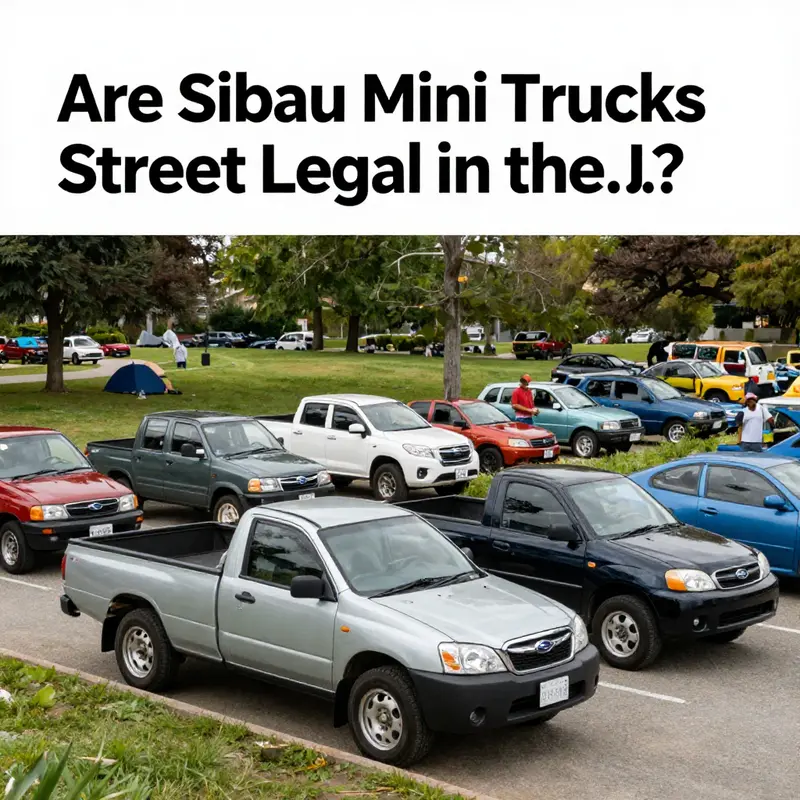
A compact vehicle from the other side of the world often invites more curiosity than concern about how it would function in daily American life. The idea of a tiny, practical kei truck arriving on U.S. roads touches a cluster of social questions that extend beyond engineering specs. It asks what Americans expect from their everyday mobility, how they imagine safety and capability, and what a vehicle’s size says about the people who use it. On the surface, a two-meter-long workhorse with a bed about 1.4 meters wide looks efficient, almost surgical in its efficiency. It carries the appeal of simplicity: fewer components, lighter footprint, easier maneuvering in crowded urban spaces. Beneath that appeal lies a more complex set of cultural interpretations. In the United States, cars are often seen as extensions of status in addition to transportation. Larger, higher-profile vehicles—SUVs, pickups, and minivans—signal ruggedness, endurance, and readiness for a wide range of tasks, from family road trips to tackling rough backcountry routes. A very small truck, even if perfectly capable on a city block or a small delivery route, can be perceived as incongruent with these established narratives. Practically, the smallest class of utility vehicles must prove its worth not just in miles per gallon or cargo capacity, but in how seamlessly it fits into a lifestyle built around durable, adaptable, and emotionally resonant machines. The social calculus, then, evolves from a simple question—does it work?—to a broader inquiry: what does it say about who we are as drivers, buyers, and communities that shape the rules of the road?
Among the practical advantages of such a kei truck is its compact footprint, which translates into nimble parking, easy navigation through dense urban corridors, and an often surprisingly tight turning radius. The vehicle’s design emphasizes utility over luxury, prioritizing a simple, nearly spartan cockpit and a bed that can carry a surprising mix of parcels, tools, and small equipment. For people whose work lives revolve around urban deliveries, campus maintenance, small-scale farming, or niche trades, these characteristics offer a welcome alignment with the day-to-day realities of crowded cities and compact suburban blocks. The engine, typically around 660cc, is tuned for efficiency and reliability rather than highway power. It delivers enough pep for city streets and short commutes but isn’t designed to dominate multi-hour interstate travel or handle heavy, sustained payloads. This fundamental balance—efficient city performance with a modest power envelope—becomes a talking point in social settings where the vehicle is discussed, admired, or questioned.
Still, the social reality in the United States is not a blank slate. The country’s automotive culture has long prized stability and predictability, and the perception of a vehicle as a practical tool is inseparable from how that tool is supported by infrastructure, service networks, and safety frameworks. A kei truck’s small size can be lauded for its parking ease and low operating costs, yet it may raise concerns about visibility, crash protection, and the ability to perform in a broader range of real-world conditions. The way people talk about such a vehicle—whether as a clever urban workhorse or a novelty with limited practical reach—depends on lived experience more than glossy brochures. In this sense, social acceptance is not a straight line from technical capability to market success. It is a conversation about values: how much space a society is willing to devote to a vehicle that prioritizes efficiency and maneuverability over sheer mass and power, and how well the vehicle can be integrated into existing transportation ecosystems.
The regulatory fabric around bringing this class of micro-truck into daily use in the United States adds another layer to the social narrative. It is here that legality, safety, and consumer confidence collide. To ride legally on U.S. roads for ordinary use, any vehicle must meet current federal safety standards and emissions requirements. A vehicle in this class would typically have to pass all applicable Federal Motor Vehicle Safety Standards and Environmental Protection Agency regulations, even if it might qualify for a special import path under exemptions such as Show or Display, which apply chiefly to vehicles that are restored or preserved and are not driven as daily transportation. The reality, however, is that this path is narrow. The U.S. market was never designed around the kei category, and the specific vehicle in question was not certified for U.S. road deployment. What this means in practice is that most individuals who wish to operate such a machine on American streets face a daunting, multi-year, multi-faceted process. They must assemble a documentation trail that shows compliance or near-compliance with FMVSS and EPA standards, arrange for testing or equivalency determinations, and secure clearances that can demand substantial time, money, and expert guidance. Even when exemptions exist on age or display, many of the safety features Americans come to expect—effective crash protection, airbags, robust lighting, and standardized crash-test performance—remain the subject of rigorous scrutiny and, in many cases, insurmountable costs.
The social conversation around cosmopolitan, city-focused mobility also intersects with the symbolic language of car ownership in the United States. A micro-truck’s understated silhouette, its tiny footprint, and its thrifty powertrain may be celebrated by urban delivery pilots and sustainability advocates as emblematic of a more efficient use of space and energy. For this audience, the kei truck embodies a philosophy: maximize usefulness in a compact footprint, minimize waste, and keep maintenance manageable. Yet for a general consumer audience, the same attributes can feel precarious when imagined against the familiar benchmarks of reliability, capacity, and long-distance comfort. Will it feel sturdy on a long highway journey if a gust of wind or a rough patch of pavement challenges its light frame? Can a small payload be considered a serious alternative to the bigger, more adaptable vehicles that are standard in many households? Social acceptance grows where these questions are answered with practical, repeatable experiences—where delivery fleets demonstrate predictable performance, where repair networks and parts supply respond quickly, and where the vehicle’s image evolves from being a quirky curiosity to a trusted work tool.
A key dimension of this acceptance puzzle is the economic and regulatory environment that shapes ownership costs and perceived risk. In Japan, kei cars and kei trucks have historically benefited from tax breaks and insurance advantages tied to their small size and limited displacement. Those incentives, however, do not translate directly to the U.S. market. The absence of parallel tax structures, insurance incentives, or consumer subsidies means that the economic calculus for a U.S. buyer leans heavily on purchase price, import costs, ongoing maintenance, and the price of necessary modifications to meet U.S. standards. When all of these factors come together, the practical attractiveness of a kei truck to the average American buyer often hinges on niche use cases where the vehicle’s strengths—parking ease, urban delivery efficiency, and unique aesthetic—outweigh the perceived compromises in performance, comfort, and regulatory compliance.
This is where the social narrative often pivots from discussion to demonstration. Enthusiasts and urban-delivery operators can be drawn to the idea of a compact, fuel-efficient vehicle that navigates city streets with ease, yet their enthusiasm sits alongside more cautious voices that emphasize the importance of standardized safety and predictable serviceability. The social acceptance of such a vehicle in the U.S. is not simply about whether a road-legal version exists; it is about how a community of users, regulators, insurers, and repair professionals can support a vehicle that sits at the edge of mainstream automotive culture. The existence of a dedicated community, online and offline, helps reduce friction by sharing knowledge about sourcing parts, adapting components to meet standards, and understanding the nuances of import and registration. For readers seeking a broader sense of how small, practical transport options are discussed and developed within the U.S. market, the minitrucks blog serves as a hub for ongoing conversations and experiments. minitrucks blog.
As the conversation evolves, a broader acceptance could emerge in specific contexts where the vehicle’s strengths align with defined needs. Small business owners running fleets for last-mile delivery in dense urban or campus environments might find value in a tool that is easy to park, quick to service, and economical to operate. A micro-truck can be designed to optimize a particular workflow—delivering supplies to dorms, clinics, or farmers markets—without demanding the broad capacity and complexity of larger trucks. In such scenarios, what matters most is reliability, ease of maintenance, and the ability to integrate into existing processes. If a critical mass of operators demonstrates that the vehicle can perform the job consistently, and if the regulatory path becomes clearer or more navigable through standardized processes or recognized approvals, social acceptance could broaden. Yet even in these optimistic scenarios, the underlying drivers of acceptance remain pragmatic: can the vehicle be used safely, affordably, and with a reasonable expectation of availability of service and parts? These questions shape the social fabric surrounding the vehicle more than any single marketing pitch could.
The chapters that follow this discussion of social perception will address the regulatory landscape in more depth and explore how import pathways, safety testing, and emissions compliance interact with consumer demand. For now, the story remains one of a niche product that resonates with a core set of users while continuing to struggle with the social, regulatory, and economic barriers that keep it from becoming a mainstream option on American streets. If you want to explore how community conversations around these vehicles unfold in practical settings, the broader content found in the minitrucks blog offers a useful lens for understanding the kinds of projects, questions, and experiments that shape the perception and deployment of compact utility vehicles minitrucks blog.
For readers seeking authoritative regulatory context, the federal guidance on importing noncompliant vehicles is essential reading. The National Highway Traffic Safety Administration provides official resources on vehicle imports, compliance, and the processes that govern whether a vehicle can be legally operated in the United States. See the NHTSA information here: https://www.nhtsa.gov/vehicle-imports
Final thoughts
Owning a Subaru Sambar mini truck in the U.S. is not just a matter of falling in love with this unique vehicle; it is also about navigating the intricate web of legal regulations, compliance mandates, and societal attitudes. While some might view these mini trucks as not just vehicles but symbols of an adventurous lifestyle, the path to street legality remains fraught with challenges. As you weigh your options, remember that understanding these components can empower you to make informed decisions about your next mini truck adventure.