

Mini trucks have become increasingly popular among local small businesses, residential property owners, and enthusiasts alike, thanks to their compact size and versatility. Whether you need a reliable vehicle for delivery or are considering a hobbyist project, understanding who makes these trucks is essential. In this article, we’ll explore the key manufacturers behind mini trucks, delve into innovative electric models, examine current market trends, and highlight regional variations across different markets. Let’s journey through the mini truck landscape together!
Tiny Workhorses, Global Factories: Mapping Who Makes Mini Trucks and How They Move Goods
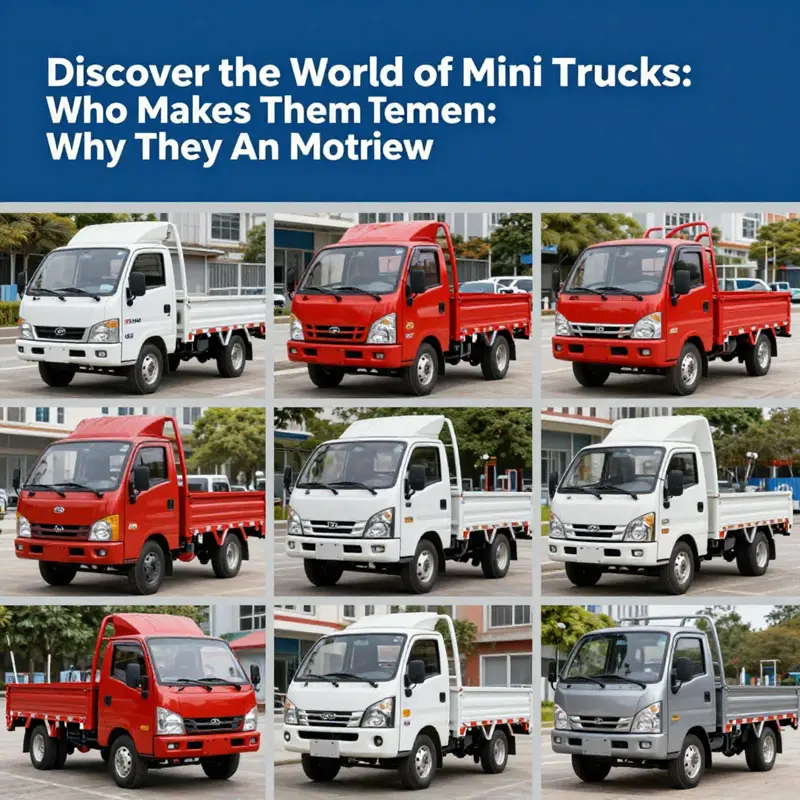
Mini trucks exist at the intersection of urban logistics, rural haulage, and the evolving demand for compact, efficient vehicles. They are not the stuff of glossy showrooms but rather the workhorses that quietly shoulder last‑mile deliveries, neighborhood servicing, and light cargo tasks in cities and towns around the world. The question of who makes these small, practical machines is not a simple binary of brand names; it is a tapestry of regional strengths, manufacturing philosophies, and market strategies that together shape what a mini truck can do, where it can operate, and how sustainably it can perform over its lifetime. In this light, the landscape looks both concentrated and diverse. A handful of large, well‑established makers in Asia supply the bulk of the traditional internal‑combustion mini trucks, while newer entrants and global sourcing networks enlarge the field to include electric variants, CKD programs, and mass‑market online channels. The result is a global ecosystem that translates design intent into fleets, into toolboxes, into urban deliveries, and into the quiet rhythm of daily commerce.
Across Asia, the manufacturing backbone of mini trucks rests on a few global corridors. Chinese producers, in particular, have built a dense, capability‑rich ecosystem that covers chassis manufacturing, powertrain integration, and final assembly for both diesel and electric light commercial vehicles. In this region, several brands have emerged as common reference points for buyers who need compact payload capacity with durable, easy‑to‑maintain systems. These factories not only supply local markets but also export to other continents through direct sales networks, international distributors, and CKD—completely knocked down—arrangements that enable assembly closer to end customers or in regions with specific regulatory requirements. This approach reduces lead times and helps customers tailor configurations to their local road conditions, payload needs, and import duties, all while maintaining cost efficiencies that keep the total cost of ownership attractive in price‑sensitive markets.
Within China, the manufacturing map expands beyond single brands to a broader capability mix. One line of manufacturers concentrates on light‑duty cargo vehicles with robust, straightforward powertrains designed for urban logistics and regional distribution. These firms emphasize reliability, ease of maintenance, and favorable fuel economies, both for diesel engines and, increasingly, for electric propulsion options. The emphasis on compact form factors aligns with a growing demand for vehicles that can navigate narrow streets, load small parcels, and park easily in dense urban centers. Another set of players builds on sophisticated chassis production and precision assembly lines, enabling a wider range of configurations and the option to produce outfits that can meet more stringent regulatory environments. The result is a supply network capable of scaling from single‑unit orders to international fleet deployments, with the flexibility to adapt to local standards and customer specifications.
Beyond the core Chinese producers, a Japanese manufacturer has also signaled a strategic commitment to mini trucks through plans to manufacture small trucks locally in the United States. This move reflects a broader pattern in which established brands seek proximity to major markets to increase responsiveness, reduce import costs, and better align with local demand cycles. It also underscores a reality of global platforms: a mini truck may be conceived in one region, but its operational lifeblood can be supplied by a constellation of partners, suppliers, and assembly facilities that stretch across borders. Localized production in the United States would likely be driven by a desire to optimize delivery timing for urban fleets and small businesses, while addressing regulatory standards, safety requirements, and workforce considerations that are specific to the American market. The spread of such localization efforts mirrors the evolution of logistics itself, where speed, reliability, and regional adaptation determine competitiveness as much as the raw efficiency of the engine or chassis.
Alongside the traditional powertrains, another facet of the mini truck story is the rising tide of electric variants. Electric propulsion aligns naturally with the urban delivery use case. For fleets that need quiet operation, zero tailpipe emissions in crowded neighborhoods, and lower maintenance costs over time, electric mini trucks offer a compelling value proposition. The Chinese market has been particularly active in this space, with several manufacturers investing in battery technology, lightweight materials, and integrated software that can optimize route planning, battery management, and fleet telematics. These developments illustrate how the mini truck category is not a stagnant niche but a living segment evolving with energy policy, urban planning, and the economics of fuel and electricity prices. Electric options broaden the pool of potential buyers—from small business owners running neighborhood shops to third‑party logistics providers who require nimble vehicles for last‑mile windows—while pushing traditional players to refine their supply chains and service models.
The market is not limited to large, well‑publicized brands. A broader, more dispersed channel exists through suppliers and smaller groups that manufacture compact vehicles or offer related solutions. In China, a number of suppliers function as wholesale conduits on global commerce platforms, exporting compact urban vehicles to a wide range of customers. These suppliers often operate with tiered pricing, MOQs, and configurable options that let buyers mix and match body styles, powertrains, and cargo configurations. While such suppliers broaden access to the mini truck format, they also emphasize the importance of due diligence. Buyers must assess not only price but also after‑sales support, spare parts availability, and the reliability of both the vehicle and its service network—factors that matter more as fleets scale and routes diversify.
If one imagines mini trucks as a spectrum rather than a single product, it becomes clear why the field includes both heavy, robust diesel options for rural routes and compact, lightweight electric variants for city corridors. The same factories that build the diesel workhorses can often adapt to electric drivetrains, provided there is a clear demand signal and the necessary supplier ecosystem for batteries and charging infrastructure. This flexibility explains the coexistence of multiple manufacturers within the same regional ecosystem and helps explain why buyers can source from different corners of the globe while still maintaining a coherent fleet strategy. The interplay between local assembly, CKD programs, and global logistics creates a dynamic where prices, service quality, and lead times can vary dramatically, yet the underlying value proposition—compact size, cargo capability, and efficiency—remains constant.
In the broader context of the global market, it is worth noting what the mini truck story is not. The iconic British brand that some associate with compact mobility does not produce trucks or commercial vehicles. Its legacy lies in passenger cars, a reminder that even within a market for small vehicles, there are distinct streams—one for people movers and another for practical, work‑oriented transport. That distinction matters because it helps buyers and observers avoid conflating brand heritage with product capability. The mini truck category has its own specialized ecosystem, built around practical payloads, rugged simplicity, and a logistics mindset that prioritizes uptime and flexibility as much as speed or prestige.
For readers who want a concrete sense of how different configurations are weighed in practice, a useful point of reference is the comparison work conducted by enthusiasts and analysts who scrutinize model features, chassis options, and performance envelopes. One such resource compiles the comparative details of various compact offerings, offering a lens into how buyers evaluate tradeoffs between payload, maneuverability, and overall cost. This kind of comparison helps illuminate the realities of procurement decisions in a market where a single “mini truck” can look very different depending on the supplier, the country of manufacture, and the intended use. See the discussion at the linked resource: comparing-kingstar-kruzr-models-specs-features.
As the field continues to mature, the capture of value in mini trucks will hinge on several intertwined factors. First, the capacity to produce at scale while maintaining quality control remains essential. This is where the Chinese producers’ experience with reliable, cost‑effective manufacturing shines, especially for fleets that require consistent performance across hundreds or thousands of units. Second, the capacity to adapt to local regulations and market demands through CKD programs and regional assembly will determine how quickly a global supplier can meet a specific country’s fleet needs. Third, the shift toward electrification will redefine total cost of ownership, with battery costs, charging infrastructure, and after‑sales services becoming as important as the initial purchase price. Finally, the emergence of wholesale platforms and direct‑to‑fleet channels will influence how buyers discover options, compare configurations, and secure responsive service networks, particularly in markets where traditional dealership models are less entrenched.
Of course, the mini truck market remains porous to opportunity, particularly for new entrants who can bring clever packaging, lightweight materials, and smart manufacturing into the mix. The Lipai Group’s emphasis on precision in compact machinery demonstrates how advanced manufacturing capabilities can seed improvements in even small utility vehicles. While Lipai is better known for micro machinery, its technical prowess signals a broader trend: the convergence of high‑precision engineering and everyday urban logistics. For buyers, this convergence translates into better reliability, tighter tolerances, and longer service life—all critical when a fleet’s uptime is closely watched and downtime translates into lost deliveries.
In sum, the makers of mini trucks are fewer in number than the many niche suppliers who sell through online channels, yet they represent a broad spectrum of regional strengths, engineering philosophies, and market ambitions. From the dense, CKD‑friendly ecosystems in China to the strategic localization efforts in North America, the mini truck story is one of supply chain ingenuity, fleet optimization, and practical design meant to squeeze every mile out of a small chassis. The vehicles themselves remain spare and efficient: simple in their core purpose, adaptable in their configurations, and increasingly electric where urban life demands quiet, clean operations. The result is a vehicle class that continues to grow not because it seeks to replace larger trucks but because it can complement them—filling gaps in the urban fabric while serving as dependable partners for small businesses, municipal projects, and family‑run operations that need a trusted tool for moving goods the short distance to their next job.
External resource: https://www.alibaba.com/showroom/mini-truck.html
Who Makes Electric Mini Trucks: Manufacturers Driving Compact Commercial Innovation

Electric mini trucks have become an axis of change in light commercial transport, and the companies that make mini trucks are pushing the segment forward. These compact vehicles blend efficiency and utility. They are engineered to navigate narrow streets, perform frequent stops, and carry useful payloads. As emissions rules tighten and urban logistics evolve, electric variants have taken center stage. The manufacturers behind them are not only assembling vehicles. They are integrating batteries, software, materials science, and service networks to deliver a complete commercial solution.
Across Asia, Europe, and North America, a mix of established automakers and specialized builders produce electric mini trucks. Some firms come from the passenger-car world and apply their scale to batteries and motors. Others began with small commercial platforms and now rewrite them for electrification. This diversity matters. It creates competition that accelerates improvements in range, cost, and reliability. It also offers buyers choice: models optimized for last-mile delivery, municipal fleets, or rural light hauling.
Material selection plays a vital role in modern designs. High-strength steels and aluminum alloys reduce curb weight without sacrificing durability. Lightweight composite panels appear in some bodies to shave mass and improve efficiency further. The goal is simple: lower mass means smaller battery packs for the same range. That lowers price and improves payload. Manufacturers who make mini trucks often balance material costs with long-term operating savings. The result is a steady shift to smart, mixed-material construction across new electric platforms.
Motor and powertrain advances are equally important. Electric drive units are now optimized for real-world duty cycles. That means strong low-end torque for hauling at low speeds and efficient controllers to minimize losses at cruise. Power outputs for mini trucks typically focus on sustained low-speed work rather than high top speed. Engineers tune software and cooling systems to keep efficiency stable during repeated stop-and-go cycles. Improved regenerative braking captures energy in urban use. That increases effective range under daily delivery patterns.
Battery technology and pack engineering have a direct effect on usability. Manufacturers who make mini trucks are refining cell chemistry, module layouts, and thermal management. Better cooling prevents degradation during heavy use. Modular packs allow easier repairs and upgrades. Some builders use cylindrical cells for energy density and cost efficiency. Others adopt prismatic cells for packaging flexibility. The net effect is longer useful life and improved charging behavior. Recent models show ranges suitable for a full shift on a single charge, even when carrying useful payloads.
Charging strategy and infrastructure remain crucial. Faster charging reduces downtime and increases asset utilization. Companies that make mini trucks often support both AC depot charging and DC fast-charging where available. They design onboard chargers to accept variable power levels. That helps fleets adapt to real-world constraints. Telematics and smart energy management integrate vehicle charging with route planning. This reduces peak energy costs and ensures vehicles start the day ready for work.
Software and connectivity are now part of vehicle value. Built-in telematics provide fleet managers with vehicle health data. Remote diagnostics reduce downtime. Over-the-air updates refine systems after deployment. Some manufacturers also offer mobile apps for drivers. These tools allow route optimization, battery monitoring, and preventive maintenance scheduling. A connected mini truck becomes more than a chassis and powertrain. It becomes a managed asset that can be optimized across many small decisions.
Manufacturing strategies are evolving too. Some global makers who make mini trucks are localizing production to reduce logistics costs and comply with regional content rules. Local assembly also shortens supply chains for batteries and key components. Others partner with local engineering firms to tailor payload configurations and body types. That approach supports specialized applications, like refrigerated delivery, service vans, and flatbeds. The ability to adapt a common electric platform to many bodies is a cost advantage for manufacturers and buyers alike.
Cost remains the barrier for many buyers. Upfront prices are higher than old internal combustion options in many markets. But operating costs tell a different story. Lower energy costs, simplified drivetrains, and reduced maintenance often produce faster payback for high-usage fleets. Governments and municipalities also accelerate adoption with incentives, procurement programs, and low-emission zones. These policies influence where and how manufacturers prioritize electric mini truck development.
Safety and regulatory compliance factor into every design. Because mini trucks work close to pedestrians and cyclists, manufacturers who make mini trucks pay careful attention to visibility and collision avoidance. Electronic stability systems, reinforced cabs, and modern seat restraints appear more frequently. These features not only protect occupants. They reduce liability and total cost of ownership for commercial operators.
Use cases illustrate the value of electric mini trucks. Urban last-mile delivery relies on predictable driving patterns and frequent stops. Electric drivetrains excel here. Municipal services use these vehicles for park maintenance, meter reading, and waste collection. Small businesses use compact trucks for trades, catering, and mobile services. In rural areas, electric mini trucks can handle steady but lower-mileage tasks where charging access is manageable. Manufacturers design variants to address each need, offering different bed types, cabin arrangements, and accessory mounts.
Supplier ecosystems are also maturing. Battery suppliers, motor manufacturers, and telematics providers form partnerships with vehicle builders. A more integrated supply chain reduces the time from concept to market. It also allows smaller manufacturers to offer sophisticated features previously reserved for larger brands. Buyers benefit from expanded service networks and better parts availability. Online procurement platforms list verified suppliers, helping business buyers compare specs, prices, and lead times.
Global market dynamics shape where companies invest. Regions with stricter emission rules and dense urban centers see faster uptake. That attracts more manufacturers to offer electric mini trucks there. Conversely, markets with abundant diesel infrastructure and looser rules adopt electric models more slowly. Yet cross-border interest is growing. Trade platforms and international partnerships make it easier for buyers to source vehicles from abroad.
For fleet procurement, consider total cost of ownership and operational patterns first. Ask how often vehicles will charge during a shift. Evaluate payload and real-world range together, not separately. Look for service packages and local support. When sourcing, B2B platforms can reveal price ranges and technical specs. They also help buyers compare warranties, lead times, and customization options. One such platform lists technical sheets and pricing for multiple electric mini truck listings, providing a starting point for evaluation: https://www.alibaba.com/product-detail/DFSK-Electric-Mini-Truck-EC31-For-Sale_1600735972858.html?spm=a2700.15936348.0.0.5d6a6b49jVrHtq
If you want deeper comparisons about small truck models and configurations, exploring focused reviews and comparisons helps. For example, the resource comparing-kingstar-kruzr-models-specs-features offers hands-on contrast between compact platform variants and real-world specs. That kind of comparative reading clarifies trade-offs between range, payload, and chassis options: comparing-kingstar-kruzr-models-specs-features.
Overall, the companies who make mini trucks are redefining what compact commercial vehicles can do. They blend mechanical engineering, battery systems, and connected services. The result is a new class of electric work truck that reduces emissions and operating cost. For operators, the decision now looks less like a leap and more like a measured upgrade. With ongoing advances in batteries, charging, and materials, electric mini trucks will keep gaining capabilities. Manufacturers will keep responding. That means more options, smarter features, and better total value for businesses that need compact, capable transport.
Shaping the Makers: Market Trends That Define Who Builds Mini Trucks

The question of who makes mini trucks invites a wider view than a simple brand roster. These compact workhorses sit at the intersection of city logistics, rural accessibility, and evolving propulsion technologies. They are produced not only by legacy automakers with long-standing assembly footprints but also by nimble regional manufacturers, new energy vehicle startups, and even firms that traditionally specialized in service models or gear tailored for specific environments. In this landscape, the focus shifts from identifying a handful of names to understanding the forces that steer production, design, and distribution. The core idea is straightforward: mini trucks are a reflection of where demand concentrates, where policy rewards innovation, and how quickly technology can be scaled to a mass market without sacrificing practicality. In many markets, this means a blend of localized manufacturing and cross border collaboration, a pattern that widens the set of players beyond the usual suspects and invites a broader definition of what counts as a maker in this niche.
A robust view of the United States market provides a useful starting point. The segment in the United States has grown into a sizeable force, valued around twelve and a half billion dollars in the mid 2020s. Projections point to a steady expansion, with a healthy compound annual growth rate hovering around seven and a half percent through the early 2030s. This trajectory is not accidental. It mirrors a shift toward compact, versatile utilities that can navigate narrow streets, squeeze into tight loading zones, and deliver in dense neighborhoods where full sized trucks become inefficient tools. The appeal lies in efficiency as much as in capacity. Consumers increasingly weigh operating costs against payload needs, and the math often favors smaller designs that balance weight, energy consumption, and maneuverability. In the face of rising fuel costs and intensifying city run time, fleets and individual operators alike are drawn to vehicles that bring down the total cost of ownership while preserving reliability and work output. Such economics shape the questions manufacturers ask when they set up production lines or decide where to locate assembly cells. Do components arrive in the right quantities? Does a local content strategy reduce tariffs and transport costs? Can a supplier ecosystem scale to support a platform that may evolve through multiple iterations? These questions influence not just which firms participate but how they organize their manufacturing networks and aftersales support, a factor that matters as fleets move toward subscription or shared-use models rather than outright ownership.
Across the Pacific, the market dynamics in large parts of Asia, especially in the Chinese context, signal a different kind of acceleration. The mini truck and compact off road segment there has witnessed an extraordinary surge, driven by policy incentives and the gradual modernization of what used to be a broader, lower spec category. Sales figures echoed this shift, climbing from a couple of million units a few years ago to well over ten million in a short span. The growth rate in this region has been breathtaking, with a compound annual growth rate that eclipsed thirty or even forty percent in certain subsegments. Several factors explain this surge. Government measures that favor new energy vehicles through tax exemptions and favorable registration policies provide a favorable backdrop for manufacturers and buyers alike. At the same time, the transition away from an earlier class of low speed electric vehicles clears the field for more capable compact trucks that meet stricter performance and safety expectations. Consumers and small business owners alike gain access to vehicles that combine urban practicality with the resilience required for light outdoor work. The result is a flourishing ecosystem of domestic brands and energy startups that compete not only on price but on the efficiency and adaptability of their platforms. While it is inappropriate to generalize too much, the trend is clear: in markets with strong policy support and rapid urbanization, the number of active makers expands quickly and includes entrants that bring fresh ideas to design, materials, and power plants.
In this evolving map, the range of players broadens beyond the traditional auto sector. The rising tide of regional champions and new entrants does not erase the influence of established manufacturers, but it does shift what count as production leadership. In many cases, the most interesting developments come from firms that integrate design with a modular approach. A modular mindset makes it easier to customize the basic platform for different use cases, whether the vehicle is destined for city delivery, for rural hauling, or for off road work in challenging environments. Lightweight materials help keep energy consumption in check while preserving payload and durability. Smart, all wheel drive configurations provide better traction and control under varied conditions, expanding the set of environments where these mini trucks can reliably operate. Extended battery ranges and faster charging capabilities further expand the ledger of tasks that a single vehicle can perform in a given shift, supporting longer runs between charges without sacrificing payload integrity. This combination of modularity, efficiency, and capability has become a clear point of competition and a signal that the future of mini truck manufacturing will not hinge on a single design philosophy but on a shared ability to adapt and evolve.
One of the most striking shifts in this space is the growing acceptance of service-oriented business models paired with vehicle platforms. A growing cohort of manufacturers blends hardware with software and services, offering subscription plans, fleet management options, and maintenance packages that otherwise would sit outside the traditional ownership model. This shift is driven by a recognition that for many buyers, the value lies not only in owning a vehicle but in access to a predictable, scalable mobility solution. Such an approach naturally invites collaboration with partners outside the automotive world—outdoor gear brands, tourism providers, and risk management firms all become part of an ecosystem that adds value beyond the metal and battery. The trend toward ecosystem thinking also spurs new kinds of partnerships and joint ventures, where a maker might co-develop a variant with a logistics platform or a regional insurer, creating a more holistic offering that aligns with how small businesses actually operate in real life. The upshot is a broader, more dynamic field of potential makers who can move beyond a traditional manufacturing script.
This shift toward services and systems, in turn, feeds back into the way factories are organized. Local innovation hubs bloom in dense urban environments and in regions where emissions regulations push for more efficient, electrified solutions. Agile, smaller teams can prototype iterations quickly, test new configurations, and adjust supply chains in response to demand signals from urban planners and delivery networks. The result is not a race to mass produce a single best seller but a landscape of overlapping platforms, each optimized for particular markets and use cases. In such a world, the line between manufacturer and solution provider becomes increasingly blurred. A company that traditionally built engines or chassis may grow to oversee a whole mobility package, including data services and insurance partnerships. This evolution widens the circle of participants and helps explain why a diverse array of players contributes to mini truck production across different continents. The consequence for buyers is a broader set of options that can be tailored to climate, zoning, and logistics needs while still delivering the compact footprint that makes these vehicles attractive in the first place.
For readers seeking a deeper dive into industry conversations, industry discussions on the topic often unfold in dedicated online spaces that track the evolution of small utility vehicles. A widely used resource that captures these conversations is the minitrucks blog, where analysts and practitioners weigh in on design priorities, regional differences, and the practical realities of sourcing components at scale. This kind of coverage helps illuminate how a simple utility vehicle becomes a platform for innovation and collaboration across sectors. For those who want to explore such discussions, the minitrucksocala blog serves as a gateway to broader debates and real-world case studies. minitrucksocala blog.
The broader market implications of these trends are clear. As urbanization continues, as last mile needs grow, and as the price of energy drives a more careful calculus of operating costs, manufacturers will continue to experiment with how mini trucks can best serve a widening array of users. Some regions will prize silent, electric powertrains for city centers; others will require rugged, affordable variants for rural routes. In every case, the success of a given model will hinge on the maker’s ability to balance capital efficiency with the agility to adapt to shifting policy landscapes and customer expectations. The modern maker of mini trucks is not defined solely by a badge or a geographic origin. It is defined by an adaptive capacity—an ability to combine a compact, efficient platform with software, services, and a partner network that can turn a basic vehicle into a complete mobility solution. This adaptable approach explains why the field continues to attract a wider set of participants, including entrants who view manufacturing as a way to enable new business models and shift the economics of urban and regional logistics.
As markets continue to evolve, readers should keep in mind that a broader, less centralized approach to production can deliver benefits in diversity, resilience, and customization. The same platform can be reworked into different configurations with relative speed, enabling a more responsive supply chain that can meet the needs of various cities, climates, and regulatory regimes. In the end, the question of who makes mini trucks is less about naming a handful of brands and more about recognizing a dynamic ecosystem that blends traditional manufacturing, contemporary engineering, and service-driven innovation. The result is a globally distributed, locally responsive set of producers that together push the category forward, expanding what is possible in a vehicle designed to work in the most constrained spaces while still delivering dependable performance.
For readers who want to explore more perspectives on market developments and production strategies, this chapter complements the broader article by pointing toward ongoing industry discourse and practical insights from practitioners who are shaping the field. By following the threads of policy, urban design, and technological progress, it becomes evident that mini trucks are not a single product line but a spectrum shaped by the people, places, and partnerships that create them. This is the essence of the era: a maker landscape defined not by a single logo but by a shared capability to deliver compact, capable vehicles that respond to the evolving needs of modern life. The next chapter will expand on how these makers translate platform flexibility into real world deployments, from city deliveries to off road ventures, and what that means for fleets and buyers who seek efficiency without compromise.
External reference for further market context: External market outlook
Global Makers of Mini Trucks: How Regions Shape a Compact Vehicle Ecosystem

Mini trucks occupy a peculiar space in mobility. They are small enough to thread through dense urban cores and nimble enough to skirt rural lanes, yet they carry payloads that support small businesses, service fleets, and last mile logistics. The question of who makes mini trucks unfolds as a narrative about regional priorities and global ambitions coming together around a shared need: affordable, fuel efficient, compact freight capability that respects space as a resource in modern transportation. Across continents, manufacturers respond to local realities while tapping into a broader trend toward electrification, smarter urban design, and more sustainable urban logistics. The result is a mosaic of producers that range from regional specialists serving specific markets to global players that move assembly lines from one side of the world to the other, all in pursuit of models that balance payload with maneuverability, price with durability, and convenience with regulatory compliance. In this light, the global map reads less like a list of brands and more like a panorama of engineering responses to place, climate, and policy. When we trace these responses, several broad currents emerge, each shaping who makes mini trucks and how their offerings evolve to meet the demands of different regions without losing sight of a shared future that prizes efficiency, compactness, and clean powertrains.
A legacy of demand in Asia-Pacific has given rise to a constellation of manufacturers that excel at compact solutions for congested cities and dispersed towns. In this region, the appeal is clear: a small truck can anchor a delivery route, run daily shuttles of goods, or support trades in urban neighborhoods where parking and access are tight. One regionally dominant firm in this space is known for a broad portfolio that ranges from two door, two seater configurations to compact cargo variants designed for long range urban and peri urban use. The emphasis here is on affordability, ease of maintenance, and a willingness to experiment with drivetrain choices that extend the usefulness of these machines in dense traffic and variable terrain. Another well established player in the neighborhood operates with a long standing reputation for reliability, leveraging regional familiarity and networked service to sustain fleets across multiple cities. Their approach to design is pragmatic: compact frames, efficient powertrains, and payloads sized to optimize daily routes rather than high speed. These companies demonstrate a common philosophy—make the vehicle you need for local delivery and light hauling, but do it with an eye toward scalability as fleets grow and service patterns become more sophisticated.
In Europe, policy and urban form push mini trucks in a distinct direction. The emphasis tilts toward eco friendly, emissions conscious solutions that fit into narrow streets, curbside loading zones, and city centers where space is at a premium. The market favors models whose architecture minimizes energy use, whose batteries or alternative powertrains deliver dependable urban range, and whose dimensions respect the constraints of European urban logistics networks. A European manufacturer with a knack for clever packaging and efficient packaging solutions stands out for its ability to translate compact design into real world advantages: robust performance with minimal footprints, quiet operation for dense neighborhoods, and a modular approach that makes fleet customization straightforward for small businesses. Their work is complemented by a wave of European engineering that stresses not only the vehicle itself but the ecosystem around it—charging infrastructure, service networks, and software that helps fleets route more efficiently and monitor consumption in real time. The idea is not simply to produce a small truck but to offer a complete package that makes micro logistics practical and attractive in a crowded urban landscape.
North America presents a different calculus. The region has long been dominated by larger light and midsize trucks, with a culture of heavy payloads and outdoor capability shaping consumer expectations. Yet the growth of e commerce and the need for nimble urban delivery has begun to tilt thinking toward smaller, more agile solutions. In this context, a number of new entrants—some drawing on manufacturing capabilities from abroad—are exploring two seat electric cargo variants and other compact formats that can operate in city centers with zero emissions and reduced noise. The market dynamic here is a blend of tradition and novelty: established fleets that want to shrink their urban footprints and new ventures that seek a foothold in last mile delivery through vehicles that can maneuver in tight spaces, discharge quickly, and park where larger trucks cannot. The regional emphasis is on regulatory alignment, city friendly design, and a business model that accommodates rapid fleet expansion as local demand evolves. It is a scene of experimentation and adaptation, where the ability to service fleets at scale is as important as the initial purchase price.
Between these regions, the incentives differ, but the underlying logic is shared. Compact trucks are valued for their ability to shrink transportation costs per mile, to ease road congestion, and to cut emissions in the places where they matter most. The architectural choices reflect this: the vehicles are designed to maximize payload density within small footprints, minimize energy consumption, and reduce total cost of ownership over the life of a fleet. They also show a growing interest in electrification across continents, with electric variants becoming a common feature in urban oriented lines. The push toward sustainability adds a crucial layer to the decision calculus for buyers, who are balancing upfront costs with long term savings on fuel and maintenance while still meeting municipal procurement rules, congestion charges, and urban air quality standards. In practice this means a re balancing of design priorities—weight management, regenerative braking strategies, battery safety and thermal management, and modular software ecosystems that help fleets optimize routes, monitor vehicle health, and anticipate service needs.
An important strand in this global tapestry is the way local producers collaborate with international suppliers and technology partners. Several manufacturers run lean operations that emphasize modular platforms capable of serving multiple regional variants. They invest in design that can be adapted to local powertrains, be it electric, hybrid, or conventional diesel, and they tailor cab and bed configurations to match the most common local payloads, be it tools for construction, groceries for urban convenience stores, or courier parcels for last mile networks. They also cultivate service networks and training programs that can stand up to the demands of fleets operating in different climates, from humid tropical zones to freezing northern markets. This alignment of engineering, supply chain robustness, and aftersales service is what allows these makers to expand beyond their single markets and eventually participate in cross border sales, licensing arrangements, or joint ventures. The consequence is a dynamic with regional flavor but global reach: local producers grow attuned to the specific needs of their customers, while the momentum of international commerce enables those same vehicles to travel farther and adapt to new urban ecosystems.
A final layer worth noting concerns how the micro economics of mini trucks interact with consumer expectations and policy environments. In many markets, the appeal rests on a combination of low operating cost, reliability, and the ability to navigate tight urban grids with ease. While the sizes are modest, the implications for urban planning, freight logistics, and last mile efficiency are substantial. Governments increasingly view compact delivery vehicles as a key tool for reducing emissions and improving air quality in dense urban cores, which in turn shapes demand and shapes what manufacturers prioritize in design. This regulatory and social context nudges producers toward electrification and toward smarter integration with charging infrastructure, telematics, and route optimization software. It also encourages non traditional collaborations—between vehicle makers, energy providers, and software developers—so that fleets can operate seamlessly in areas where electricity is abundant or where charging has to be scheduled around peak load times. The combined effect is a global market that remains deeply regional in character but is steadily converging on shared standards and common aspirations for clean, efficient, and compact freight mobility. Readers interested in a broader market perspective can explore industry analyses that document the evolving size and shape of the mini truck segment, including how regional demand patterns feed into a global forecast.
For those who want a practical lens on how these makers translate regional ambitions into everyday performance, a wealth of real world usage stories and fleet reviews can be found in dedicated industry blogs. The Mini Trucks blog offers readers hands on perspectives from operators and fleet managers navigating urban deliveries with compact cargo vehicles. It provides an accessible window into what works on the street and what needs refinement in different cities. To explore these practical insights and see how the latest regional offerings translate into on the ground results, visit the Mini Trucks blog. Mini Trucks blog.
In sum, the world of mini truck production is a study in regional specialization organized around a common need for compact, efficient, and adaptable freight solutions. Asia Pacific units the market around affordability and urban versatility, Europe pushes the envelope on emissions and city friendly design, and North America experiments with two seat electric and other compact formats to meet last mile demands while preserving the sense that urban freight can be streamlined without sacrificing reliability or cost effectiveness. The producers across these regions share a strategic instinct: to craft vehicles that are not simply smaller versions of full size trucks, but purpose built for the realities of local streets and the realities of fleets that must cover distances efficiently and quietly. The trend toward electrification, modular platforms, and integrated software is not a fleeting fashion but a structural shift in how we think about urban freight. As supply chains mature and cities grow more congested, the appeal of a compact, energy efficient, easy to service mini truck will only increase, cementing the idea that mini trucks are more than a niche—they are a practical instrument of modern urban logistics.
External resource: https://www.grandviewresearch.com/industry-analysis/mini-truck-market
Final thoughts
The mini truck industry is thriving thanks to active manufacturers like BAW, HOWO, and Isuzu, who adapt to both urban needs and environmental demands. As we embrace electric innovations, it’s clear that the future of mini trucks is bright. Understanding these manufacturers and their offerings can empower local small businesses and enthusiasts to make informed choices about their transportation needs. Embrace the efficiency and flexibility that comes with owning a mini truck!